orwellianTwo

Stuff I write when I’m travelling

Trips

  • Well, it was about time you took a break from all the temple photos and got a look at the general Cambodian scene, the gritty, the quirky, the charming, like.

    But as promised I still had the “Grand Circuit” of Angkor temples to do, and so I’m afraid the piccie deluge must continue. And I hope you agree, these sights are worth pouring – and purring – over.

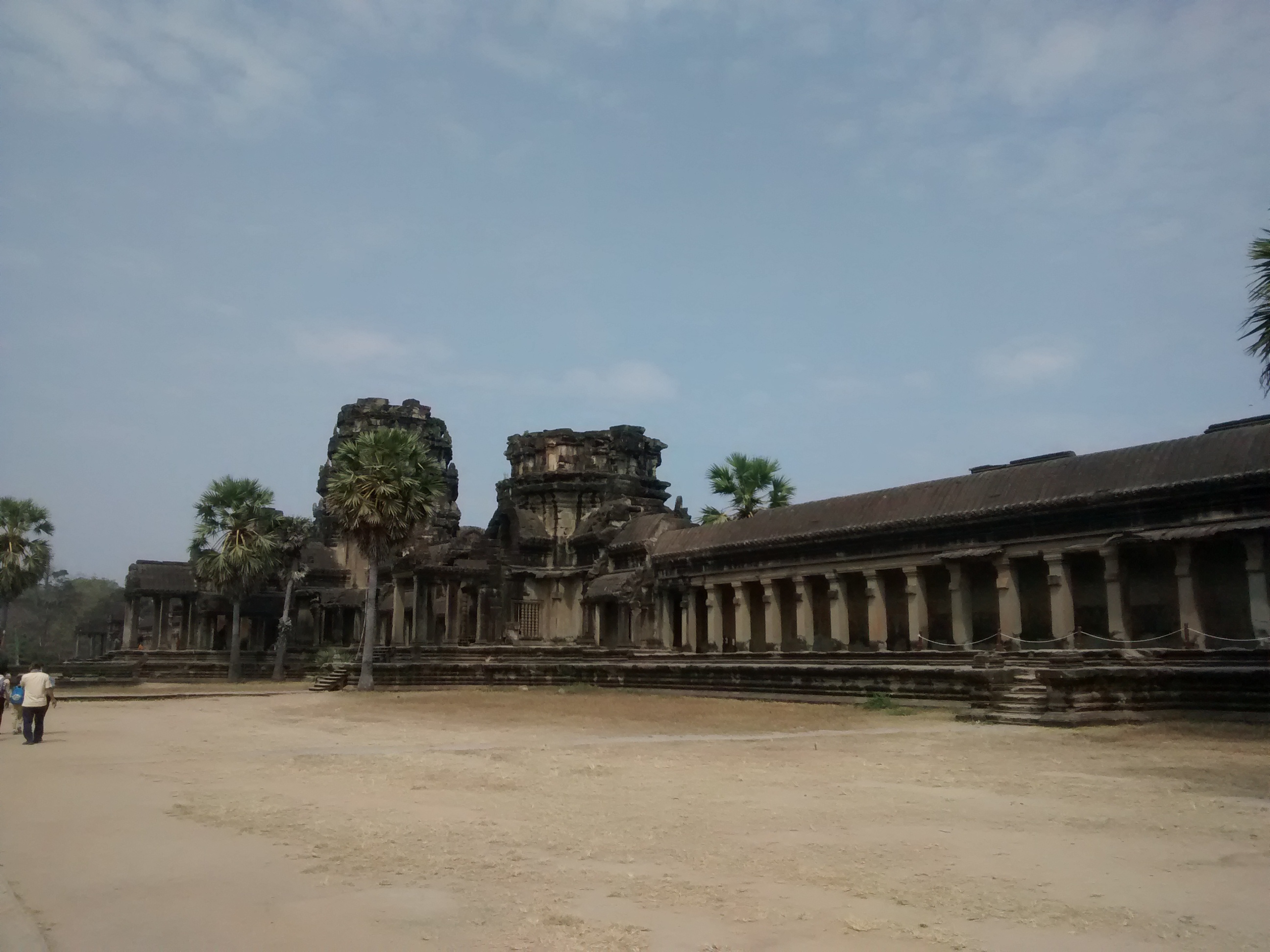
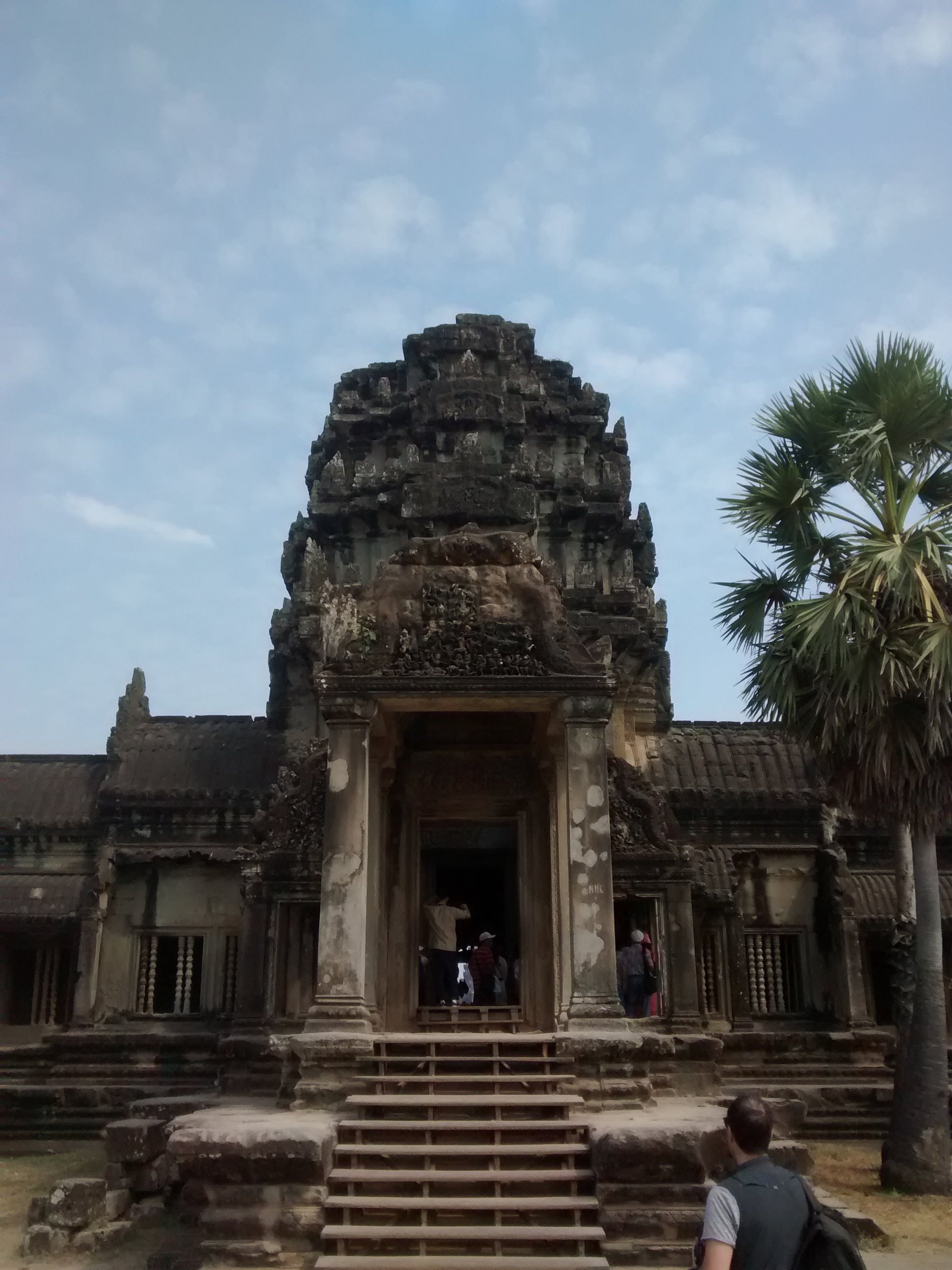
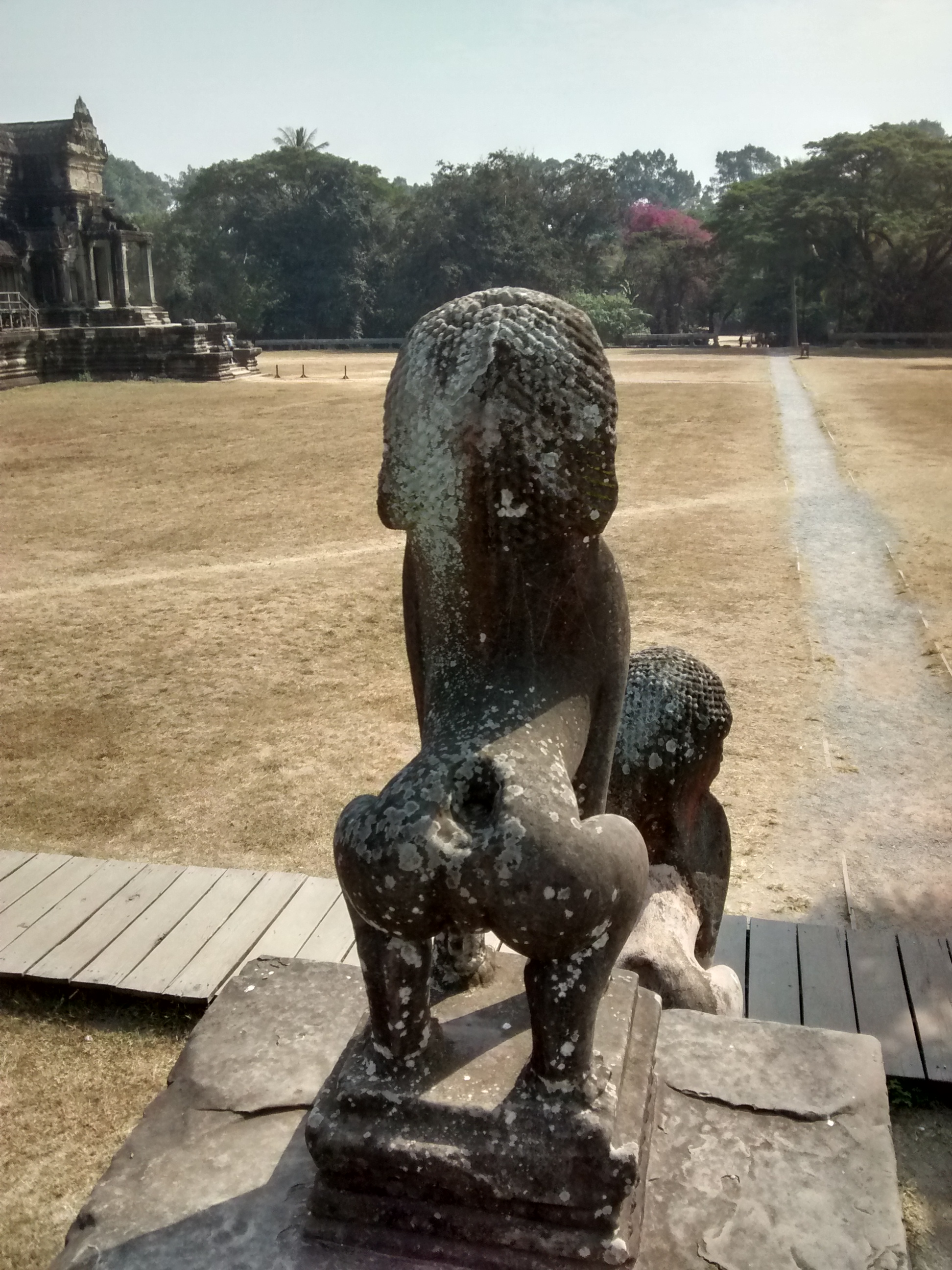
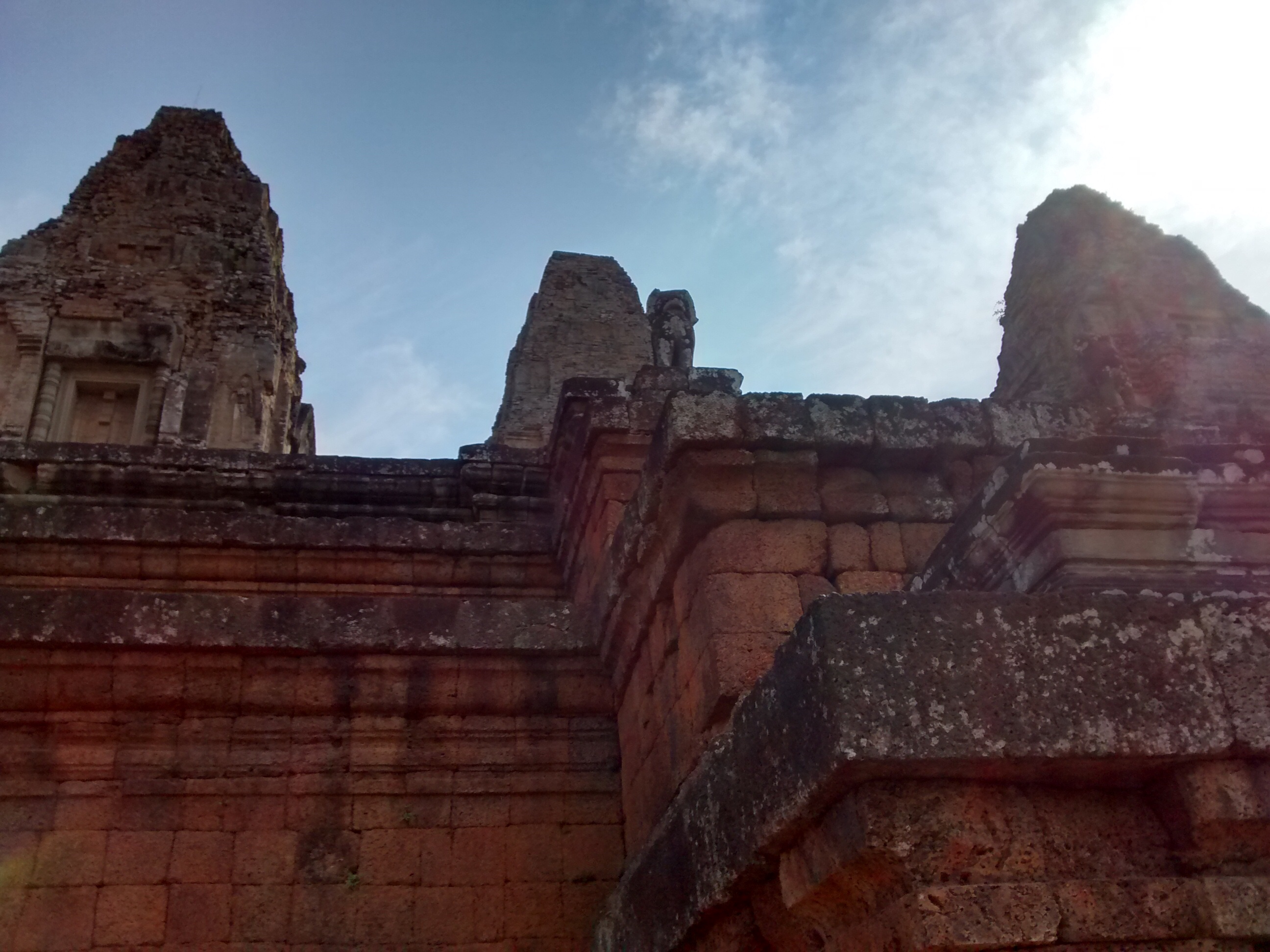
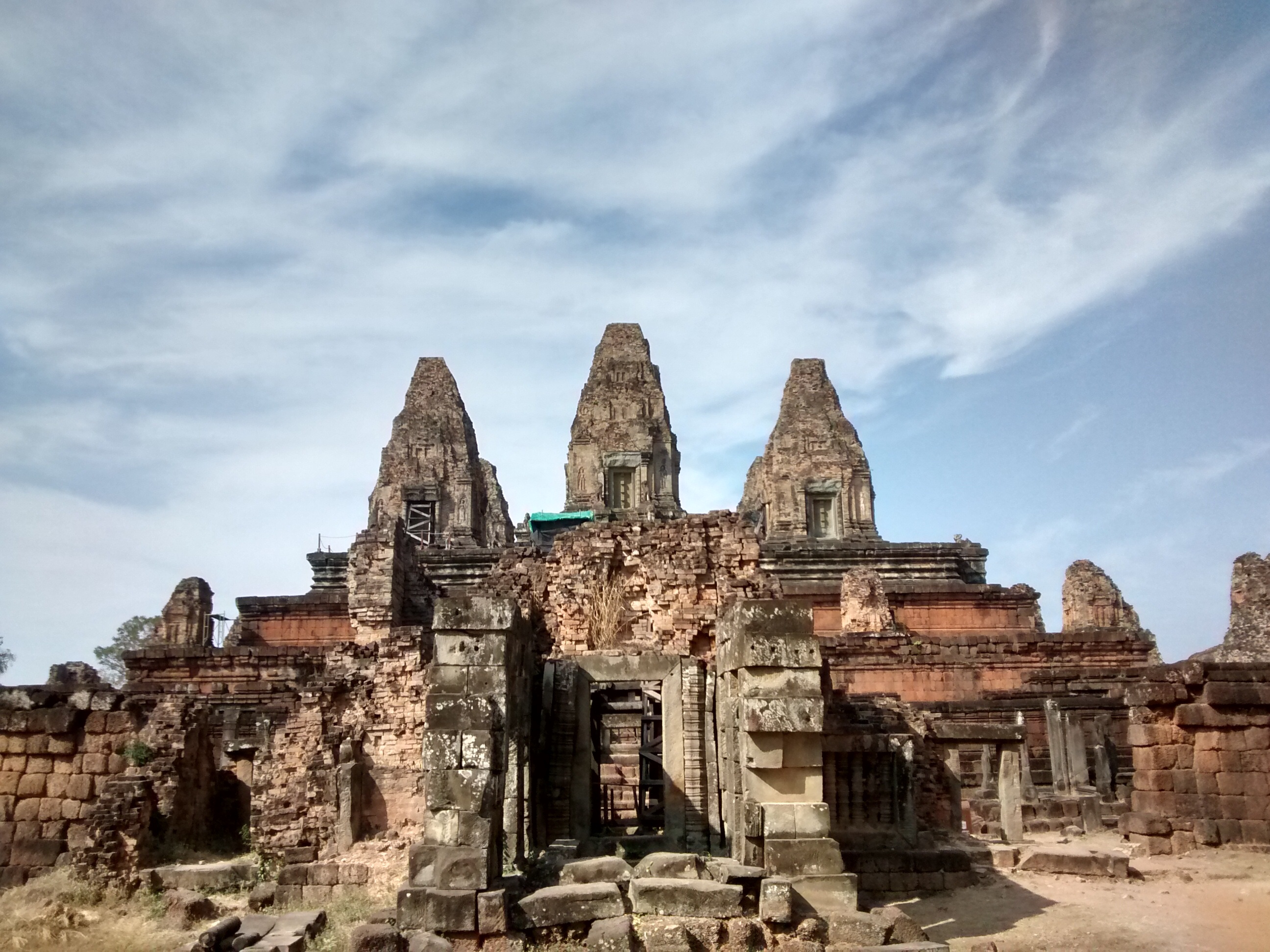
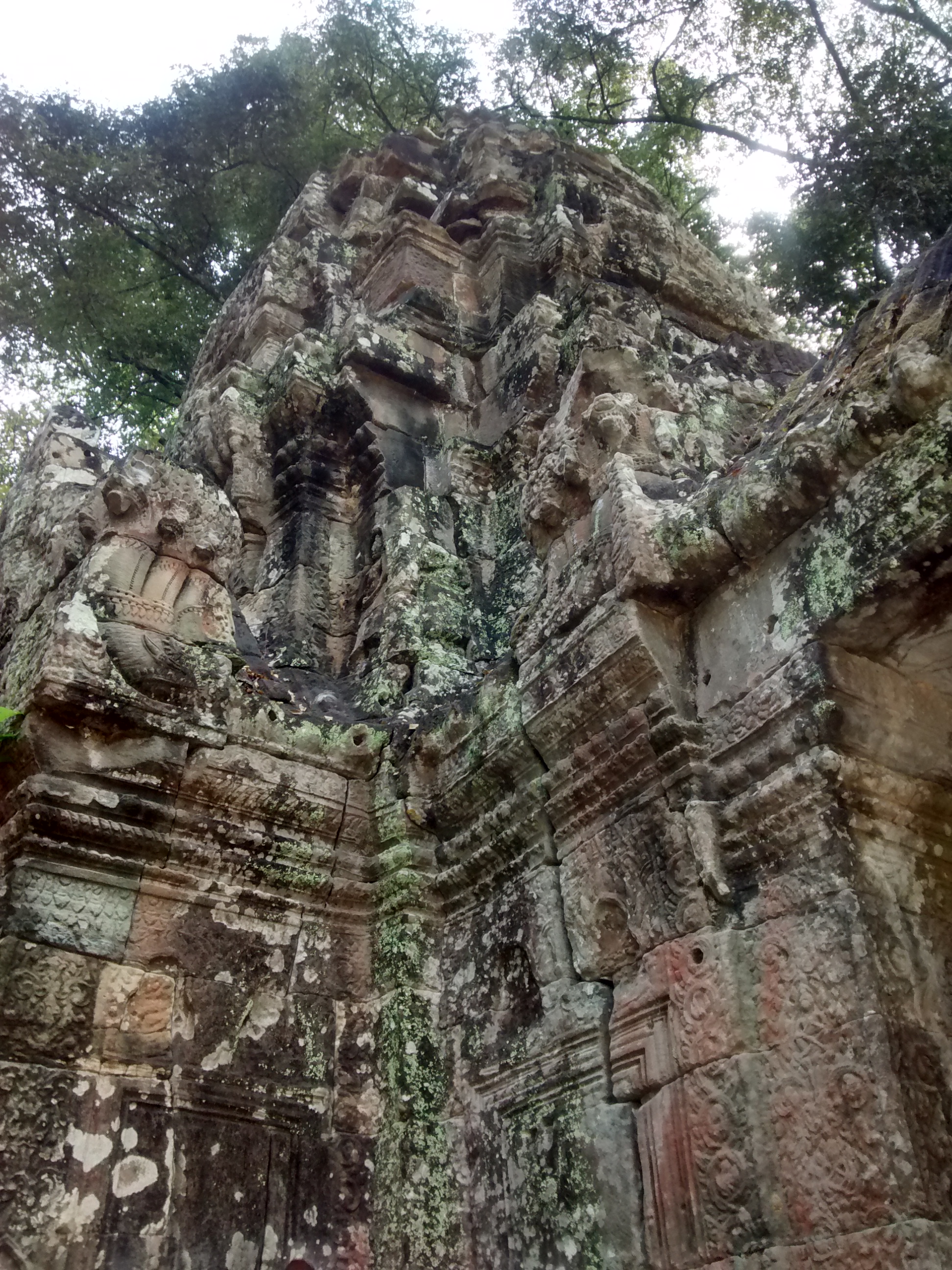
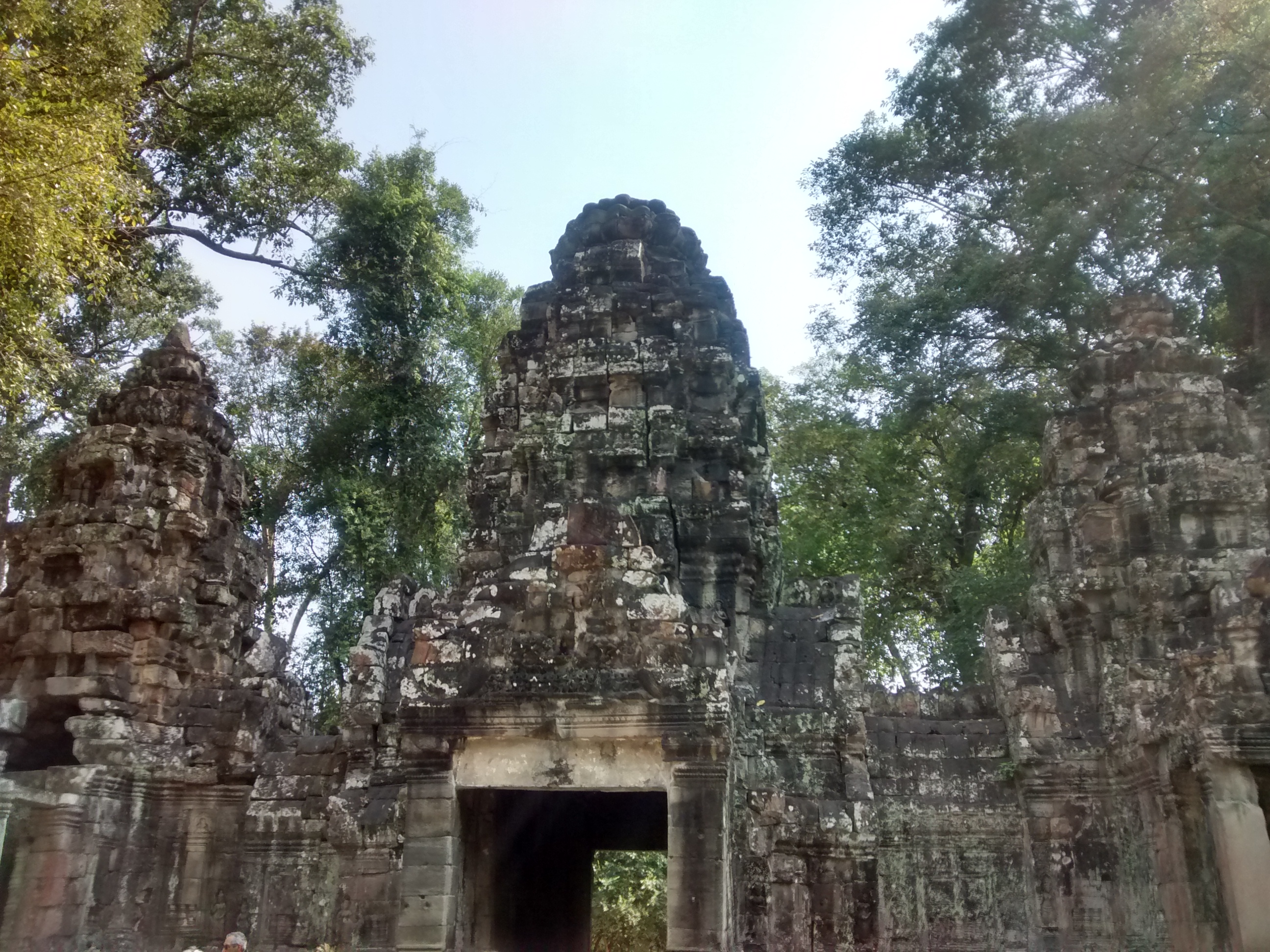
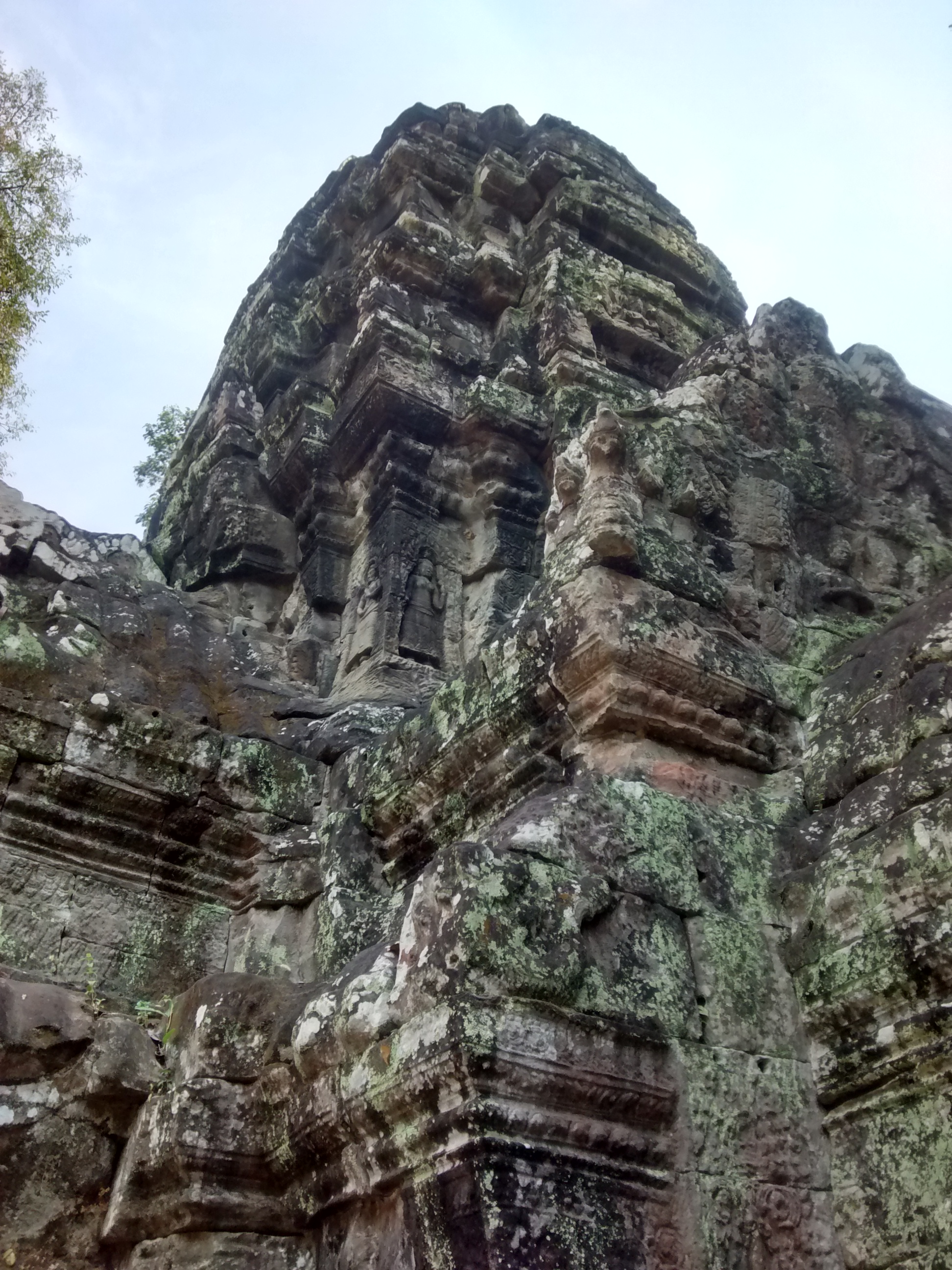
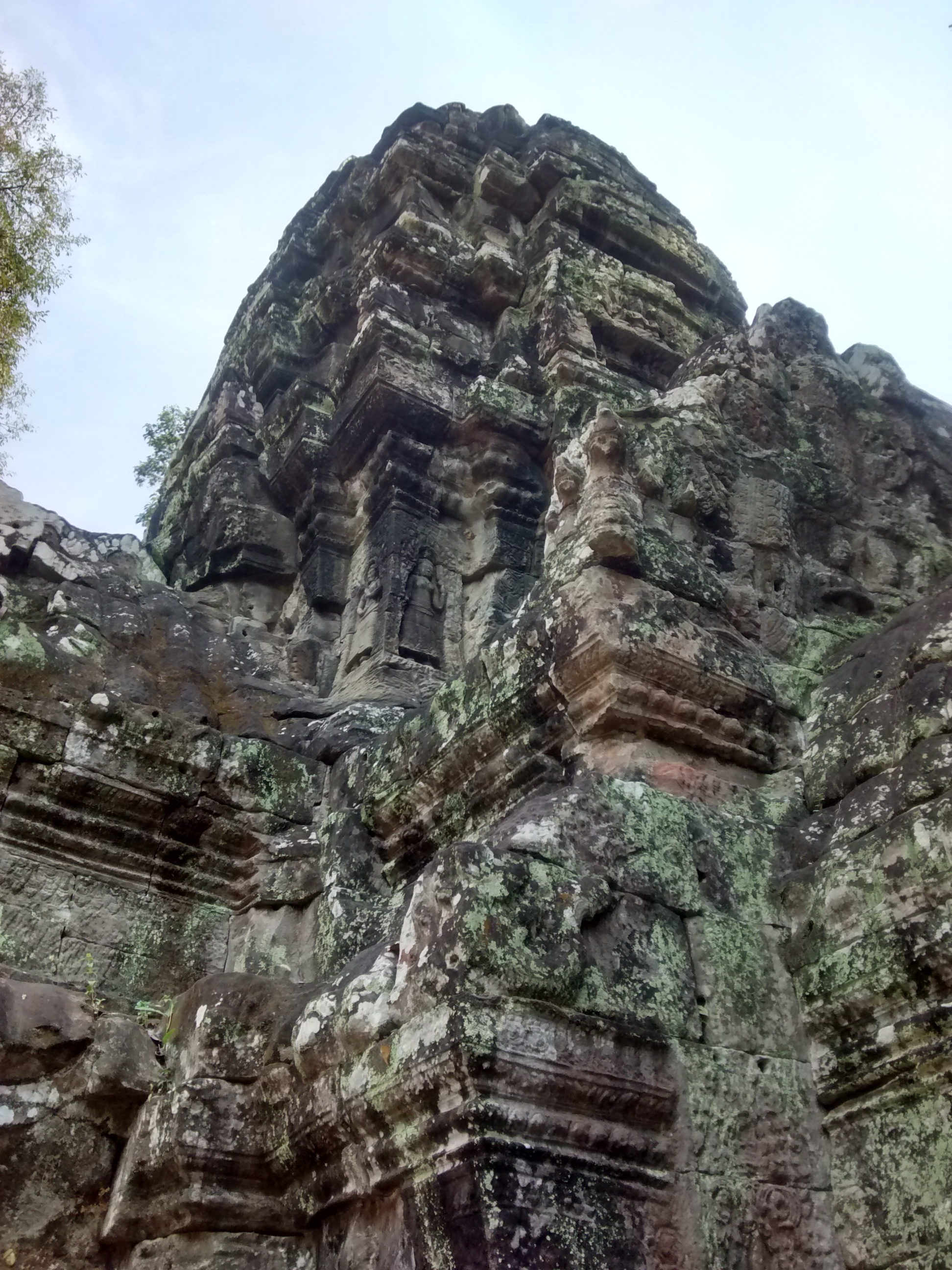
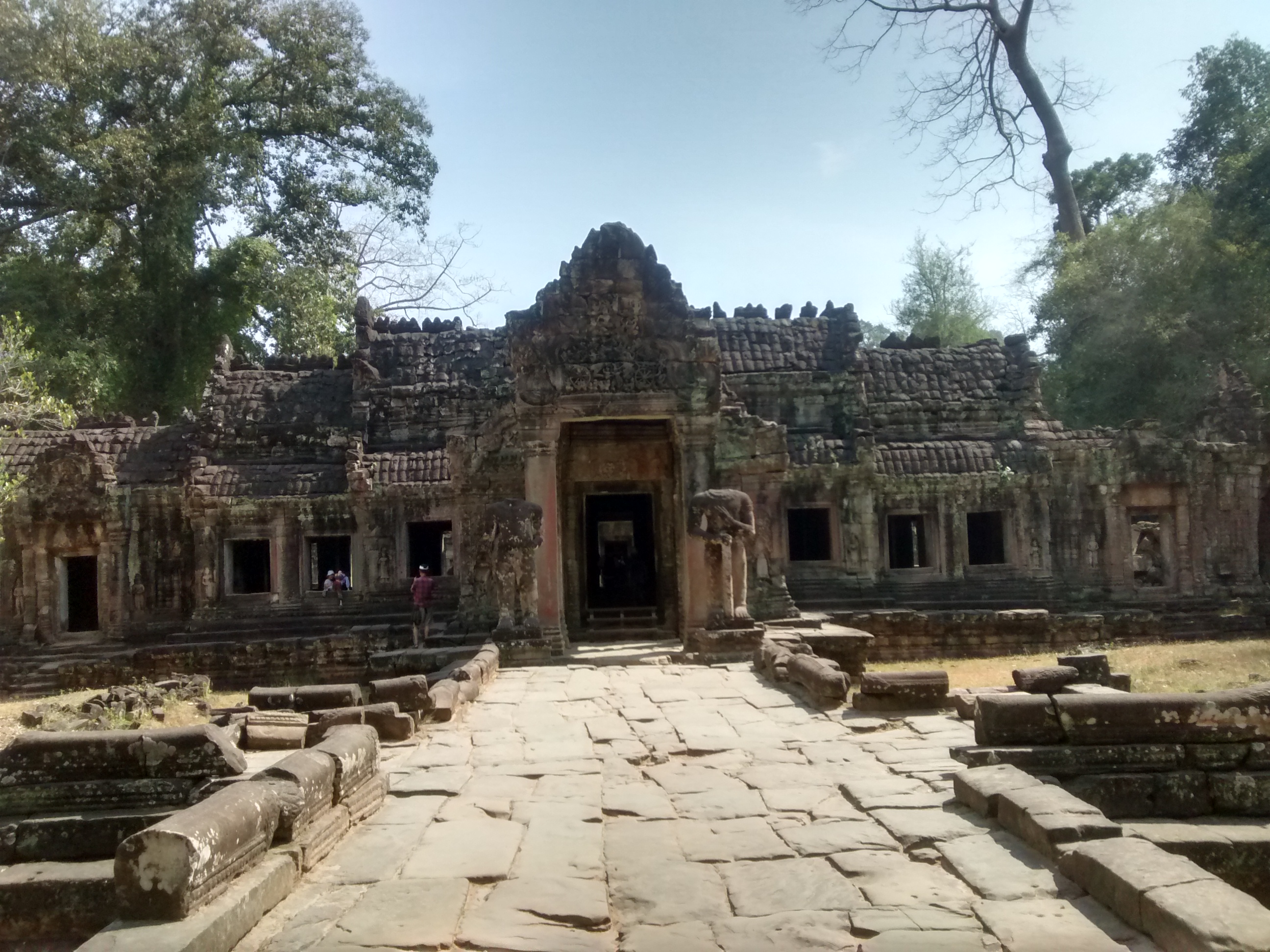
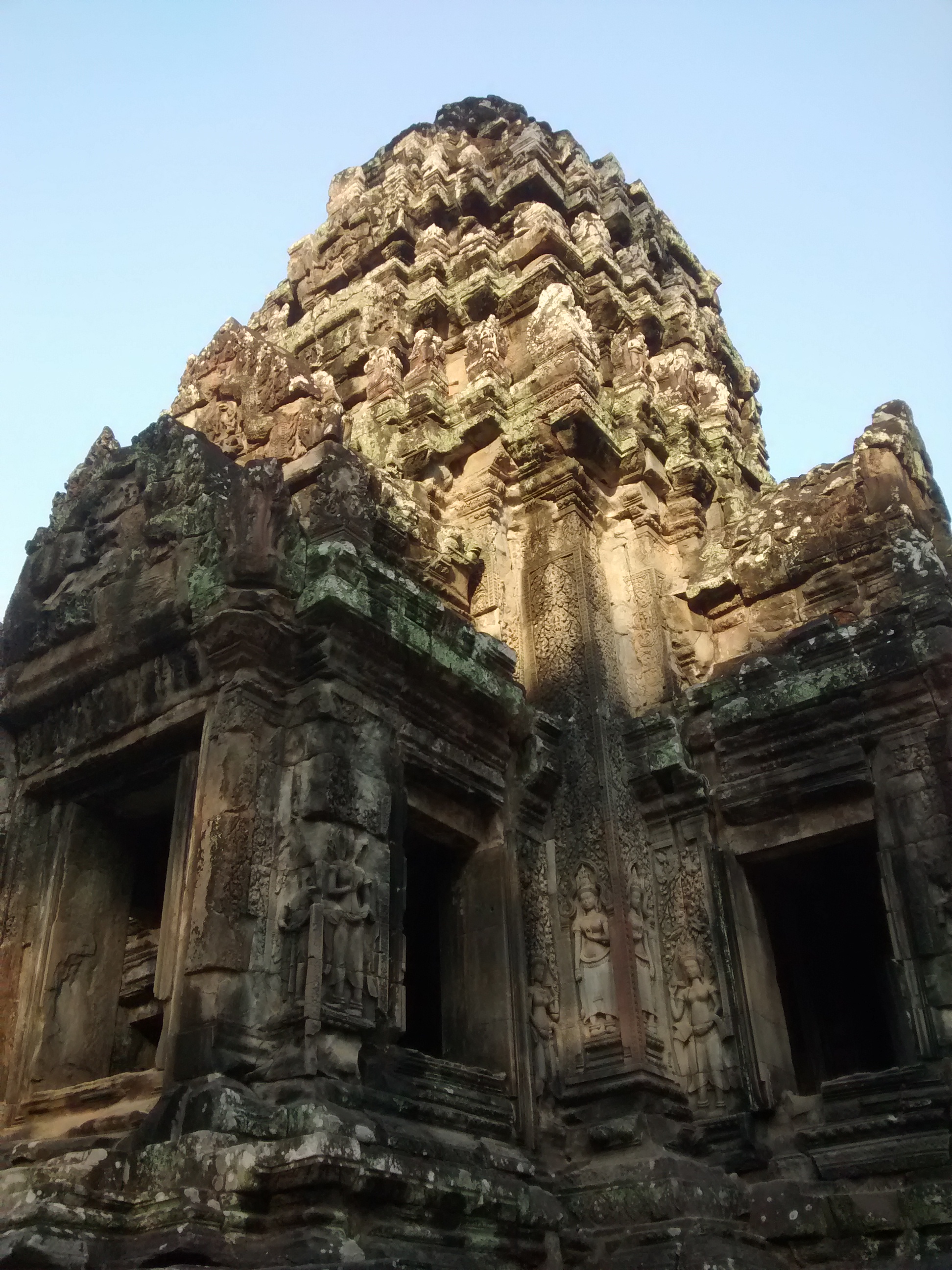
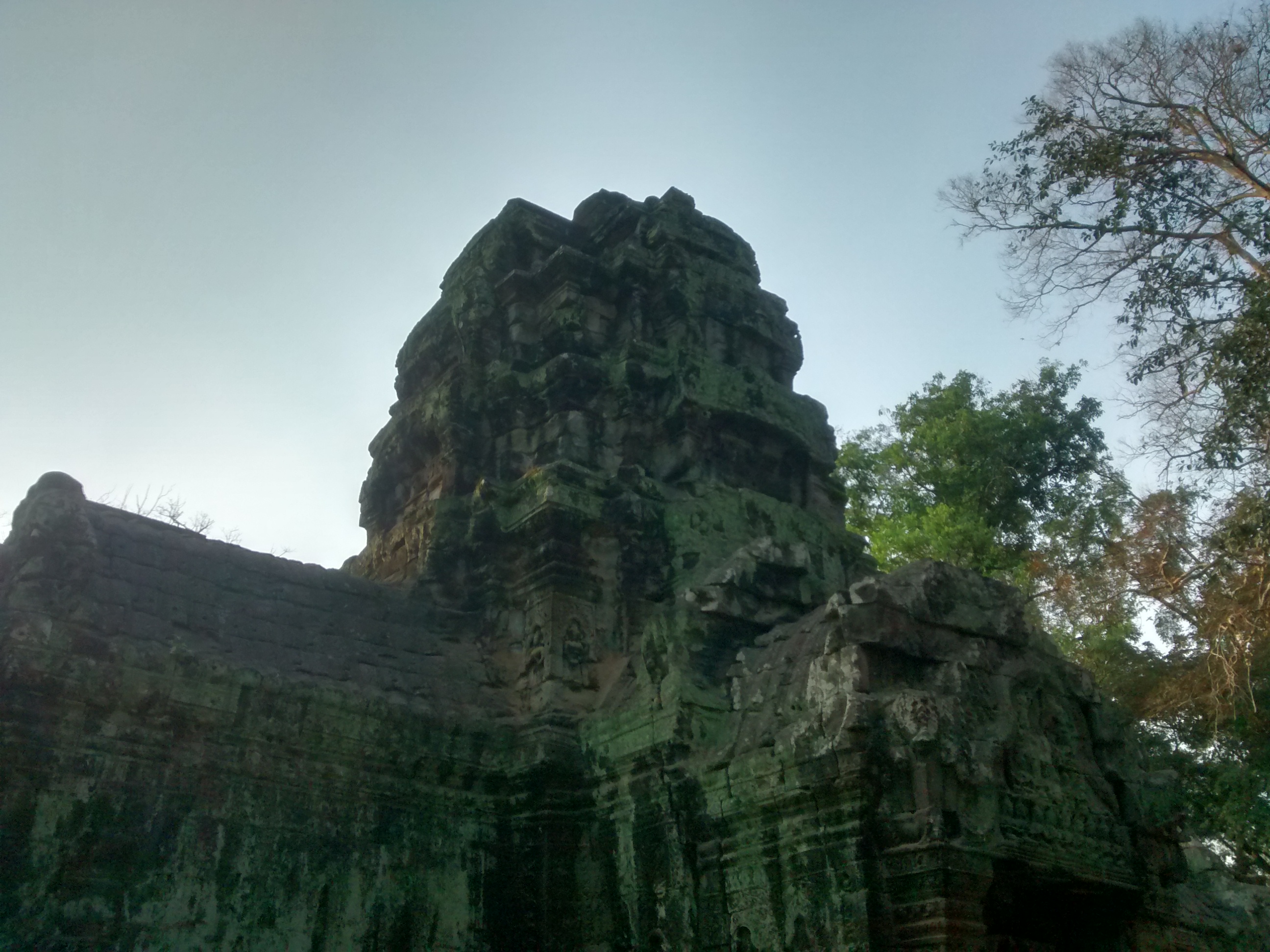
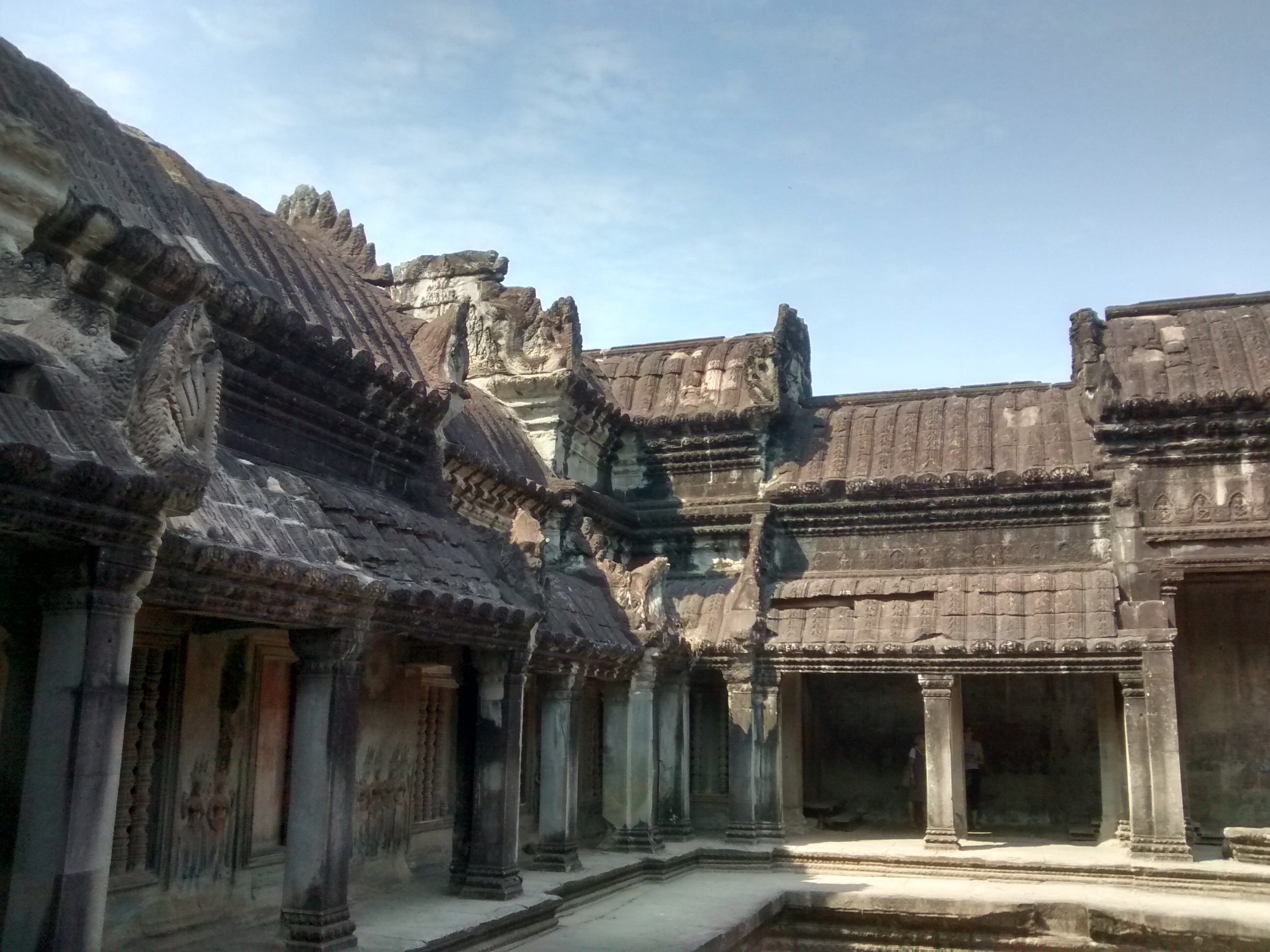
    Five temples today, and the first one deserves its own post. Preah Khan, built in the late 12th century by our old friend Jayavarman VII, was a great city and Buddhist university as well as a temple. The extent of the city is equivalent to the city that surrounded Angkor Wat.

    (My source for most of this is Ancient Angkor, Freeman and Jacques, which all the touts seem to be selling at silly prices around the monuments).

    Death by smartphone camera coming up…

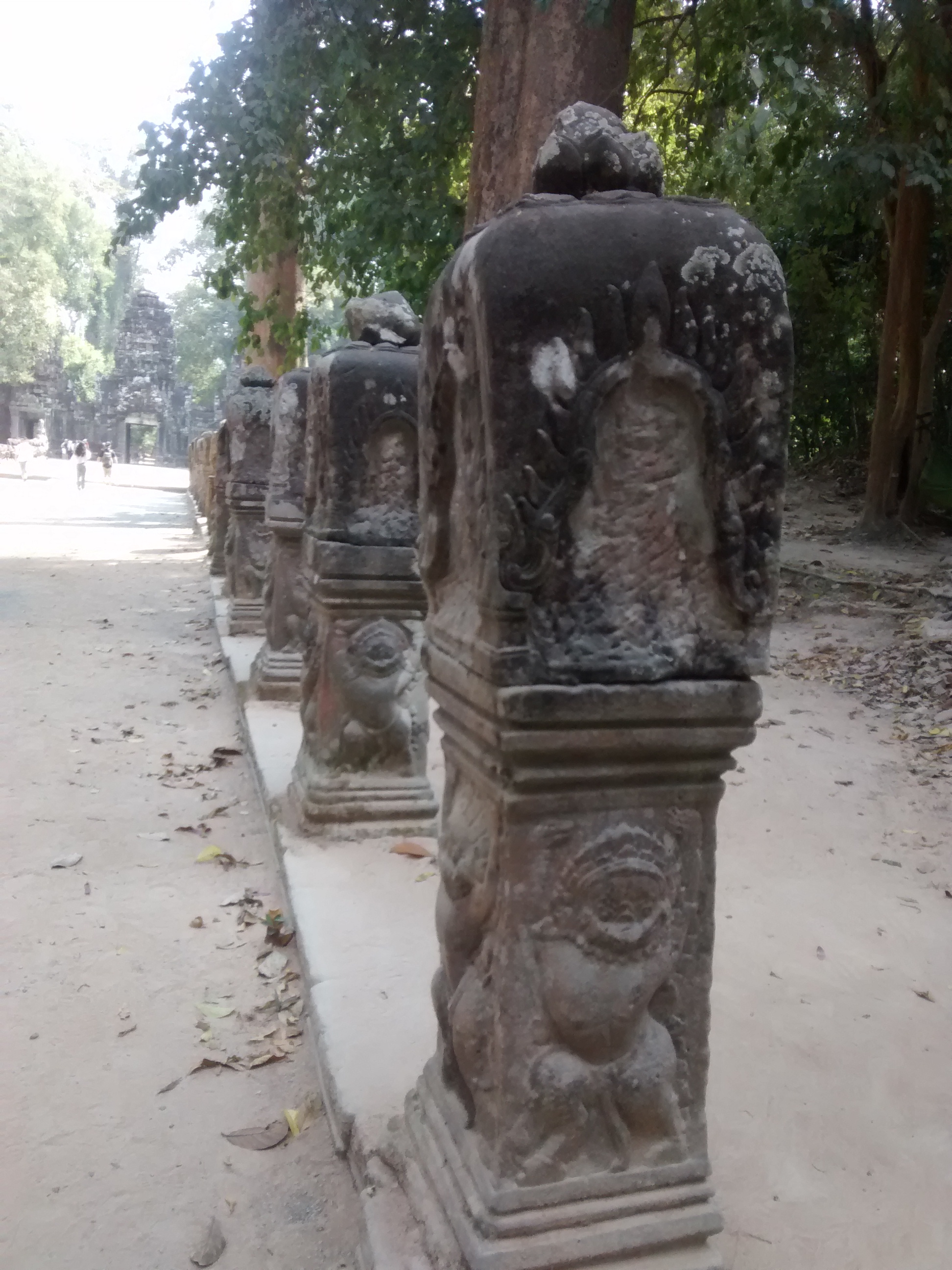
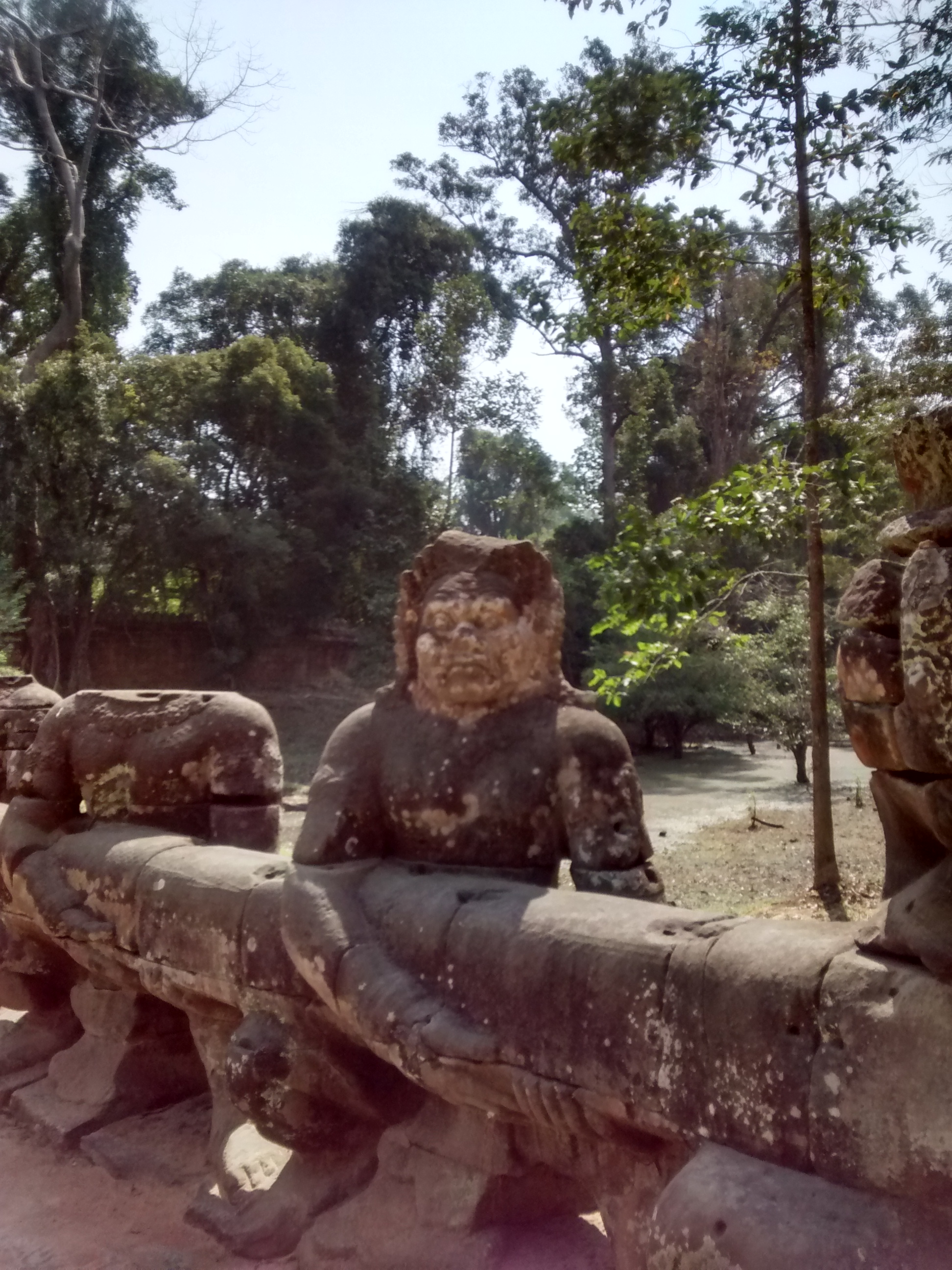
    Boundary stones mark the way in. They lead to a causeway over the old moat. And causeway into a gate means…

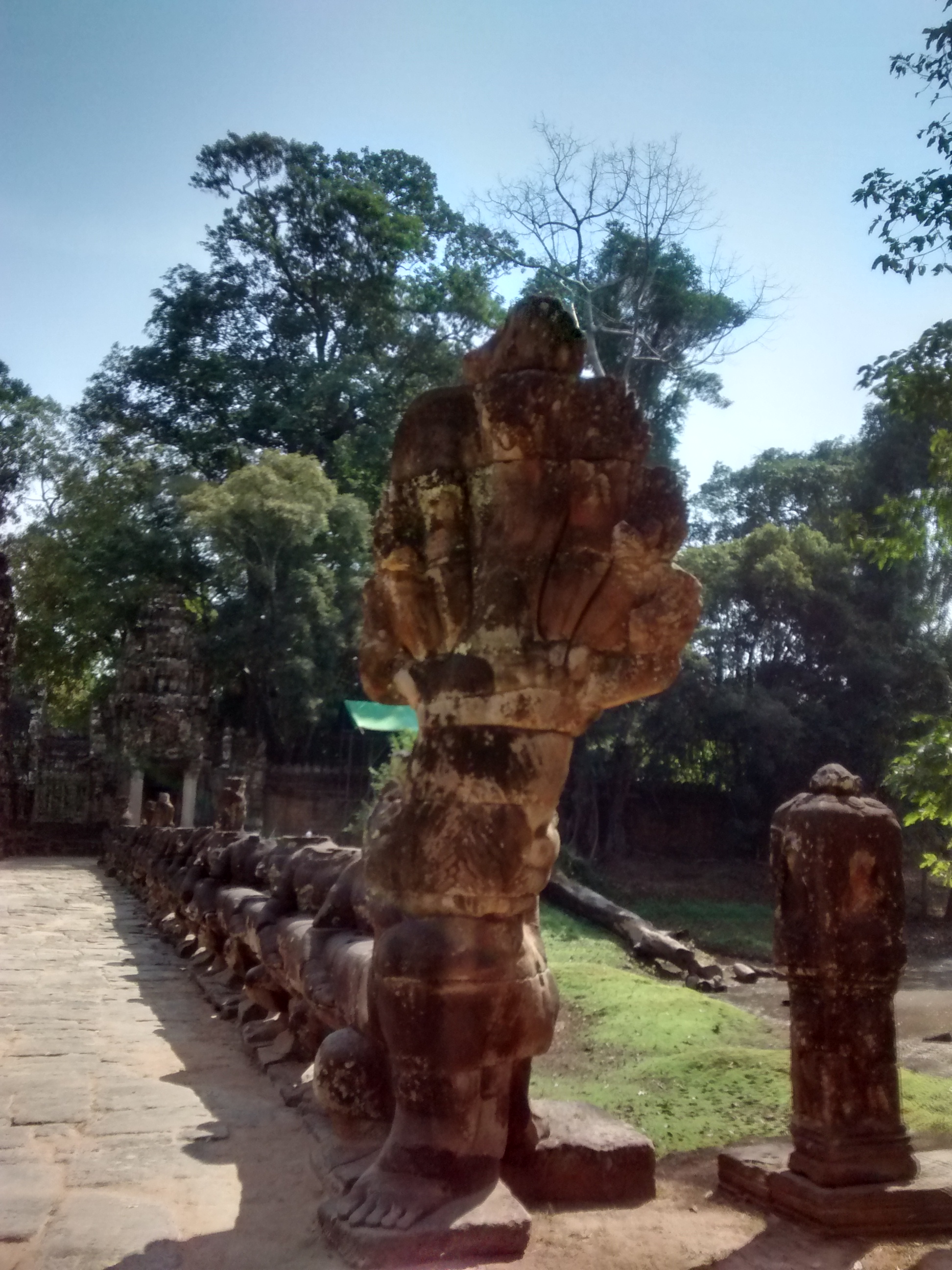
    …more hacked-off demons. This time we see the hydra-like head of the naga they’re pulling.

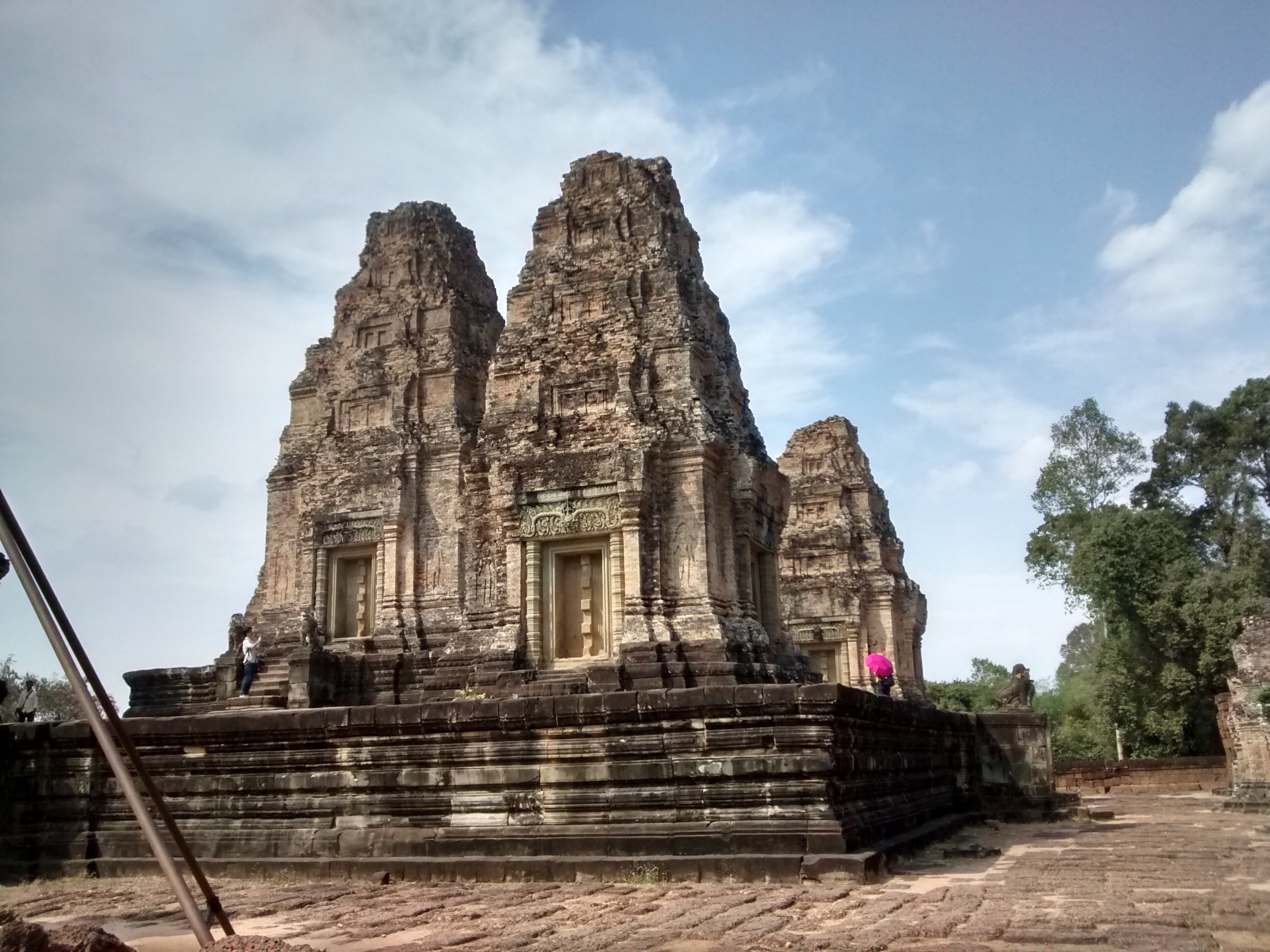
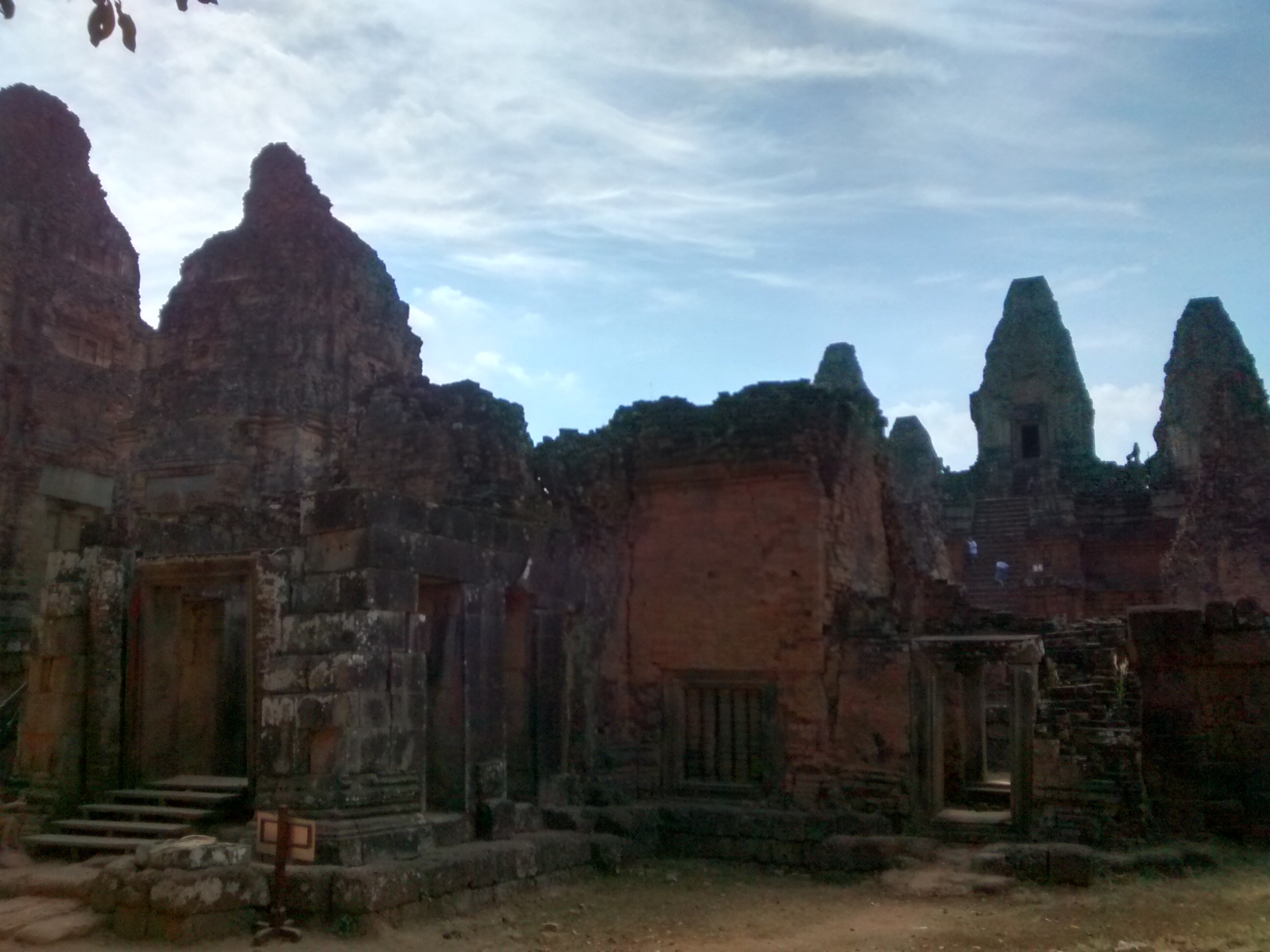
    I liked Preah Khan. There’s the main east- west axis and opportunities to branch-off to the sides, so it felt nicely compact while still big and varied enough to host all the visitors.

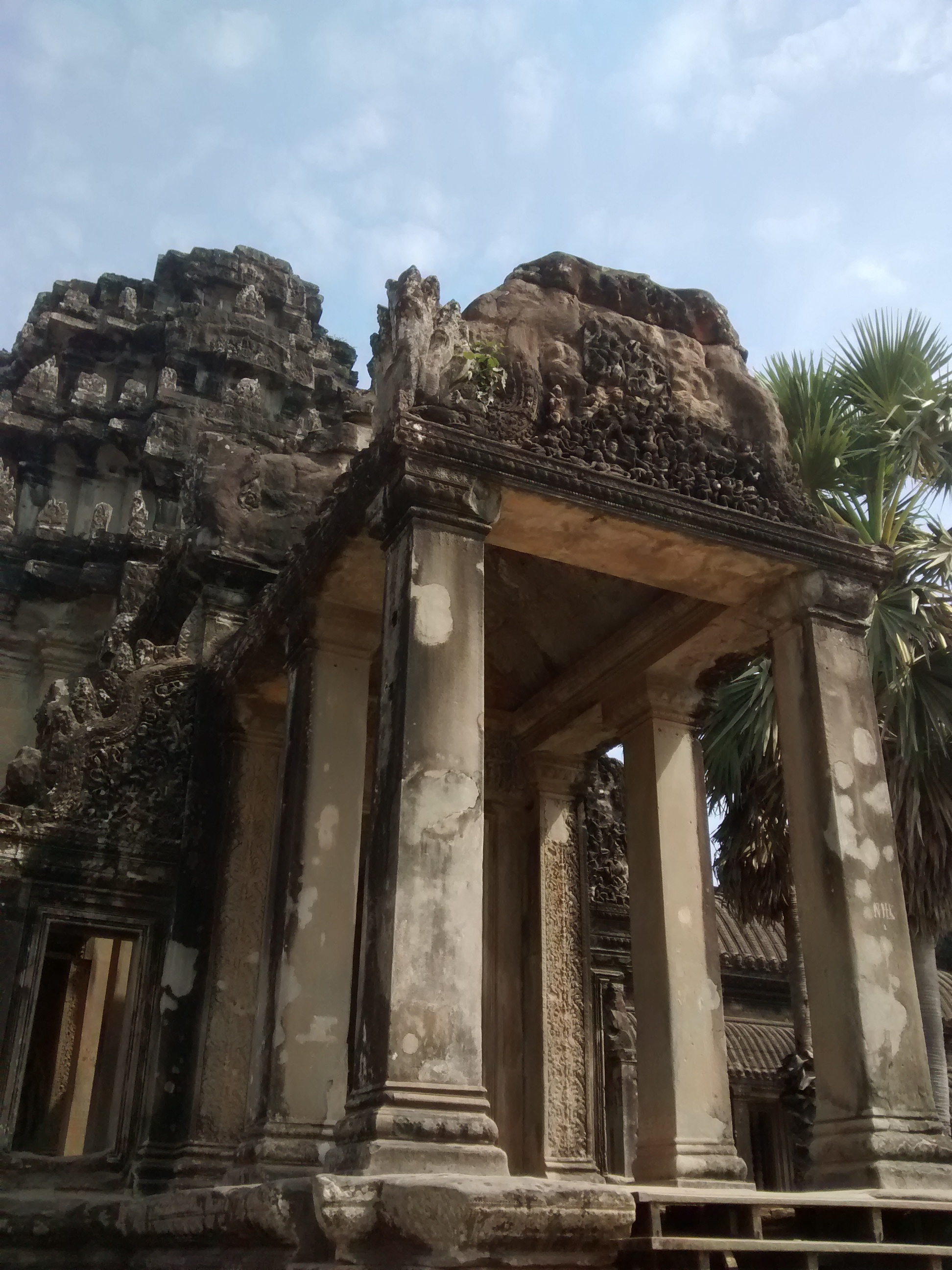
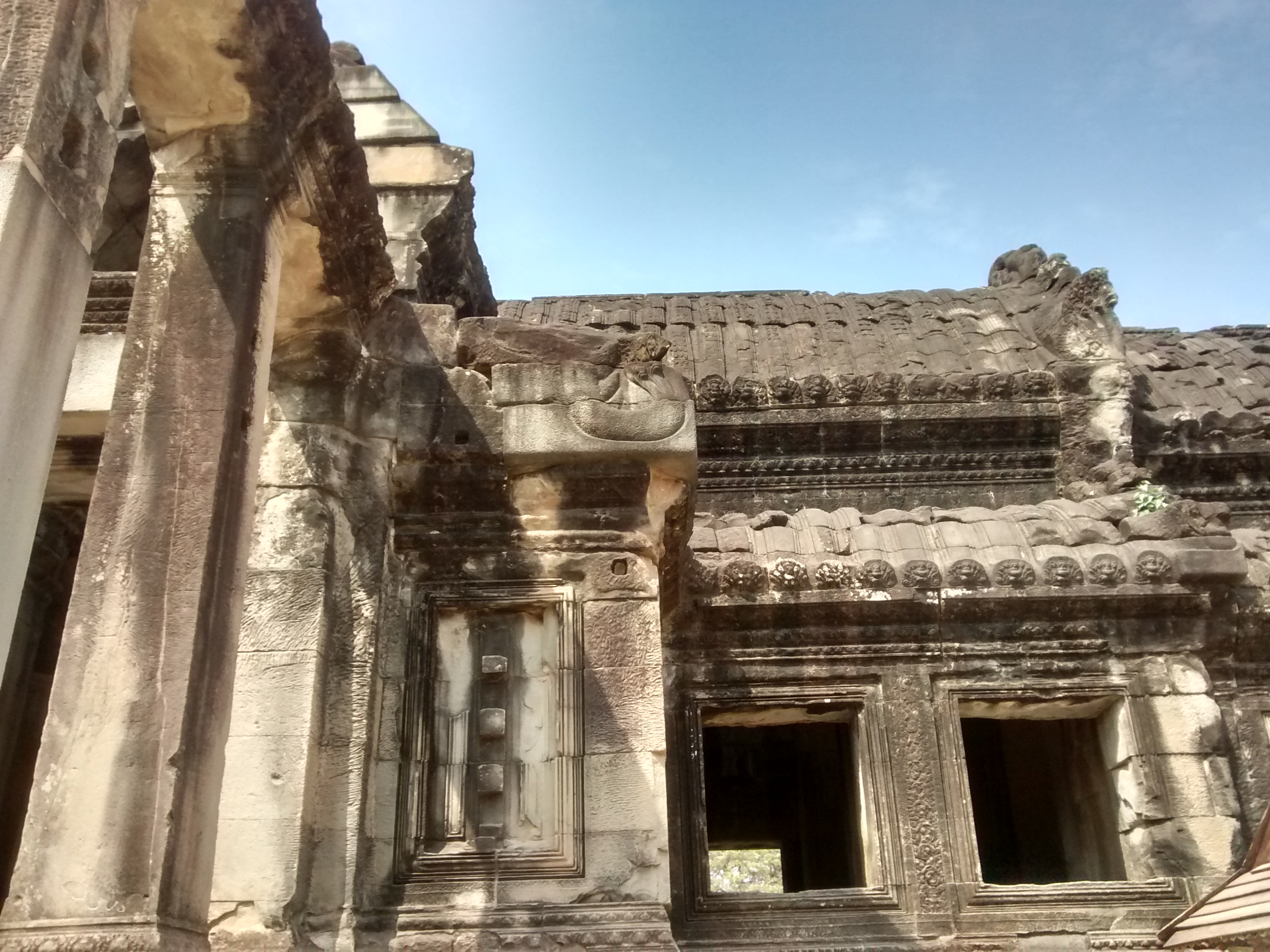
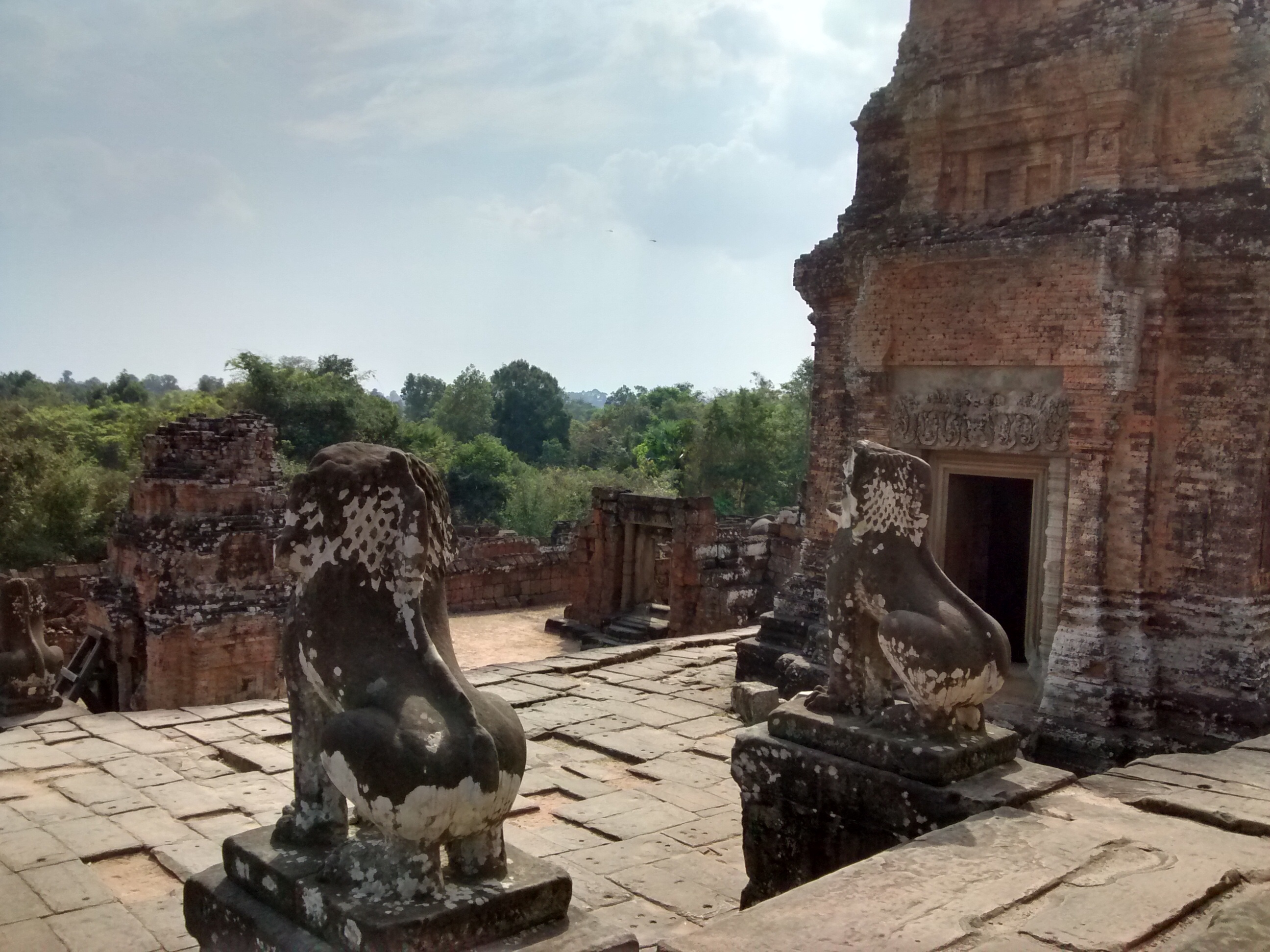
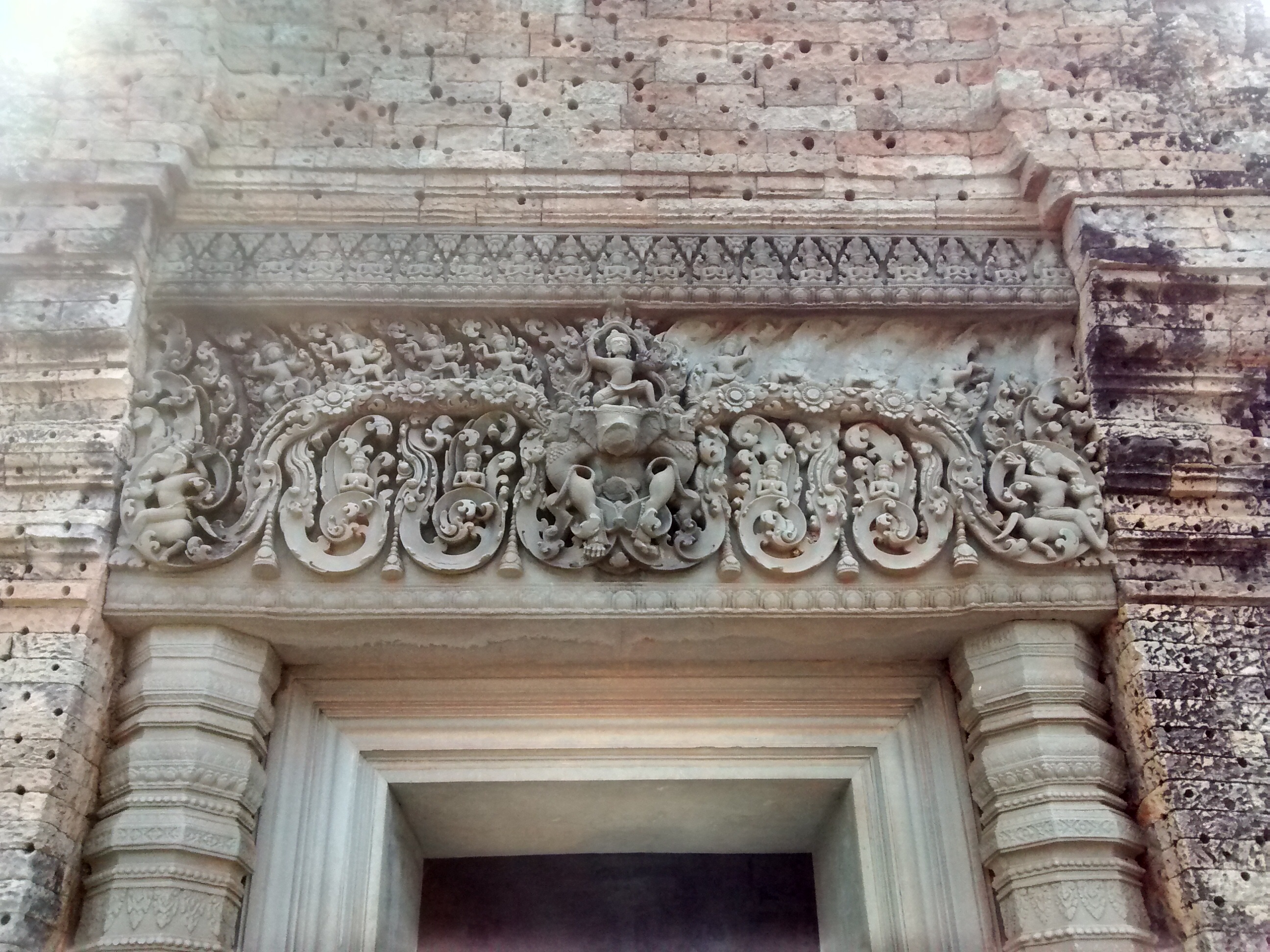
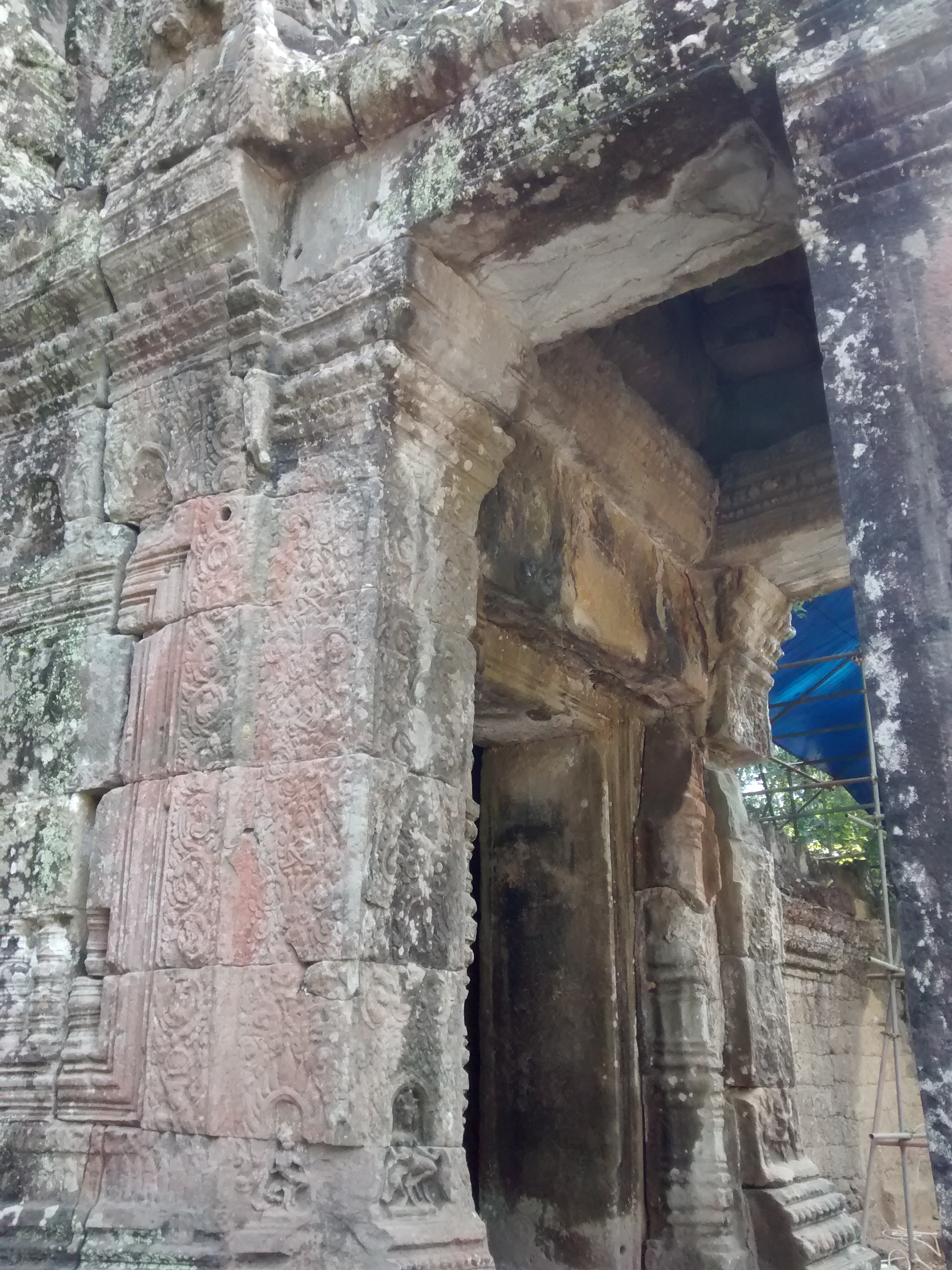
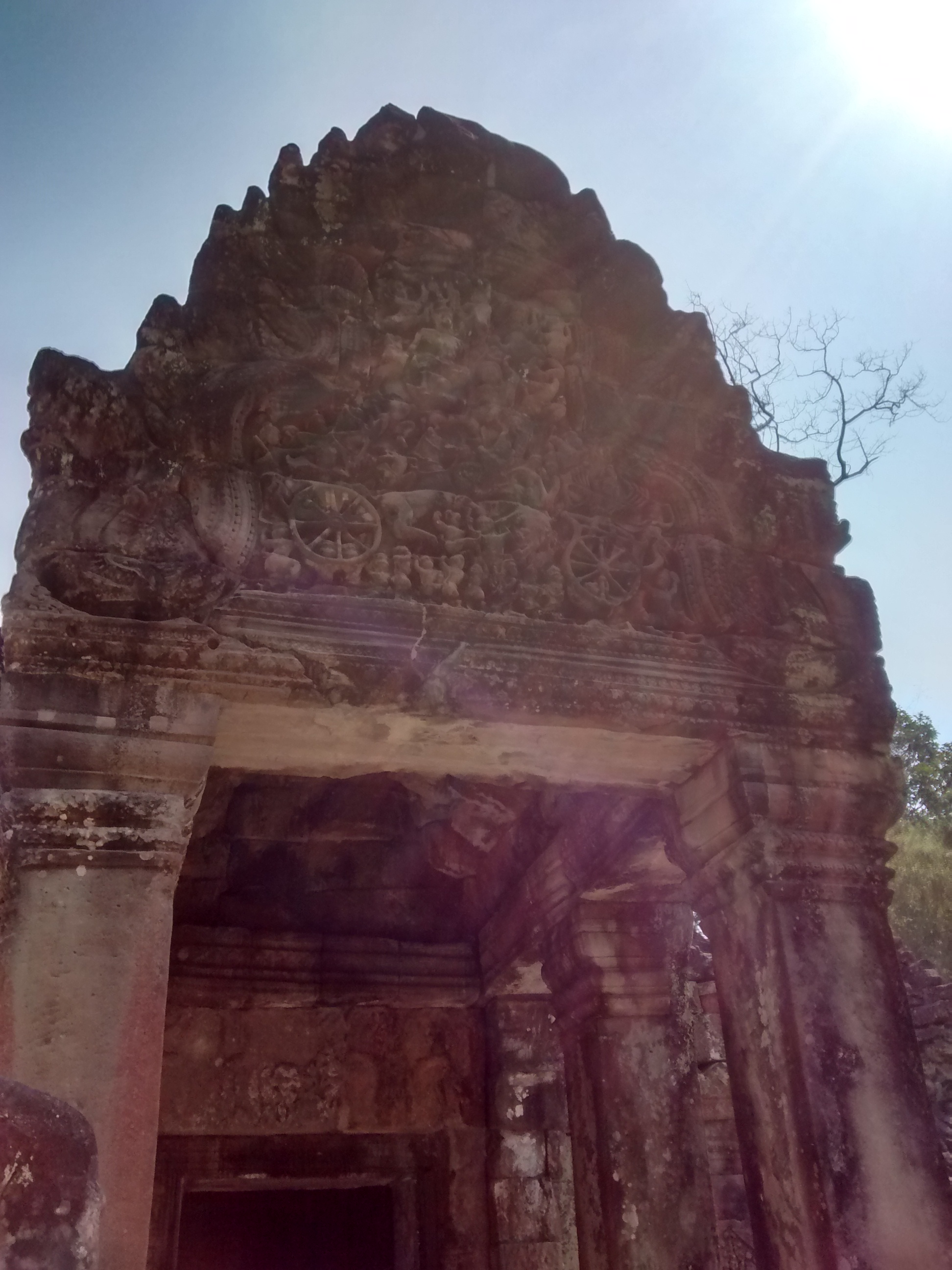
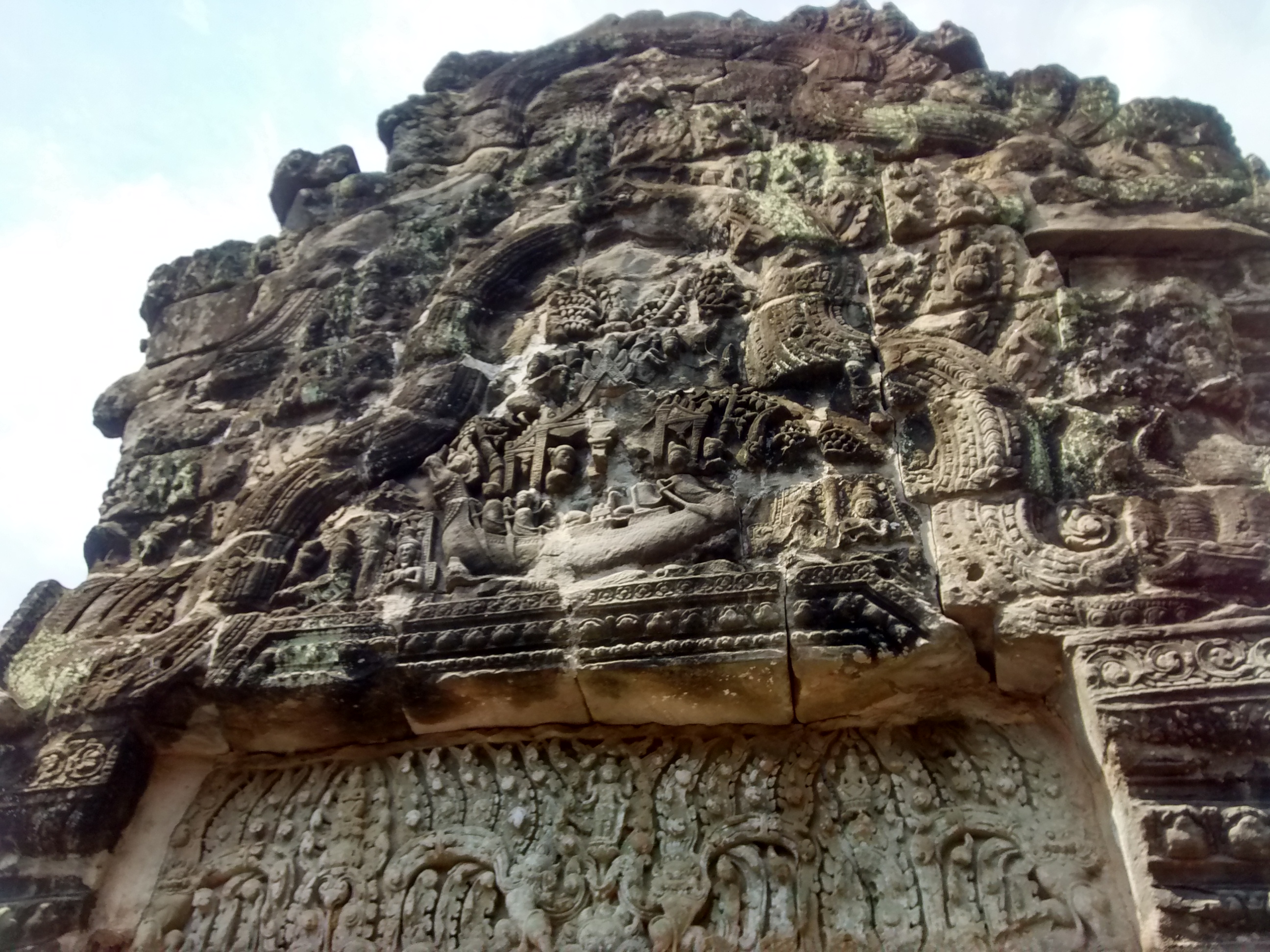
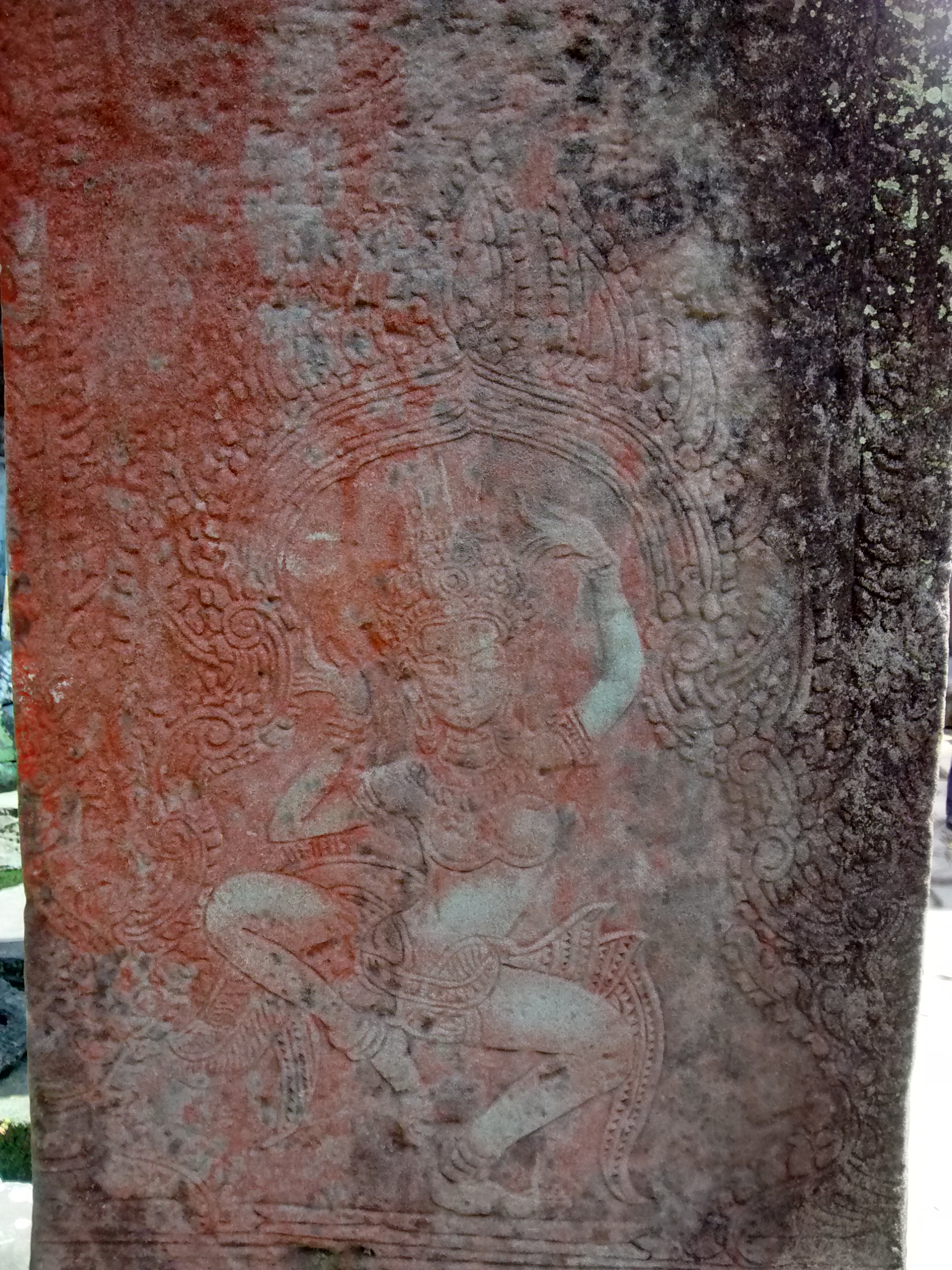
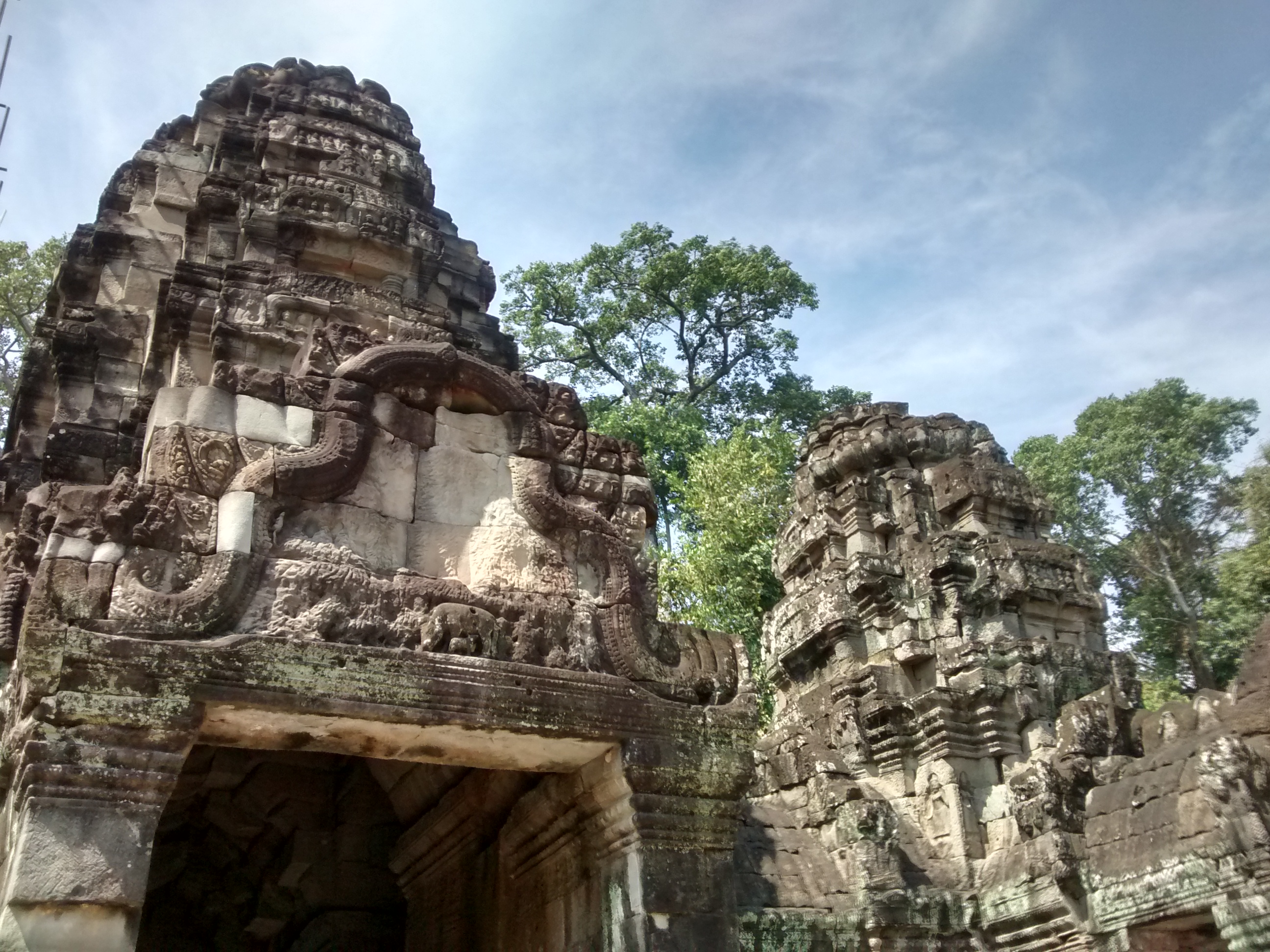
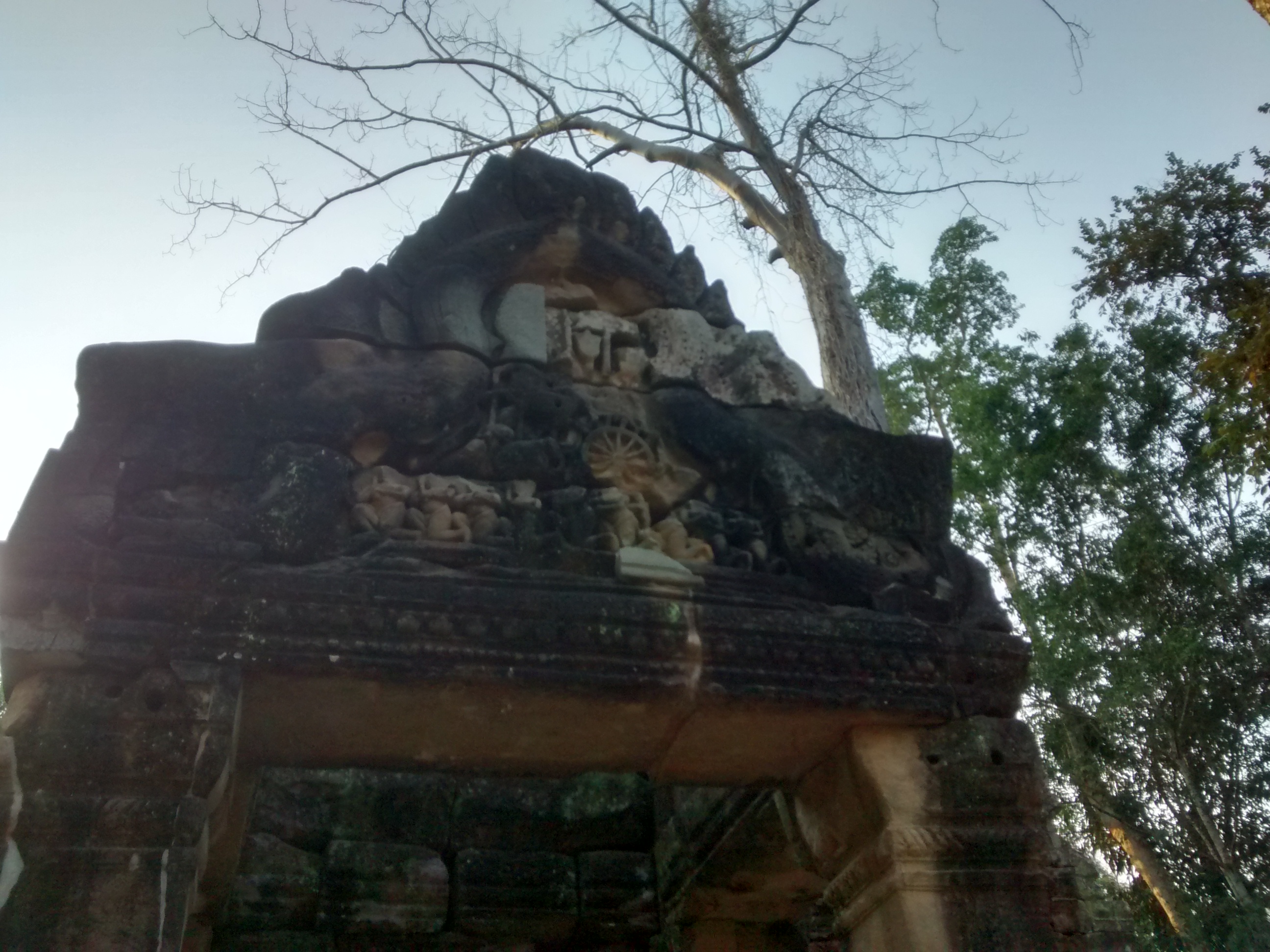
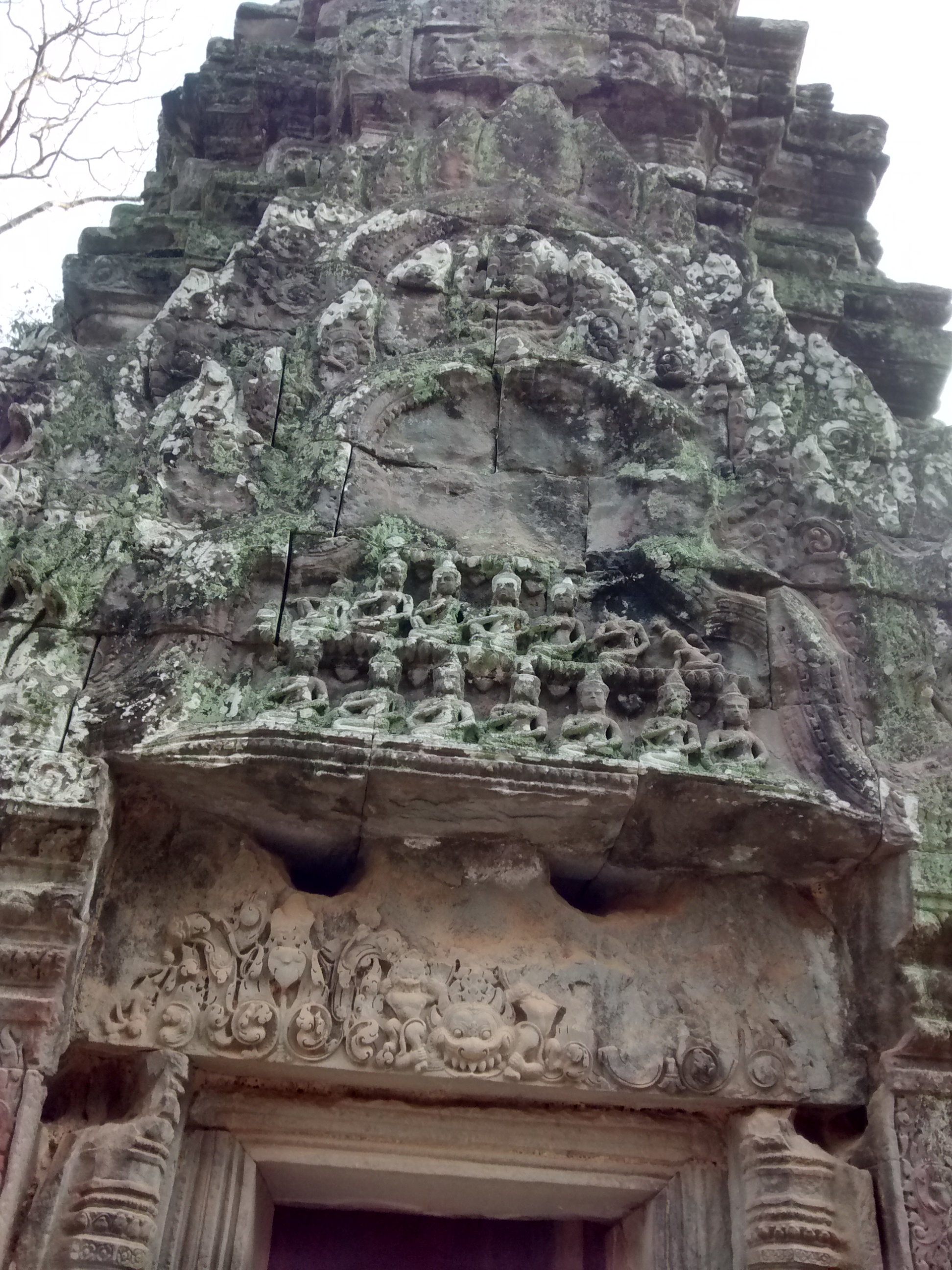
    And still with the stunning detail of bas-reliefs and lintel decorations, comes as standard here.

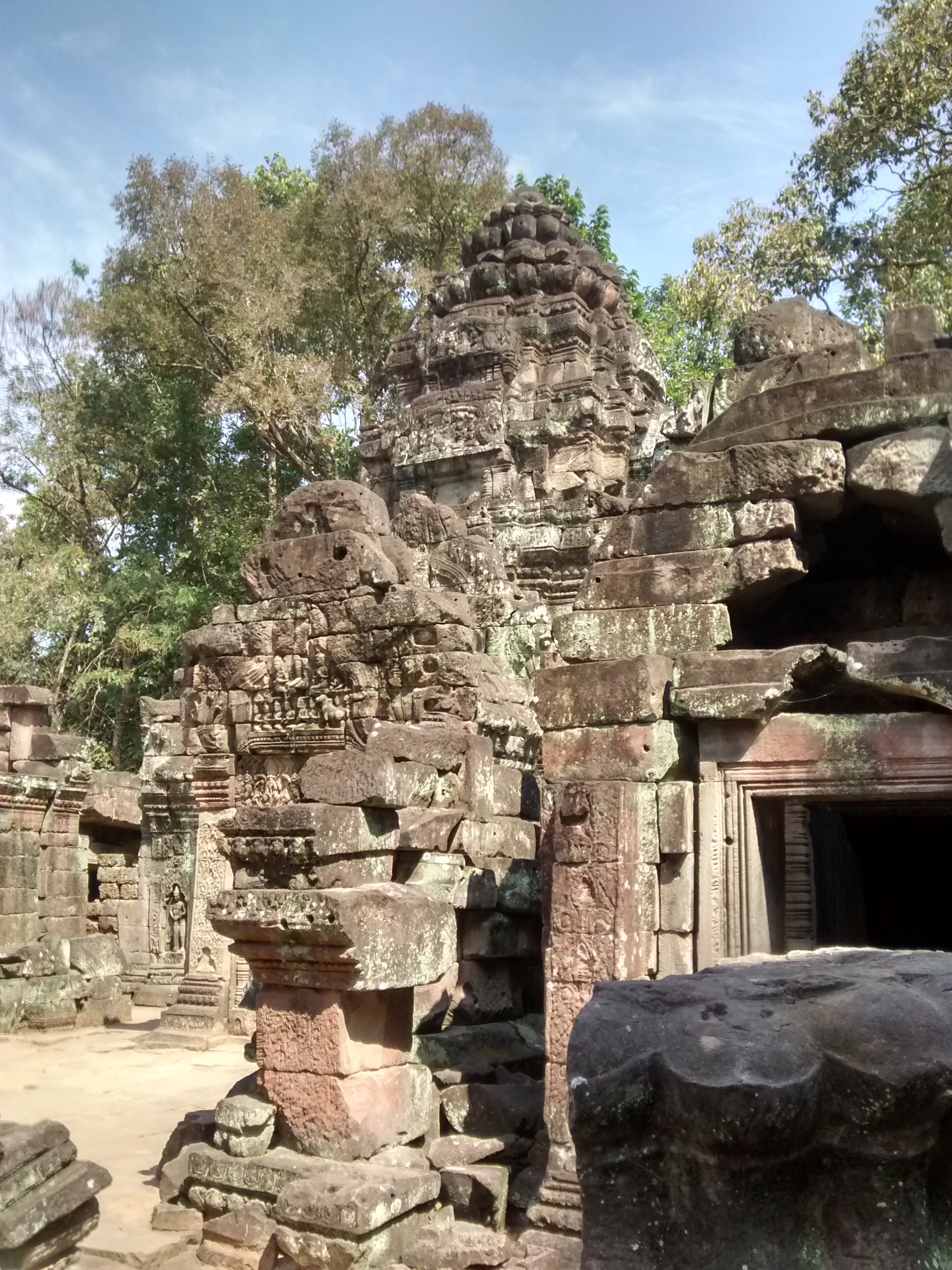
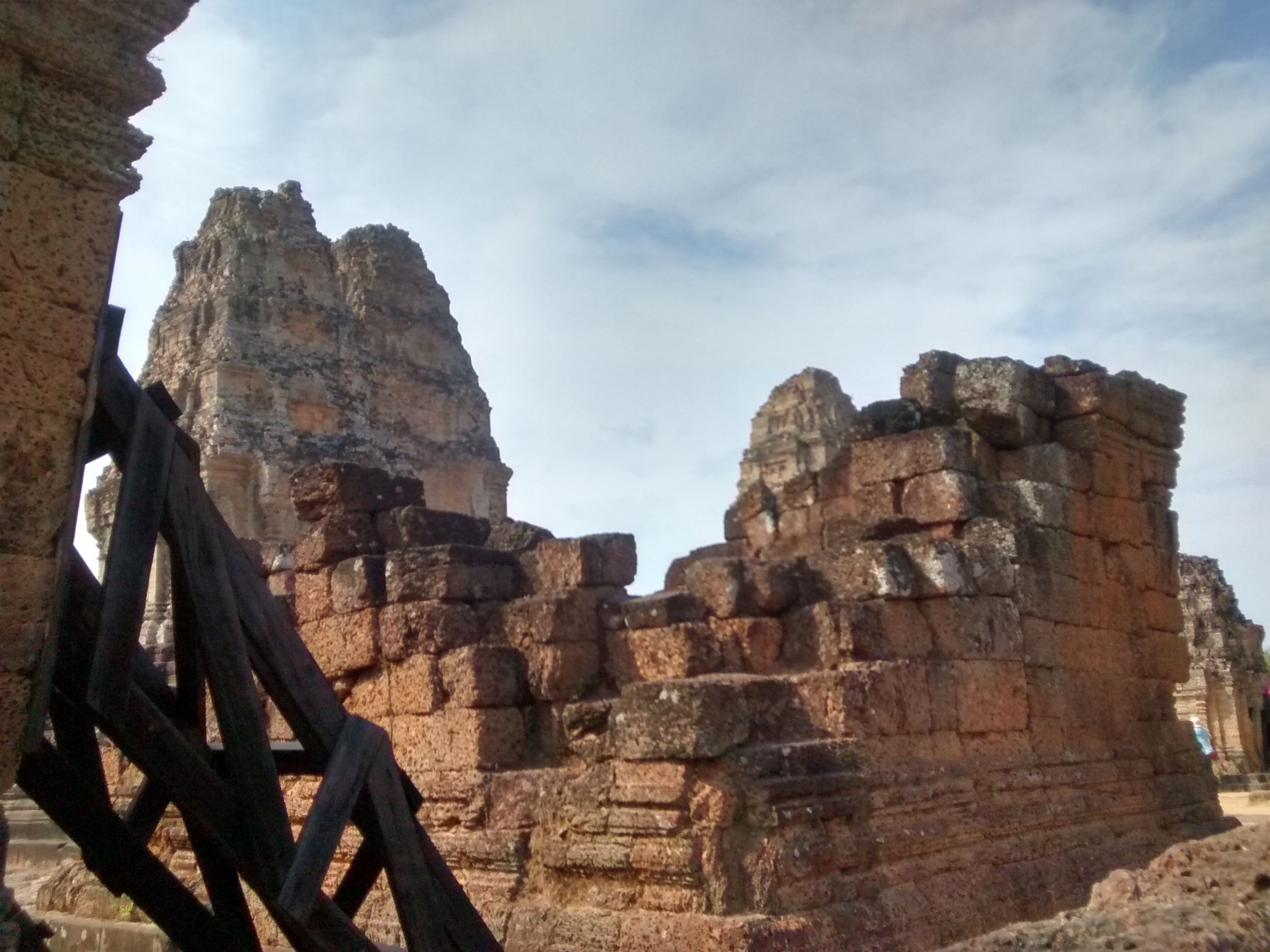
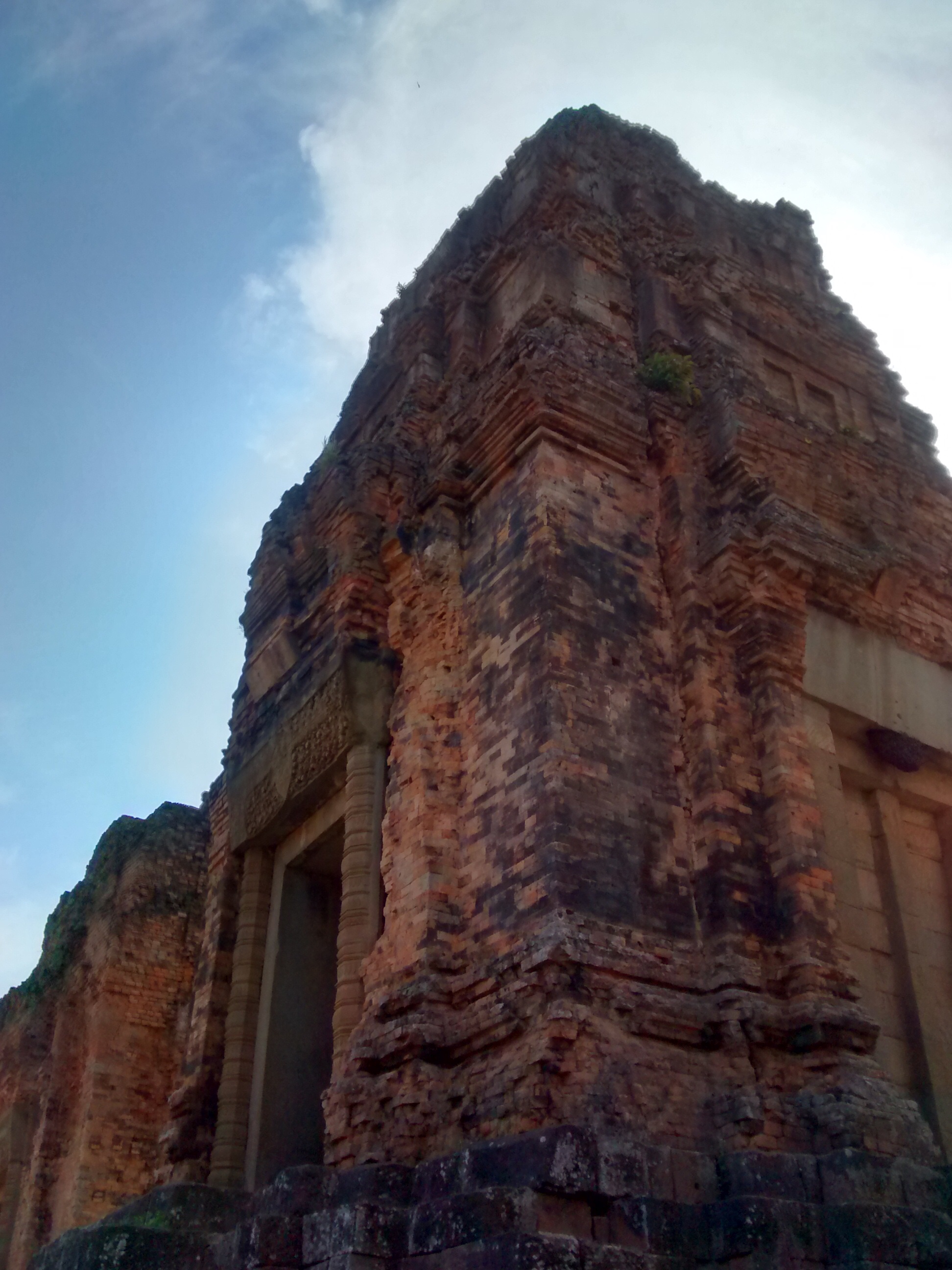
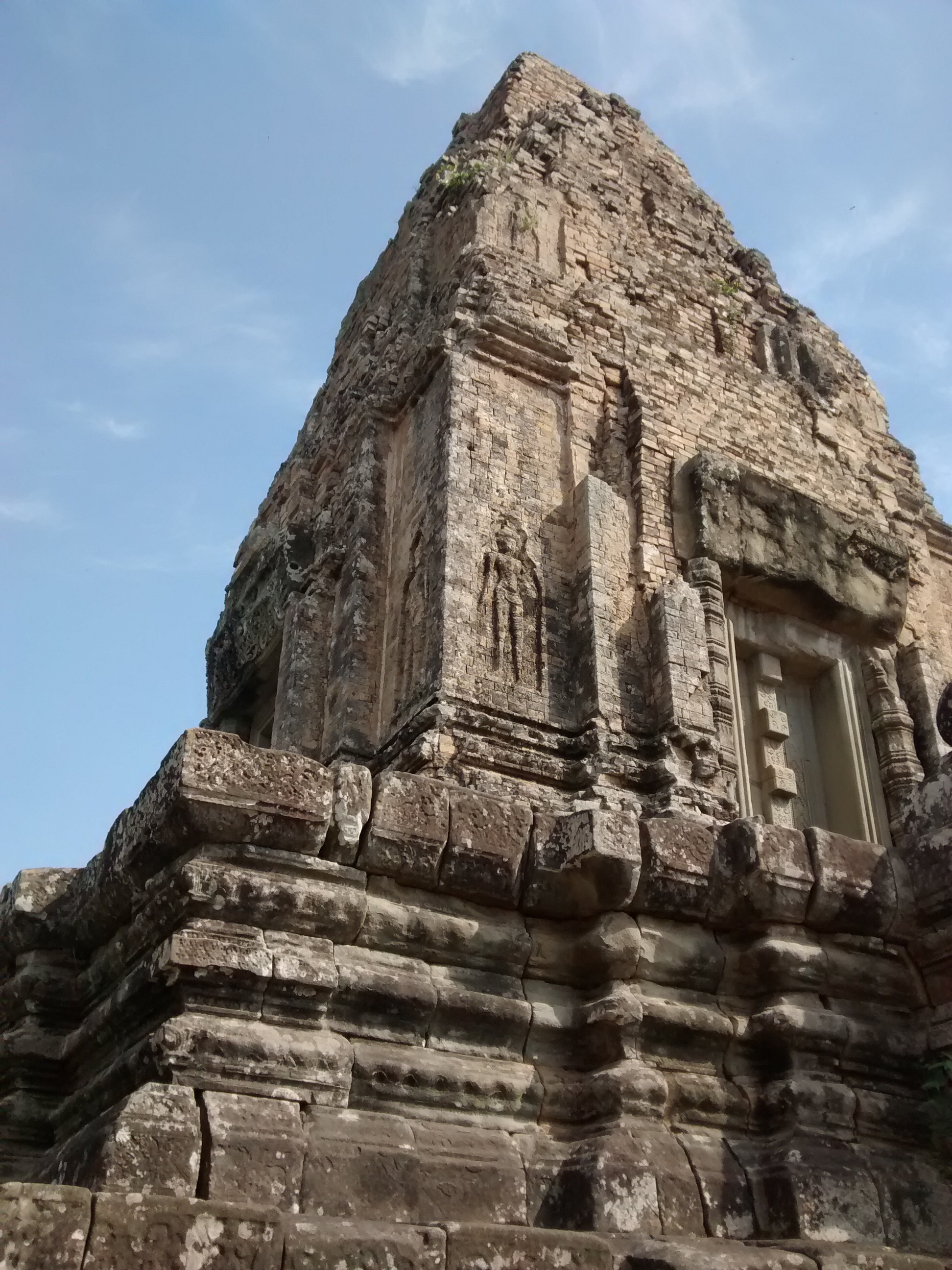
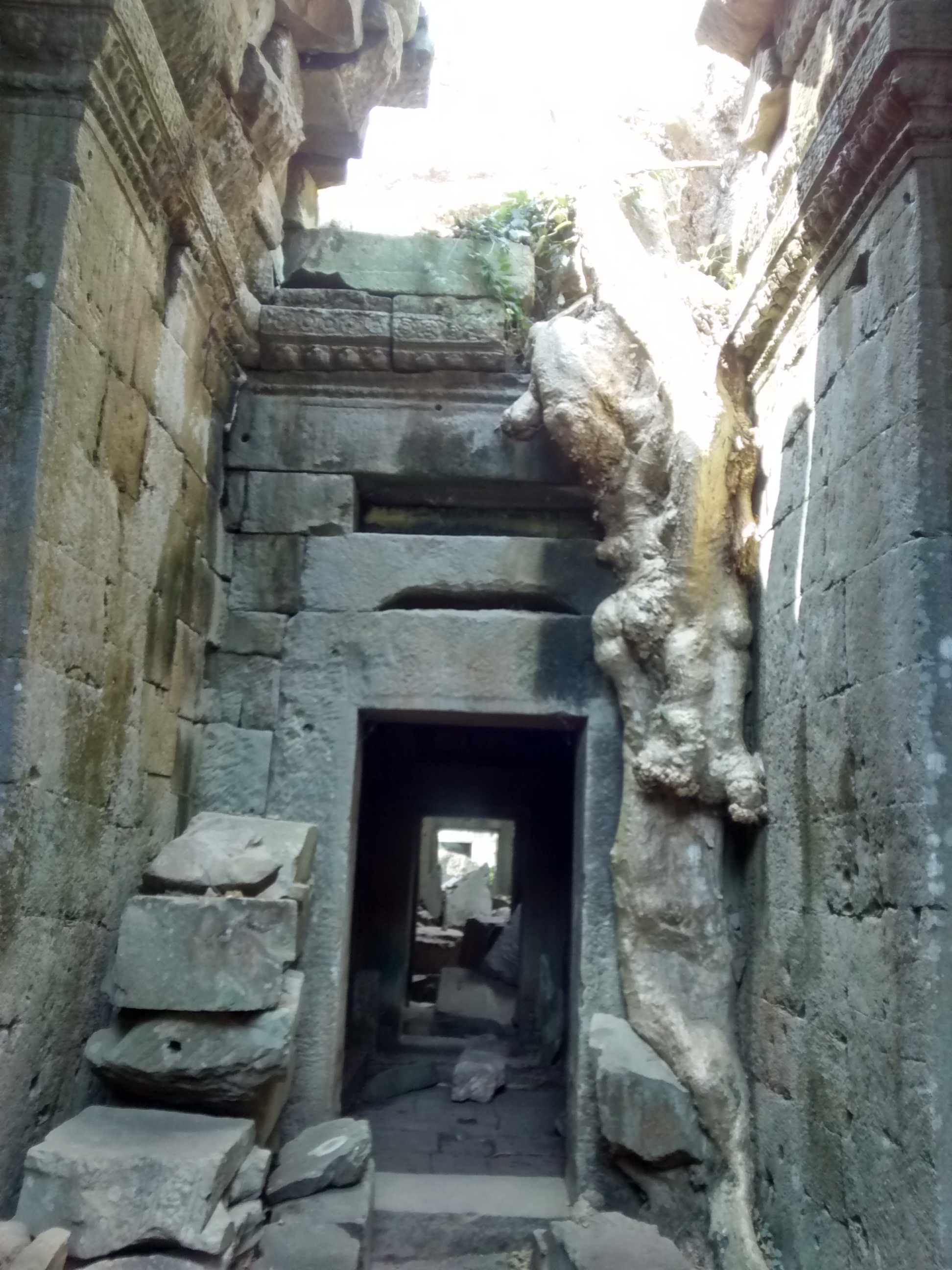
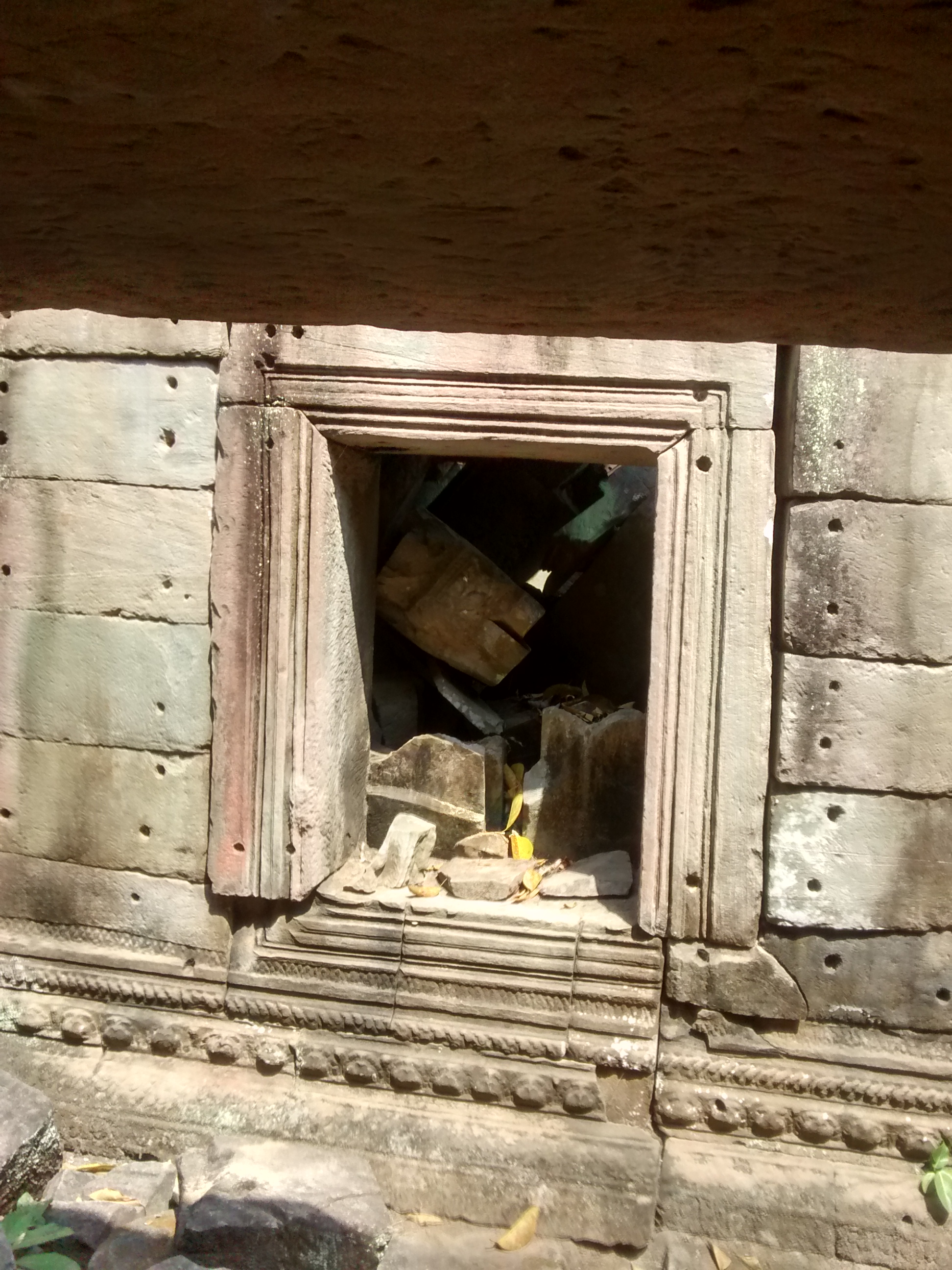
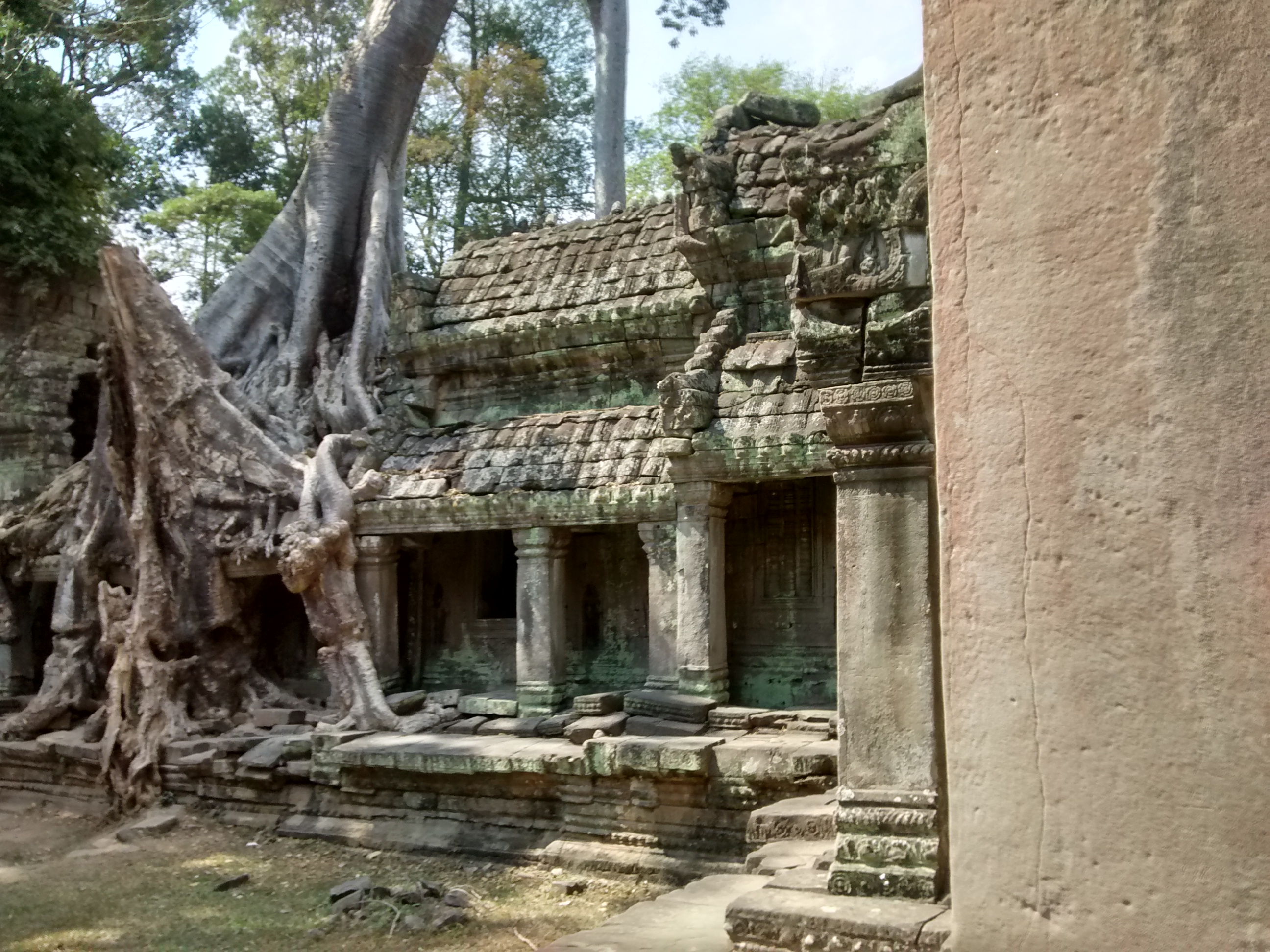
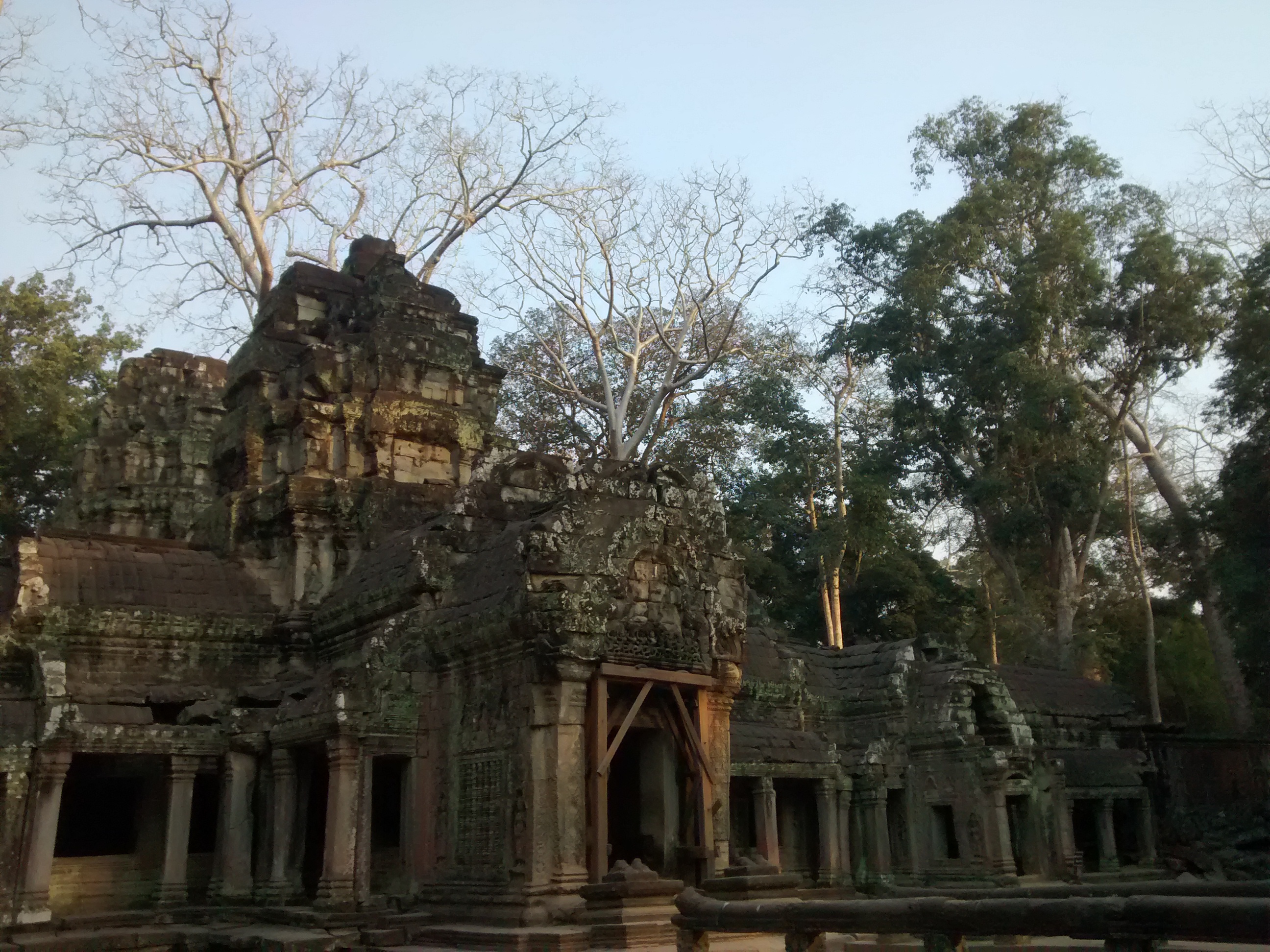
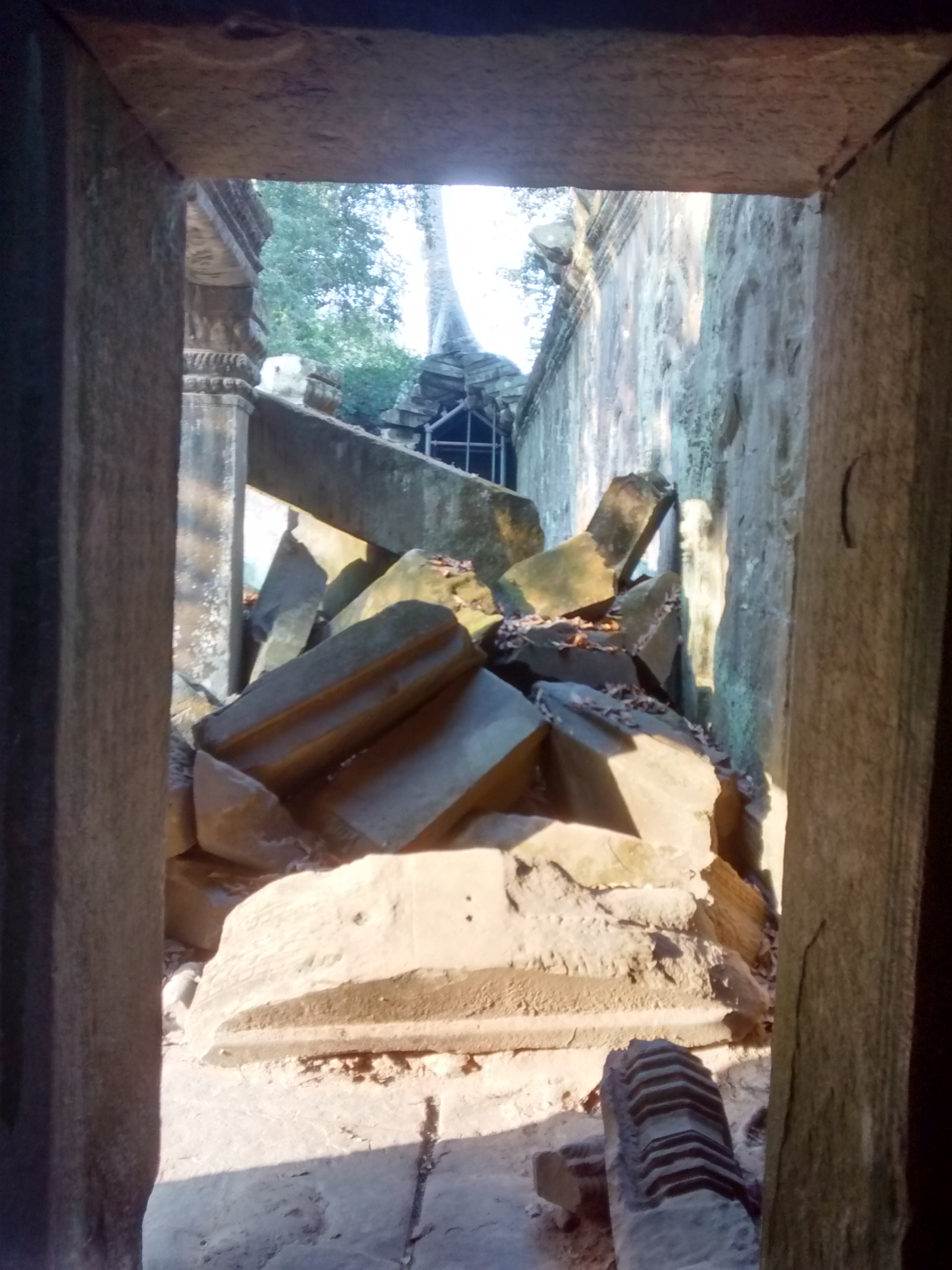
    Like many of the temples, not everything has been reclaimed, there’s a lot of fallen masonry about, and in short Indiana Jones would feel at home in this mysterious little world.

    Chess on a boat.

    (It doesn’t say who won.)

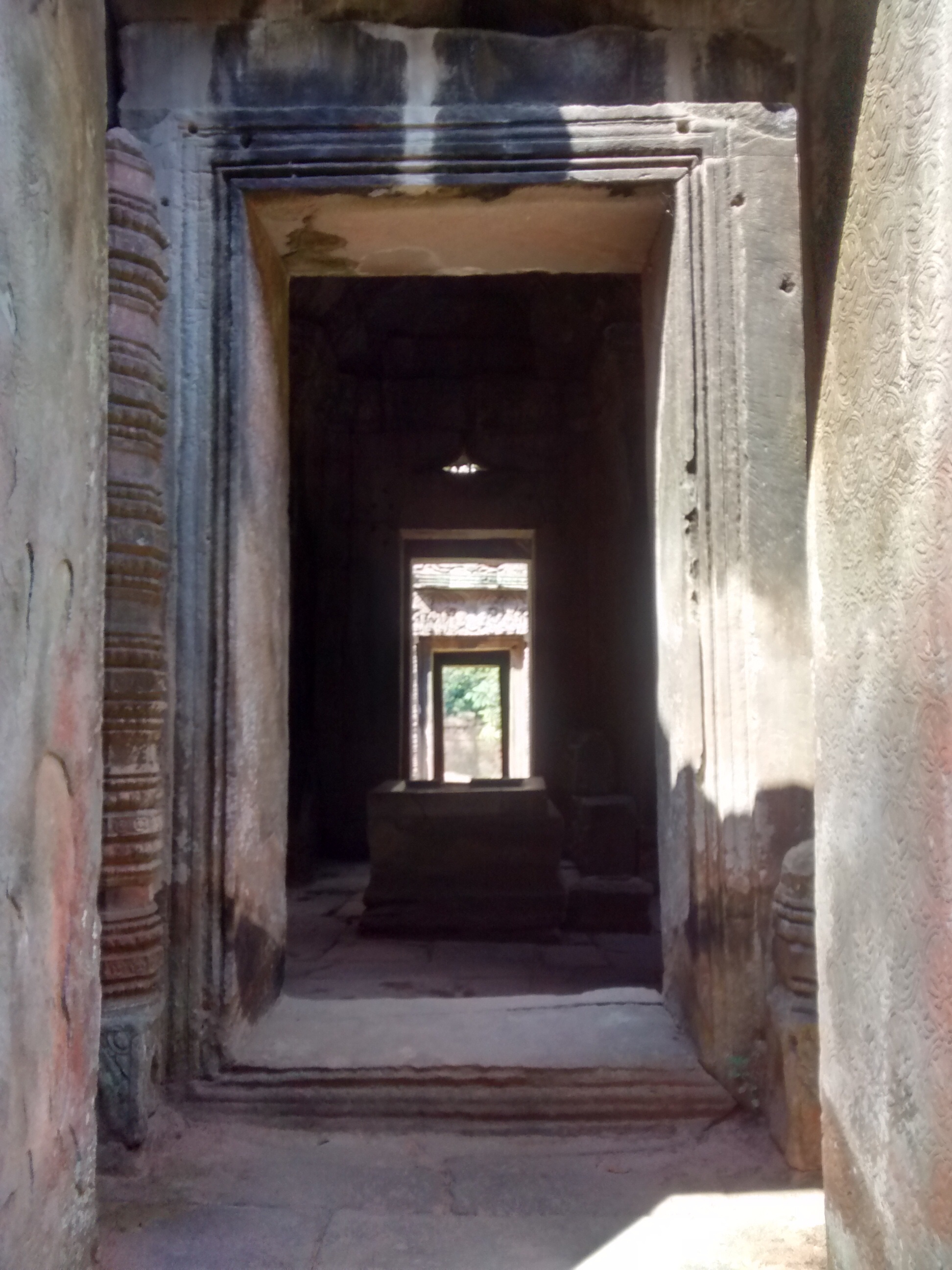
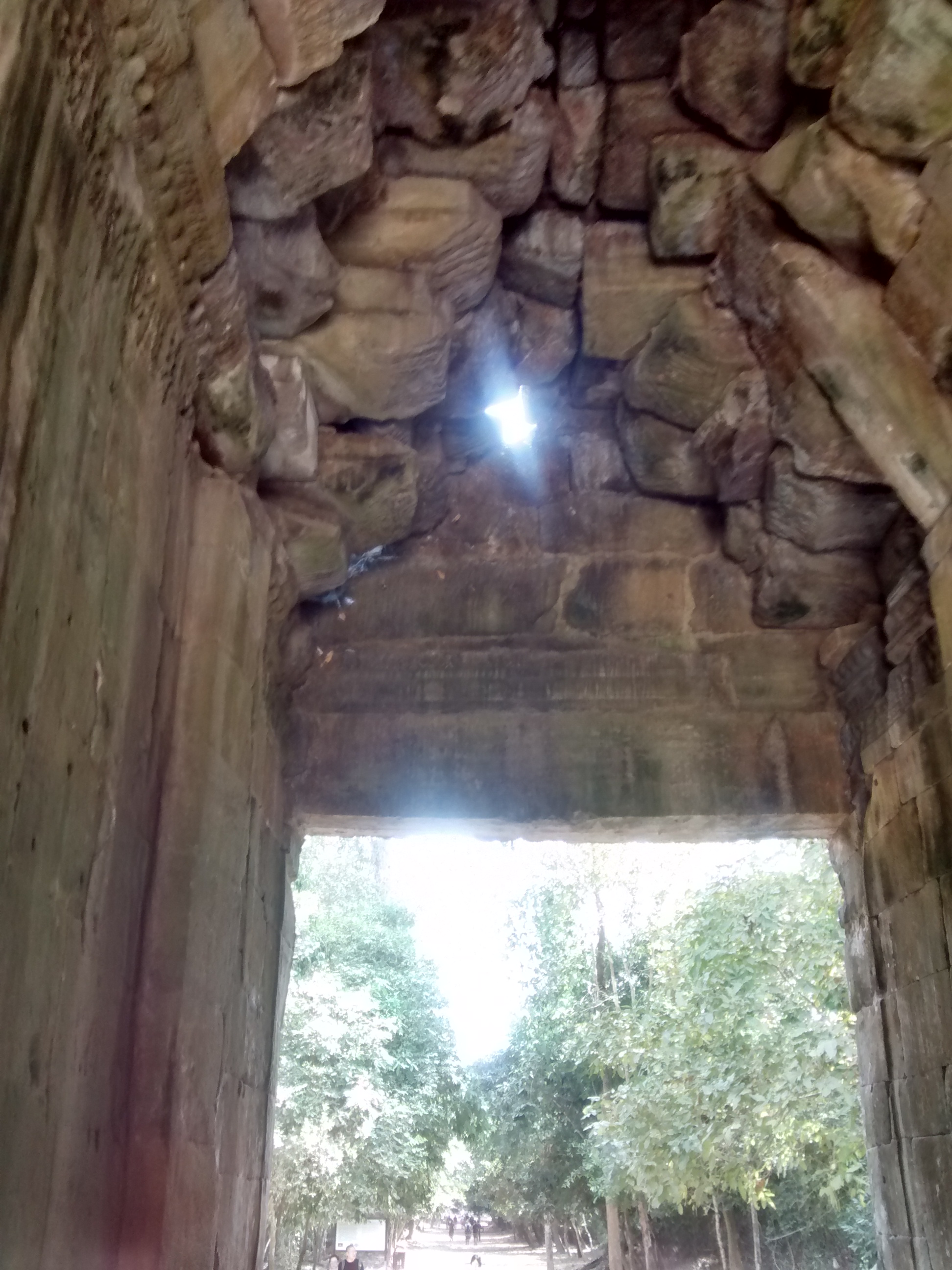
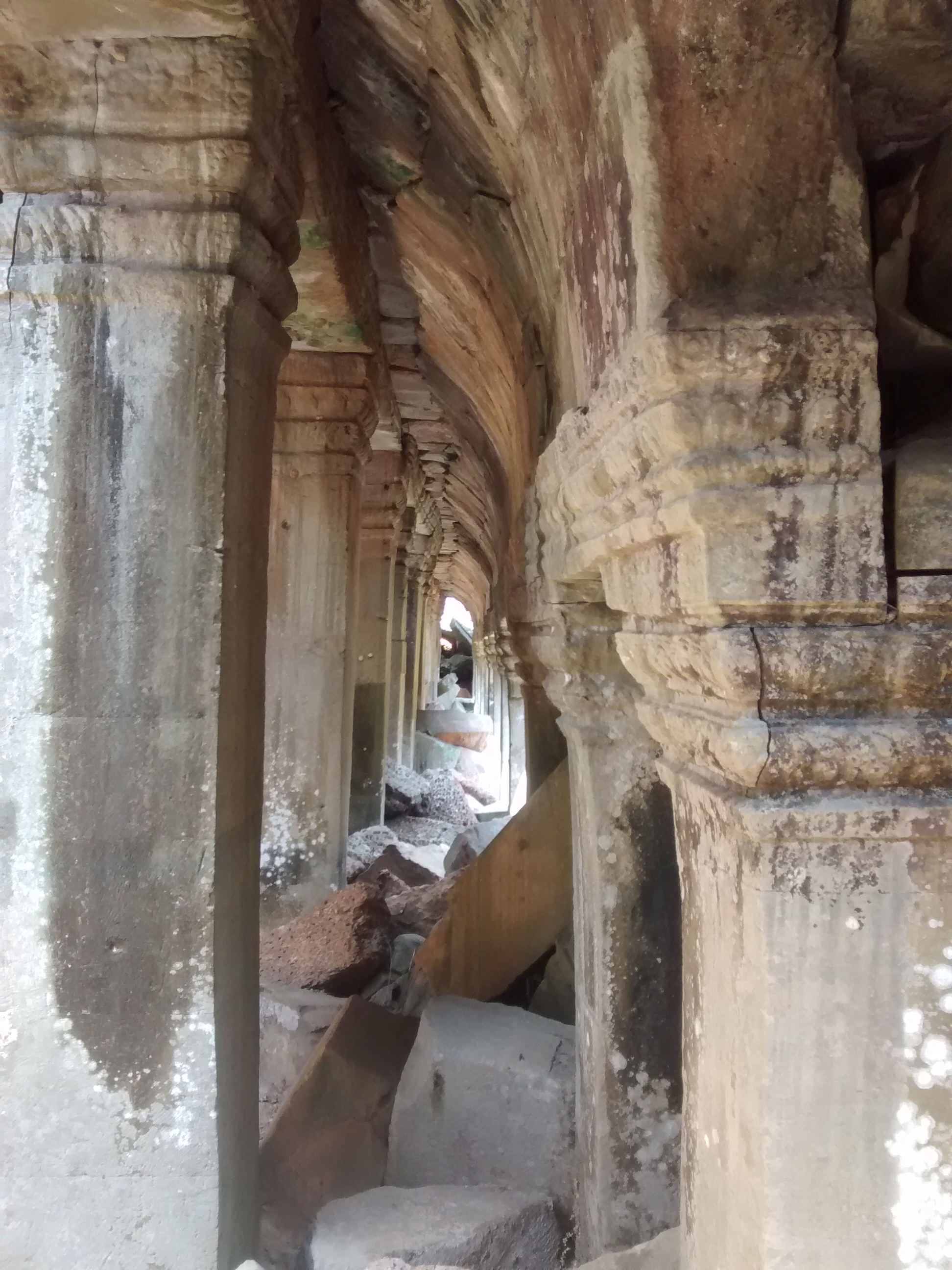
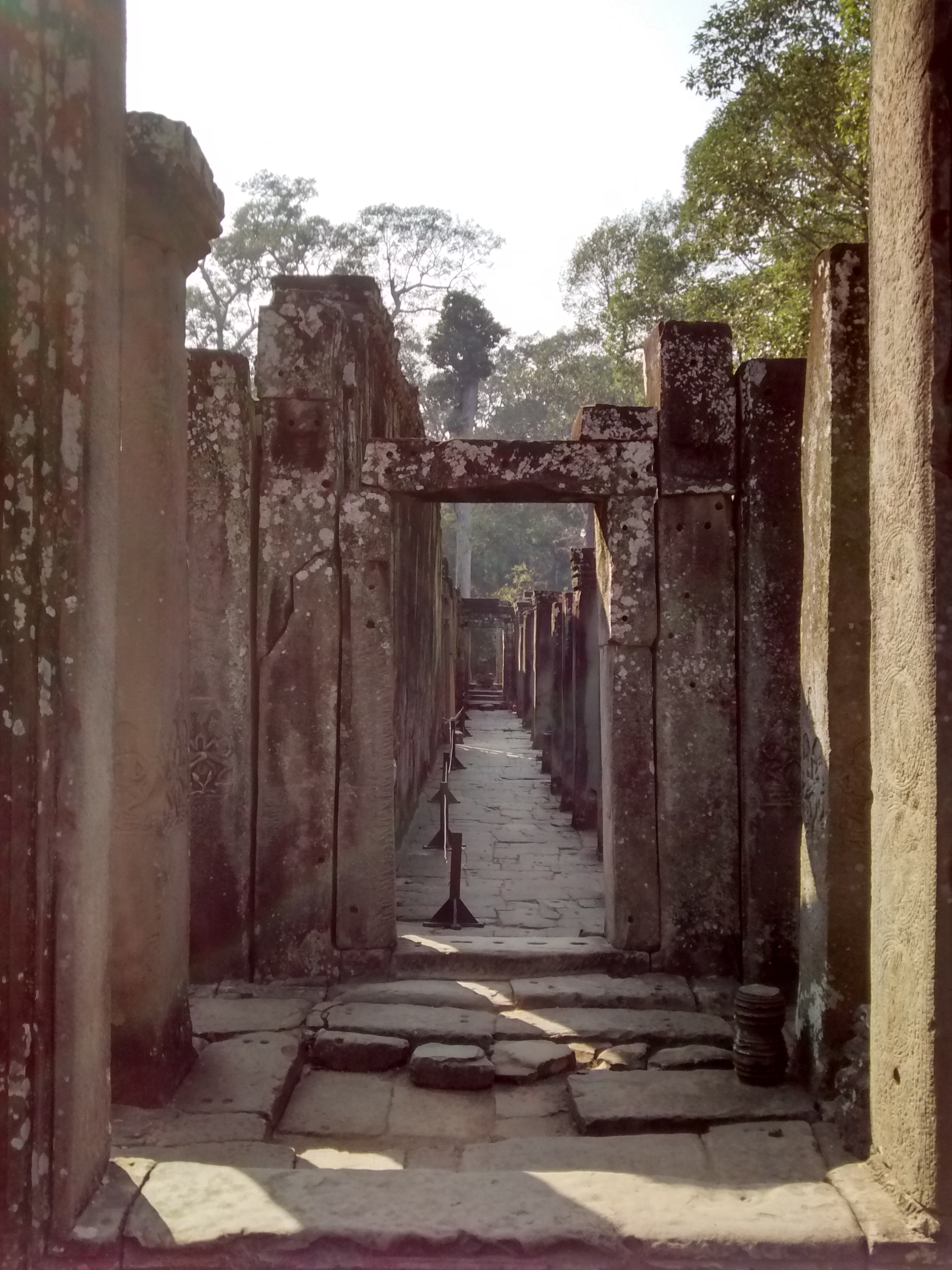
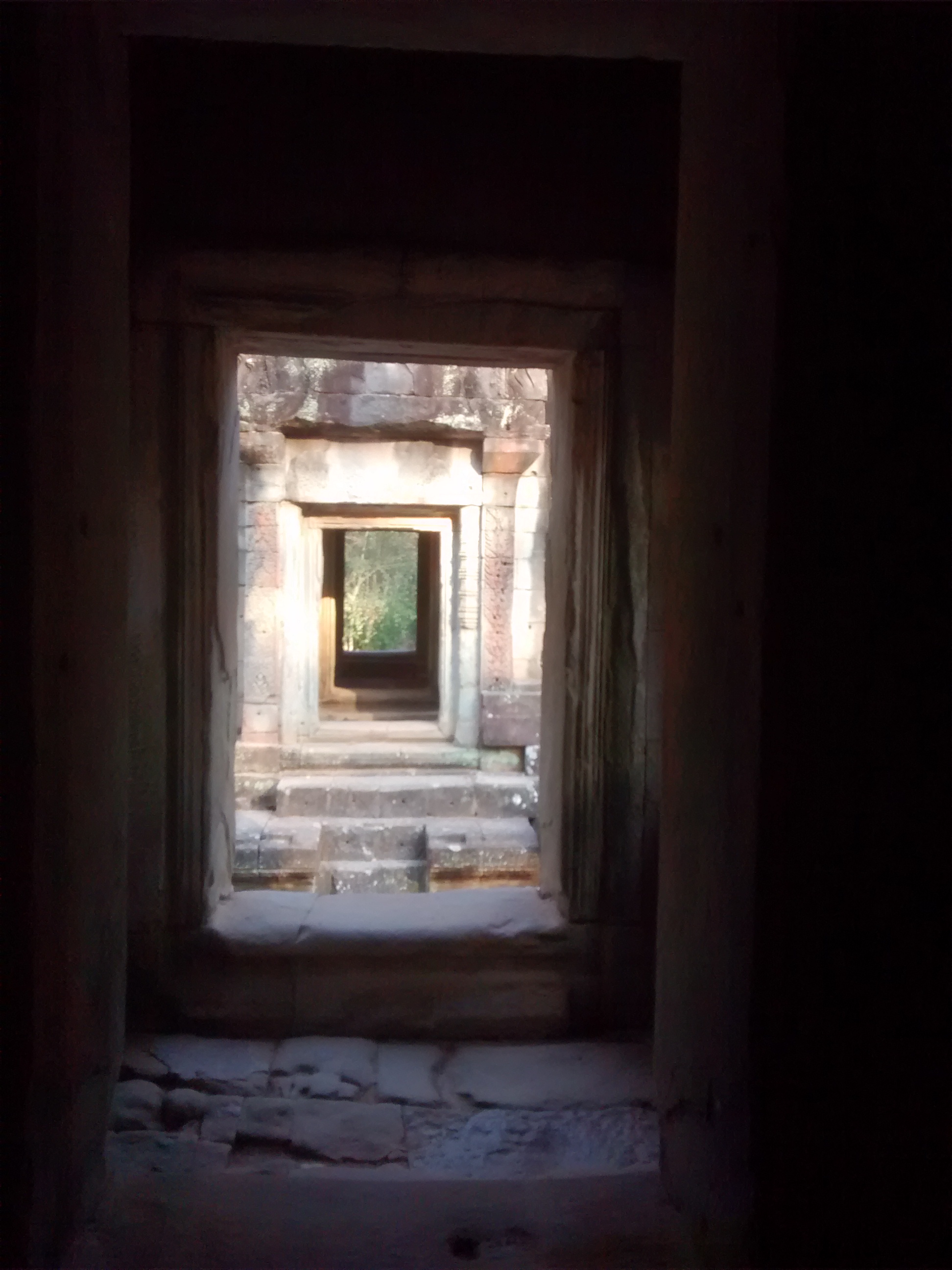
    Ruined ancient passageways.

    What stories have they seen unfold, what secrets do they hold? And if a passageway is restored, can it still claim its witness when the stones are reassembled?

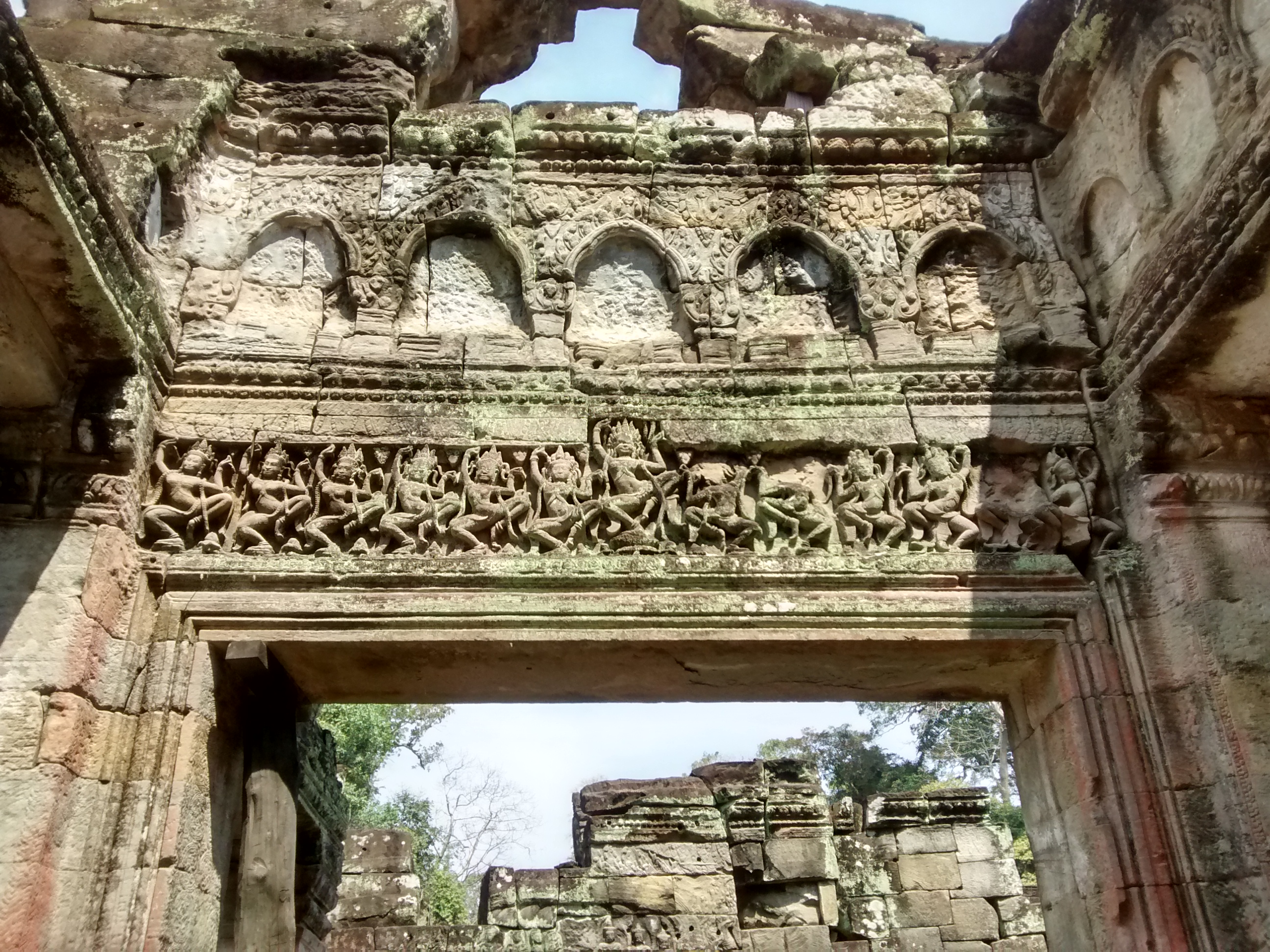
    Entering the so-called Hall of the Dancers.

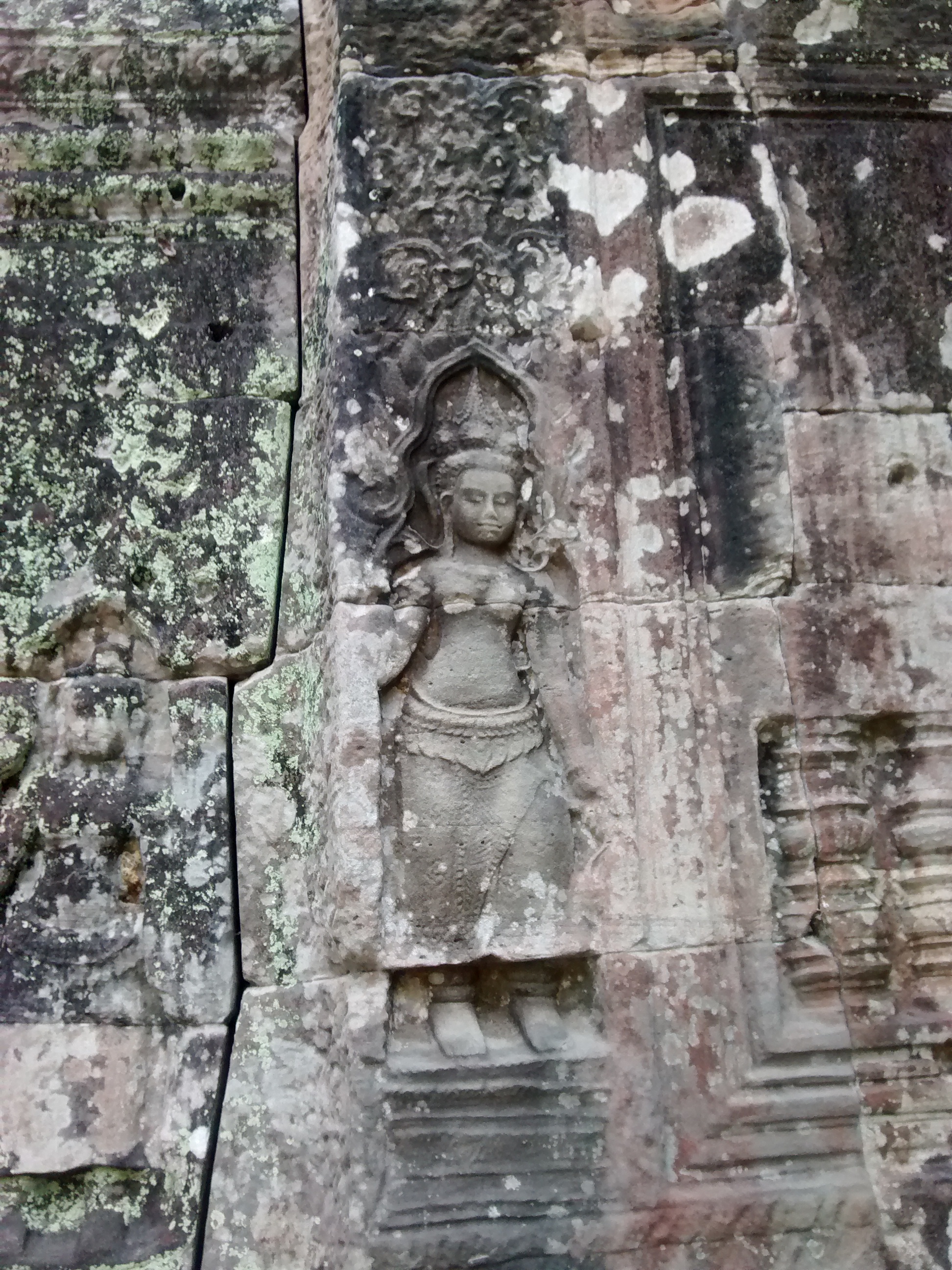
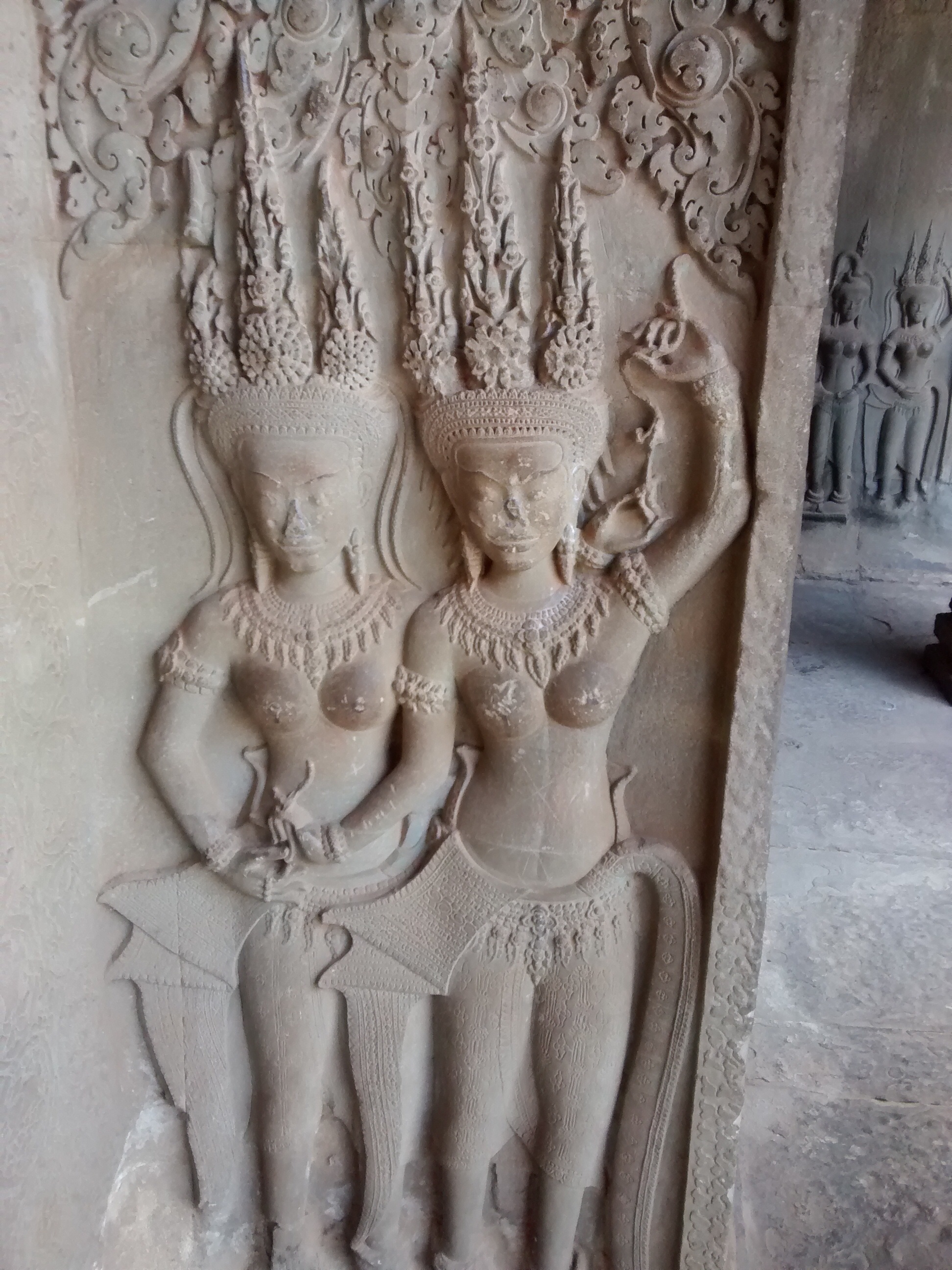
    So called because of the number of lintels that featuring bevies of slinky apsuras.

    There were originally figurines of the Buddha in those recesses above the dancers. But future rulers would revert Angkor from Jayavarman VII’s Buddhism back to Hinduism, and Jayavarman VIII, in particular, wasn’t ‘aving any Buddha. Out they came.

    Fat good it did him. Cambodia has now been solidly Buddhist for centuries.

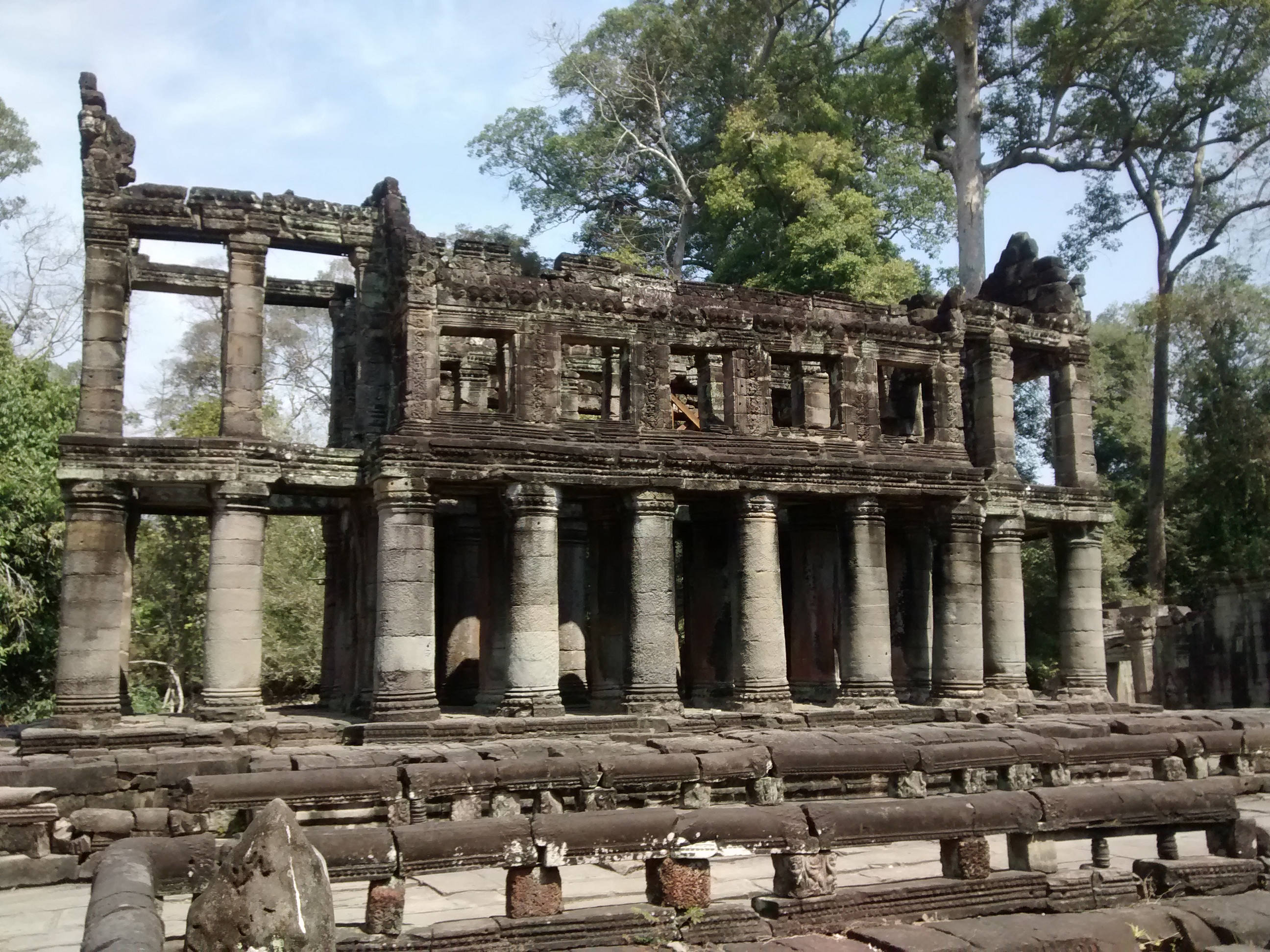
    Yes, we’re still in Cambodia – not Greece. What this rare two-storey building was used for is unknown. But cultures from the Mediterranean to Japan were part of a great web of trade and influence in the first millennium AD, and religious beliefs, art and architecture were reaching places like Cambodia directly or indirectly. Globalisation is not just a modern idea designed to get populist fanatics ranting.

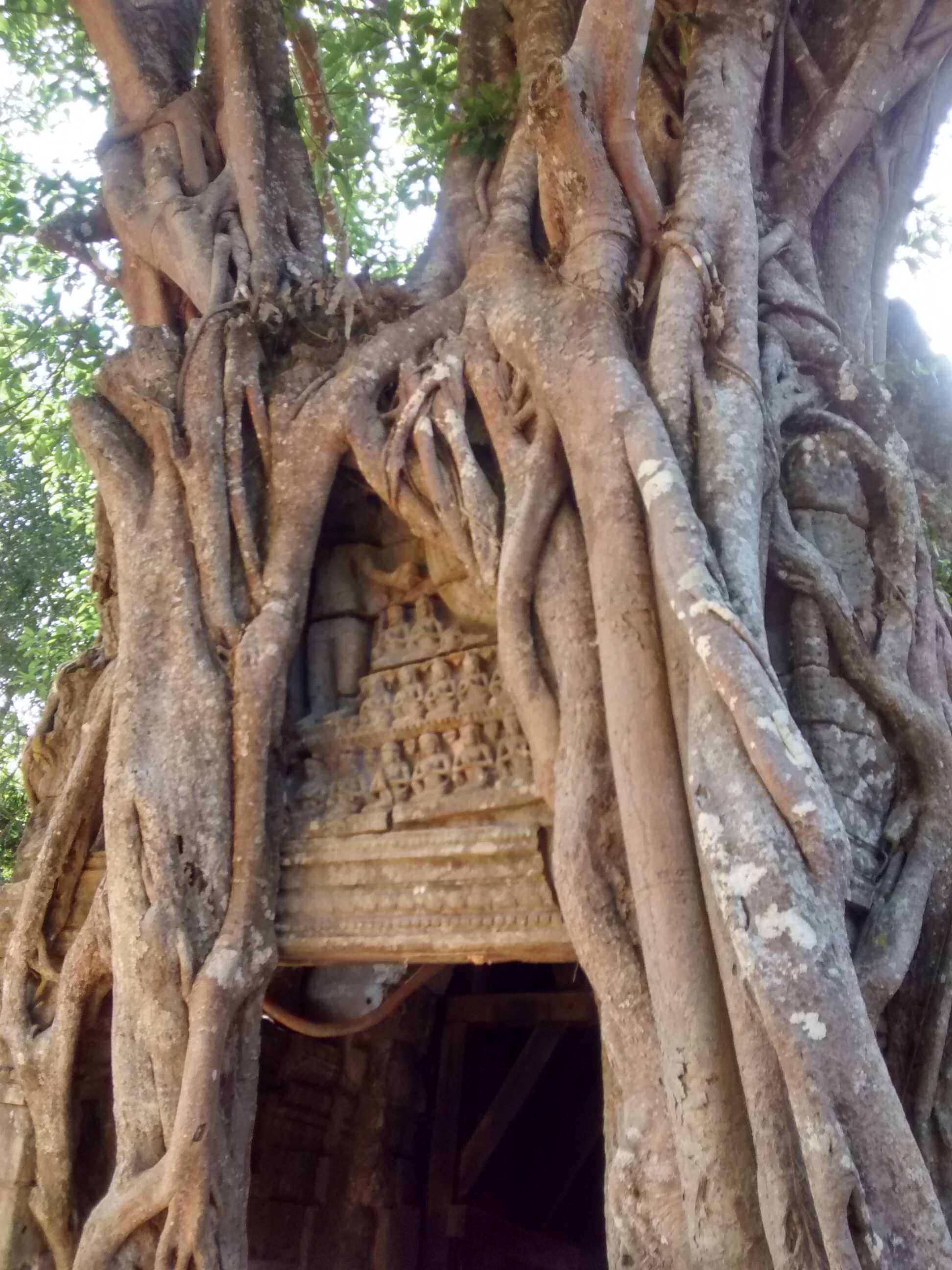
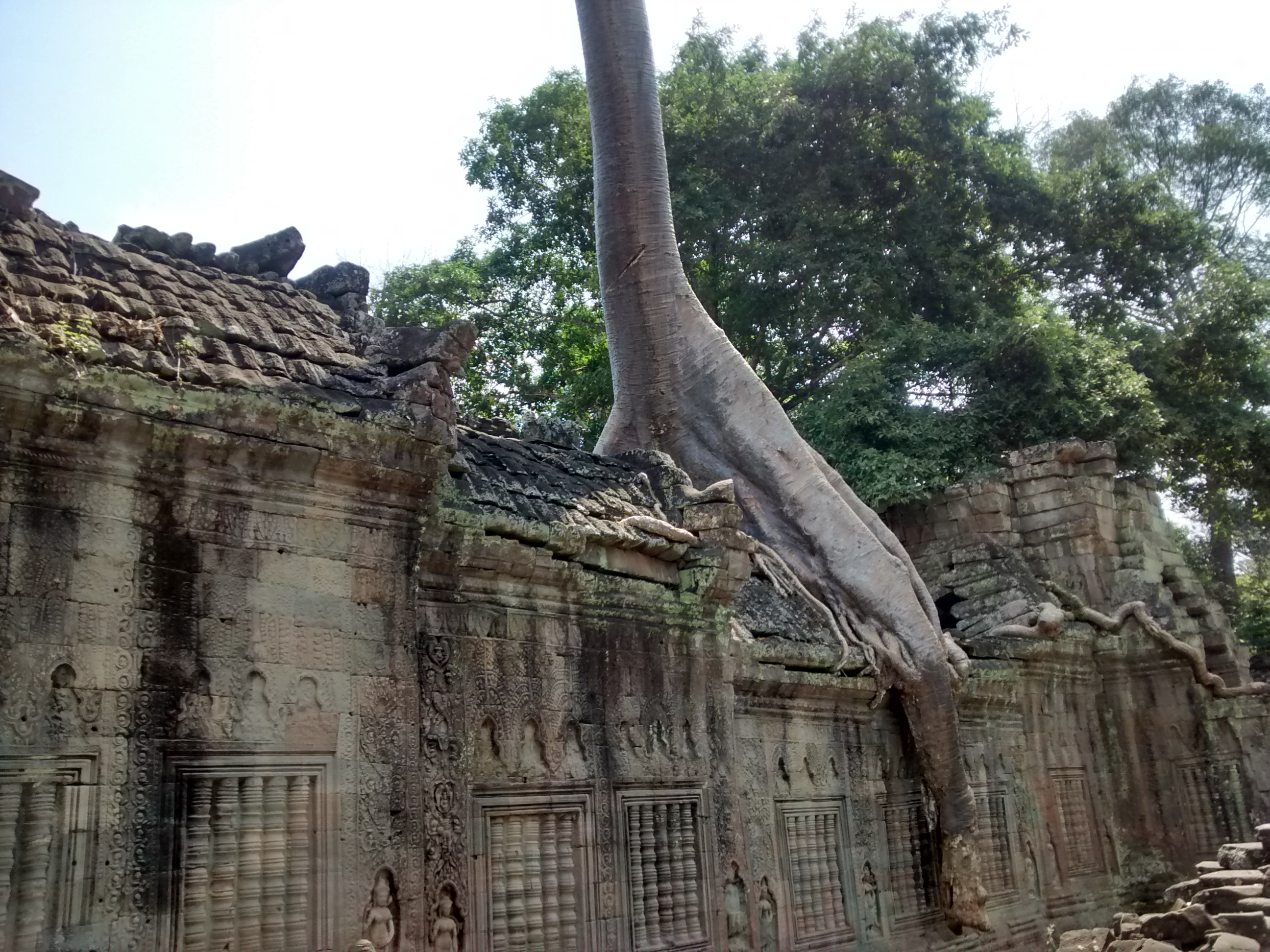
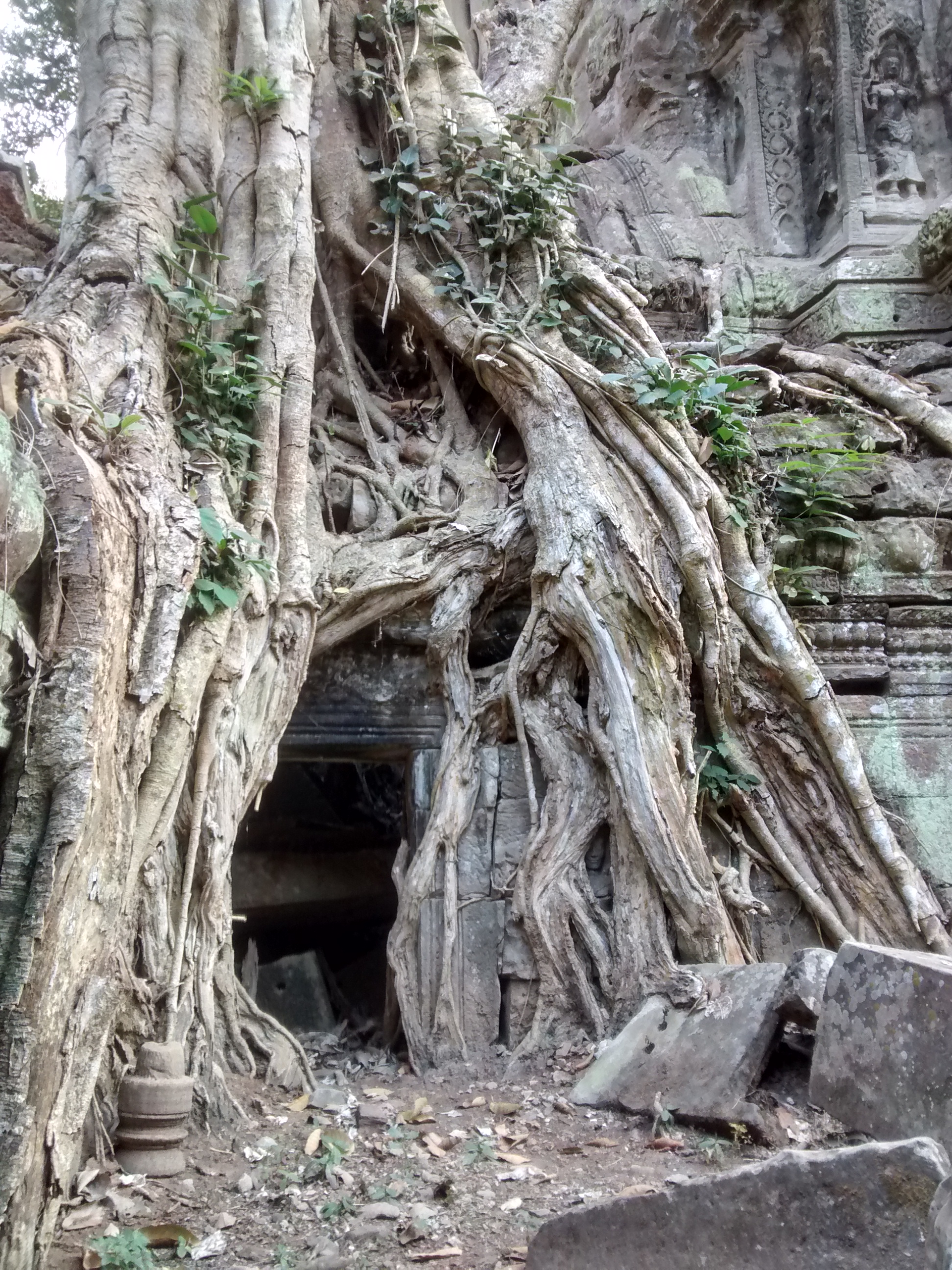
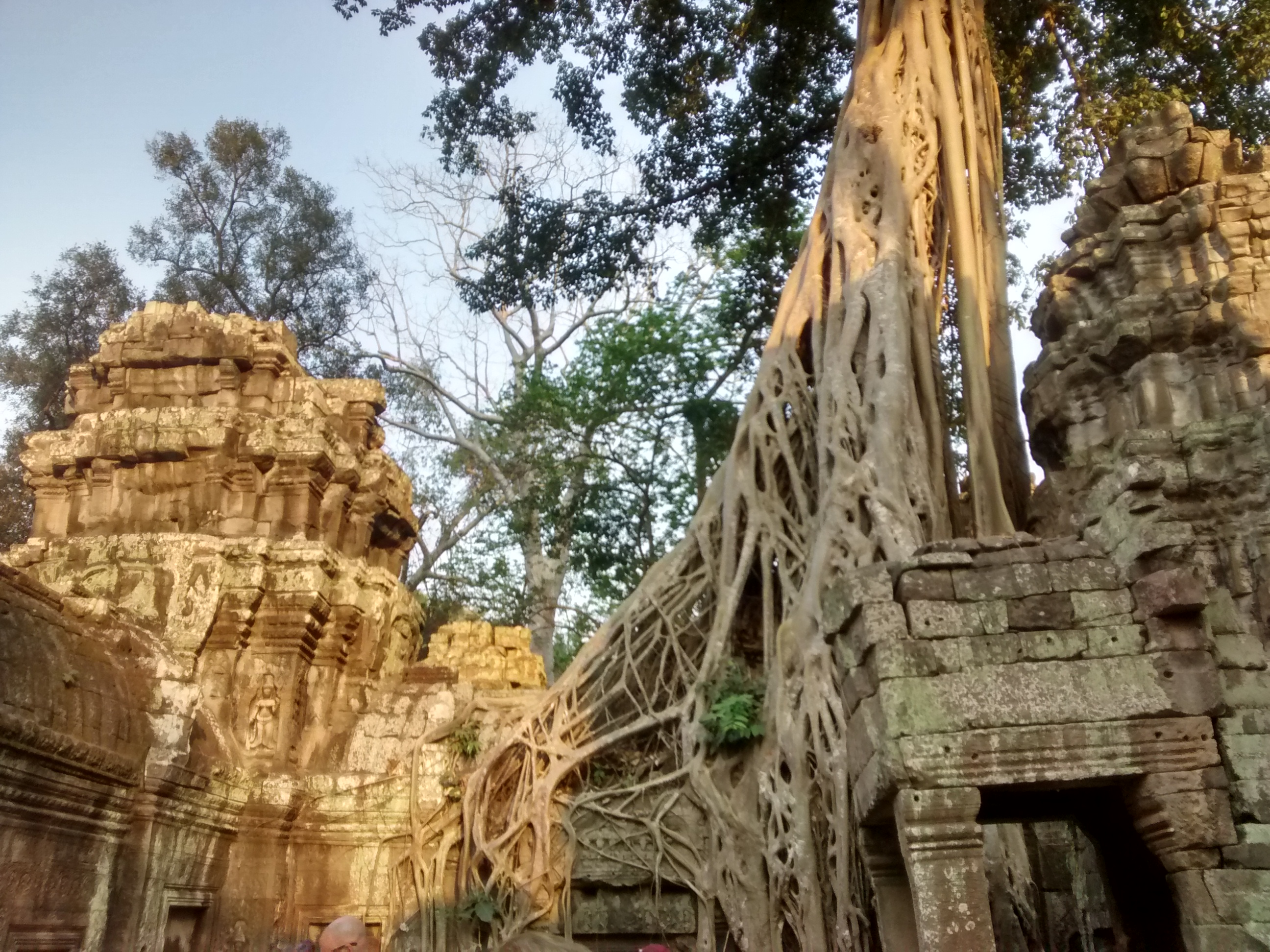
    Still the Angkor Archeological Park – not Jurassic Park. Those are silk-cotton trees, the forest clinging on to its age-old dominion on the ancient temple. Freeman and Jacques believe that the trees are so old, they’re going to fall…

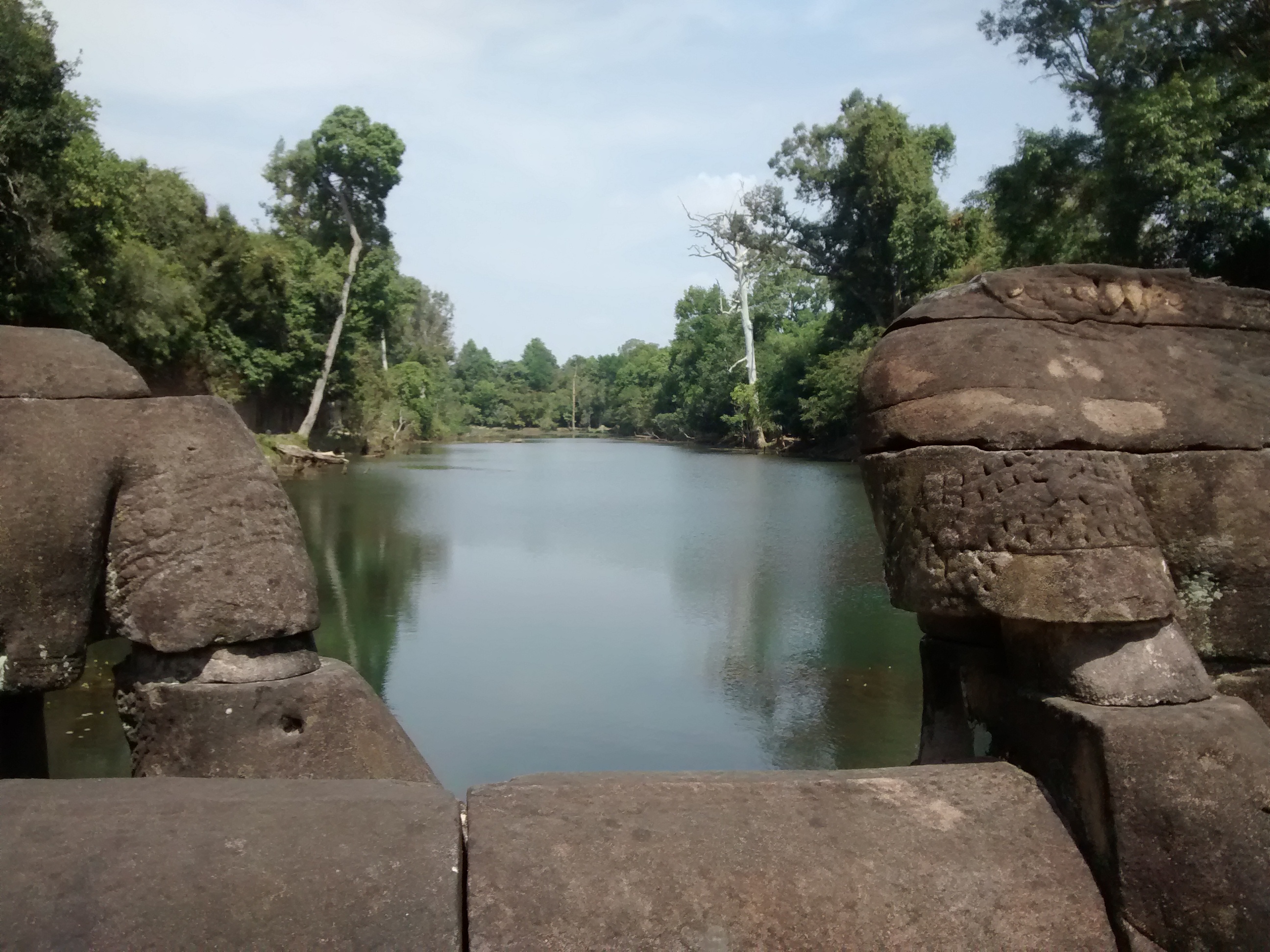
    Better leave then. Out through the east gate, and after we run the gauntlet of the poor young trinket sellers on the long dusty path out (I couldn’t shake mine off so I bought two “silk” scarves for $3) we reach the other causeway, more nagas and tug-of-war, and the serenely flowing moat.

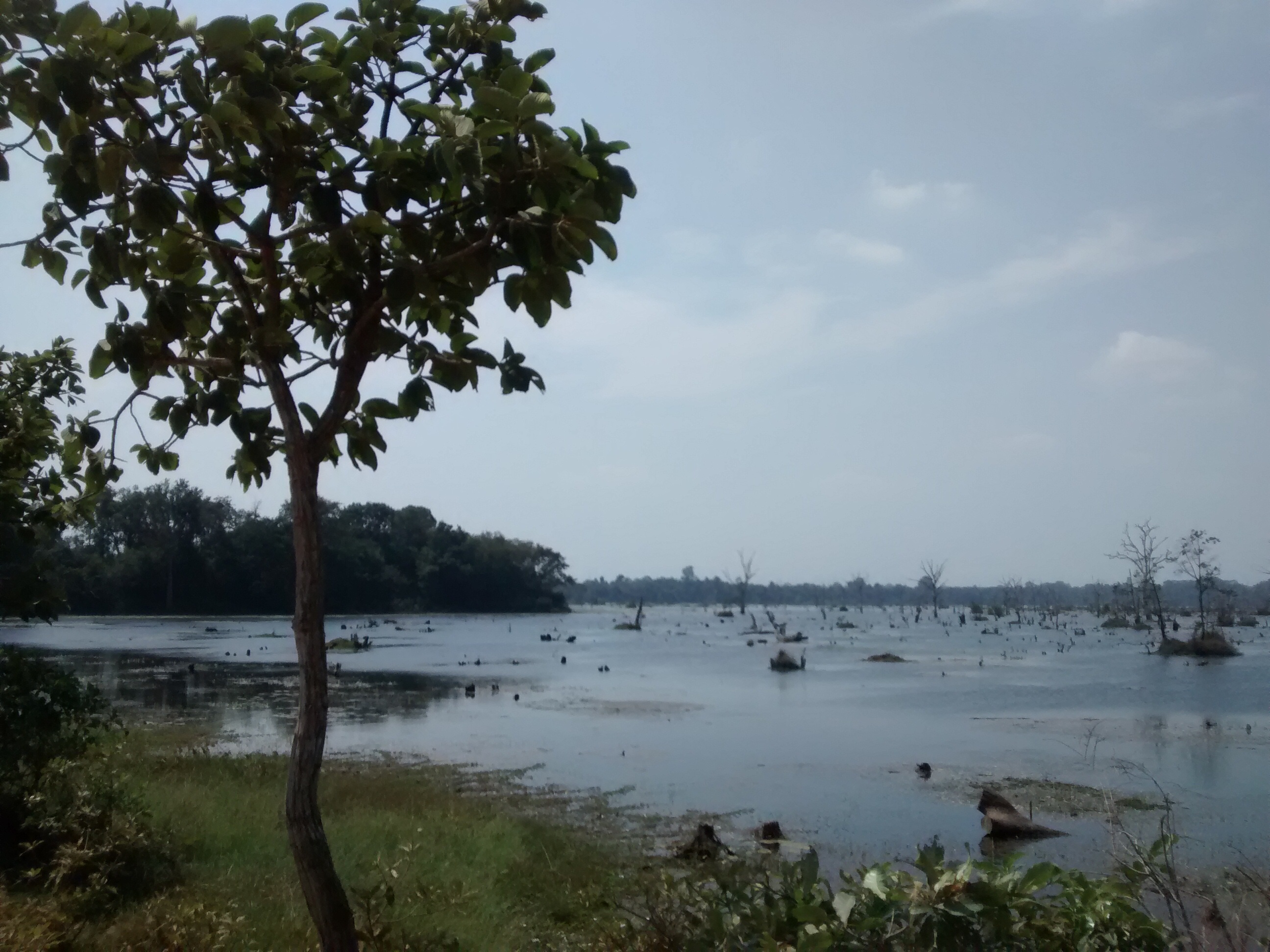
    Except that it doesn’t flow under the causeway. The passageways are blocked. The other side is stagnant.

    Dead trees, lost memories, faded faith. A world of wonder stirring again and finding new life in the imagination of humankind

  • While we make our way through the vast wooded space that is now Angkor Thom, a tip if you ever want to visit the Angkor monuments. I’d strongly advise a visit to the Angkor museum in Siem Reap. Eight small and well-presented galleries of statues and figurines will give you a good grounding in the history of the Khmer empire, and also in those aspects of Hinduism and Buddhism that are relevant to the temples. Their 1000 Buddha gallery is worth a look on its own.

    Our friendly tuk-tuk driver tells us we’ve reached the temples. Let’s get out and take a look.

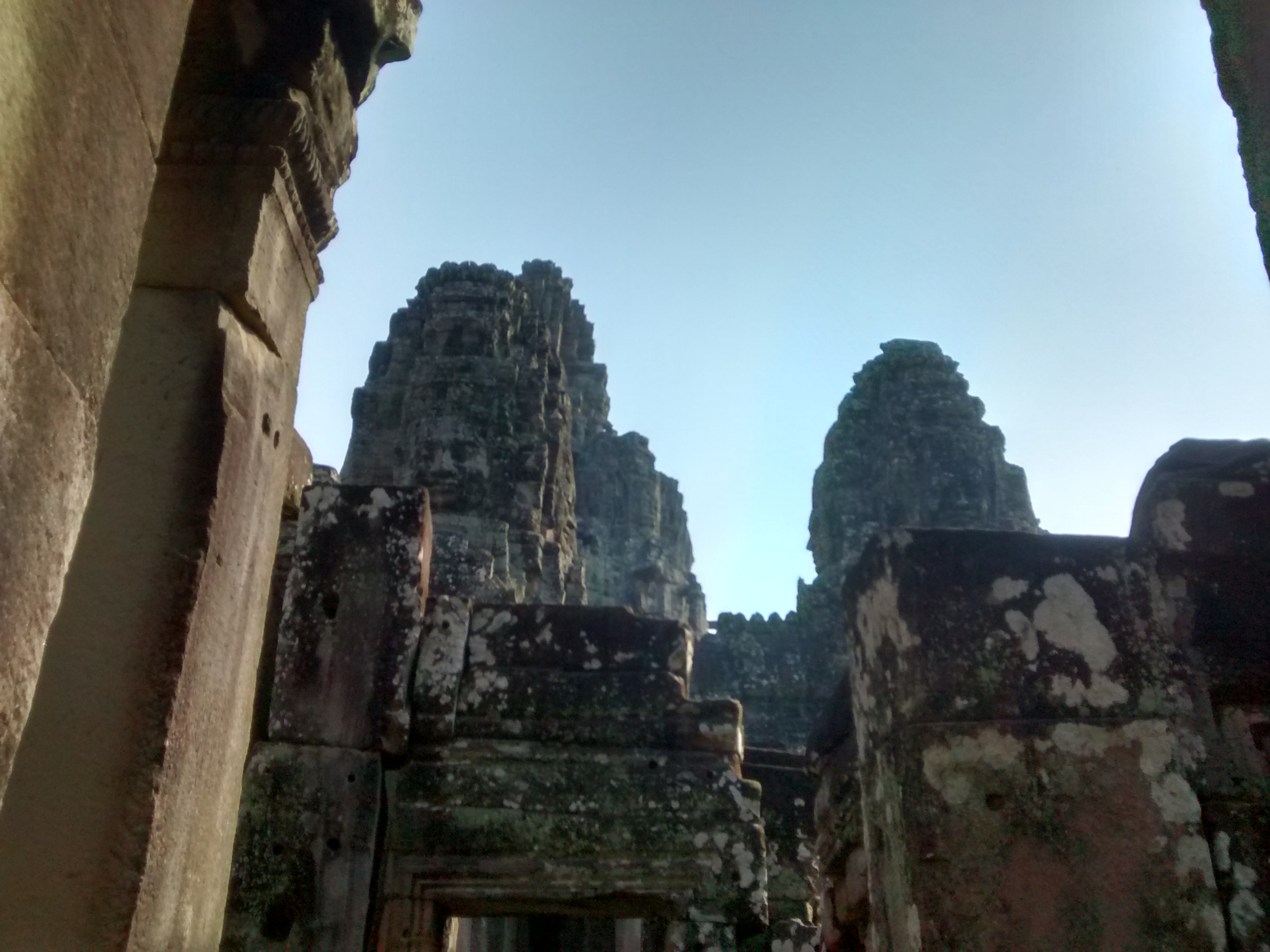
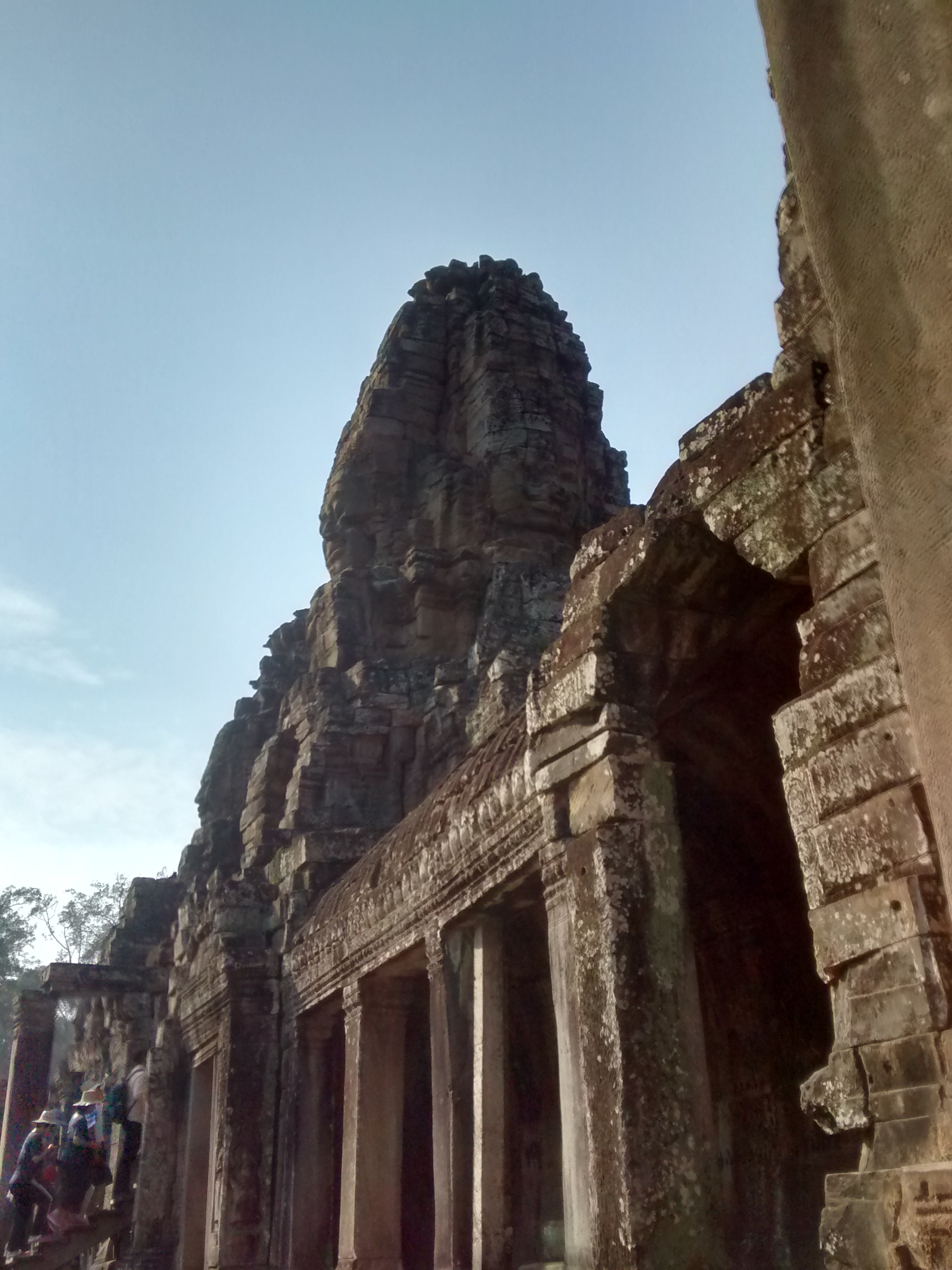
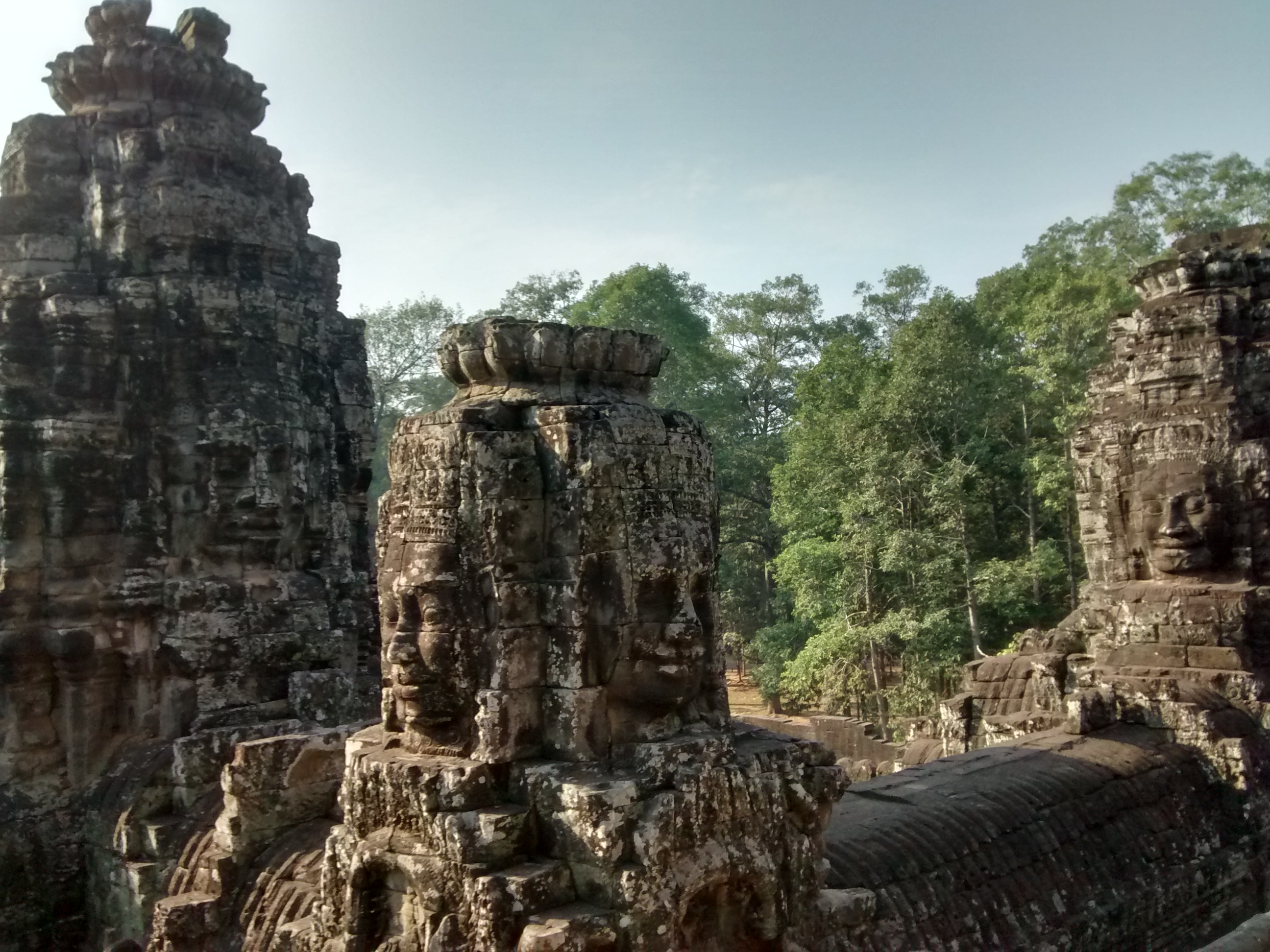
    The Buddhist temple of Bayon, 12-13th century, built by Angkor’s most revered king, Jayavarman VII.

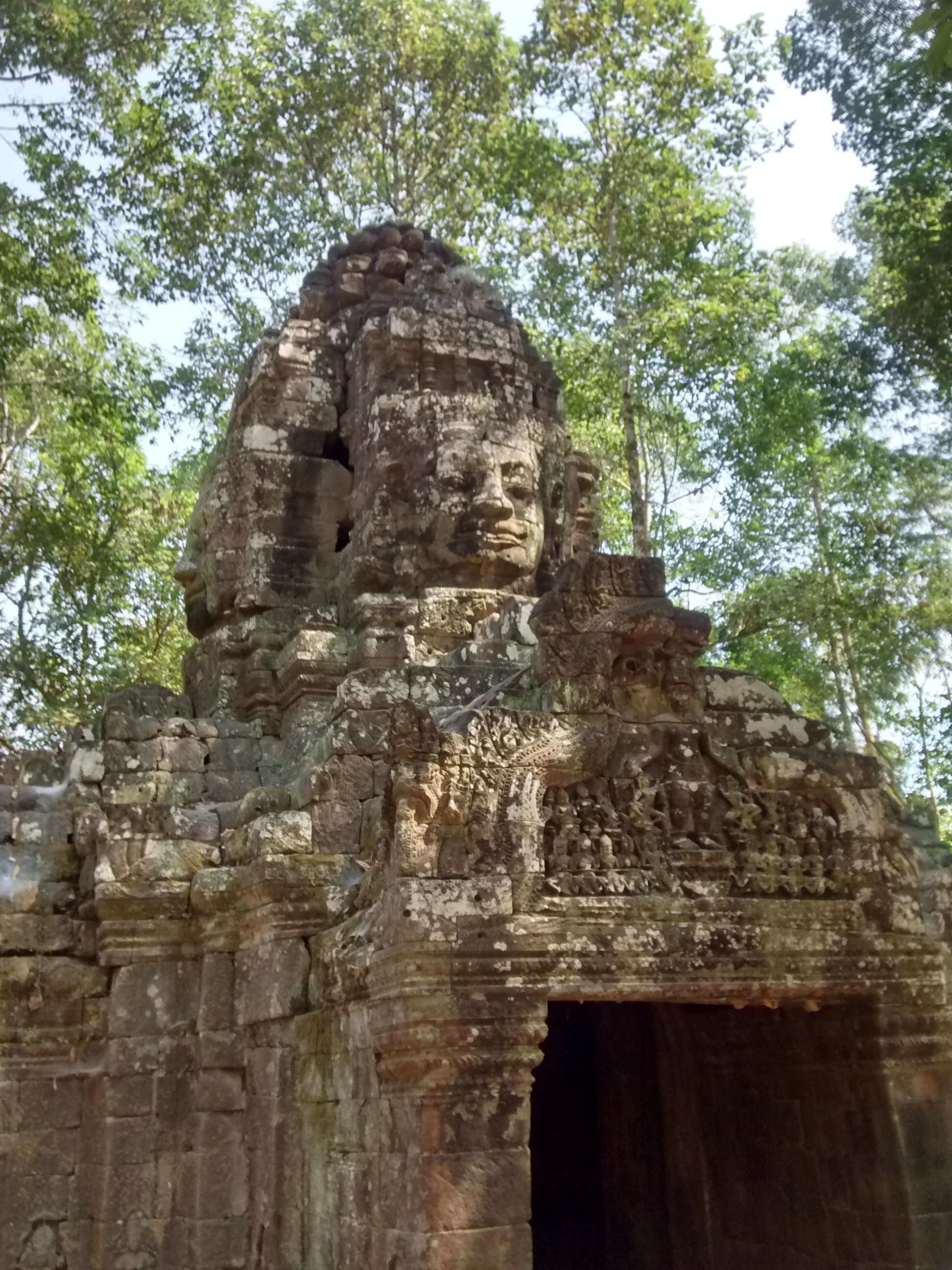
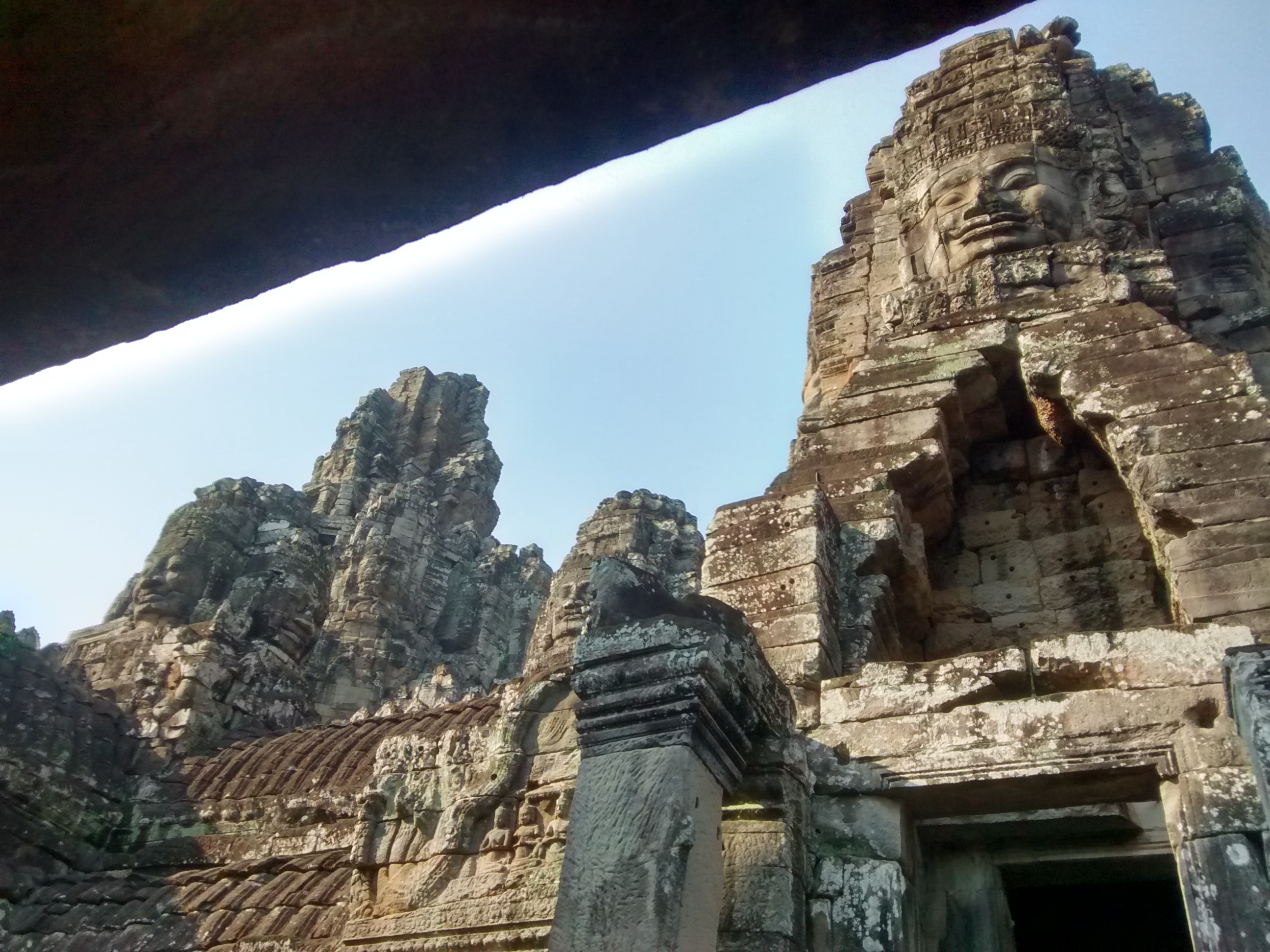
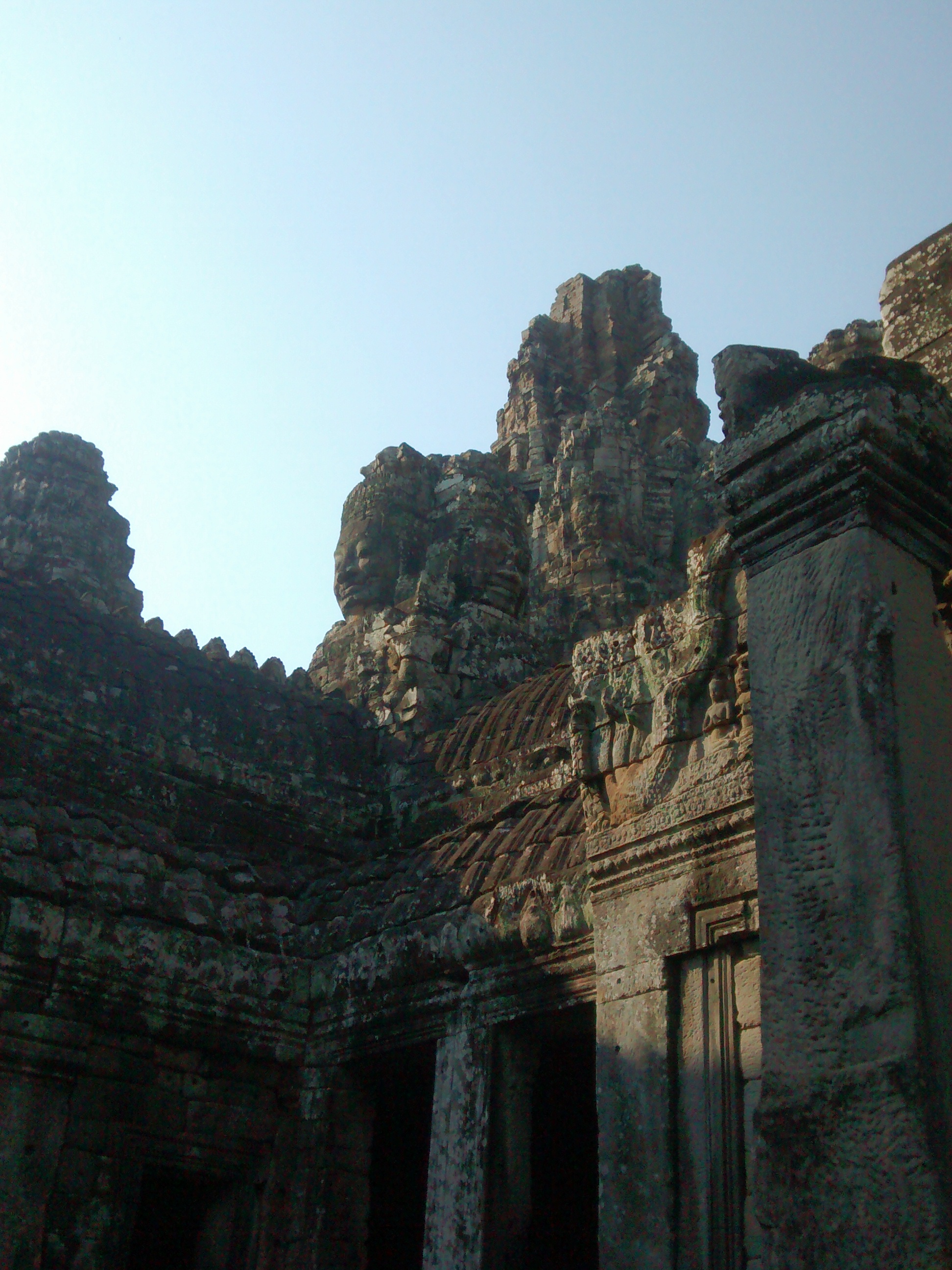
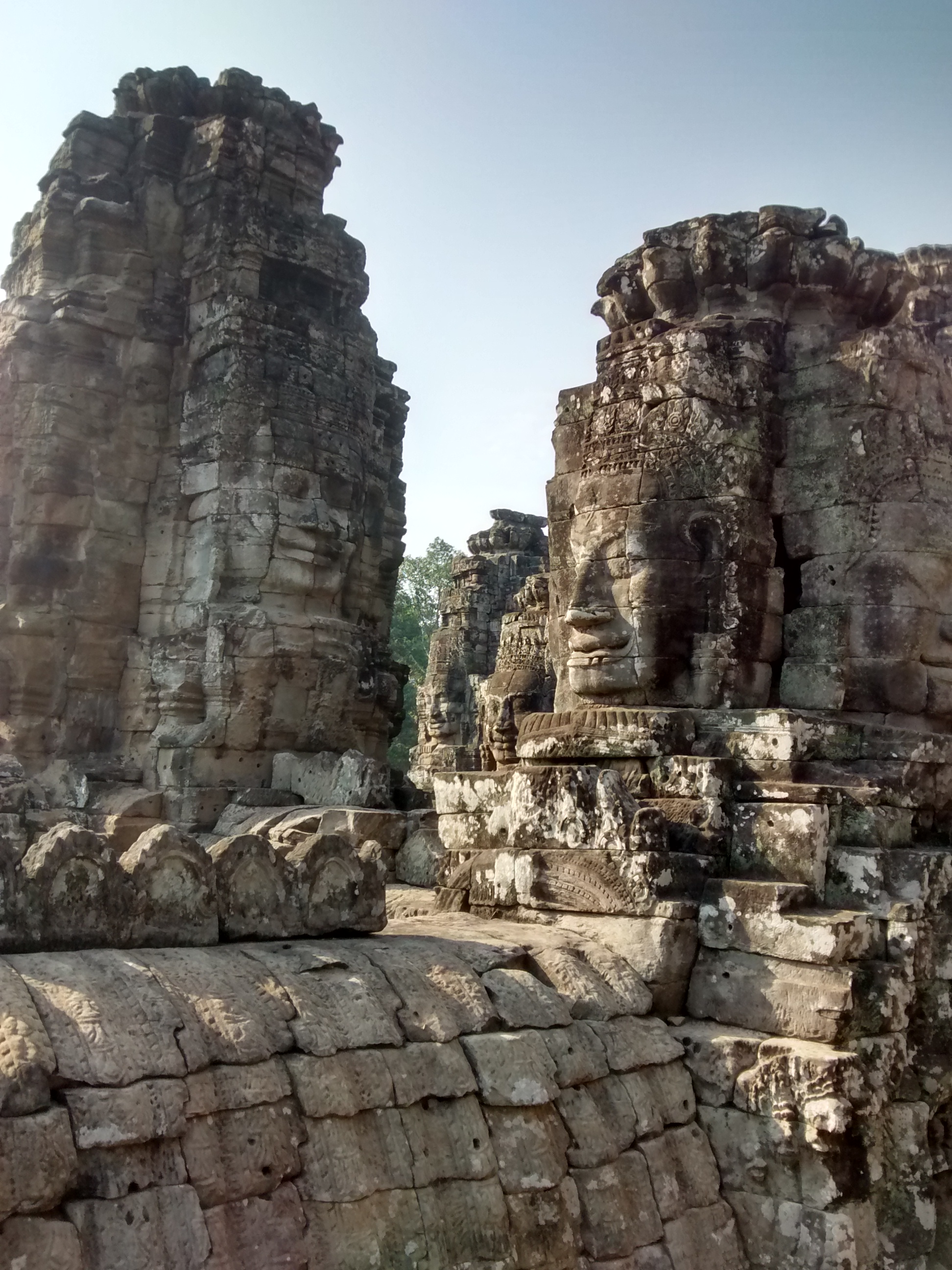
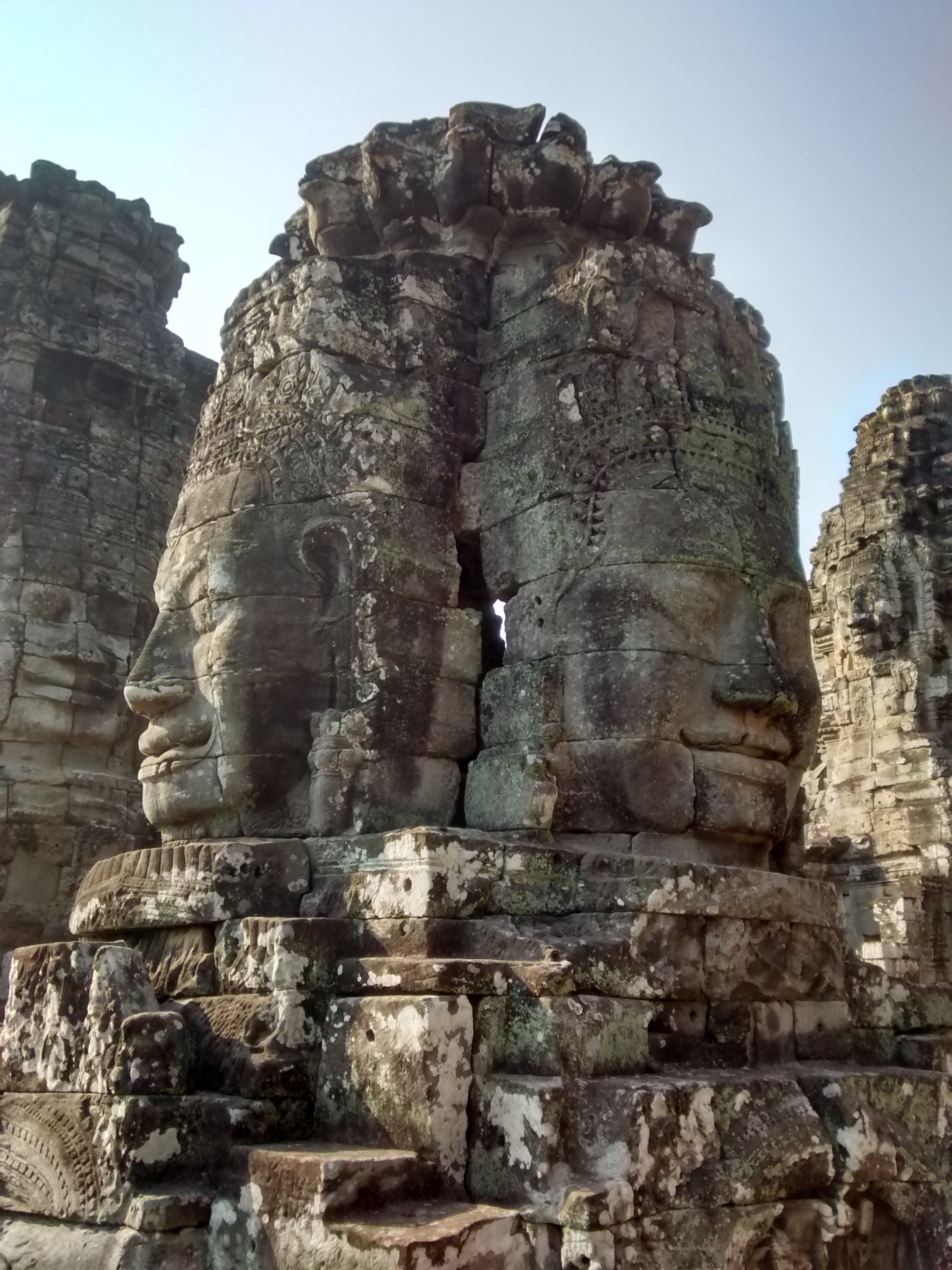
    I promised you more faces. Bayon has dozens of them. Four faces on each tower, each serenely gazing out in one of the four cardinal directions.

    Angkor Wat is the big drawcard, but the other temples, smaller and more enigmatic, also draw the crowds.

    Mind your head! (I didn’t always.)

    Who is it? A Buddhist bodhisattva, more-or-less a saint, here themselves personified by Jayavarnam VII himself.
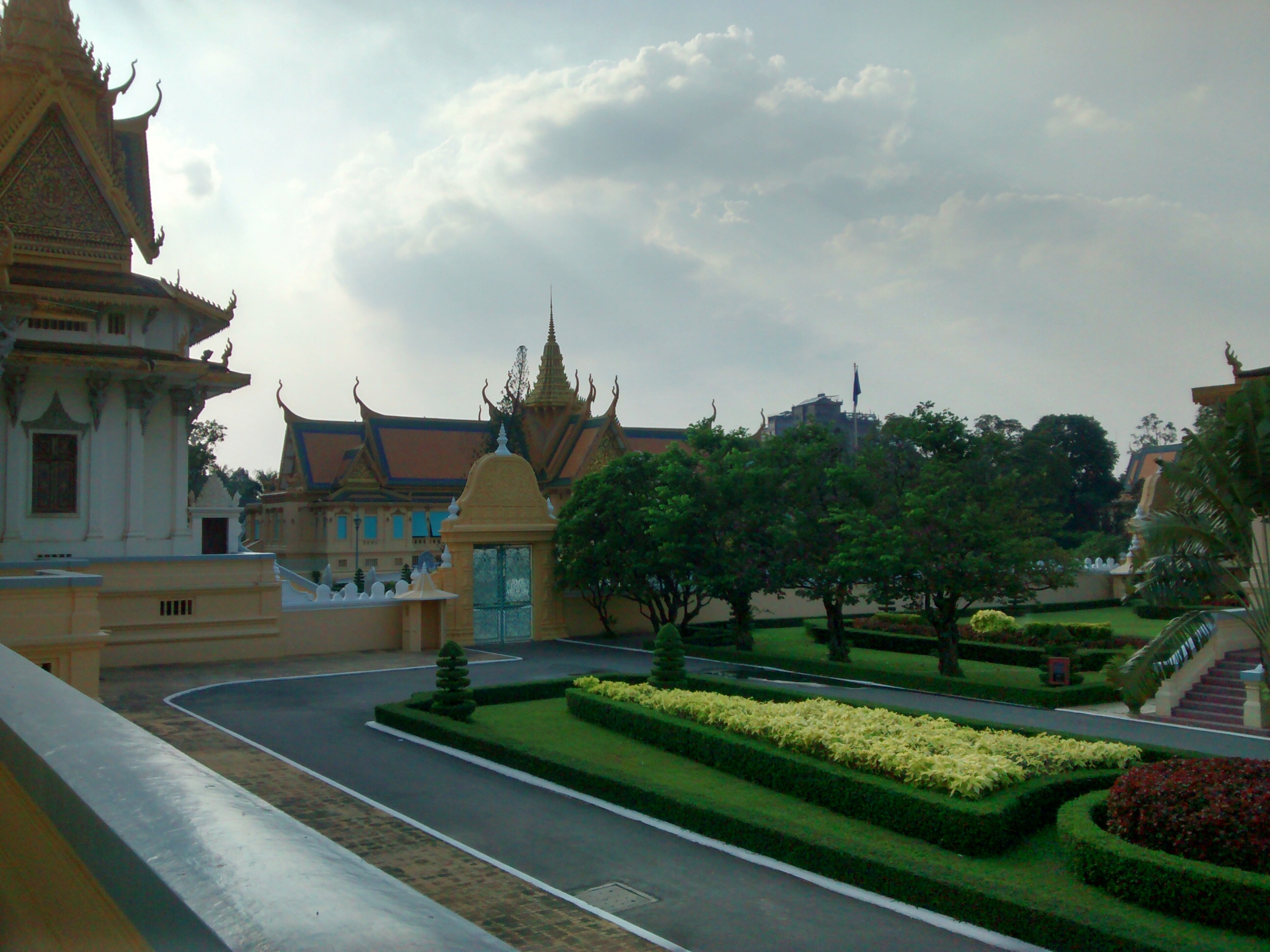
    Sublime.

    Unfortunately, more crowded than these pics let on, and getting up the steep terraces can be quite a scramble even with the modern steps. So, after being unceremoniously shooed out of the photo line of one group of tourists, I got out.

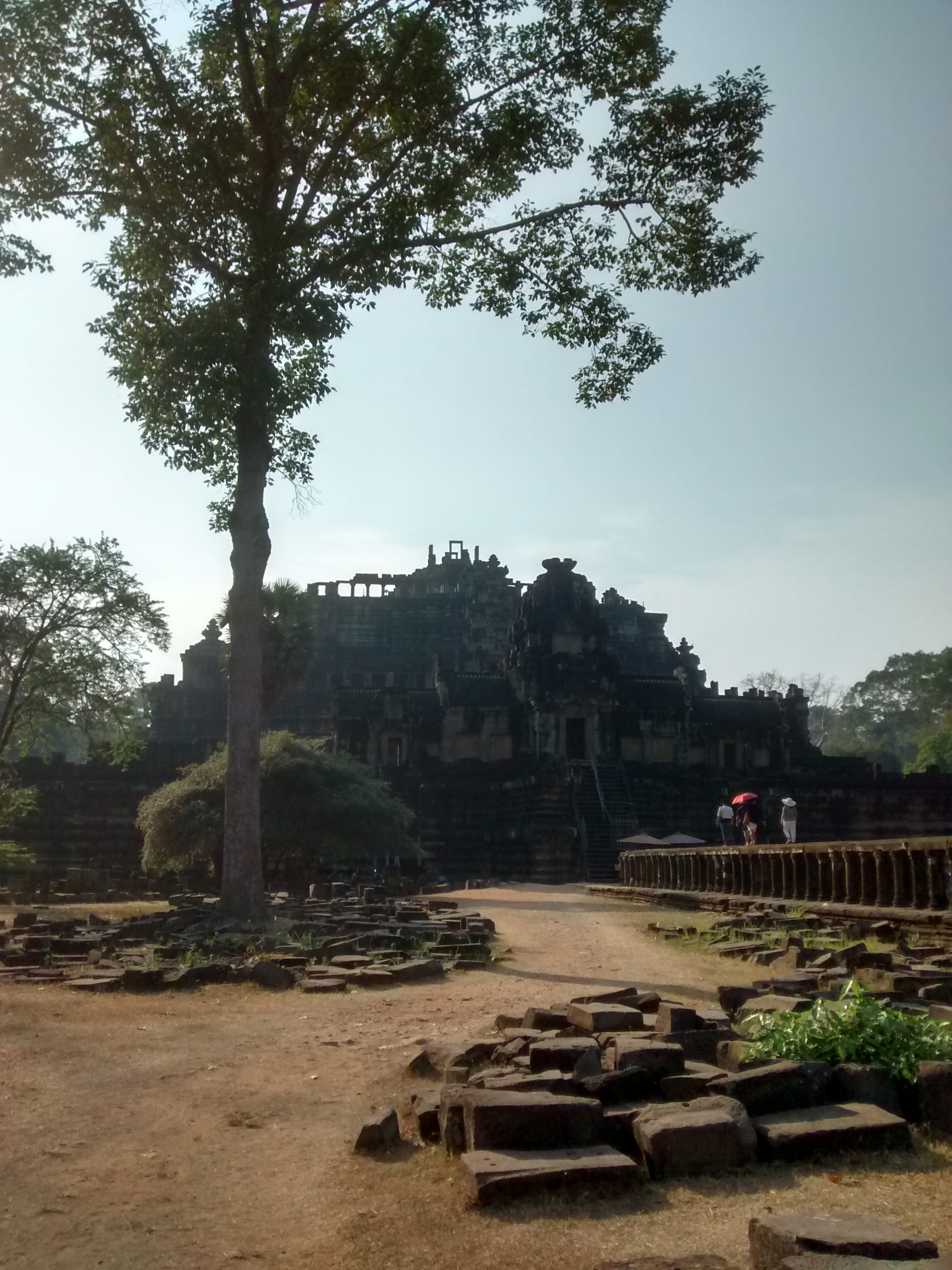
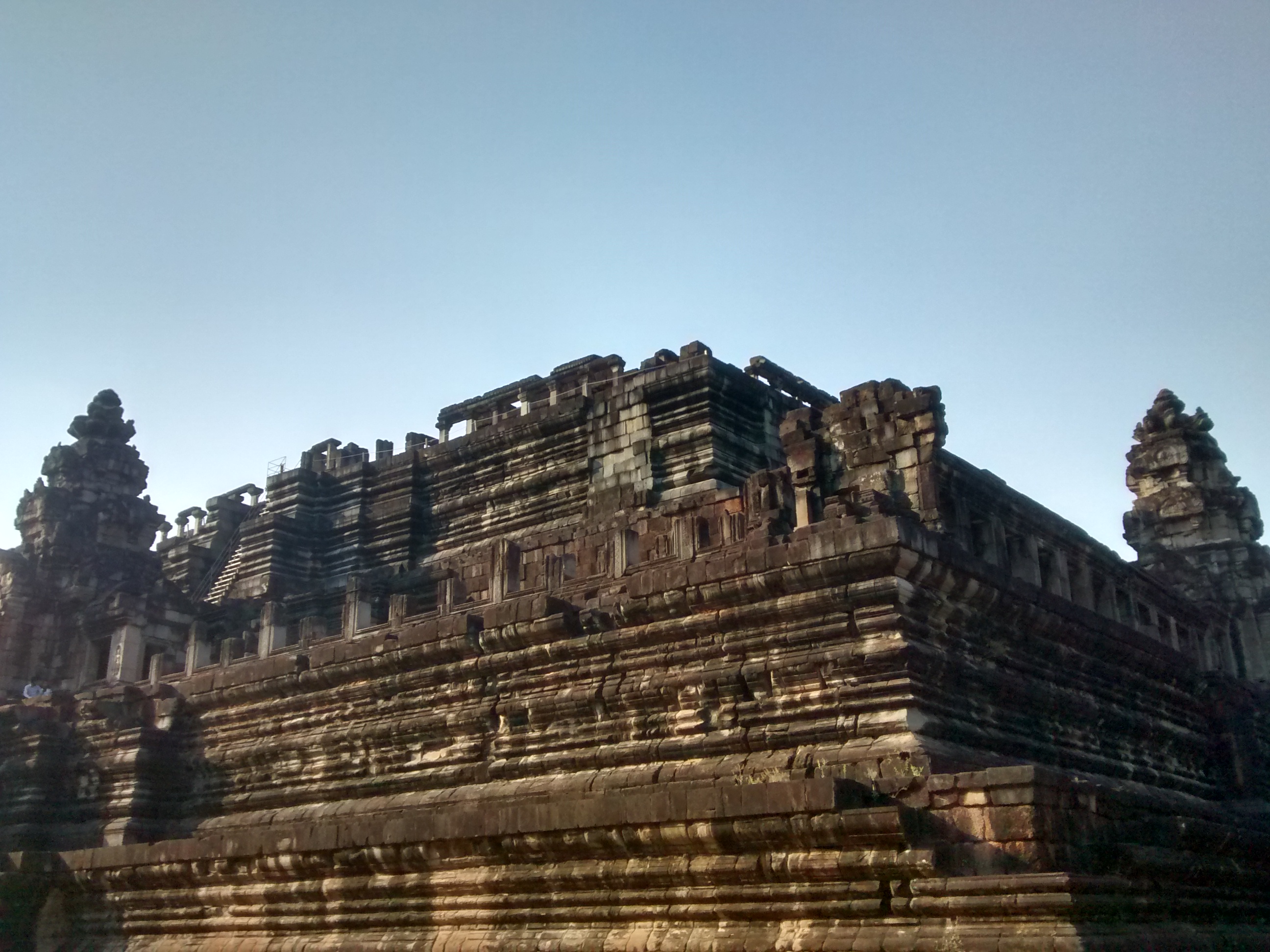
    A ten minute walk to the temple of Baphon, where I was beginning to succumb to the common Angkorian condition of being “templed-out”. So out of Angkor Thom, and on we go.

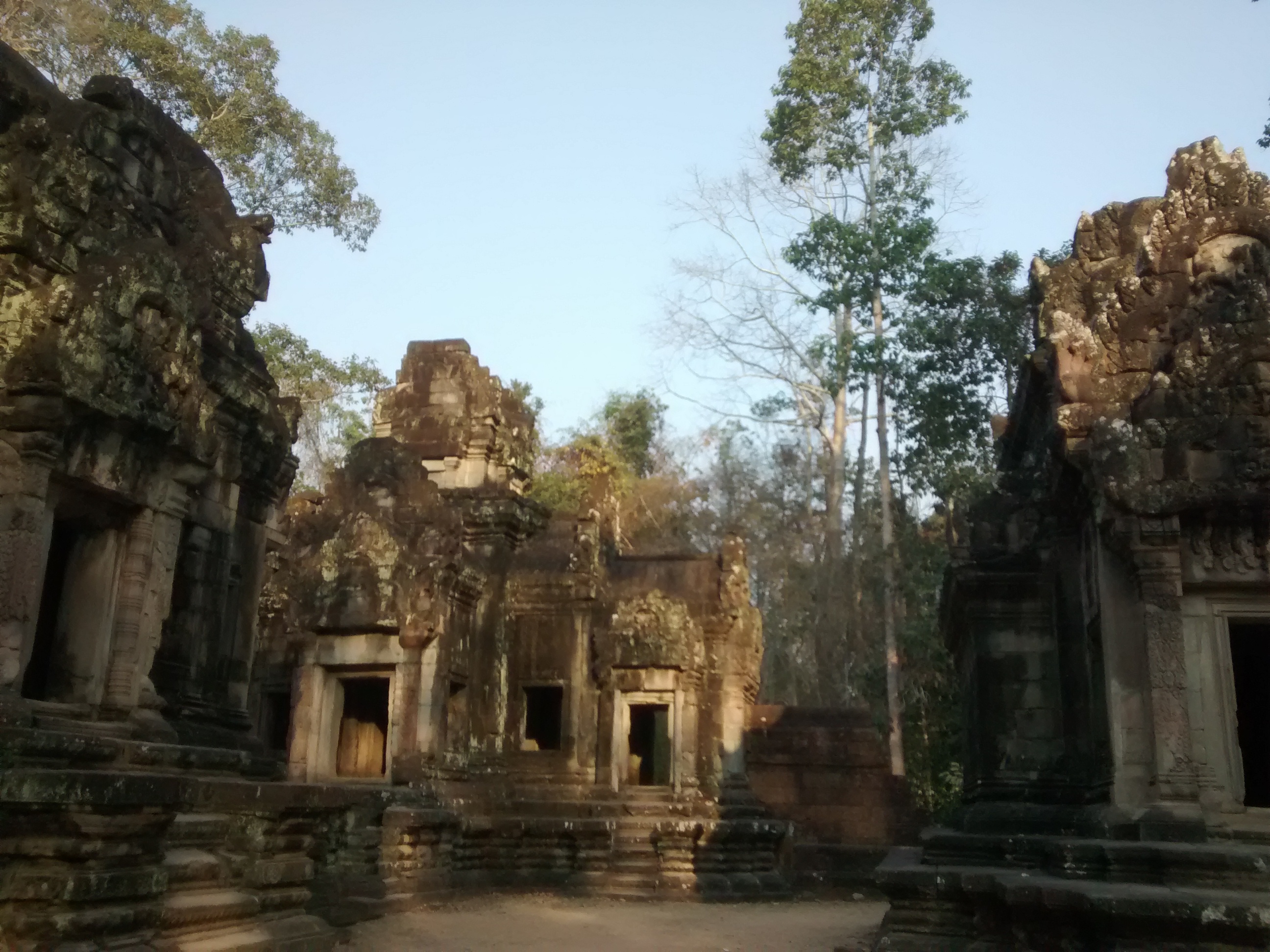
    Next to Thomannon, a delightful and rarely-visited temple with its own atmosphere and in its own enchanted spaces.

    Time’s running late – the park closes at 5:30! – so with an hour to go, we rush on to Ta Prohm. The one with the banyan trees.

    The French – never ones to appear arrogant at all – decided to leave one of the temples unrestored to show what the lost city looked like before they turned up. That temple was Ta Prohm.

    Not a bad idea. Naturally Hollywood came calling…

    On the right is the top of the temple entrance from the Tomb Raider films. Not the full view – I don’t feel comfortable photographing people without asking them. And there was quite the crowd here.

    Note how the light is changing on the temple walls. Of course, the really big ticket here is witnessing Angkor Wat at sunrise or sunset. Maybe I’ll give it a go in the two days I have left on my site pass.

    Because, as exhaustive (and exhausting) our tour has been today, we have only followed what is known as the Small Circuit.

    There’s a Great Circuit as well.

    Told you this place was big.

  • Cambodia.

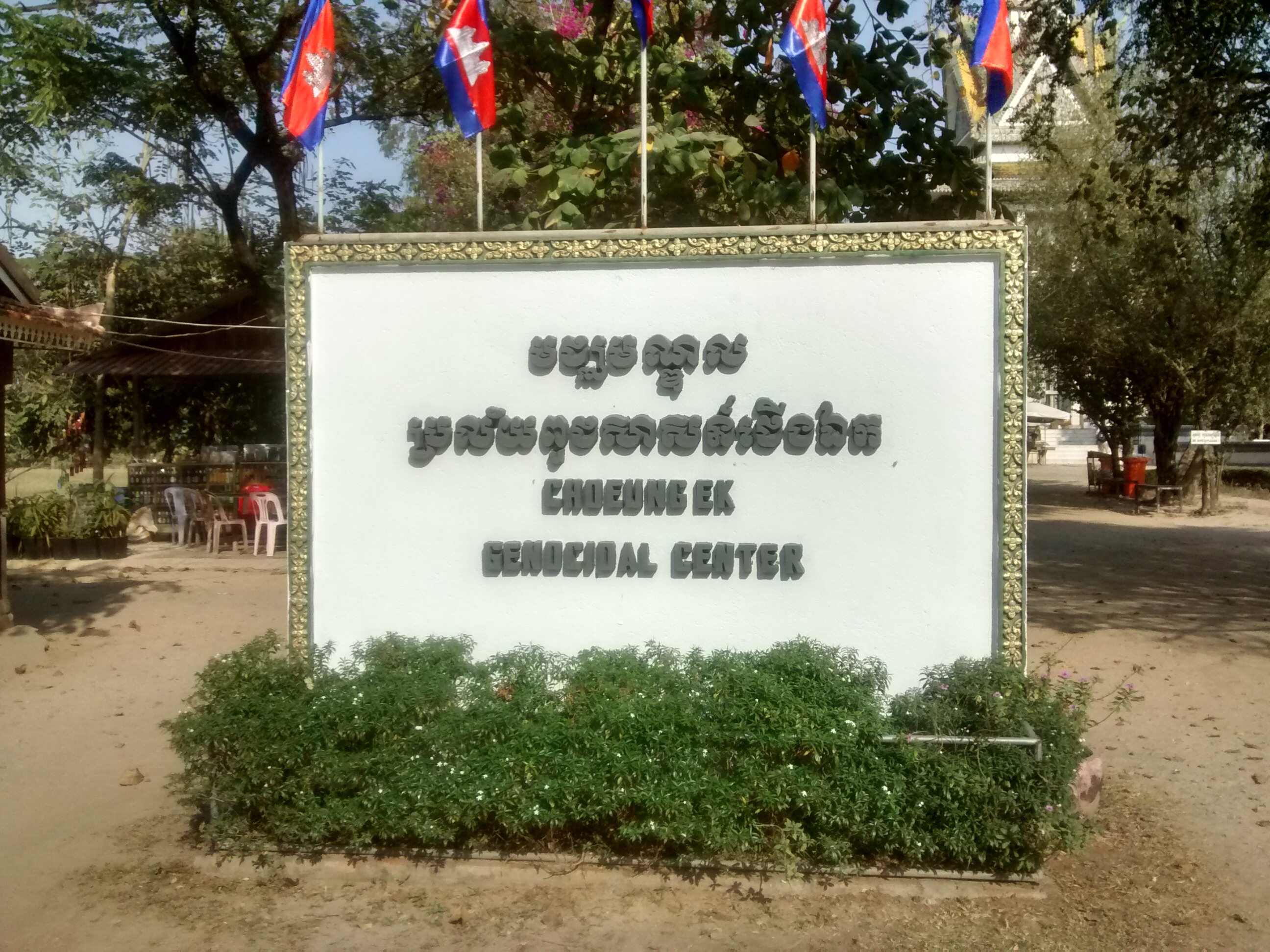
    A different destination to the normal. Rawer, poorer, more troubled, not many holiday destinations have undergone a genocide within my lifetime. But certainly friendlier than most places I’ve been to.

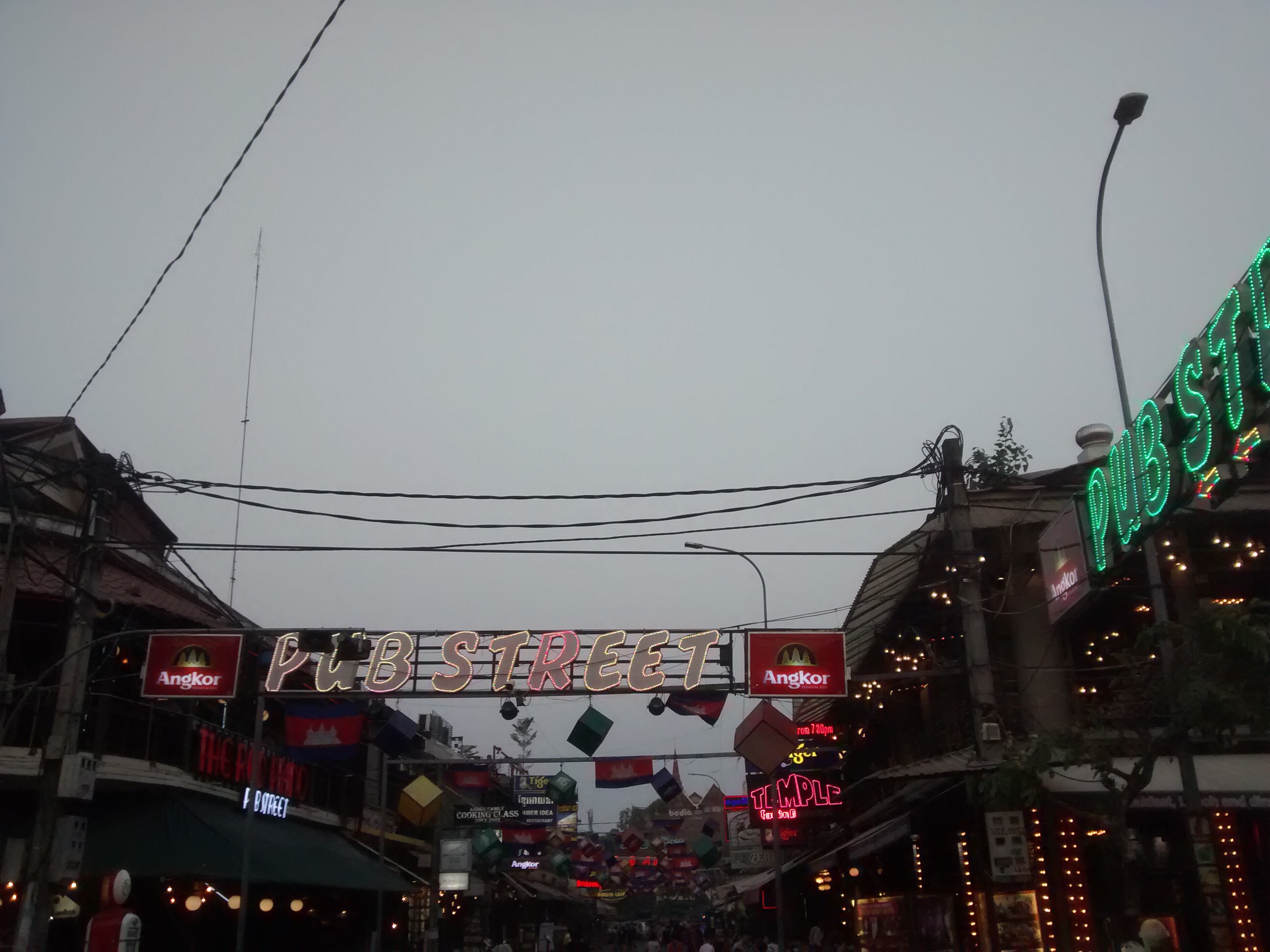
    We start in the north at Siem Reap, the centre of the country’s tourist industry. Once a small village on the river, it’s grown into a lively backpacker hotspot full of boutique hotels, all-bases-covered eating places, and pulsating bars. Hence Pub Street, the Ground Zero of all the fun.

    You get the feeling that Cambodia’s miserable recent history has left it well behind its neighbours and it’s desperately trying to catch up with Thailand and Vietnam. We’ll tease out some of that tragedy as we go on. We have no choice here, it’s unavoidable.

    But why are we in Siem Reap? Why is everyone else? Because Cambodia did have a golden age, and it left us one of the wonders of the world…
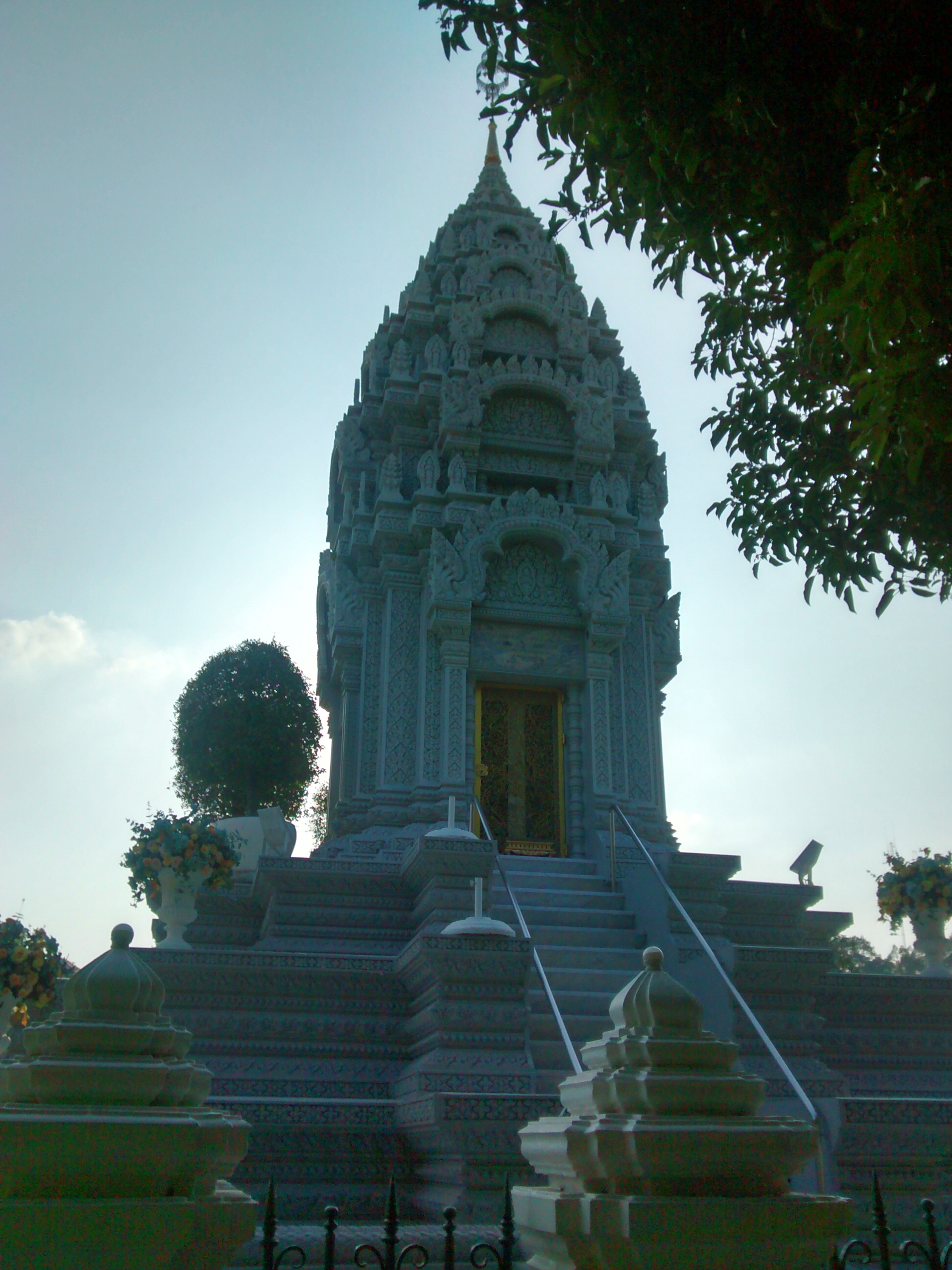
    The majority of Cambodians are Khmers, and after a millennia of Indian influence the Khmers felt ready to establish a mighty Asian empire from about the 9th century AD. The empire had evolved from a number of city-states, so they gave it a name based on their word for “city”.

    Angkor.

    Soon the capital ended up about 4-5 miles north of Siem Reap. And what a capital it was. 77 sq miles of royal palaces, Hindu temples, hospitals, schools, irrigation, possibly the largest city of its time, anywhere.

    Sorry, we should say “what a capital it is“. Because although the wooden houses and the rest gradually vanished after the empire fell in the 15th century, the majestic temples remained, although they fell to ruin and were reclaimed by the rainforest as the centuries passed. The French, who like that sort of thing, colonised Cambodia in the 1800s and set about their restoration. And today tourists from around the world come to gasp at their glory, or just gasp for breath getting around the vast site in the hot sun.

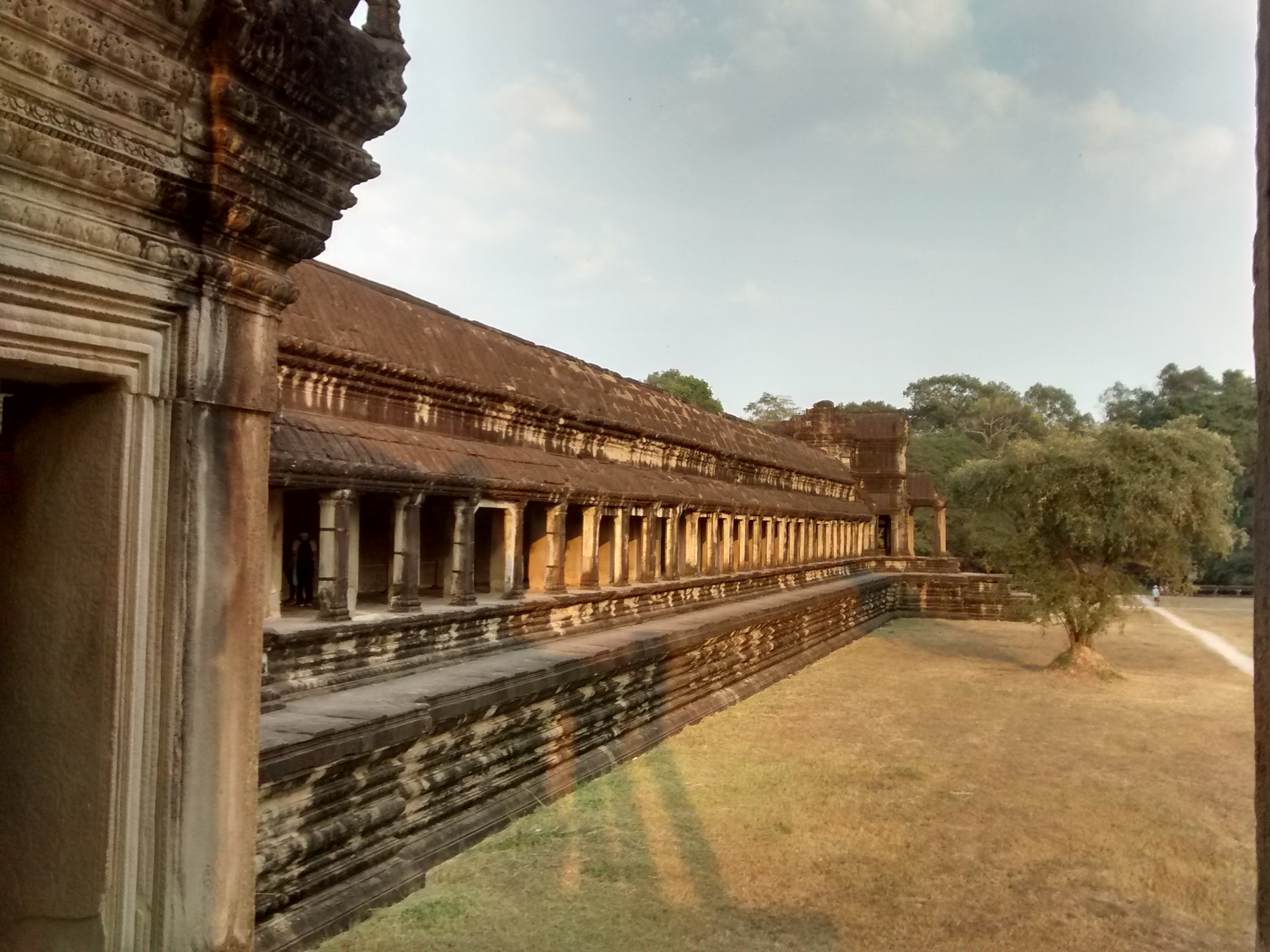
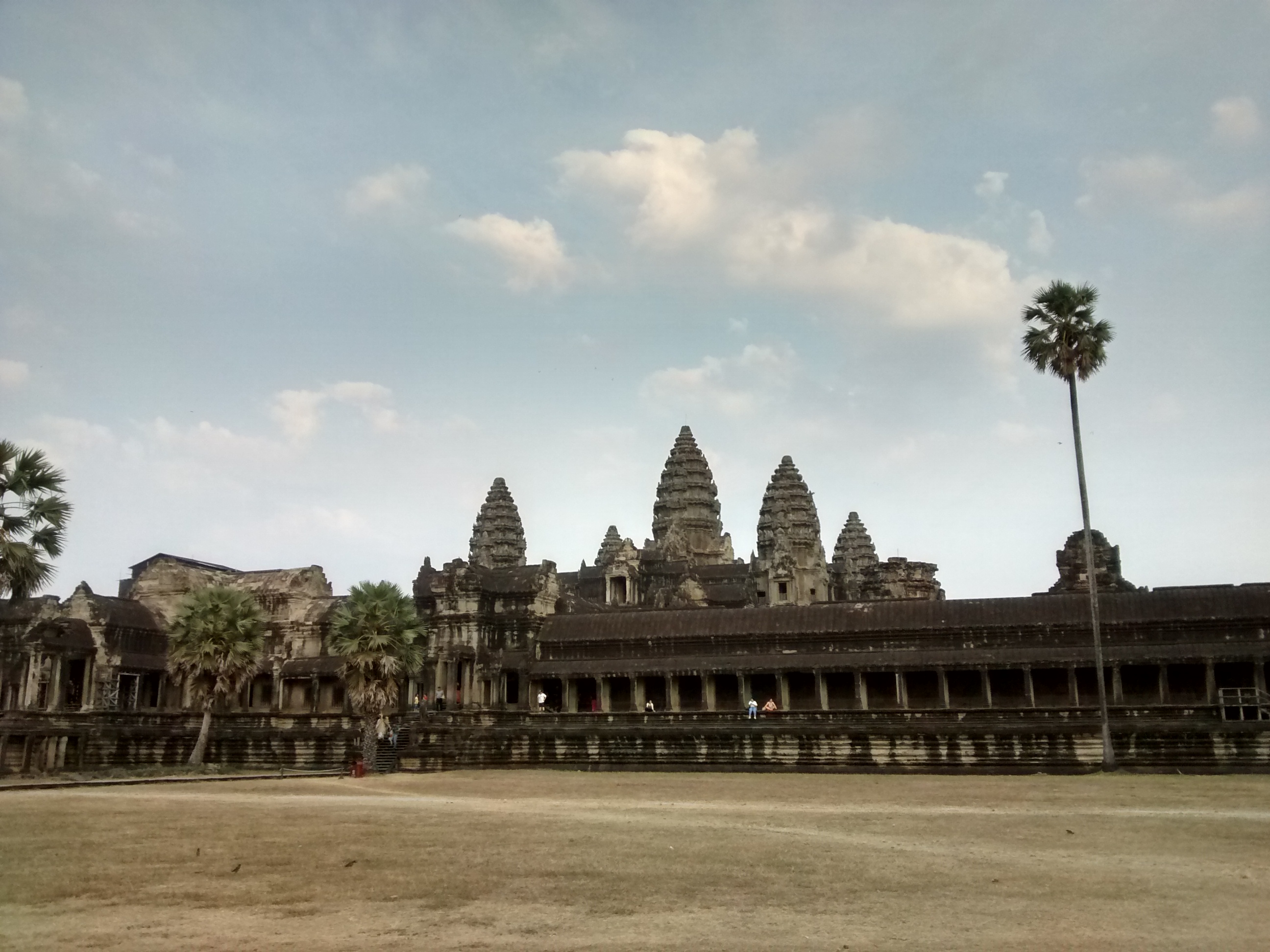
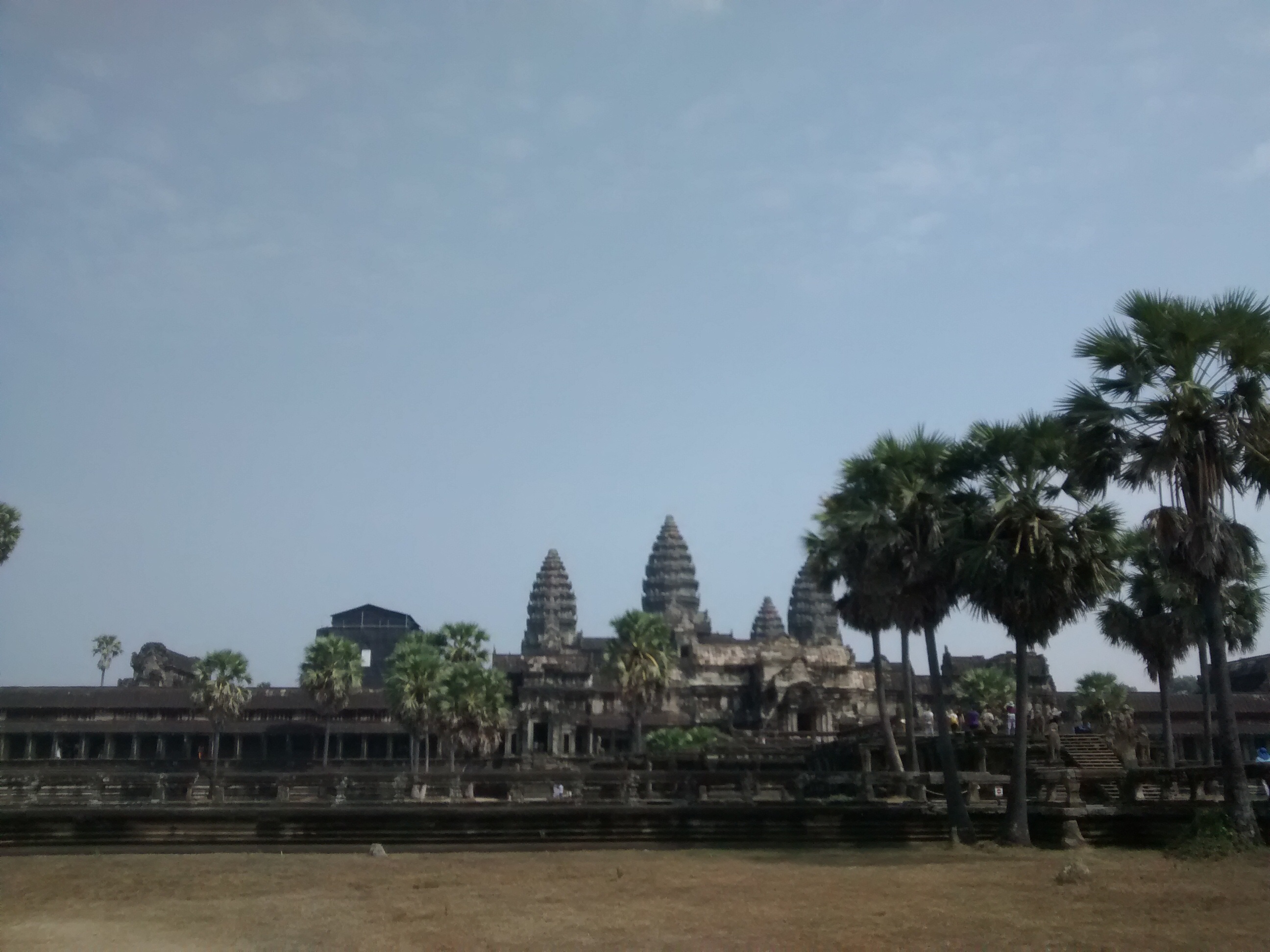
    Fortunately the tour starts with what most people come to see. Founded in the 12th century as a Hindu temple, later converted to Buddhism, but still retaining its wonderful Hindu engravings along the walls of its endless side-galleries. The whole place feels endless. It’s the largest religious monument in the world.

    It is, of course, Angkor Wat.

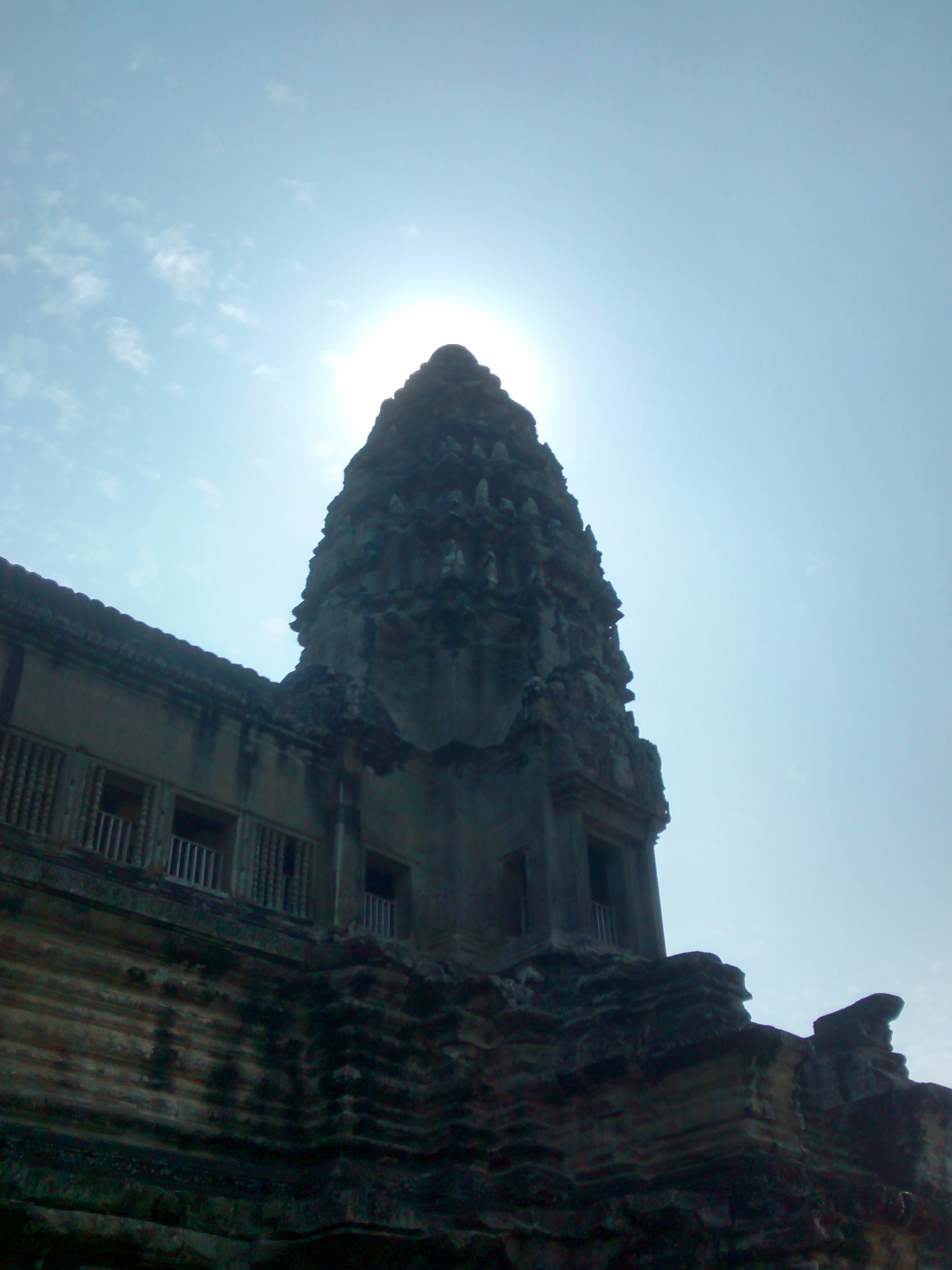
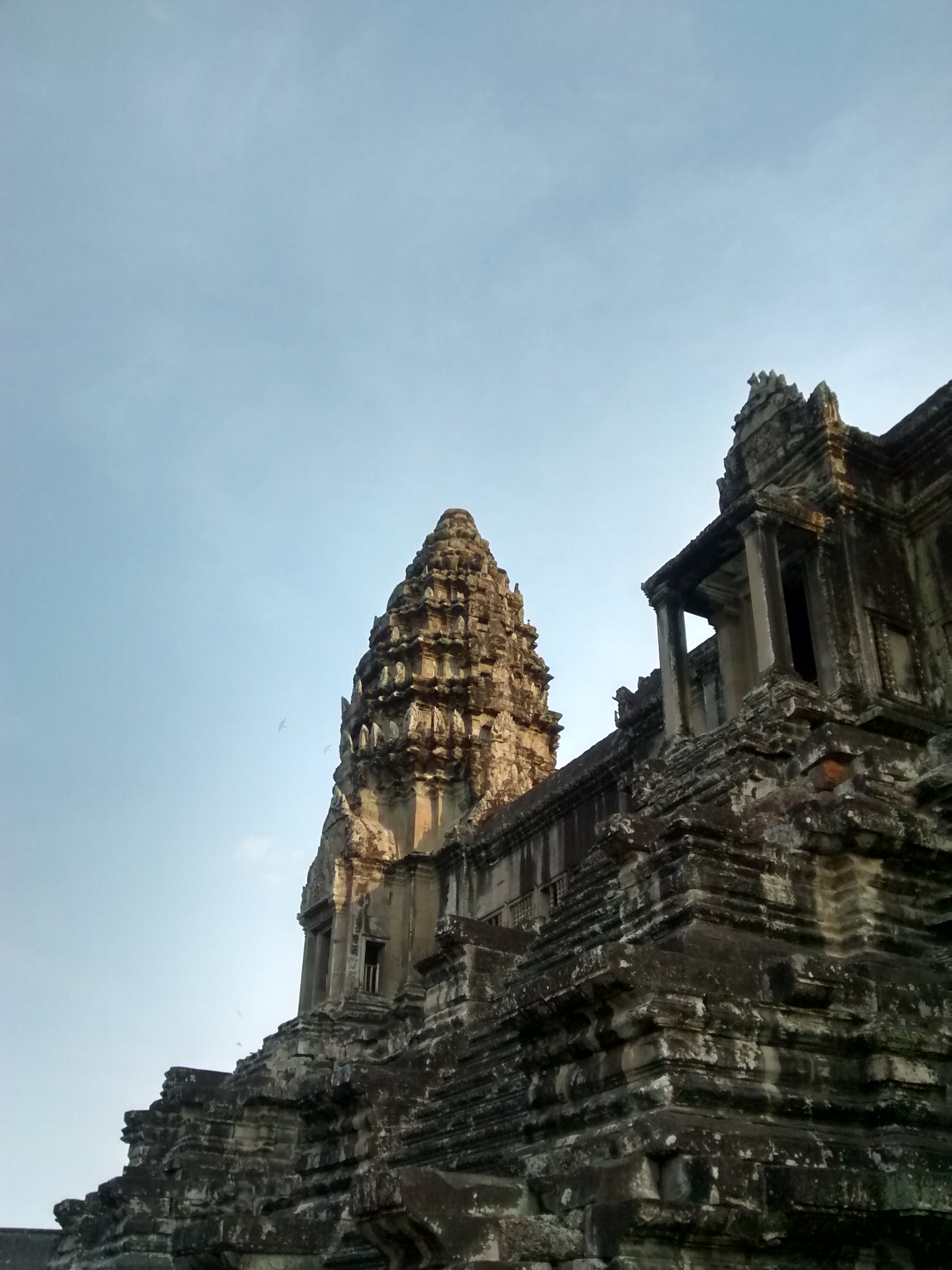
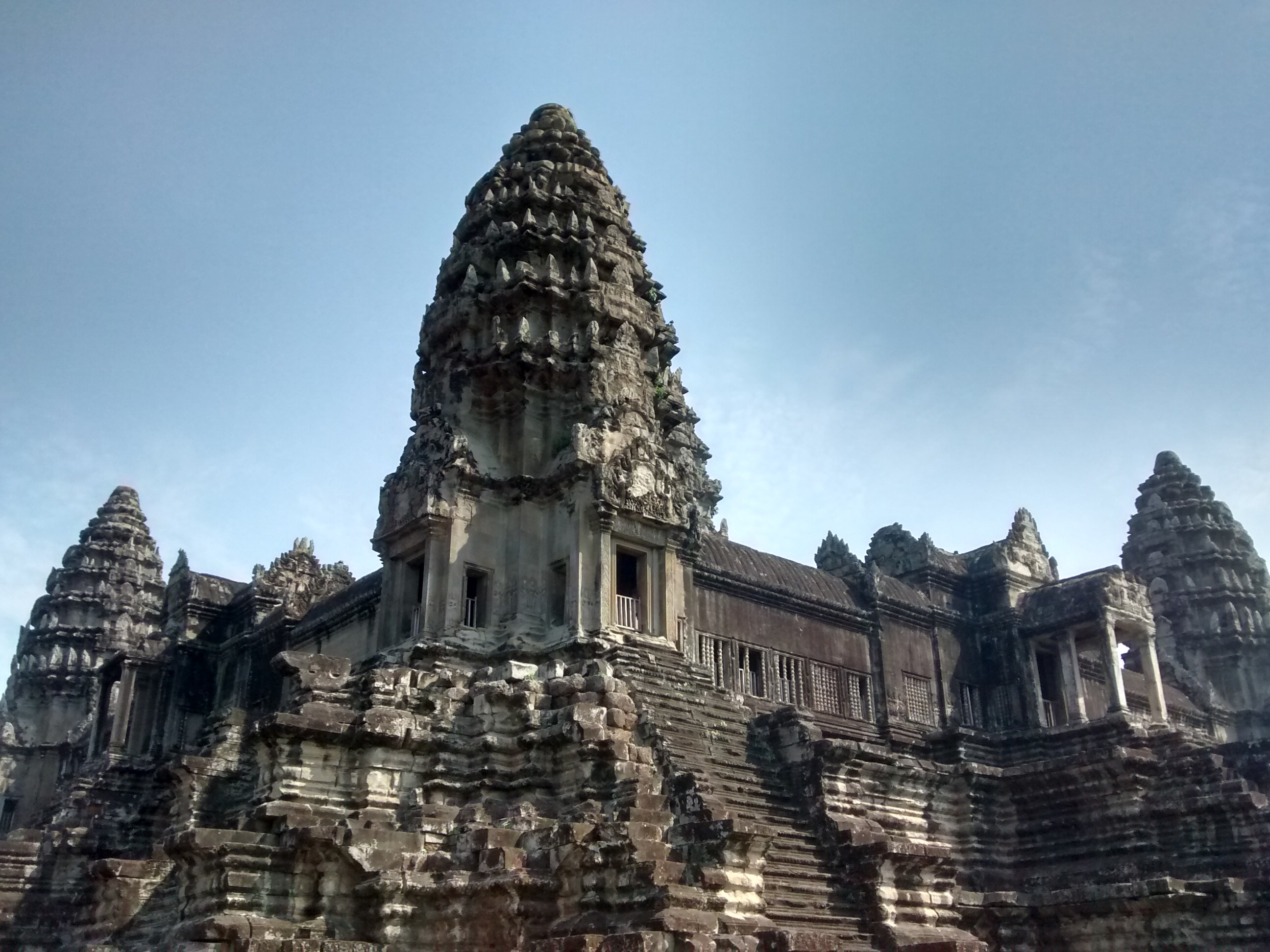
    Those famous five central towers (well, four of them anyway) representing the mystical Mount Meru, a common theme in Angkor architecture.

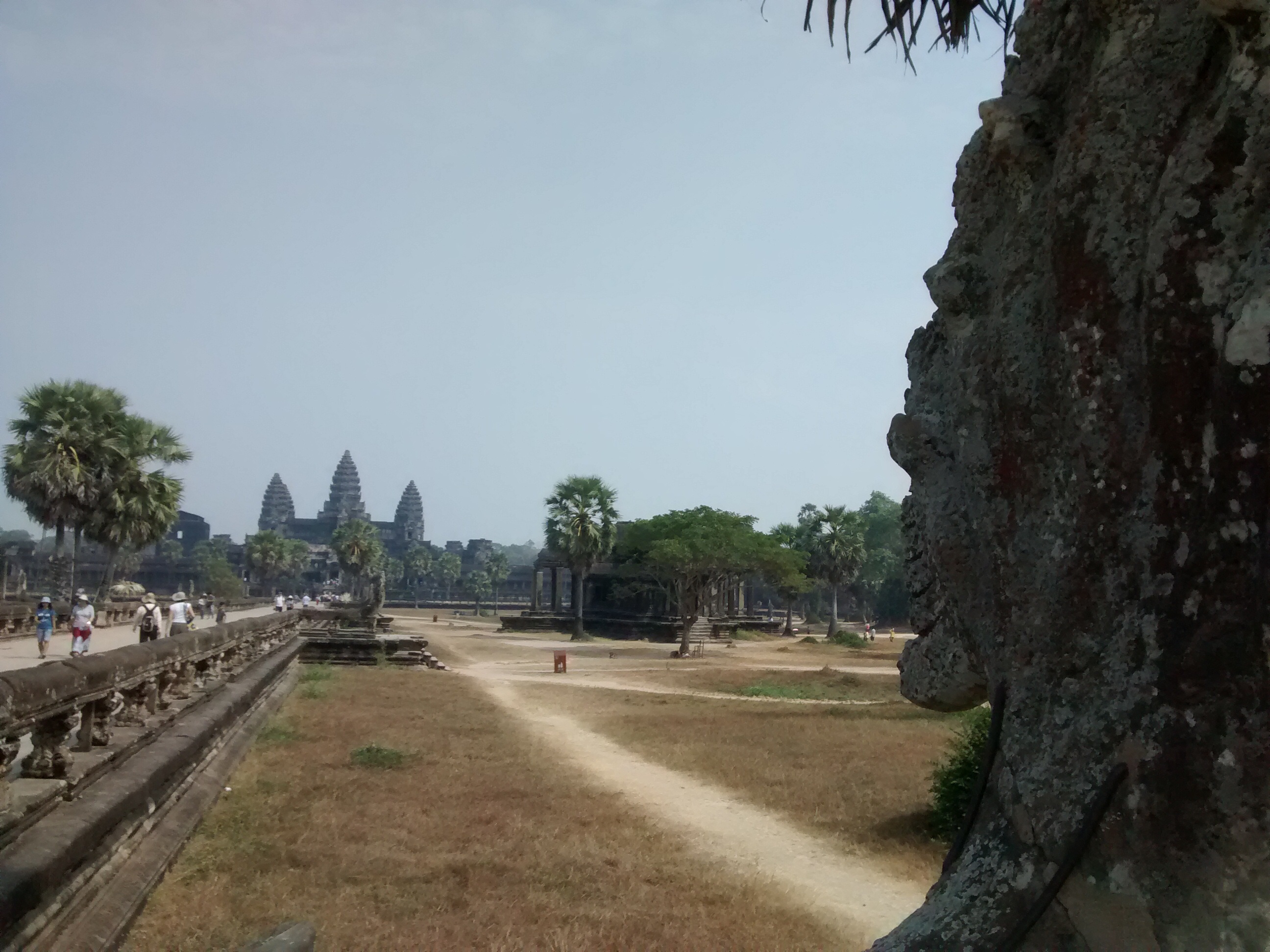
    The causeway into the temple is contemporary with it. The paths to the side are reconstructions of how the old town inside the outer walls might have looked. Oh, yes, we’ve already passed through the west gate of the outermost wall. Now do you realise just how big this place is?

    The legendary apsara dancers. The graceful tradition of Apsara has always been at the heart of Cambodian art and culture – even after Pol Pot got his blood-soaked hands on it – but the dancers themselves arise from Hindu mythology. More about that later, but here’s a clue – it involves a tug-of-war, grumpy demons, and lots of milk.

    Ninety minutes would never do justice to Angkor Wat, but we have other sites to see. So back down that long causeway, out through the outer wall, across the famous moat – time to drop in to the old capital itself, Angkor Thom.

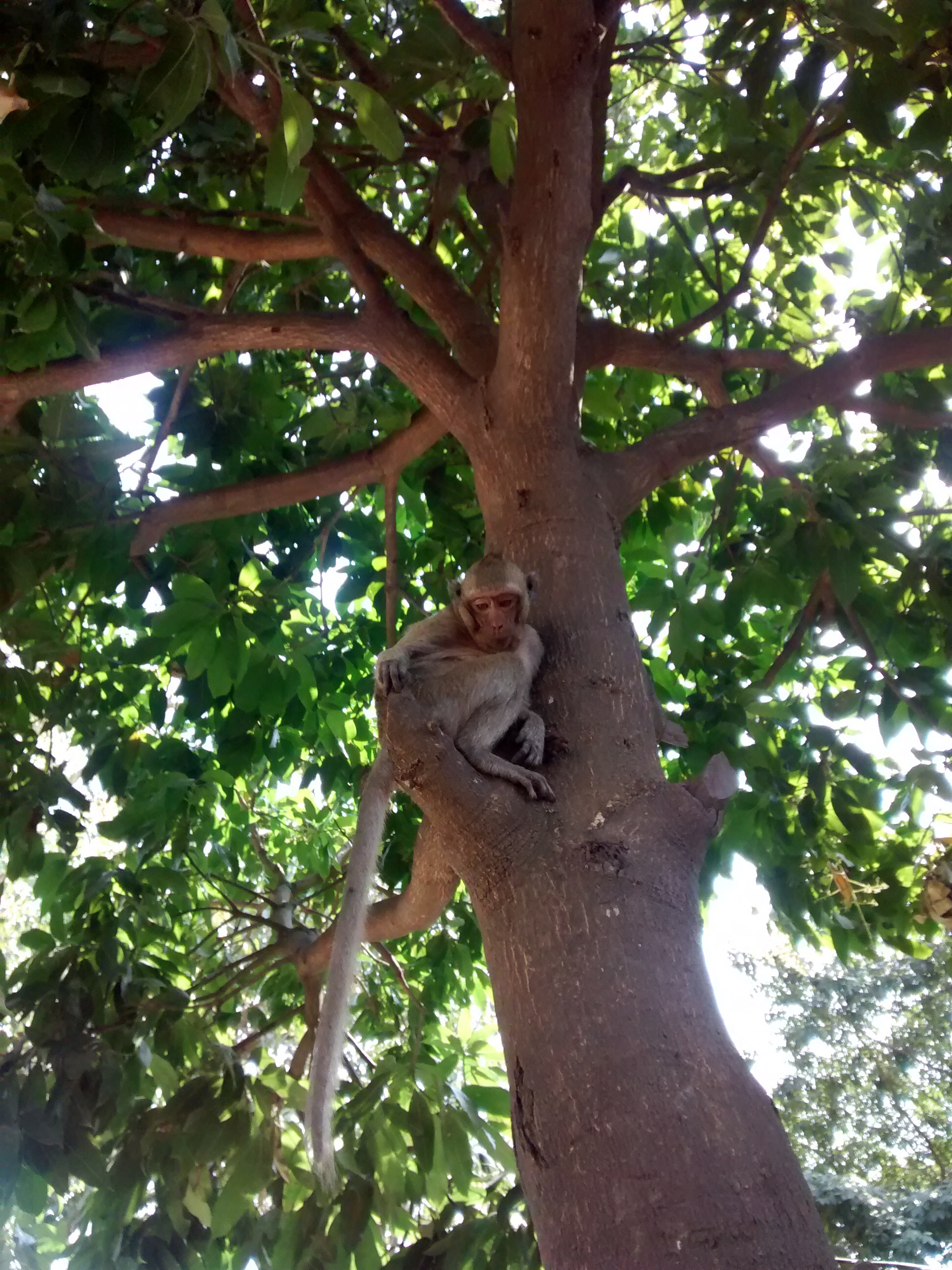
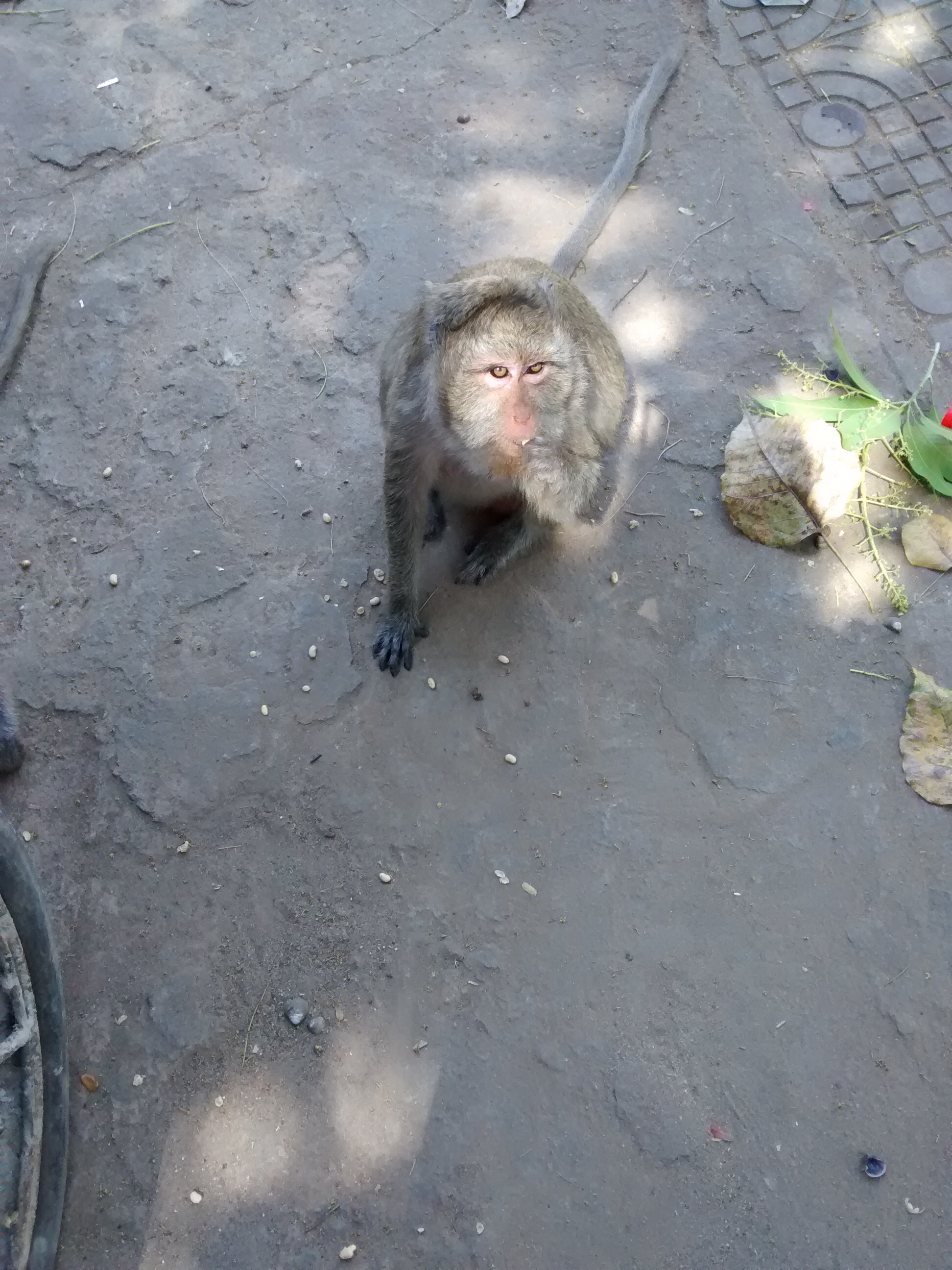
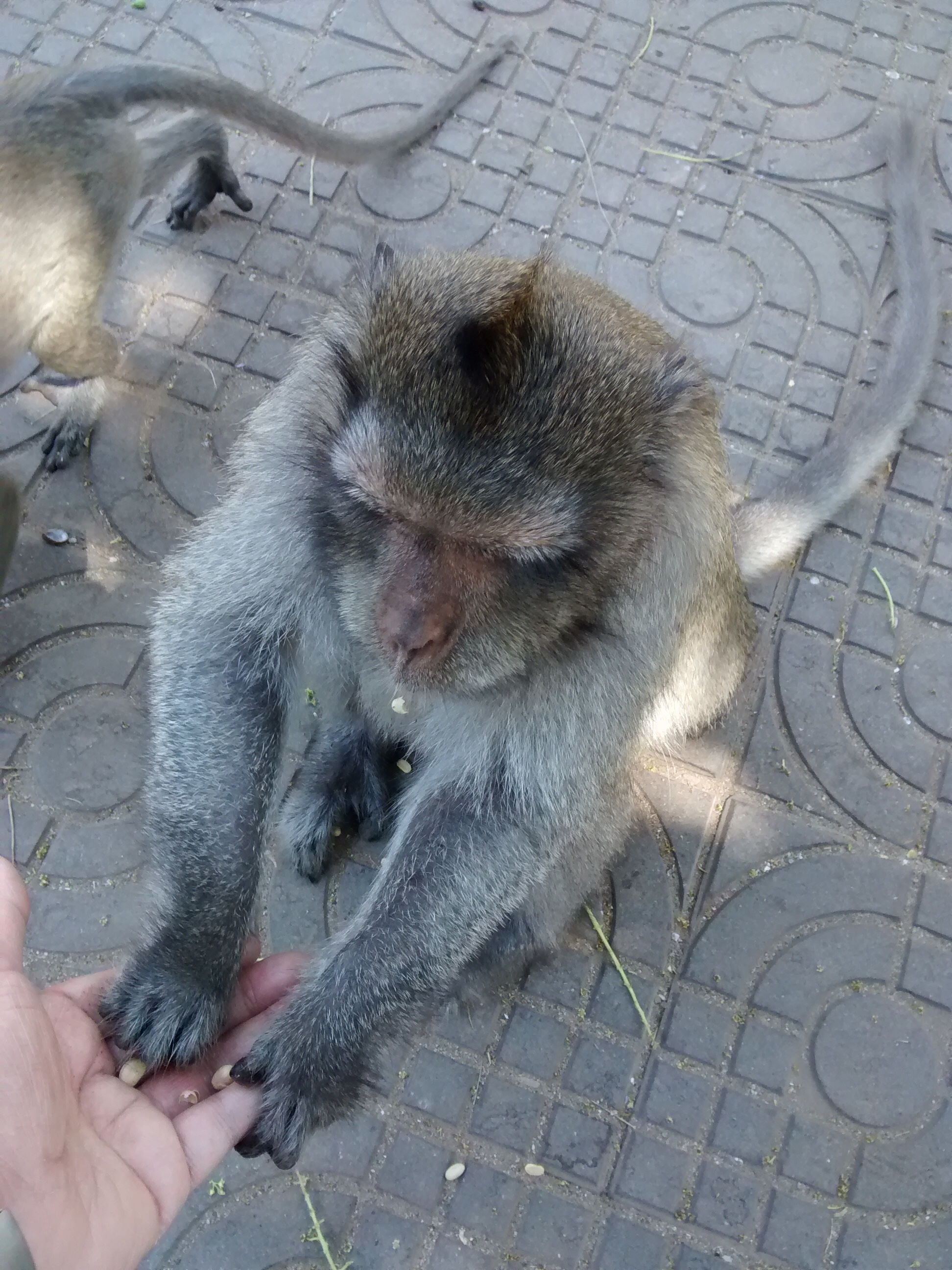
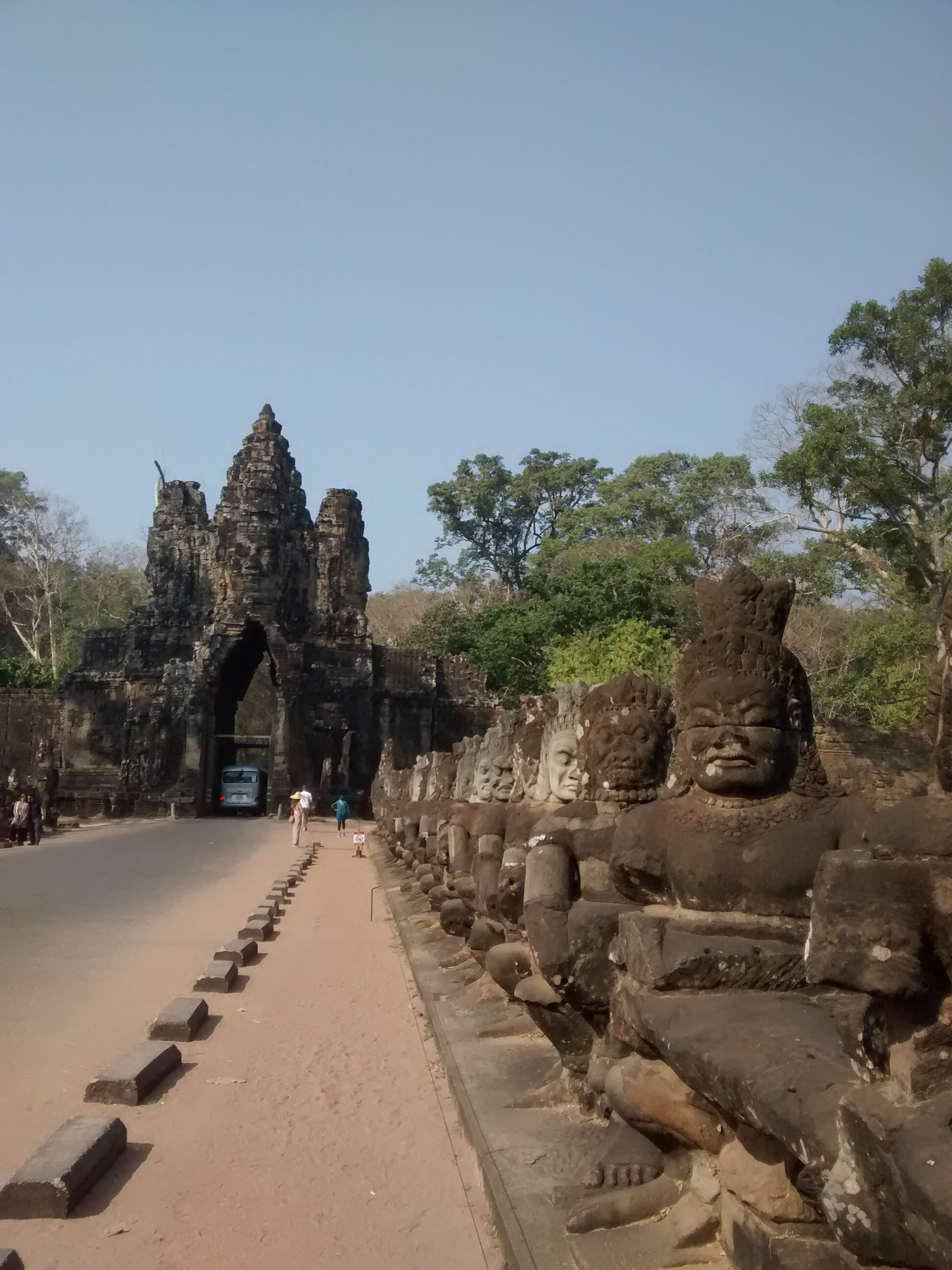
    You’ve grasped how big the Angkor Wat site was. Angkor Thom was about four times as big. Most of that is now gone, replaced by scrubby parkland, the inhabitants replaced by cheeky macaques. Here’s the South Gate.

    So, let’s deal with apsara then. You know sometimes, you don’t know how you did it but you come up with a plan. It might be an itinerary for a trip, or how to split a restaurant bill, or if you’re a Hindu divinity it could be to team up your fellow devas with the Hindu demons and pull on a snake to churn the ocean of milk and release the elixir of life. Or you might just stay in and watch TV.

    They were at it for a thousand years, demons on one side, devas on the other, snake wrapped around another mystical mountain, mountain churning the milk. Mountains are heavy, and so one of the gods very sensibly supported its weight, by becoming a tortoise.

    Eventually the milk was churned, the elixir was produced, and amongst many things that flowed out, out flew the first apsaras.

    Demons, right? Clue’s in the name. They were supposed to share the elixir but they reneged and tried to grab the lot. The gods weren’t pleased and gave their share to the saintly devas. See the demons, on the right, still pulling that snake. Look at their faces. Not happy.
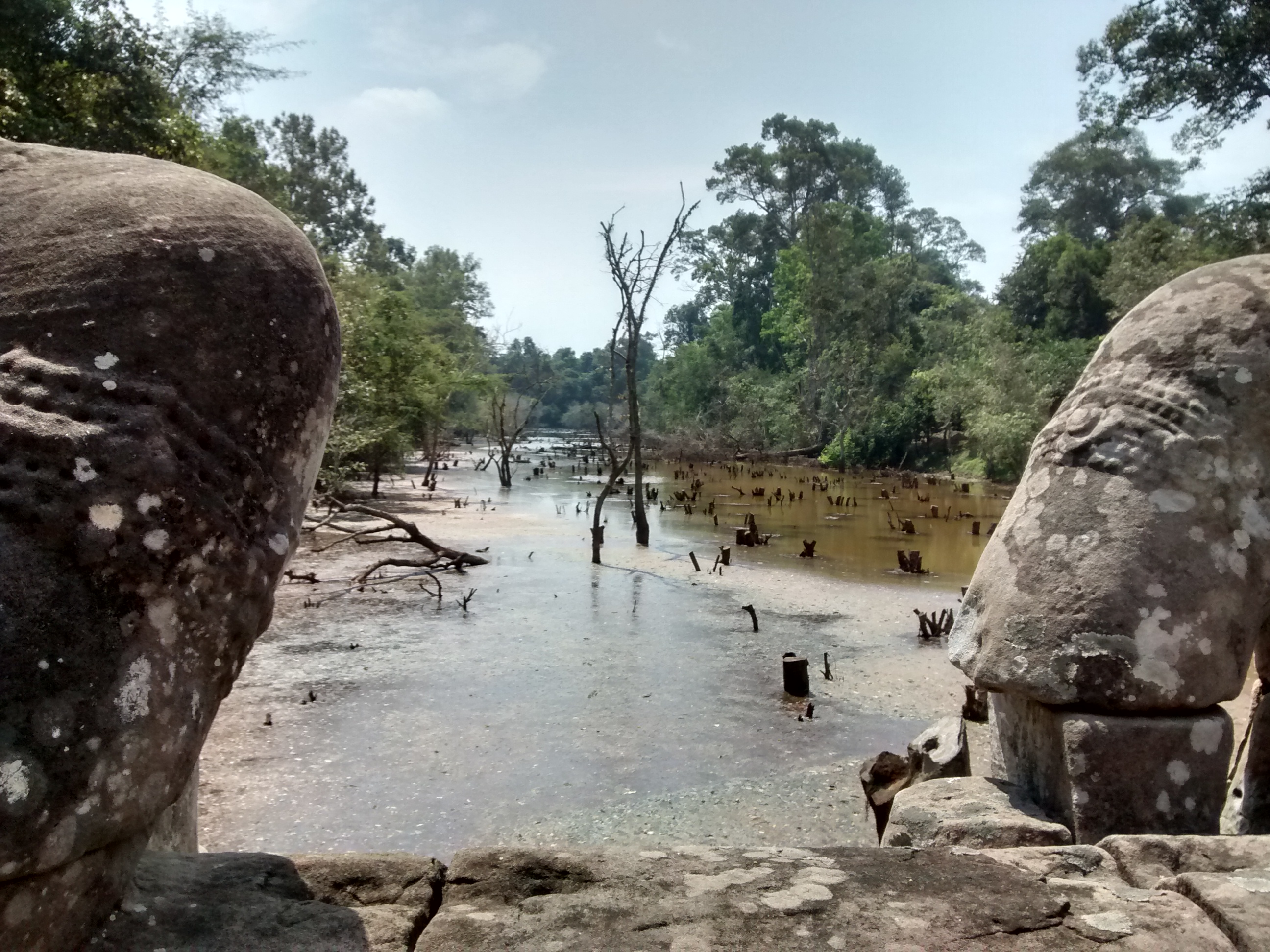
    Talking of faces, can you make out the one in the gate? Look closer. No? Ok then, no worries, there’ll be a few more in my next post!
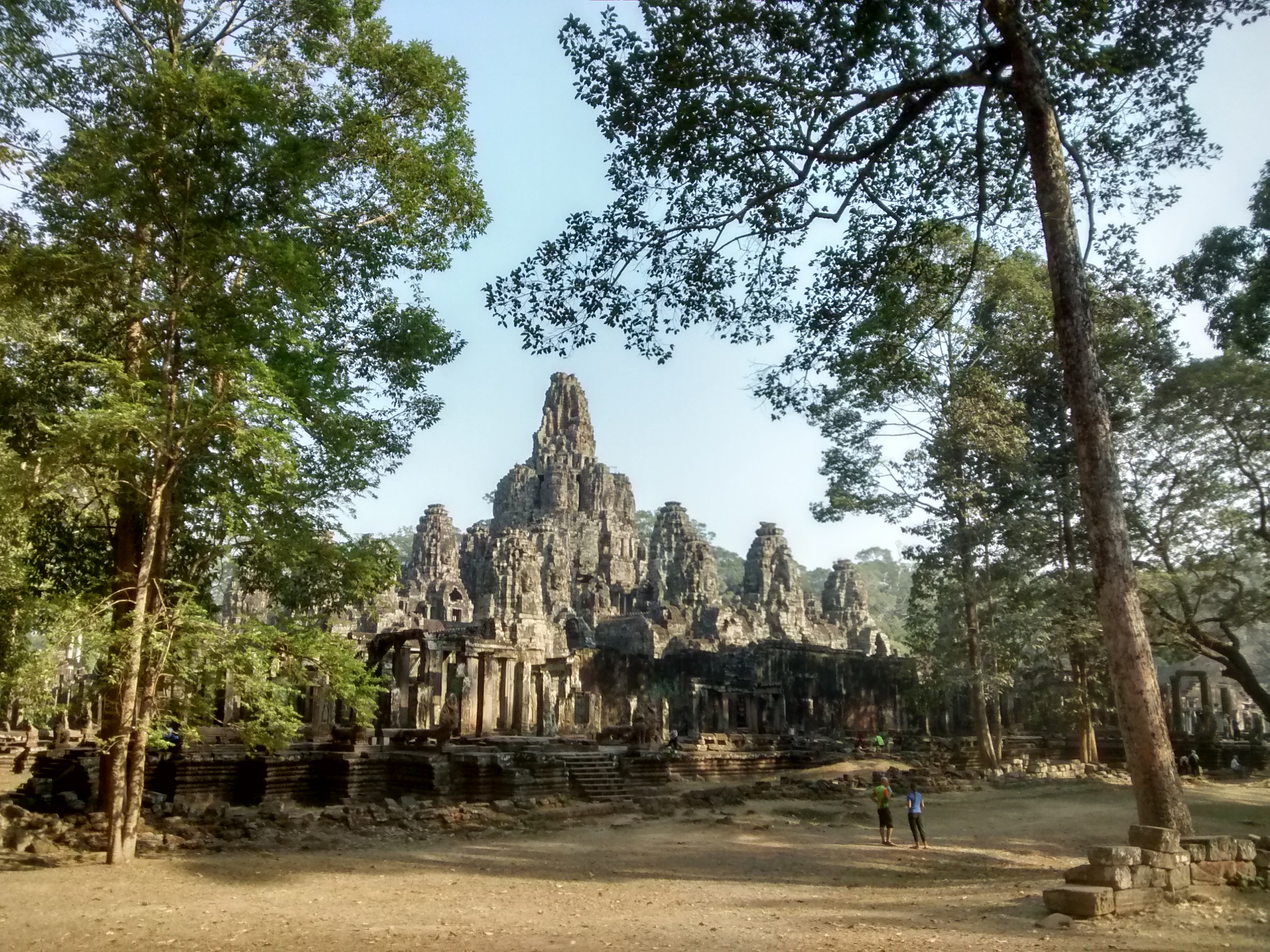
  • Rising more than 1000 metres above the city, the cliffs of Mont Saleve are known as the Balcony of Geneva. You can hike across its woods, you can even hike up it, or you can just come for the stupendous views of the town, the lake, and the surrounding mountains.

    We’ll spend our last day on this trip up there, but we’ll be taking the telecabina to reach the top. First there’s the bus ride into the suburbs, then the short walk through the little town and across the level crossing to the station.

    , not forgetting the border crossing. It’s in France.

    Up to the top we go. What follows is just a series of lovely views and landscapes, if you like that sort of thing.

    The view of Geneva at the top station.

    They switched off the Jet d’Eau just as I was about to line up the shot!

    There are signs to indicate the walking paths, but they then disappear with a great Gallic shrug. I pottered around for a bit in the fields…

    There are wonderful viewpoints of the surrounding mountains

    The Mt Blanc range should be to the right of the last one but it was covered in cloud.

    Beautiful area, but the locals didn’t look too impressed

    Back at the station I discovered there was another route and to a better panorama on Mont Blanc. It was stony and steep in places, but at least it was signposted

    even though I still couldn’t make it out.

    In for a penny…the Observatoire, the very top of the hike, was just ten minutes away so on I went. Well worth it.

    The paragliding station. No. I didn’t.

    Back to the lower panorama.

    Is that it, over there?

    God knows.

    All in all I had a great time up on Mont Saleve and it’s the one thing I’d definitely recommend you do if you’re visiting Geneva. Weather permitting.

    Back in the town, you can also see Mt Blanc from the quayside (hence its name of Quai du Mont Blanc). But that’s if it’s clear up there. This is my best go, early evening on the last day.

    And when I turned round…

    The Palais Wilson, the original home of the ill-fated League of Nations.

    In a way that sums up Switzerland. A small country boasting an incredible concentration of natural splendour, that’s somehow managed to punch above its weight in world affairs.

    And as I check my wallet before checking out for the airport, it looks likes it’s done some punching there too. Still, it’s been fun. Hope that some of it came over to you too!

  • Geneva has always been a proudly independent place, and a centre of the Protestant Reformation of the 16th century. Despite being Francophone, it was always destined to end up in the predominantly German-speaking Swiss Confederacy.

    The leading figure in much of this was Jean Calvin, founder of the Republic of Geneva. In 1909, 400 years after his birth, the authorities built a Reformation Wall, as grandiose a celebration of Reformation landmarks and heroes as the Calvinist mindset will allow. It sits in the Parc des Bastions, against the fortifications of the Old Town, and in the grounds of the University that Calvin founded.

    You’ll make out the 1602, if not the French. The Catholic Duke of Savoy mounted a sneak attack on the Old Town in that year. The plan was for an escalade, or a scaling of the walls, but, like most of the Savoyards, it fell flat on its face as the locals mounted a stiff resistance, sometimes accompanied by boiling soup. To this day the Escalade is celebrated here every December.

    Other events in the history of Protestant liberty commemorated include our own Bill of Rights, shown – just about – here…

    …and there are also heroes such as Oliver Cromwell, who brought his own individual sense of religious tolerance to the Catholics of Ireland, and please just look! Look at the lovely sculpture! And the water!

    The centrepiece of the wall are Calvin himself and his three key allies.

    From left to right, William Farel, Calvin, Theodore Beza, and John Knox.

    What the Wall doesn’t tell you – apart from Drogheda – is what an austere and joyless place Geneva must have been under Calvin. Before then the region was known for its superb jewellers. But jewellery became seen as ungodly frippery, and the jewellers had to turn their products into something wholesome and functional. And what could be more useful than something that told God’s hours…

    But time moves on, and time has the last laugh. The group of four are situated so they look straight across the small ornamental park, and down the entrance of the university building. And when I was passing it looked like they were holding a Fresher’s Fair. And doing it to the sound of some hot Latin dance grooves. At least one student was out there throwing shapes, beer in her hand…

    The sights wafted over to Calvin and chums, on the back of those Latin beats…

    Knox looks horrified. Beza looks terrified. While Calvin has some new, and rather nasty edicts in mind.

    And Farel, well it might just be me, but – doesn’t he look like he wants to be over there too?

  • That’s Lake Geneva we’re rounding, on our way to Geneva and our final stop.

    What’s Paris’s great icon? The Eiffel Tower. London has Big Ben, New York the Statue of Liberty. Geneva? A safety valve in the water mains.

    Just like in Paris and that radio mast, the locals were quick to spot the appeal of the pressure flow when it was first installed as a 30 foot jet in 1884. A couple of moves down the years, new pumps and more oomph, and the Jet d’Eau now majestically climbs to 140 feet.

    That’s if it’s on. They switch if off in high winds. You’d be surprised by how often that happens.

    Like Zurich, Geneva sits on a gorgeous lake and river, like Zurich it’s full of money, like Zurich it’s frighteningly expensive. But while Zurich has its banks and enjoys spending the dosh, Geneva plays the more earnest and high-minded cousin, creator of humanitarian institutions like the Red Cross, home to most of the UN bodies and to other major international organisations like the WTO.

    Perhaps its most famous institution is a tram-ride away…

    If you haven’t organised a special tour, there are two exhibition spaces at CERN. I was utterly engrossed by Microcosm, a detailed account of the design and operation of the LHC, including a full-size model of the actual beam line piping.

    I also liked the sculpture in the grounds…

    …but that tells you more about me than anything else.

  • The Harder Kulm mountain is a favourite hike of the locals. It takes about two hours to reach the top. I tried but I was on my own and it’s a challenge. I gave up after fifteen minutes.

    The point where I turned back down.

    Rather than the big struggle up the mountain, I chose the gentler- sounding 20 minute descent into the neighbouring community of Unterseen.

    …riiiiiiight.

    View to the side of the path ..

    Pretty steep. Ooooookayyyy.

    The path itself was fine…wasn’t it?

    Looking back after I’d passed that dry rocky riverbed.

    Eventually, if you’re a wuss like me you stop worrying about the sudden narrows in the path, the sudden rises, the sudden twisty bits – but only when you see the locals, Gran, Mutti and the kids, bounding up like they’re crossing the front lawn.

    So we get down. Time to look back up.

    Harder Kulm. (Can you see the face in the rock?)

    This part of the world has a thing about dodgy monks. The 12th century monastery was important in the birth of the town. There was once a particularly powerful monk called Leonhardus. He was not one to waste the chance to exploit the people in the town, knowing very well how scared they were of him.

    One day Leonhardus was out on the mountain collecting wood when he saw a young woman. Fancying the chance of some more exploitation he chased her until her only escape and chance of retaining her honour, was the cliff face. She did the honourable thing.

    So why the long face?

    However powerful a monk may be in his organisation, he’s answerable to an even more powerful CEO. When Leonhardus (or “Harder”) died, the fate of the young girl cropped up in his appraisal meeting. To this day, Harder is condemned to live on in rock, miserable, sullen eyed, droopy moustache, forever stony-faced.

    I fly home on Sunday so I’m literally here all week. Anyway, that’s the story they told us on the guided tour. And if you’re wondering why a medieval monk has such a fetching 19th century ‘tache, maybe it’s to let the passing Victorian traveller know they weren’t off the hook, or something…

    …or he was a time-traveller, or…I don’t know – oh just look! Look at the lovely mountains!

  • Some pictures from around town on the first day here

    In the distance, covered in snow and cloud – the Jungfrau.

    A generous portrayal of the over 60-year-old General Guisan, the leader of the Swiss forces in the Second World War.

    A view towards Lake Thun.

    (But weren’t the Swiss neutral in WW2?

    Well yes, but they were surrounded by the Axis and Guisan figured you could never be too sure and beefed up their defences…now look over there, look at the lovely mountains!)

    The following morning and it’s time for a day trip to the famous mountain village of…

    Another incredible journey up into the mountains to reach it, but unfortunately I was too spellbound to take any pictures until the train reached the little station.

    Grindelwald is surrounded by mountains, but one snowy peak particularly looms over it.

    We’ve seen the Jungfrau, or young lady or Virgin. It is one of a row of three snow-covered peaks. To its east is the monk, or Monch. The monk has nobly (or ignobly, as some believe) got himself between the damsel and this mountain, the ogre.

    The Swiss German for Ogre is Eiger.

    You’ve noticed that one half of the peak is covered in snow. Apparently that’s easier to climb. The other half is the Nordwand, the notorious, iconic North Face, only conquered for the first time in 1935. The Swiss jokingly call it the Mordwand, the Murder Wall.

    Hmm, at least 64 climbers since 1935…how many before that…maybe they aren’t joking?

    Gulp.

    We won’t be going anywhere near that thank goodness, but we have our own challenge. Up the main drag, turn left…

    …been a while since I’ve been in one of these…

    At the top is the outdoor activity area of Grindelwald-First, from where you can ride bikes, trip-wire, do scary cliff walks – or just hike. Which is what we’re going to do. An easyish walk up to Bachalpsee, 50 mins, a 300-foot climb in total, but well worth it.

    The goal…

    …a couple of rather lovely mountain lakes

    Eventually I went back down and got the train back. No more photos though. Well how do you follow that?

  • So I wasn’t expecting to do a blog this time. But Switzerland is experiencing an exceptional period of weather this September and the glory of the lakes and mountains is being shown off at its best. So here we are.

    So we’re off. The train has to get down to Lucerne first…

    and from there we have another train to catch, which is a bit of a chore…

    …but someone has to endure it…

    Thankfully we reach Lake Brienz…

    and we’re nearly there.

    (This might not be Lake Brienz. There were so many stunning lakes I might have got confused). Anyway, we do make it to…

    and we’ll be spending a couple of days here.

    One of Switzerland’s premier tourist resorts, lying snug between two lakes and loads of green and craggy peaks, it’s a magnet for paragliders, rock-climbers, whitewater rafters, and other certifiable people. Chinese tour groups come here for the Swiss watches, Arab tour groups for the Koranic references to the lakes and mountains of Paradise, Indians for the Bollywood movies that have been set here.

    And the Brits? They sensibly stay away. Switzerland is always pricey but because we are taking back control from them Euro-furreners and we’ll be great again, the pound has sunk against the Swiss franc. Things here can cost twice what they cost in London!

    Will I survive the week? Tune in to my next post to find out!

  • Next door to Santa Monica beach is Venice Beach, which plays the hippie dropout cousin to Santa Monica’s staid respectable member of society. They share the same vast sandscape, the same lines of waving palm trees, and to be honest, the same waves of homeless people. But Venice has the street performers on its boardwalk, the Rasta-themed street stalls facing the colourful souvenir and T-shirt stores, and it has the blocks of meat working out at notorious Muscle Beach.

    The guide books promise that Venice Beach is the place where the beautiful people come to flaunt it in some of the best people-watching in the world. But when I got there, most of the promenaders seemed to be disappointingly normal and well-balanced – and disappointingly numerous.

    The town of Venice is also known for its murals and street art, which is no surprise.

    So that was Venice on a mild but grey Thursday.

    The following morning, the clouds melted and I headed back to the beach. Southern California had started to happen.

    Santa Monica’s Third Street Promenade marks the Memorial Day weekend.

    The flat, dreamy expanse of sand that typifies the two beaches. But this particular spot of Santa Monica beach has a sadder side…

    Looking back to Santa Monica Pier and, in the far distance, Malibu beach and its super-duper-stars.

    Baywatch was actually filmed on Santa Monica beach.

    Enough of the beach, because someone has asked me why it’s called Venice. Where are the canals? For this we need to head on past the beaches and push on to Venice town.

    The man behind the development in 1905, one Abbot Kinney, wanted to create a place which was a cross between the real Venice and New York’s Coney Island fun beach. Vegas did Venice with the fake architecture and a big pool in front of the resort with gondolas.

    Kinney did Venice with canals.

    And they’re stunning.

    Punting and rowing around here was quite the attraction when they were constructed but the coming of the motor car caused them to fall out of fashion – the plaque I was reading didn’t explain why. But over recent decades people have seen sense and restored them, maybe to beyond their former glory.

    I don’t know how much these little canalside properties go for, but I know what my lottery winnings might be going on if the impossible happens.

    Lovely lovely, nice canals. You get the picture.

    On the walk back to Santa Monica I get to answer a question that’s been bugging me. Venice…Venice…why does a Venice in California ring a bell, why has it done so for years…Venice…then I see it. Venice Place!

    I was a big Starsky and Hutch fan as a boy. Venice Place was Hutch’s bachelor pad, and it appeared in the series as frequently as the police department or the Gran Torino with a white stripe itself.

    Wow. I wasn’t expecting that. To celebrate, just before we get back we grab a bite to eat at SaMo’s original firehouse, which by the looks of it seems to be the haunt of choice for the Muscle Beach set.

    Probably the worst pub in the world in which to spill someone’s pint.