orwellianTwo

Stuff I write when I’m travelling

Trips

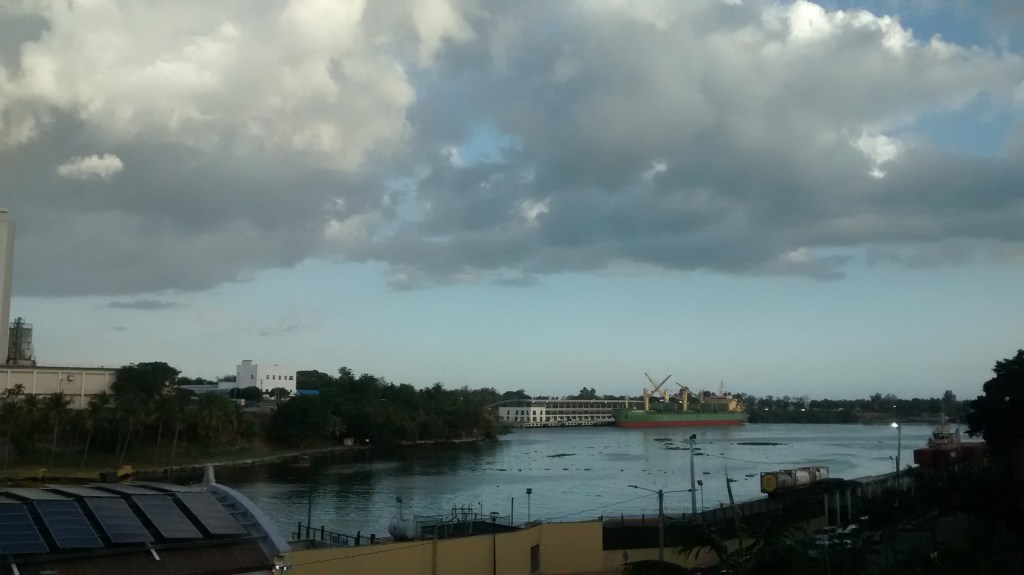
  • Lunch at one of the restaurants lining the Plaza de Espana, on the banks of the functional Ozama river.

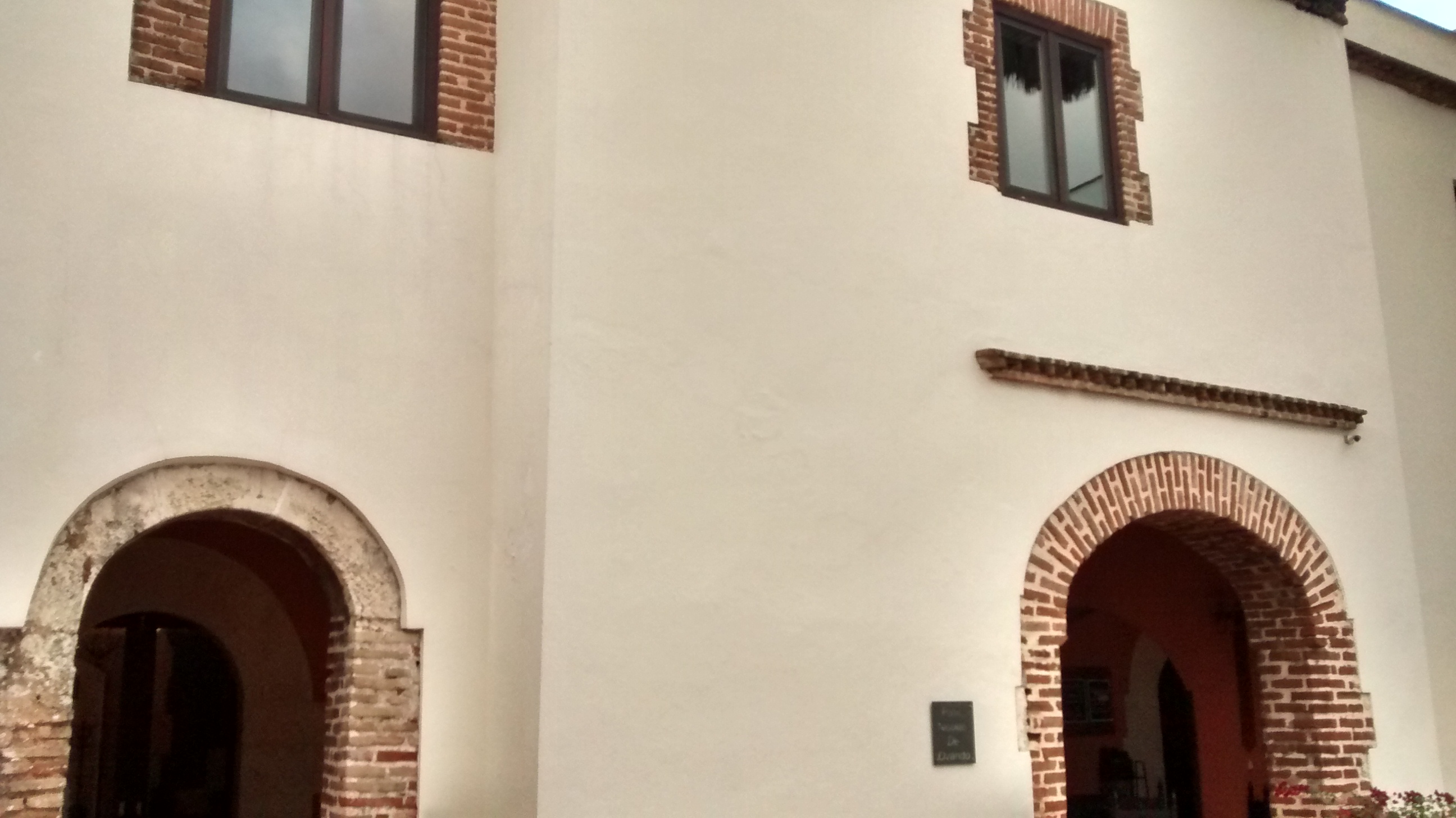
    To the left, the 16th century Alcazar de Colón, the home of one of the first governors of Hispaniola.

    Very good! You’re right. Spanish speakers do know Christopher Columbus as Christobel Colón. But not so fast. The governor was Diego, Christopher’s son. He lived here with his wife, Maria del Toledo. And sometimes Chris himself popped into stay in one of the spare rooms.
    Things didn’t end well for the big man though. Various intrigues caught up with him and he ended up dying penniless in Spain in 1506.

    Columbus is buried in a grandiose tomb in the massive, crazily grandiose cathedral in Seville. But is that true? Not the mad cathedral bit – I’ve been there and it’s insane. No, the other bit.

    In 1877 they found a box in Santo Domingo’s Catedral with some bones in it and Columbus’ name on it. To this day Dominicans are convinced they have the real thing. So much so, that they decided to build a new mausoleum for the 500th anniversary of Columbus’s voyages in 1992.

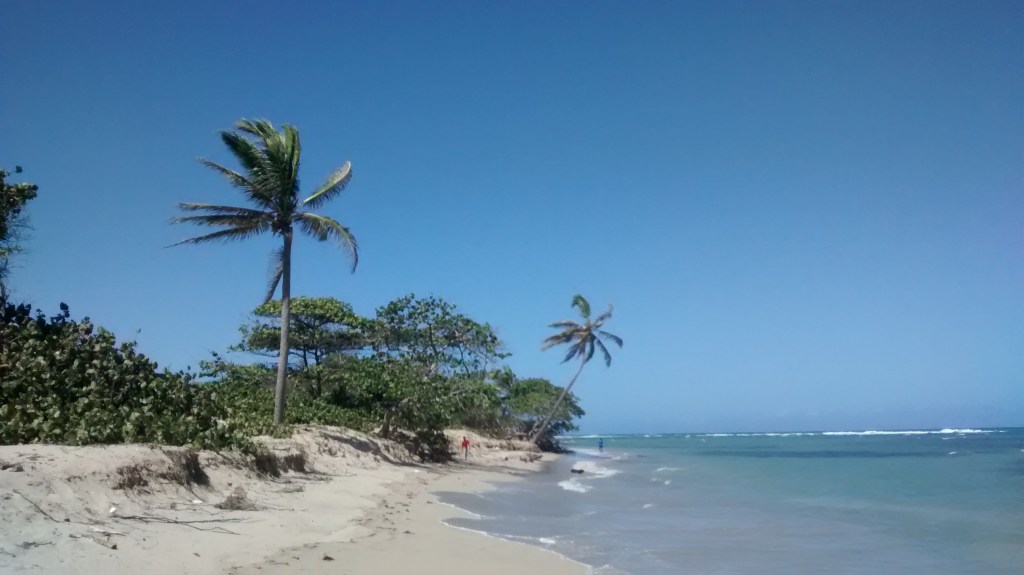
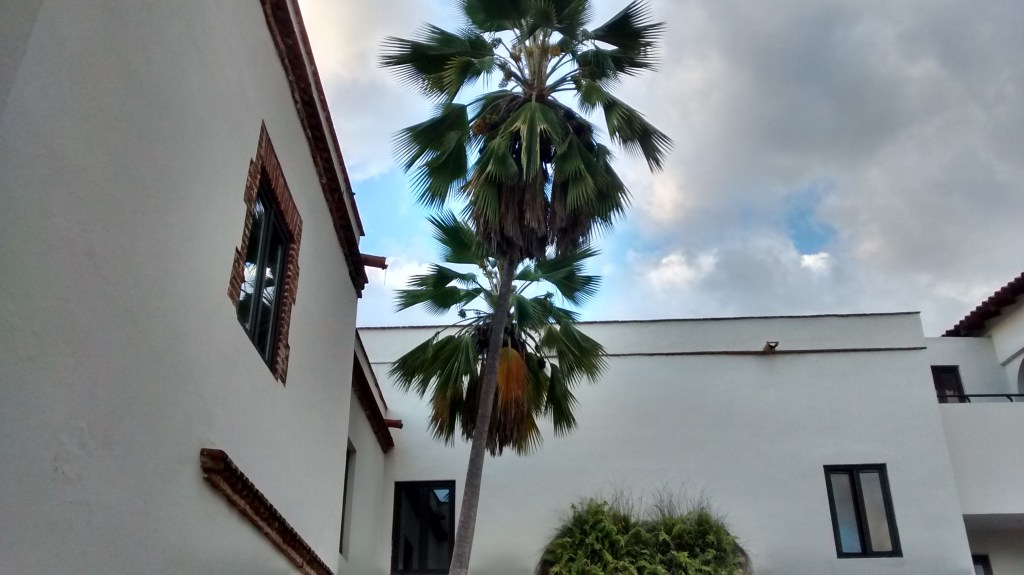
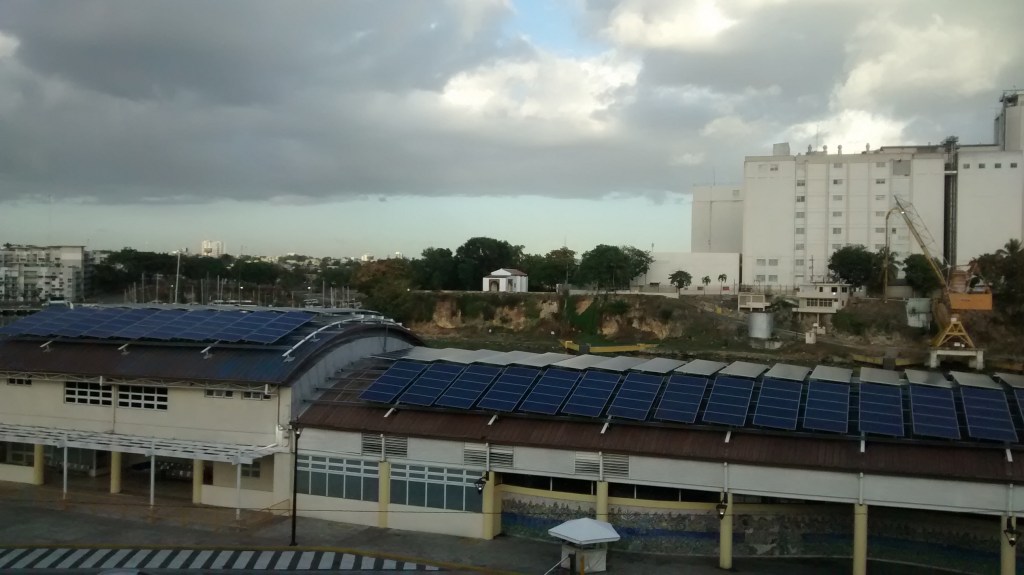
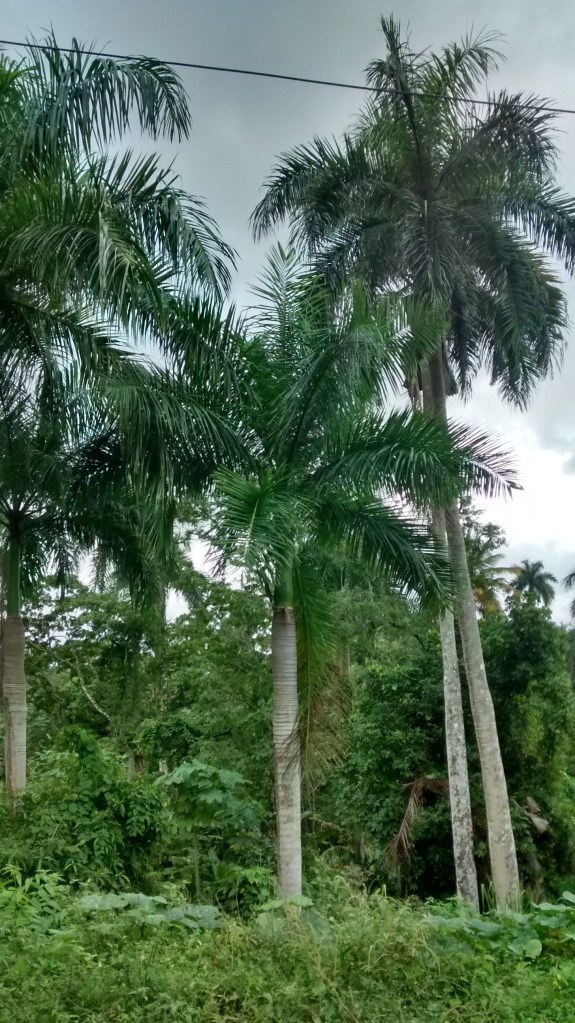
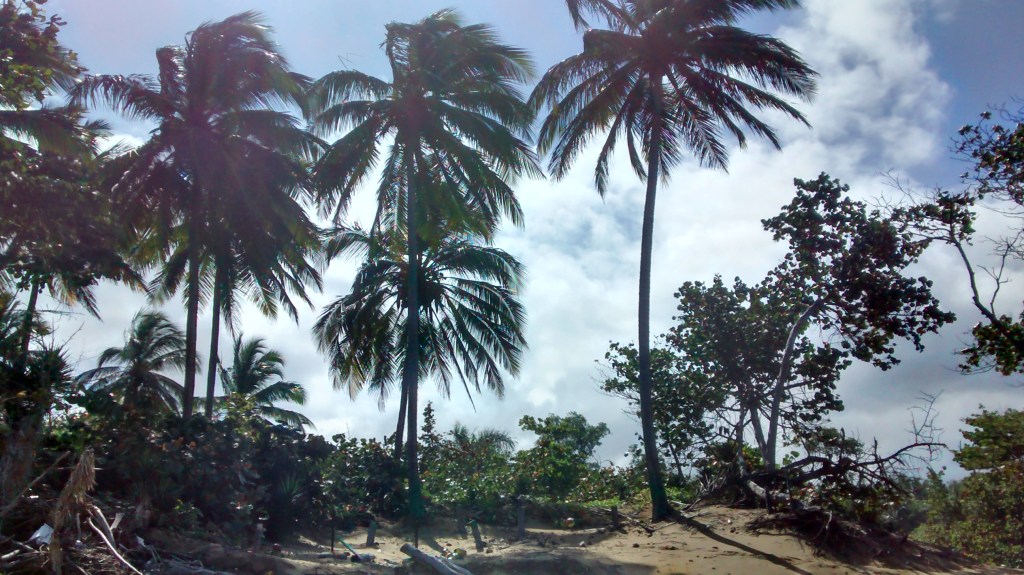
    Now go back to the photo. Look at the second palm tree to the left of the sunshade. (Sorry about “palm tree” and “sunshade” by the way).

    Can you see the building behind it?

    That’s the mausoleum. The Faro a Colón.

    I went there yesterday.


    It’s 680 feet long, too long to fit in my field of vision from where I took the photo. Two side corridors run alongside a loooong central atrium that’s open to the skies. It’s not a real lighthouse, but a series of projectors beam spectacular light displays on special days. Those aren’t windows by the way.

    You enter to the right, and near the entrance, at the apex of the cross that the building forms, is that box.

    To the side, a little exhibit about the voyages, including the anchor from Columbus’s flagship the Santa Maria.

    Now that is something.

    The corridors? Various countries contributed to the 70million USD it cost to build the thing, and they all have a room or two of wood-panelled recesses along the corridors to show what they think of things – in China’s case to plug an Olympic bid, Russia to show off some Russian dolls. Britain? Amongst other bits and pieces we sent along the ugliest portrait of the Queen you could imagine. Sorry Ma’am.

    And as you can imagine the representatives from the Americas take the whole thing more seriously, with more focus on their own indigenous heritage – artwork, dress, musical instruments, and in Venezuela’s case, ideological screed, line the wood-panelled crosses on the walls. Even the USA present some sober and dignified photographs of Native Americans. God knows what Trump would have come up with.

    Ornamental crosses everywhere? Building shaped like a cross? John Paul II coming here no less than three times during his papacy? (Well done again!) You see what’s going on here. This is not about Columbus, the enabler of Western modernity and progress. We are here to venerate Columbus, the man who brought a whole new continent to the loving grace of the Roman Catholic Church.

    The traditionalists would be pleased. The Columbian era delivered the people of the Americas from the godless dark of illiteracy and human sacrifice into the light of God’s grace and civilisation. It’s a fitting mausoleum to a man whose express wish was to be buried in his beloved Hispaniola. Columbus deserved to have it this way.

    The progressives, on the other hand…


    Imagine you’re an architect in the Soviet Union of the 1930’s, and Stalin has asked you to build him his future mausoleum. You don’t know exactly what he wants, but you know all about the gulags. So you decide to do, not just Stalinist architecture, but the crudest, the most over-the-top version of brutalist Stalinism you can imagine. Just to be ab-so-lute-ly sure, you understand. And a decade later you have a quick chat with George Orwell as well.

    A progressive would say this is the sort of triumphalist monstrosity you’d come up with. Considering what happened to the indigenous peoples of the Americas as a result of the conquest, and how it compares to Stalin’s crimes, the anticolonialist would agree; Columbus deserved to have it this way.

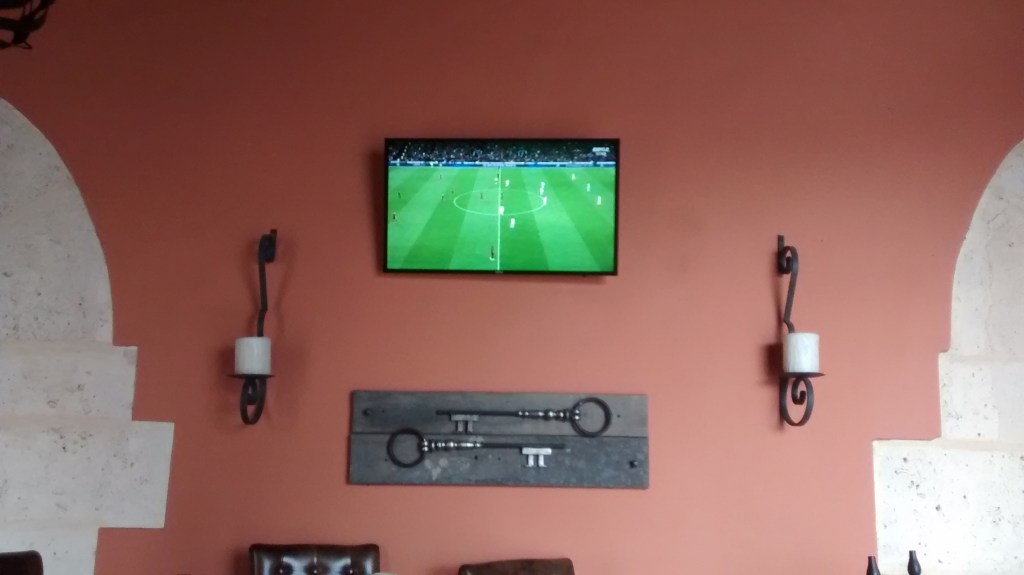
    I wonder what you think. Me? Ah…I see that the heavy shower that came over as I was writing this, is over, and the tropical air has that lovely fresh, flowerly feel that comes after rain. Time to settle the bill, and enjoy the afternoon!

  • …and survived. Very safe.

    The Zona Colonial dates back to 1494, only two years after Christopher Columbus arrived on the beautiful island. Airbnb is blamed for many things, but at least they would have thrown this particular Italian traveller off the site for his behaviour in resort, like claiming the whole resort for the Spanish royals, forcing the hosts to work in silver mines, and then wiping them out with imported diseases. And not leaving a review.

    Santo Domingo quickly became not only the capital of the new colony of Hispaniola, but the nerve centre of the Spanish effort to take over the Nuevo Mundo, the New World. The well-preserved Zona Colonial still looks and feels like a small Spanish town, with simple whitewashed frontages gracefully lining the atmospheric calles.

    Santo Domingo was the first major European settlement in the Americas, and you can walk the streets and pick out the firsts – the first Western-style university, the first monastery, European fortress, etc.

    And this place, the Catedral de Santa Maria La Menor, completed in 1541.

    The first cathedral in the Western Hemisphere.

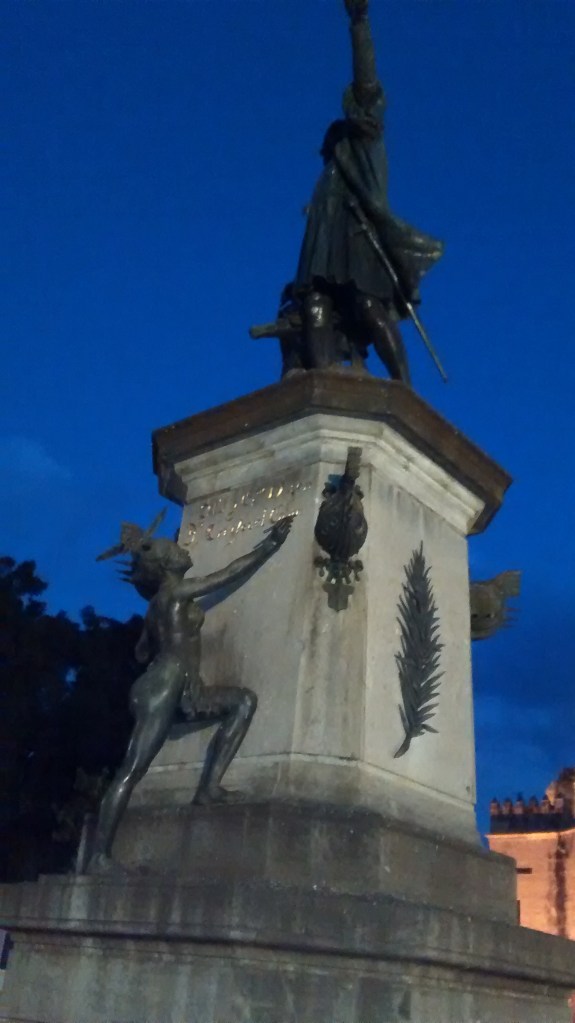
    And in the plaza, it’s the old boy himself, pointing the way north to Puerto Plata and the silver ships, eyes as ever on the prize.

    The woman on the pillar represents Anacoana, the first indigenous person to be taught to write Latin script.

    Ladies and gentlemen, guys and girls, welcome to the Ground Zero of European colonialism.

    Now, this is all a bit sensitive of course.

    If you’re of one opinion, you might see Columbus as a hero, sailing out into the unknown on nothing more than a hunch about how to get to India, and ending up finding a whole new continent, leading to an age of heroic exploration that created the modern world. No Columbus – no Apollo 11, no Android or WordPress, no global popular culture, no Latin America. And, most importantly, no Messi.

    On the other hand, this brave new world was skin-colour-coded. Anyone on the wrong side of the line faced exploitation, plunder, slavery, genocide, and unyielding impoverishment and discrimination that menaces the human race to this day. And even then those humans were lucky, compared to the rest of the natural world.

    I get the feeling that the locals are proud of the antiquity of this first colony, not to mention the boon to tourism. But they’re also aware and proud of the people who were here first – the Taino people who met the three ships but who would later be “disappeared”.

    I think our next stop will deal with the questions around Columbus’s legacy in a way that will satisfy both the traditionalists and the anti- colonialists. Let’s see if you agree!

  • As the high walls of the old city loomed above us, my taxi edged ever closer to my lodging at the end of its two-hour drive from the airport. The tropical sun continued to descend out of the afternoon Caribbean sky as we turned into the narrow, stifling streets of the Zona Colonial itself, the touristic heart of Santo Domingo, the safe bit according to the guide books.

    And very soon, we would make another turn and very nearly run over a guy running out the corner and down the street. The security guard trying to catch him was pretty lucky too…

    To make things easier, I’d organised flights into Punta Cana, on the extreme south east of the Dominican Republic. Punta Cana is probably one of the biggest all-inclusive resorts in the Caribbean, if not the world, great for a holiday in a gated world with fabulous beaches and all you can eat and drink.

    It wasn’t for me. I wanted to explore a little and find a little more. Which is not to say I don’t do all-inclusives – as we’ll see – but there has to be a little more of interest beyond the hotel walls.

    So instead I got out of Punta Cana airport and headed to the capital of “DR”. Bus times didn’t work out for me so the safest – though very expensive – option was taxi. But then, the island of Hispaniola is the second largest in the Caribbean, and Santo Domingo is 150km from Punta Cana. I took the hit and the two hours began.

    I made it to the hotel and a sticky, sultry night had fallen when I ventured out onto the calle…

  • All good trips have to end, and this was a good trip. For my last day it was one of the many Bangkok must-dos I haven’t done yet – a trip to the Damoen Saduak floating market, 100km southwest of the city.

    The canal was dug in the mid-19th century and a number of local traders set up stalls on the various tributaries the canny villagers built around it.

    Progress sailed past the canal in the next century, but the national tourist authorities saw the possibilities of drawing visitors as early as 1971. What that means today is that the site is now flooded with daytrippers and most of the stalls are selling overpriced tourist tat. Still, it’s a pleasant enough way to spend half the day, and there are so many sub-canals that there are only a couple of choke points where you’re bumping into other boats.

    Once we’re done here, it’s off to the Mae Klong market a few minutes down the road.

    A bit more like it for me, this one. Everything’s on land this time, so there are no mooring issues.

    And I do like a decent shop that’s easy to get to. Preferably on a train line.

    But not normally literally.

    Apparently trains run through here eight times a day, and when the warning bell sounds the traders dutifully roll their stalls away, and the hundreds of visitors equally dutifully stand too close to the line and have to be shooed back by the stallholders.

    The next train arriving at the three-clementines-for-18baht-stall…

    Great fun. As has been this trip. Hope you enjoyed the ride. The train carries on past Mae Klong and onward through this beautiful country and this endlessly fascinating region. But for us, for the time being, it’s the end of the line.

    Bye for now!

  • First, I’d like to say how much I appreciate those of you who’ve told me how much you’re enjoying my posts. I’m happy to know that my attempt at writing a travel journal is going down well with you. It might not make you feel you’re here alongside me, but hopefully you’re engaged with my subjective view of the journey.

    I’m aware that you’ve had nothing to engage with over the last few days since that post about the Khmer Rouge. The reason is simple. I’d hoped to get my beach time In Sihanoukville, Cambodia’s up-and-coming but apparently laid-back resort hub on the south coast. But that’s 4 hours from Phnom Penh and the logistics of getting the bus there and back, then flying home via a stop in Bangkok in the time remaining weren’t encouraging. So instead I hit the beach by flying to Bangkok and then doing the 1.5 hr bus down to one of Thailand’s premier resorts, Pattaya.

    And it left me completely uninspired.

    Pattaya is a big city in its own right, with one million inhabitants, but the resort is a huge party town. Which is fortunate because the beach isn’t up to much and you wouldn’t want to swim here even if you were a fish. It’s popular with Chinese tour groups, Indian lads, Russians, and elderly middle-aged men who sit in British themed bars and stroll around town with their Thai lady of choice – a deal having been concluded, and the goods now in supply chain. Thailand has tried cleaning it up a little and now encourages more families to visit, but there’s some way to go.

    The resort is totally full-on, in many ways, all types of tourists converging on the notorious party-central Walking Street, where everything is available, loudly and doused in neon. I suppose people are free to do what they want as long as it doesn’t harm anyone, and everyone seemed to be enjoying themselves on the street and in the various bars (I had a look and checked – for the purposes of this blog of course), but if you imagine picking up Oxford Street and central Amsterdam and plonking them on a not-great Caribbean beach, then you’ve got the idea. And it didn’t appeal to me.

    Pattaya is fine if you like that sort of thing, but Siem Reap and Phnom Penh both had more genuine warmth and raw charm to them and they both felt like more relaxed places.

    The name Siem Reap is thought to refer to battles from the Angkorian era. It means “Siam Defeated”. Sorry Thailand – modern Siam – but I think Cambodia’s got another win so far on this trip. But I’m now in Bangkok for the last two nights. And if there’s one place in the world where anything can still happen, it’s here!

  • Warning: this post talks about some distressing historical events. I will leave out the really disturbing details, but I leave it to you to decide whether or not you want to skip it completely.

    We have seen many nagas on our travels through Cambodia. Representing prosperity, they adorn many stupas and temples with their blessing and protection. In this Buddhist pagoda we can see two serpent heads, looking out over from the two visible corners of the lower roof. Meanwhile, four naga tails flute out from the very top of the pagoda, rising high into the tropical sky. I’m no expert, but maybe they reach out to offer a tender touch to the world of spirits.

    Up in that corner below the roof, spreading its wings, is a garuda, a mythical bird of Hindu and Buddhist tradition. There are four of them, too. You also see many garudas around, and it’s often shown holding a naga above its head in triumph. The truth is, they don’t get on. But here, on this pagoda, garuda and naga agree to appear alongside each other, in the spirit of peace.

    To explain why, we have to introduce a third mystical beast – the Elephant in the Room that’s been overshadowing our travels, as it must do any visitor to Cambodia.

    When the victorious forces of the Khmer Rouge entered the capital in 1975, they found a city swelled with many refugees from US bombing in the rest of country, which itself claimed 100,000 lives and drove many people to the side of the conquerors. So when the population was told they had to evacuate Phnom Penh for their old safety, people believed these then popular liberators who’d saved them from the corrupt Lon Nol regime.

    It was a lie. The leader of the Khmer Rouge, Pol Pot, held to an even more extreme version of Maoism than Mao himself. To him the only worthy person was a peasant, the “old” or “base” people. The idea of the city, its institutions, its schools and hospitals, its culture, was capitalist decadence and had to be destroyed. Cambodia had to start from scratch, a nation of the base people. The citizens of Phnom Penh were being forced out into the countryside to work the land.

    What happened there, with its stupid production targets, non-farmers being forced to meet them, the fact that the Khmer Rouge leadership didn’t have the foggiest idea how to run a country, is not our story – although that story led to a famine that is thought to have cost two million lives.

    Our story is about the people the regime really didn’t like.

    Tuol Sleng was a school before the Khmer Rouge came into Phnom Penh. Before long they turned it into a prison to hold political opponents and members of the old regime. Nothing new there, that’s what most dictatorships do. But it didn’t stop there. Soon, being considered a traitor and being a “new person” – urban, educated, intellectual -became one and the same. People were being rounded-up for such unspeakably imperialist crimes as being a doctor or a lawyer, wearing glasses, having soft hands (not the hard hands of a labourer). In the climate of terror some people offered false testimony against others, sometimes in their own family, just to avoid arrest themselves.

    Judicial process? No need. Angkar, the name the regime gave itself, could never be wrong. So if they suspected you, then you must be guilty. And, oh yes, all the lawyers were locked up as well. By the way, please don’t confuse Angkar, the group that destroyed Cambodia, with Angkor, the nation’s pride and joy. If it helps, put a W in front of both of them. And chuck an S at the end of Angkar as well.

    So you came here to confess your crimes, that you were working for the CIA or the KGB, or whatever, and then you would face the consequences. You could be held in a cell no bigger than a toilet, sleeping on the floor. Or you might be held in mass detention, 32 of you to one room, sleeping alongside each other on the floor. Then you were taken out for your barbaric torture.

    The noticeboard mentions “chap”, but thousands of women were sent here too. And Pol Pot believed that if the enemy were a plant in soil, you had to take out its roots to stop it growing again. So whole families were sent here. Since 1980 Toul Sleng has been a museum dedicated to the memory of what was done here, and there are a couple of heartbreaking family album portraits of some of those husbands, wives, and children who were imprisoned here.

    But there are even more mugshots taken by the authorities themselves of the prisoners, men, women, and many, many children. Some people look defiant, some scared, others bewildered, most resigned to their fate. It’s one of many things here that leave a lasting impression.

    There are also photos of prisoners who were victims of “mistakes”, meaning they died during interrogation. They shouldn’t have. They should have completed their confessions! The photos were part of the investigations into what had gone wrong, and the interrogators would most likely end up on the wrong side of the cell walls themselves. (As did some of the senior Angkar leadership when the inevitable power struggles began).

    Others avoided the misery by taking their own lives. The wire across the balcony in the earlier photo was to keep prisoners from jumping to their deaths. (The barbed wire in this one was as much as to keep people out as stop prisoners escaping)

    It’s estimated that around 17000 people passed through here between 1975 and 1979, and there were similar prisons across the country. Fourteen unidentified bodies of prisoners were found in their cells by the liberators, and they are buried in the grounds.

    Out of the 17000, only seven people that we know of avoided the inevitable step to Stage Two. One was an artist, another a plumbing engineer – skills the prison authorities found useful. The artist’s harrowing depictions of torture and murder are also on display here.

    Stage Two. Once you had been dealt with here, you were driven 20 or so miles away to an old Chinese cemetery outside the city at Choeung Ek.

    The Killing Fields.

    Trucks would arrive from the prison two or three times a month at the beginning. Later on, they came every day. All the buildings have gone now – including the wooden rooms when you were held overnight before they killed you. Bullets were expensive so they used other means.

    For example, can you see the sharp, serrated edges on the leaves of this sugar palm? Hammers, knives, machetes etc, also came in handy.

    The butchery took place at night, revolutionary music blaring out so that the neighbouring villages couldn’t hear the screams. Sometimes they’d kill 300 people here a day.

    You were either killed in what would be your mass grave, or your body flung into it. They kept consignments of DDT here to throw into the pits to finish the job – and to deaden the stench.

    Men, women, children, babies…killed and buried in mass graves all around here. And imagine the same thing, repeated across the country.

    The truth is, they don’t normally get on. But here, on this particular pagoda, garuda and naga agree to appear alongside each other, in the spirit of peace.

    Because this pagoda at Choeung Ek is dedicated to the memory of all who died here – particularly to the 5000 whose skulls are piled high within its walls.

    And, maybe, those high fluting tails of the nagas are reaching out to us, too. For, as the superbly- and movingly-narrated English audio guide, from whom I draw for this post, reminds us (delivered by a Cambodian who himself lost five of the nine in his family), this has not just happened in Cambodia. It has, and could happen anywhere.

    And why not, at a time when the educated are derided as “experts”, lawyers once again as “enemies of the people”, when 52% condemn 48% as denying “the will of the people” and call for saboteurs to be crushed, where 48% condemn 52% as ignorant racists destroying the country and hurl their own accusations of treason, where authoritarianism and populism, fuelled by paranoid suspicion and fear, is gaining ground again across the world?

    Why not?

  • “Why are you spending so long there?”. The response when people in Siem Reap heard I was going to spend three nights in Phnom Penh. And when I arrived, I began to wonder too.

    One thing I’ve not done is convey a sense of the street life in Siem Reap. So, think – what’s the easiest thing you’ve done in your life? Breathing? Responding to the offer of a free luxury holiday in the Caribbean – No! sitting on a beach during said holiday, supping rum punches!

    They’re all very easy, but surely not as easy as Passing the Cambodian Driving Test. Imagine a place where the roads are full of weaving tuk-tuks and mopeds, ignoring lane indications and discipline, Give Way markers at intersections (no worries there – they don’t exist), and sometimes even the direction of travel. Even on one-ways.

    In relatively laid-back Siem Reap, that does have its charm, even if you can’t escape the mayhem because the back roads don’t have pavements, or you’re just trying to cross the road and suddenly find yourself become a track marshal at MotoGP. At least you’ve got all the lively bars and food places to dive into and cheer you up.

    But on first impressions Phnom Penh is worse, just another faceless big city but with the traffic problems (Except there’s twice as much traffic. And there are pavements but they’re chokka with cars, or motorbikes, or people eating at table). And it’s steamy and as noisy as hell. After my bus journey from Siem Reap (just the six hours), the tuk-tuk ride to the hotel was not an encouraging plunge into the madness (particularly when the driver forgot where he was going).

    But once you draw breath and get your bearings, and venture a few streets away from the businesses and the offices and the big expressways, you discover that like all cities, Phnom Penh has another side and a charm of its own.

    It’s main attractions (if we ignore the Elephant in the Room for a moment) are the Royal Palace-Silver Pagoda complex, and the vibrant Sisowath Quay area on the green embankment of the Tonlé Sap River). Here we are now, near the palace grounds.

    The beautiful National Museum.

    The Royal Palace.

    Which was closed until 2pm. Never mind, an enterprising (and persistent) tuk-tuk driver came along and roped me into a quick spin around the city.

    The Independence Monument. Cambodia said Adieu to its French rulers in November 1953.

    Sihanouk.

    We span down the Quay, along the riverbank, then over the river to a more homely world on the other bank. Still with the golden temples…

    … but more villagey. And even poorer.

    We randomly ventured into one village compound where, as I understand it, the monks had relocated from one of the temples.

    Tuk-Tuk’s English was viable but not great, and it became very clear that he’d not said “monks”.

    Feeding big-city macaques normally encourages them to grow into a nuisance, but the locals here didn’t seem to mind. And I’ve said that our guy was persistent.

    So, when in Rome…

    We sped out of monkey village, and down to a small fishing village on the riverbank. And here, laughs were in short supply.

    The inhabitants are Muslim Cham people from Vietnam. The Cham nation was once a great rival to Angkor, dangerous enough to have their defeats celebrated on the temple walls.

    Looks like those days are long gone.

    Turning round from this viewpoint…

    …brings you to this…

    A five-star hotel.

    No wonder they need the trees.

    We made our way back and finished up back in town. Before heading to the palace, I popped into a famous institution on the Quay for something to eat.

    Cambodia became a UN protectorate in 1992, and free elections were organised. The improving security situation lured foreign journalists back into the country, and a couple of them set up the Foreign Correspondents Club in this building. It became iconic as the hacks who frequented it covered the final days of the Khmer Rouge as a fighting force and then the disappointingly un-gruesome death of Pol Pot.

    Today, the journalists have gone and the FCC is just another three-star hotel and restaurant/bar, but they’ve managed to keep that feel of a journalist’s hideaway in a country in turmoil.

    I do have to say, I was half-expecting the servant to come up to tell me my rickshaw-wallah had arrived; it does have that colonial feel to it. But, for someone like me growing up in the 70s and early 80s, Phnom Penh wasn’t so much a real place as a news headline, so it was fascinating to be in the rooms where those stories would have been crafted in the 90s. And it’s a delightful, atmospheric place to be as well.

    The FCC overlooks this old ruin of a French colonial building, now used as a performance venue.

    Ah, the Palace should be open by now, let’s pop in.

    The palace we see today (this is just the Throne Hall) was sited here in the 1860s and many buildings were rebuilt between 1913 and 1919. Together with the Silver Pagoda, highlights include some gorgeous stupas containing the ashes of former monarchs, and the stunning collection of golden Buddhas in the Silver Pagoda.

    The current king is the 65-year-old Norodom Sihamoni (those are his private quarters behind that low yellow wall). One of Sihanouk’s children, crowned in 2004 in the Throne Hall, he’d been out that morning delivering ambulances to medical facilities elsewhere in Cambodia. But he’s back now – as shown by the blue royal standard in the centre-right.

    Sihanouk again – this time, his stupa.

    Time to leave the palace and time to call a halt for the day. Now I’m beginning to rethink my Phnom Penh expectations. Is three nights enough?

  • Before we leave Siem Reap, here’s a short post back at the Wat, kicking off with some photos that I didn’t post before.

    The “Elephants” gate at the west wall. There were five entrances on the 1.5 km long wall – for elephants and commoners at north and south, for priests and for high officials near the centre…

    … and in the centre…

    …this one for the royals.

    Amongst the many great achievements of the Angkorians, was the invention of American Football.

    The Wat in the early afternoon.

    One visit isn’t enough for this wonder, so on my last day there I went back in the early afternoon. I hope you appreciate the change in the way the light plays off the stones as we approach the sunset.

    Unforgettable.

    Farewell, magical Angkor. Farewell.

  • Time for a break from all that temple-ing. Let’s have something different.

    War and genocide.

    In 1431 the Thais sacked Angkor, marking the start of what the Khmer call their Dark Ages. A weakening, declining state gradually became the prey of their Thai and Vietnamese neighbours until, in the nineteenth century, they had no choice but to become a protectorate of the newly-arriving French.

    Officially the Dark Ages end at this point, but they surely saw nothing as dark as what was to follow in the 20th century. To find out more, we head to the sobering War Museum on the outskirts of Siem Reap.

    “Poor Cambodia”, Porfirio Diaz might have said. “So far from peace, so close to Vietnam”. Cambodians won their independence in the 50s, but could not isolate itself from the conflict over the border. Sihanouk, the prince-turned-PM, favoured the North, and allowed them to pop over to the Cambodian side to establish supply lines to the South. Uncle Sam was, to say the least, unimpressed. Between 1968 and 1973 the US pounded Cambodia with 2.7 million tonnes of bombs. Even Japan only got 1.7 million – including the nuclear ones.

    That was only the start of the misery. And of the unexplored ordinance problem.

    Meanwhile the generals sided with the South and Sihanouk was deposed in 1970. Then it all kicked off. Civil war. More ordnance. Sihanouk joined the anti-US resistance, which included a Maoist group called the Red Khmer. What’s that in French? Khmer Rouge.

    The Communists entered the capital in triumph in 1975, just as in Vietnam. Then the slaughter, as we all know, really began, as the new leader Pol Pot tried to rid his country of any traces of opposition, the 20th century, and then everything else. Our tour guide’s telling of the story was informative, moving, and shocking, especially when it came to his own family. More about the horror when we get to Phnom Penh.

    Eventually the Soviet-backed Vietnamese had had enough and invaded in 1979. The Khmer Rouge were forced to the Thai border where they continued to fight on until the 90s. Cambodia is now one of the poorest countries in the region and is only now beginning to recover.

    It’s also one of the most heavily mined in the world. Both sides in the later war used landmines – the resistance (who also started upon each other) and the Vietnamese (who had ulterior motives for their good-guy invasion). They think they’ve cleared most of the mortar bombs, anti-tank, anti-personnel, unexplored bombs. They’re hoping the rest will be sorted by 2025. Meanwhile a dozen people were killed this January.

    2025 is a lot of months away.

    Let’s look at some hardware.

    Everything we see here was supplied by the Soviets to the Vietnamese.

    They even let you climb on them.

    What became of the soldiers who were using them? How were these armaments captured?

    We have to imagine.

    And what about those on the receiving end?

    Up we go.

    Eerie, thinking what must have gone on in those portholes, standing here, in the shadows of ghosts.

    And it had one more casualty to take. How to get down? Gradually. But I still grazed my thumb on the side. In case you’re worried, it was a small cut and it got washed and they put a plaster on it.

    And I still managed to go out again and play with an AK-47. So you can stop worrying about that too.

  • We leave Preah Khan and continue on the Grand Circuit. Our next stop:

    Each of the Khmer temples would house statues representing Shiva, Vishnu, and mates, and were intended to be a home of the gods, rather than a site of regular worship. The late 12th century Neak Pean makes that very clear.

    There’s no ferry.

    To get to the little site, you cross the tranquil-looking Jayatataka…

    …no lake, but the 12th century reservoir built to supply the city around the Preah Khan temple.

    Next, lunch, and then the small, attractively ruined Ta Som

    We all like a good ancient passageway.

    The last two temples are earlier, 10th century, and more in the “temple mountain” style that we saw at Angkor Wat. That means more climbing on the steep steps to get to various enclosures, which will be a challenge in my sandals.

    For those of you who are flagging a bit through all these temples, hang on in there. The next blog post’s got tanks and rocket launchers!

    First, East Mebon.

    Not officially a temple mountain, inasmuch as the five towers are not mounted on a very high third enclosure. Still the second one was a bugger to get up.

    After the slightly perturbing climb back down the ten steep steps back to the road, it was nice to know that we just had the one to go before we headed back to the hotel.

    It was only when we got to Pre Rup that it became clear it was a real temple-mountain.

    From second to top tier there must have been about 30-40 dizzyingly steep steps. You could either try your luck with the original stone walkway, or the newer rather rickety wooden steps. I went for rickety.

    And survived. Like everyone else.

    Well, it was hard work, but the stunning sights along the way made the Grand Circuit well worthwhile. Back to the hotel and to a contented evening, feeling a little cream-crackered.