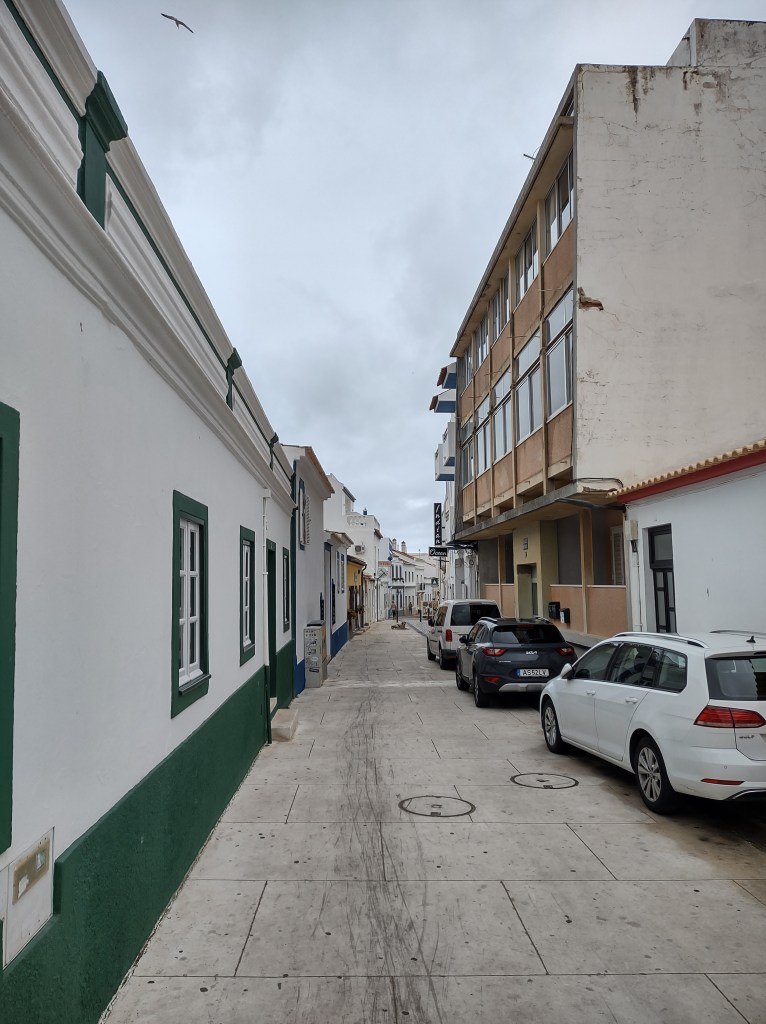
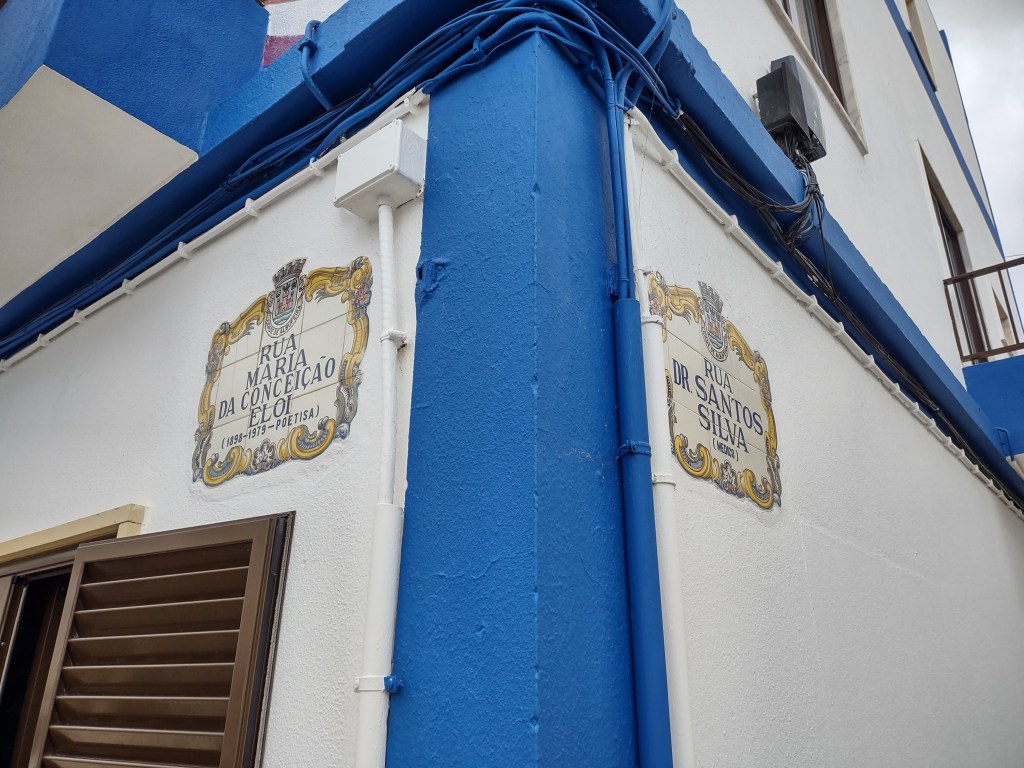
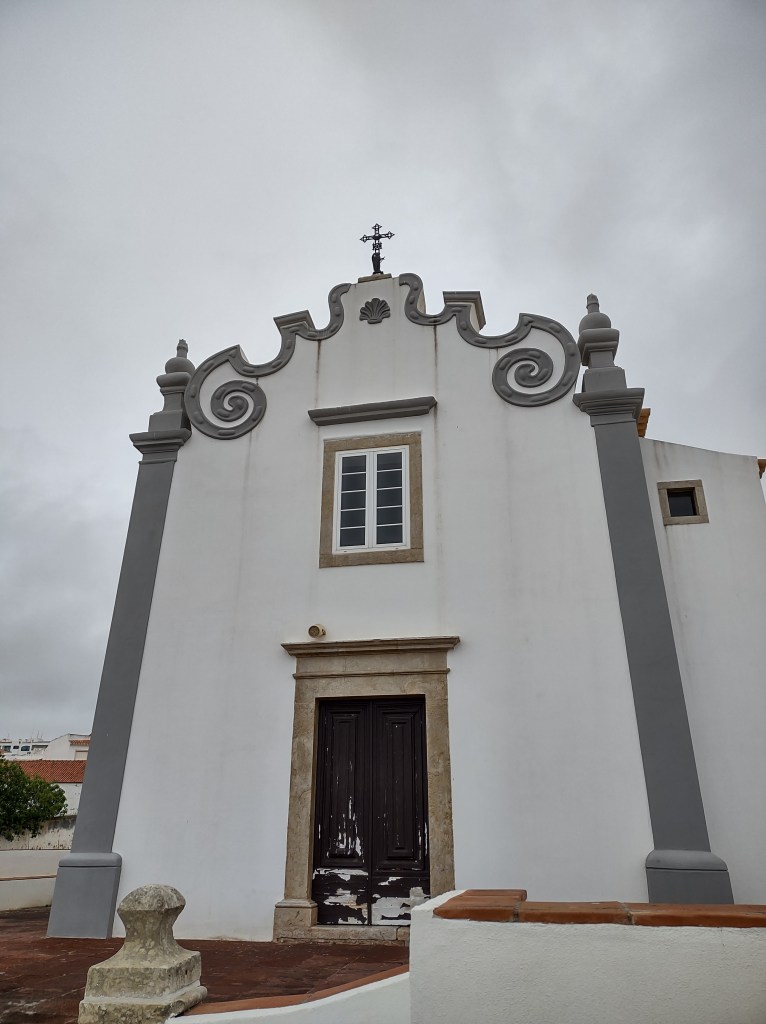
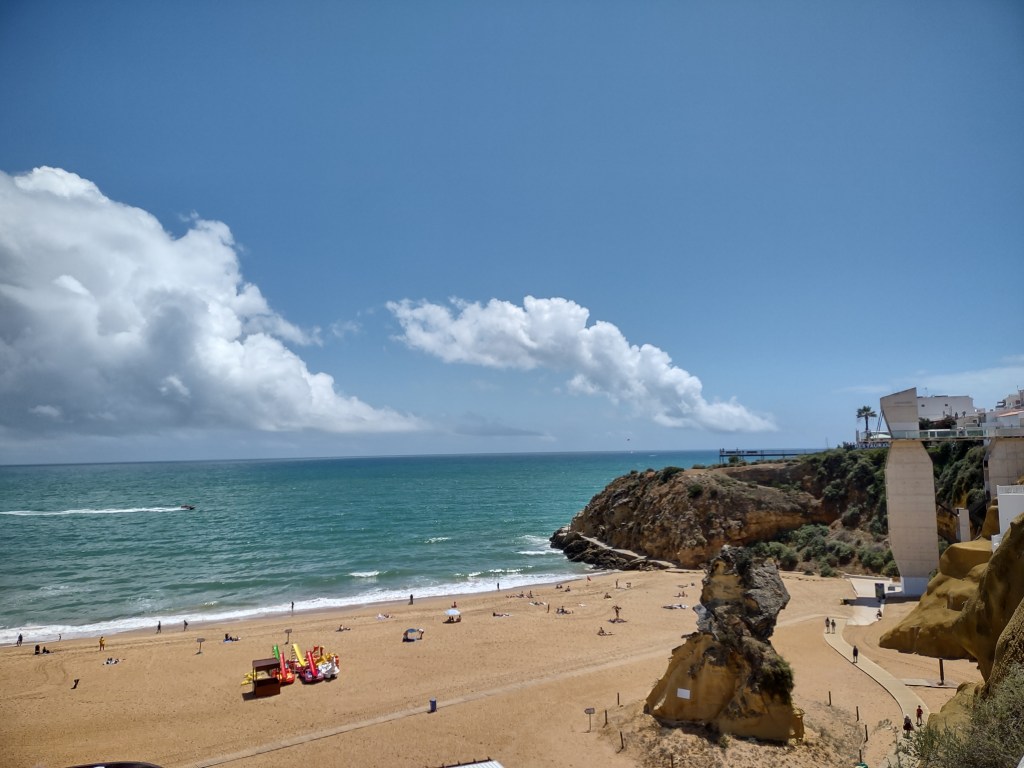
And, as some of you Algarve experts will know, lager-louty, yobbish Albufeira. Because there is no doubt this is the raucous banging nightlife hub of the region with an Old Town full of lad pubs, lad clubs, lad everything. But even here you can find the odd trace of the old fishing village if you look for it. And if you find the right place to stay you can also find the odd trace of sleep.
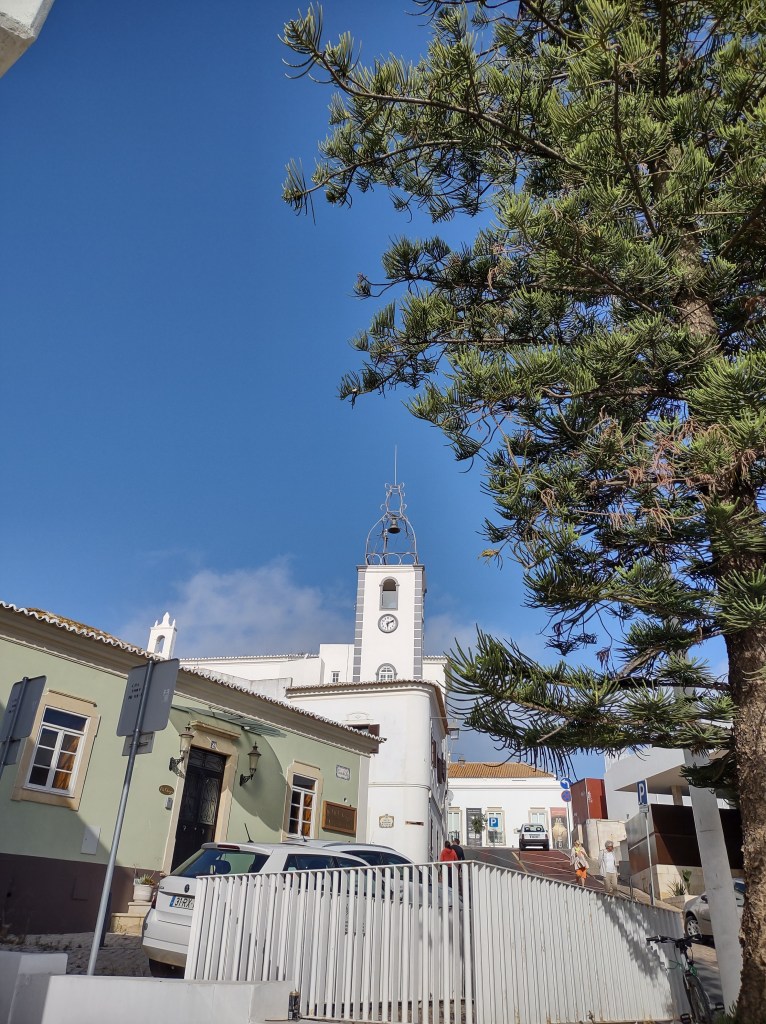
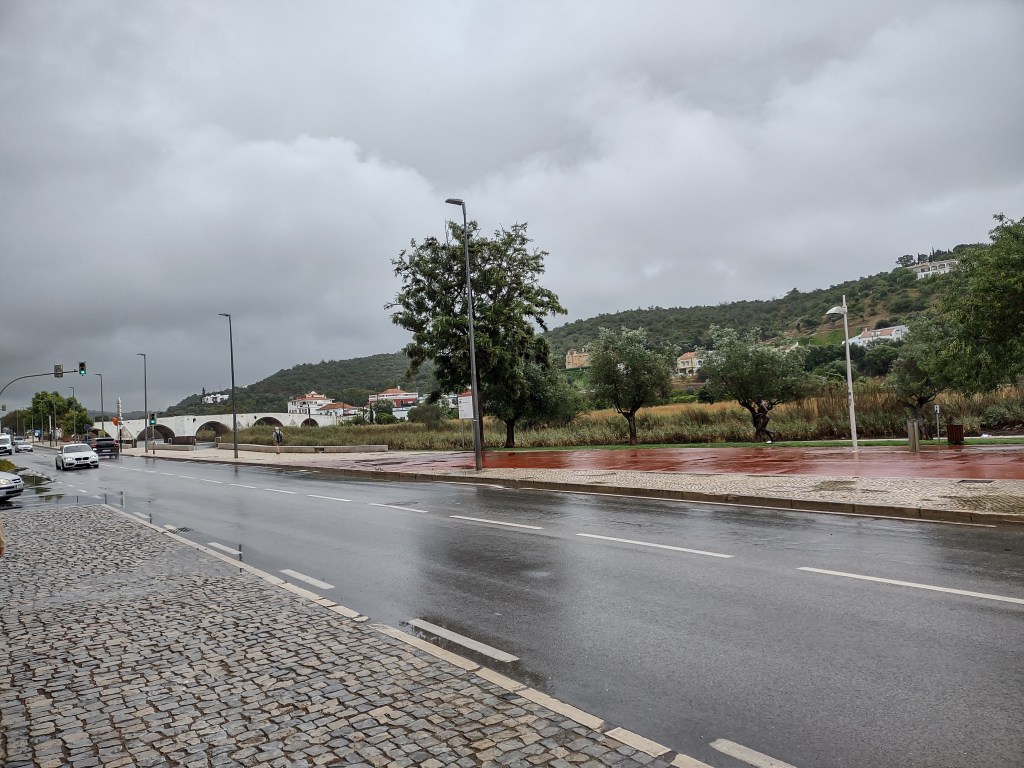
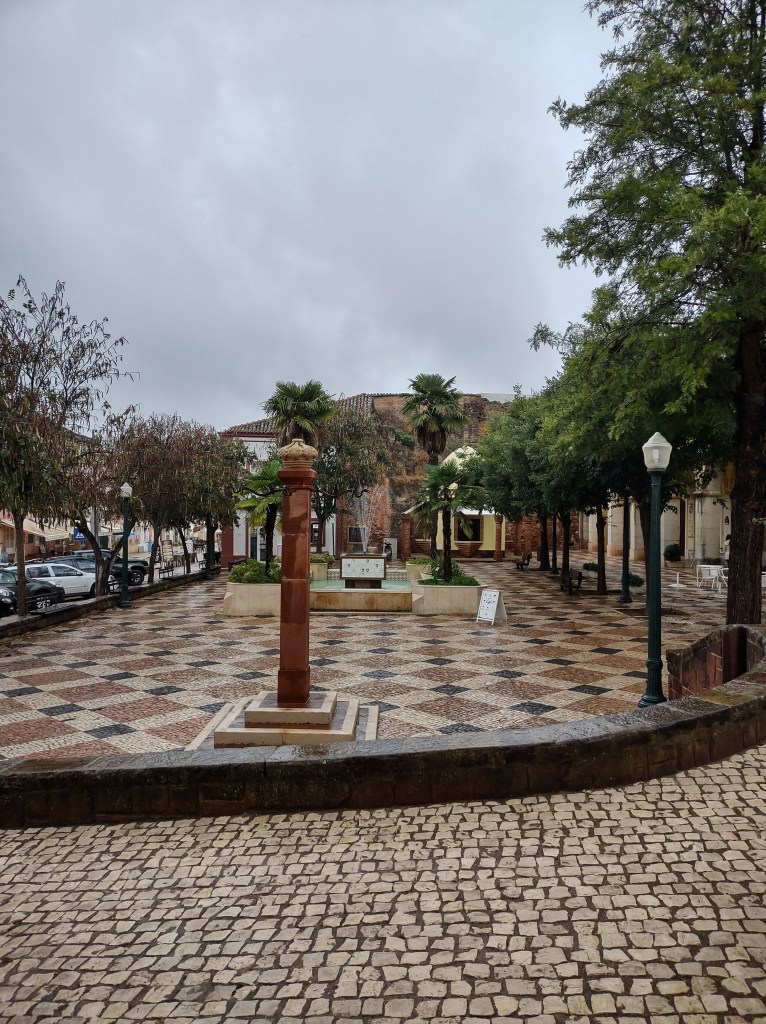
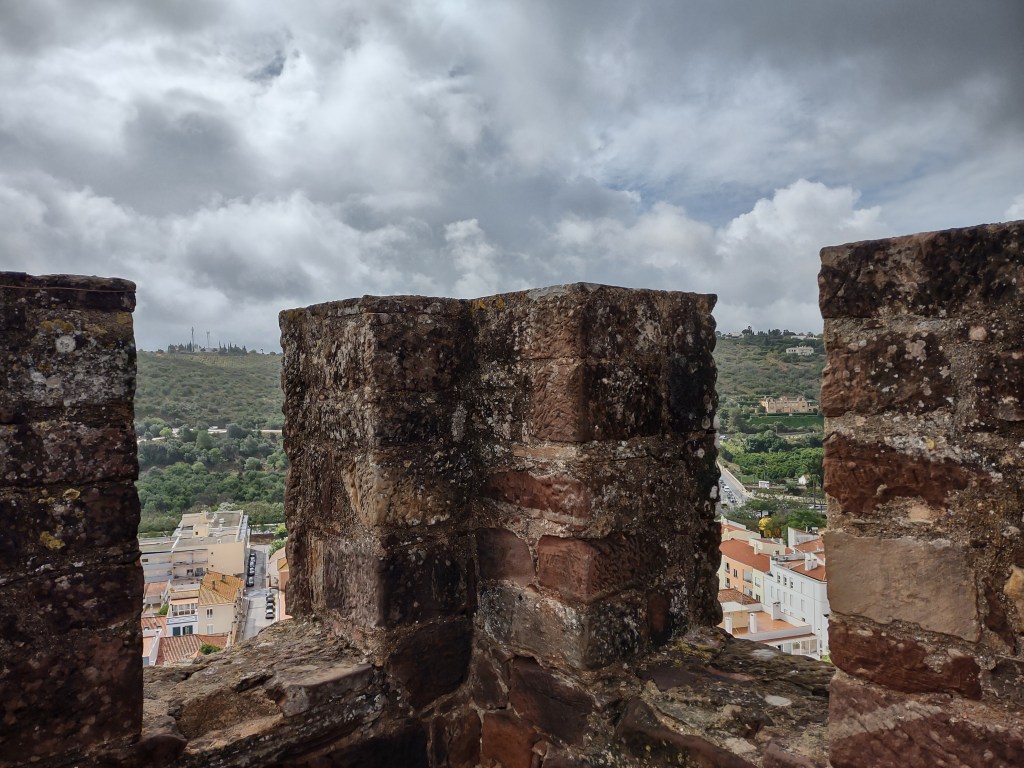
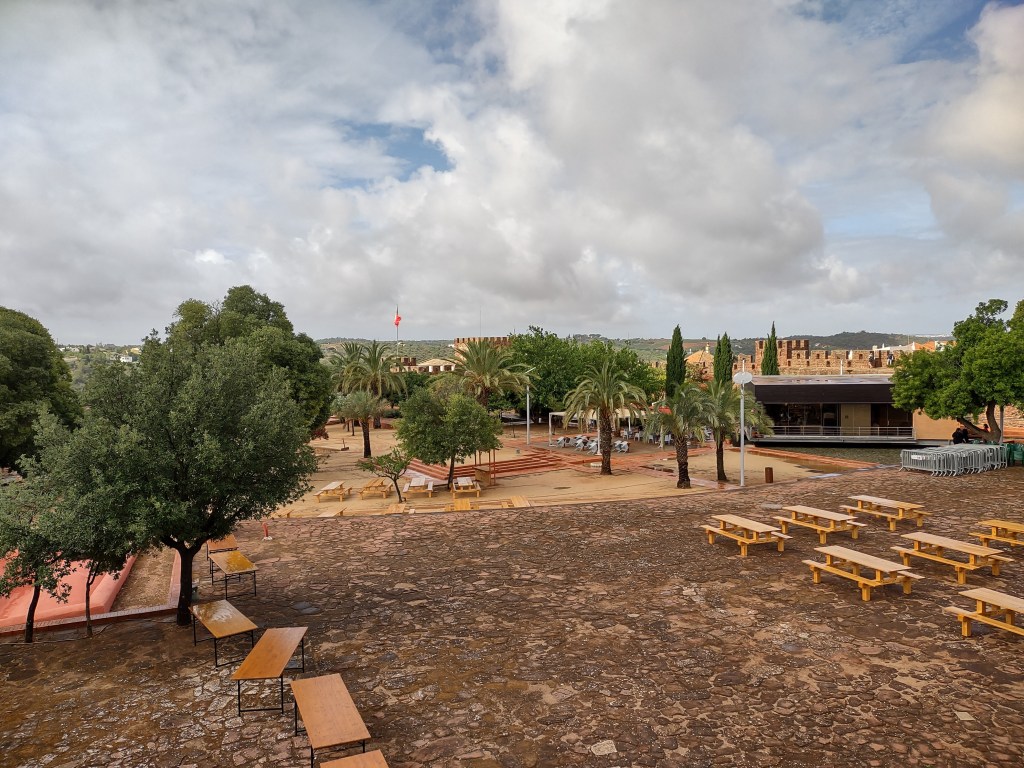
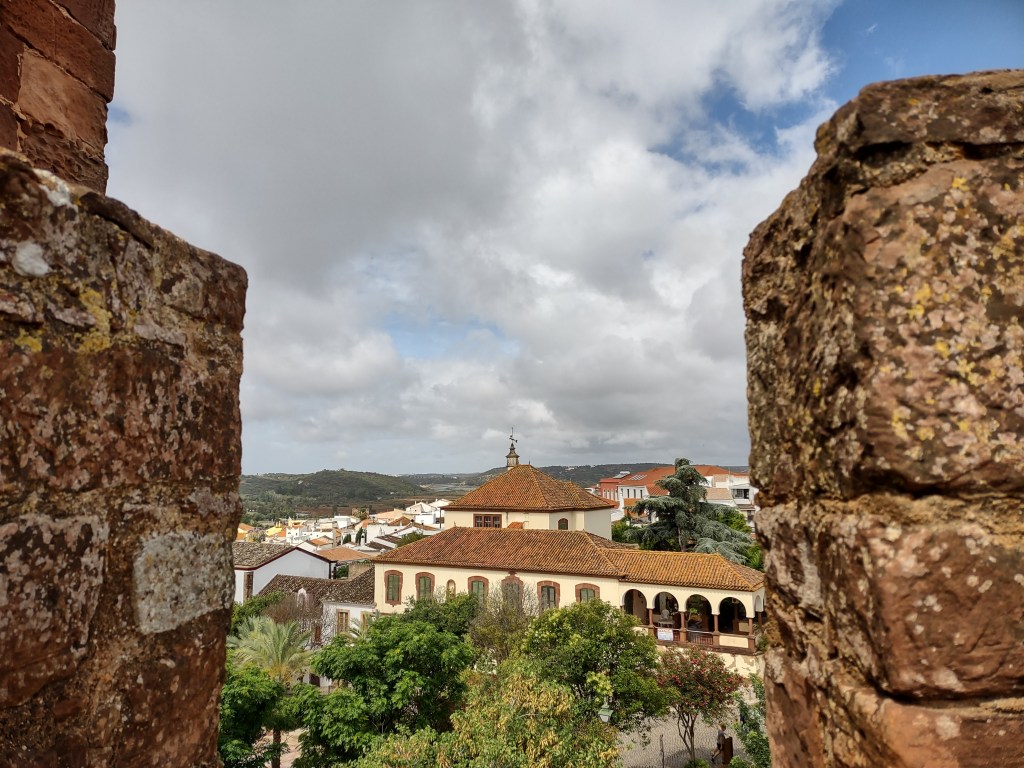
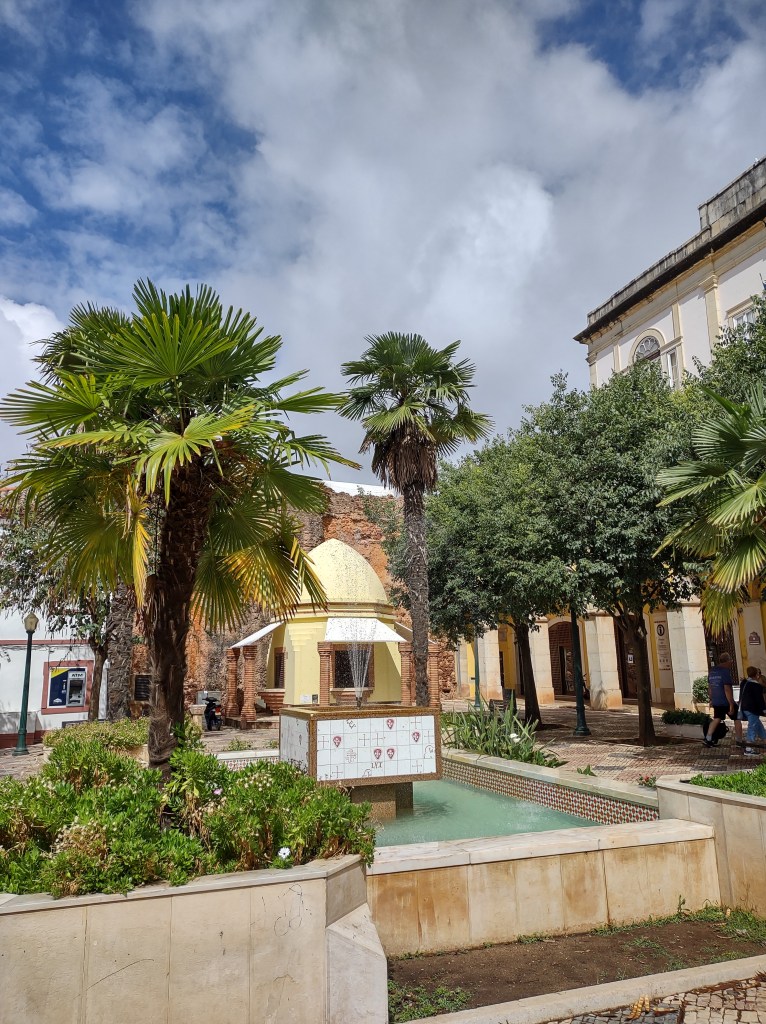
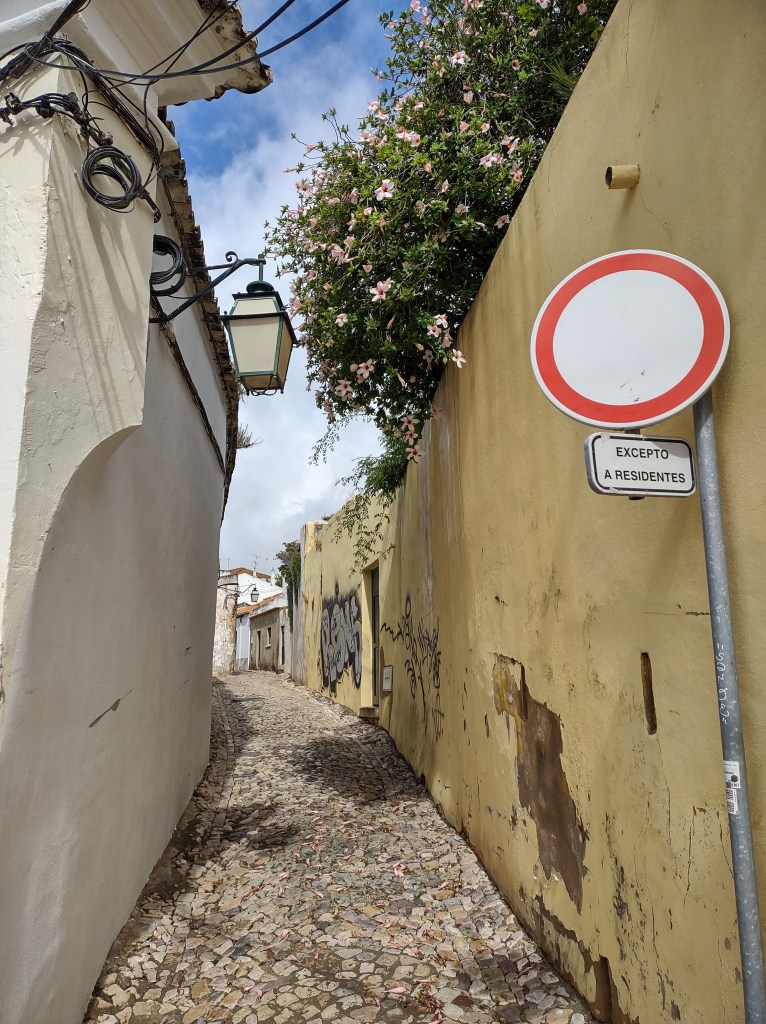
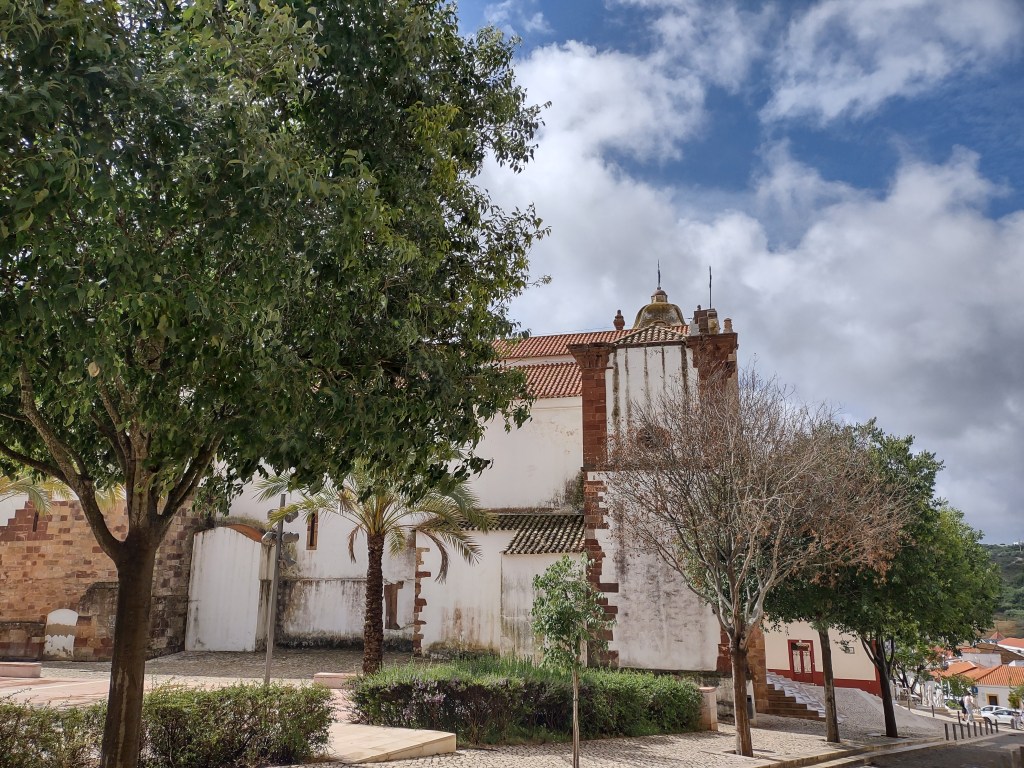
Yesterday I went on a tour of some other spots around the Algarve. First up was the lovely old town of Silves.
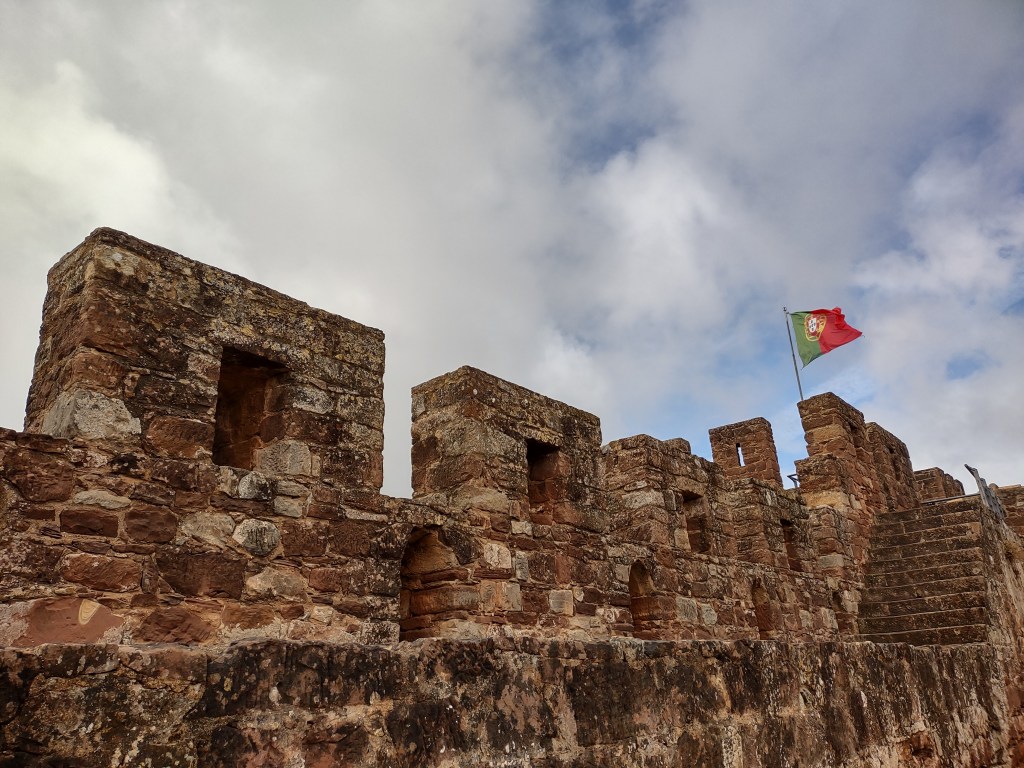
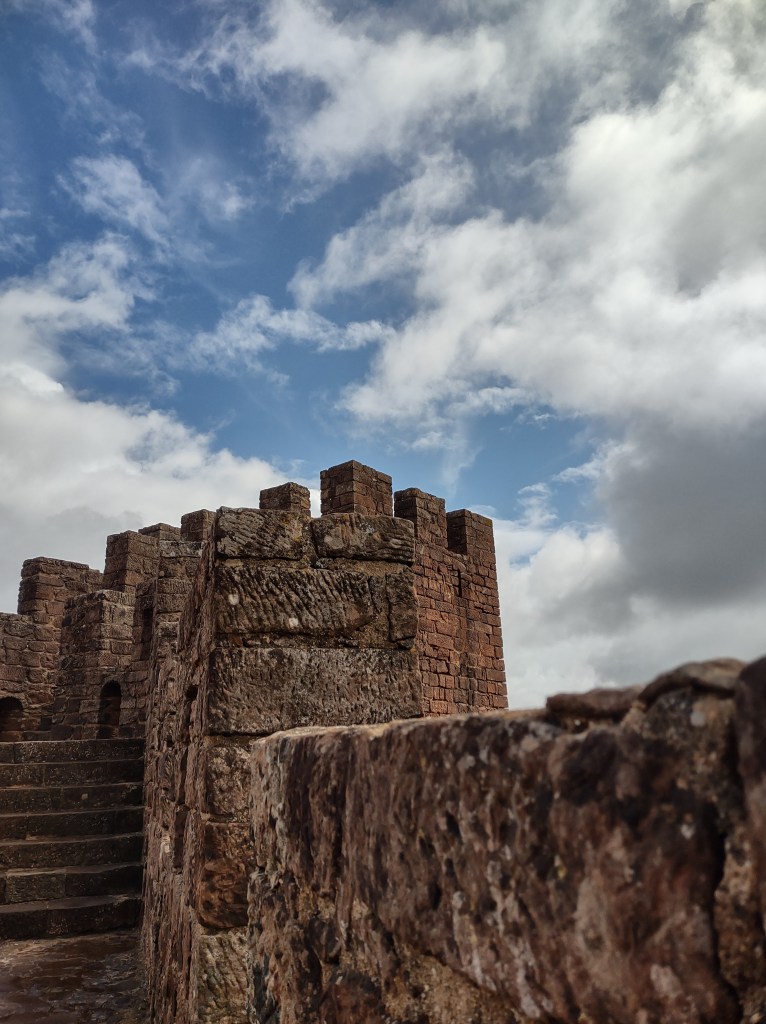
Moorish Arabs ruled Silves from the 8th to the 13th century, and they ran the region from their great castle, the most significant in the Algarve.
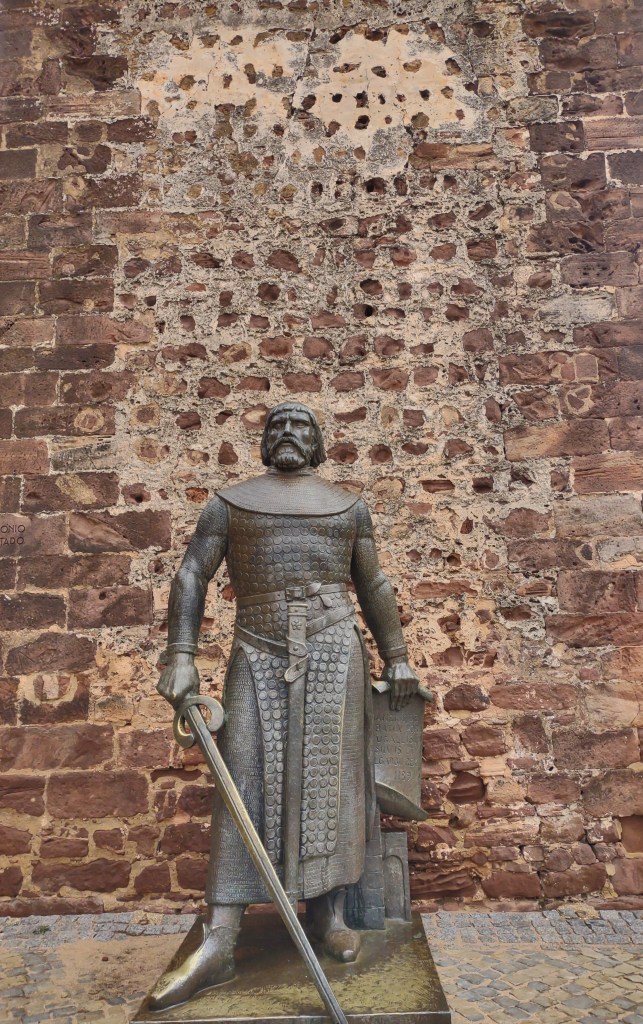
The Christians had a couple of goes at taking the castle and the town, and they first succeeded in 1189 under Sancho I, King of Portugal.
Here’s the man himself, standing outside the castle walls. In the words of the official chronicler of the Almohad court – excuse me while I translate from the original Arabic…
“and, behold! the Infidel has arisen. May mighty Allah – good grief look at the guns on that guy! He must be twelve feet tallas well. Has the enemy discovered anabolic steroids already? My brothers, we need to scarper!”
A few years later the Moors retook Silves, having realised it was just an over-the-top statue. But the Reconquest would not be stopped, leaving behind a nice old town with delightful traces of the Moorish years.
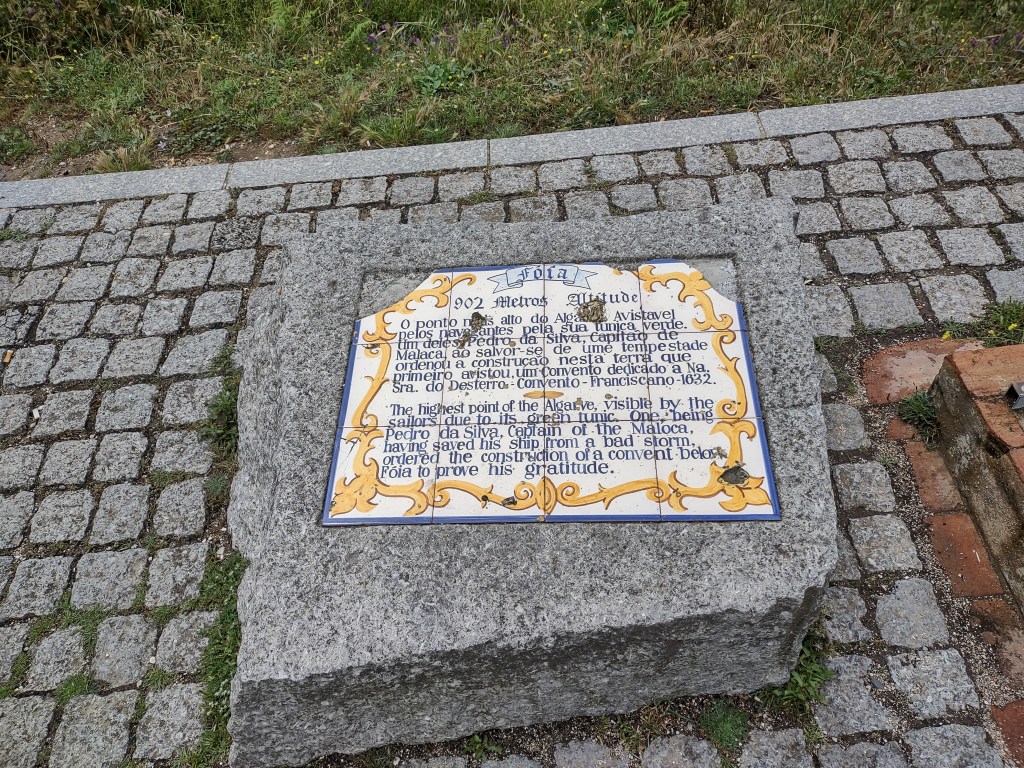
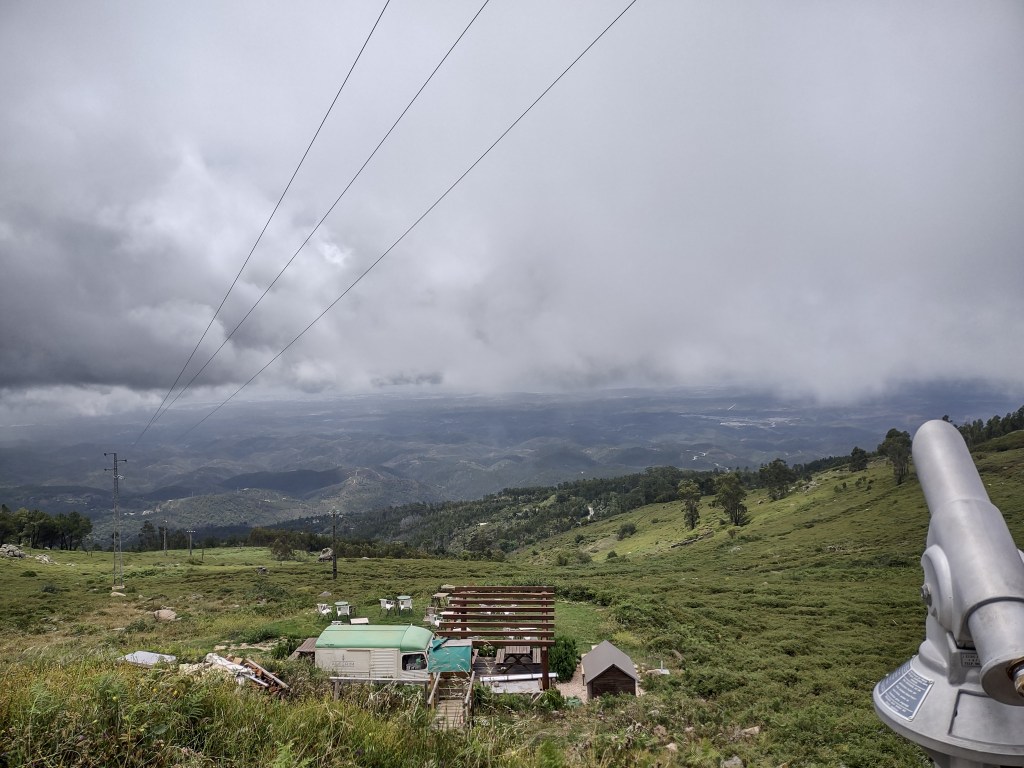
After a drive up to the highest peak in the Algarve…
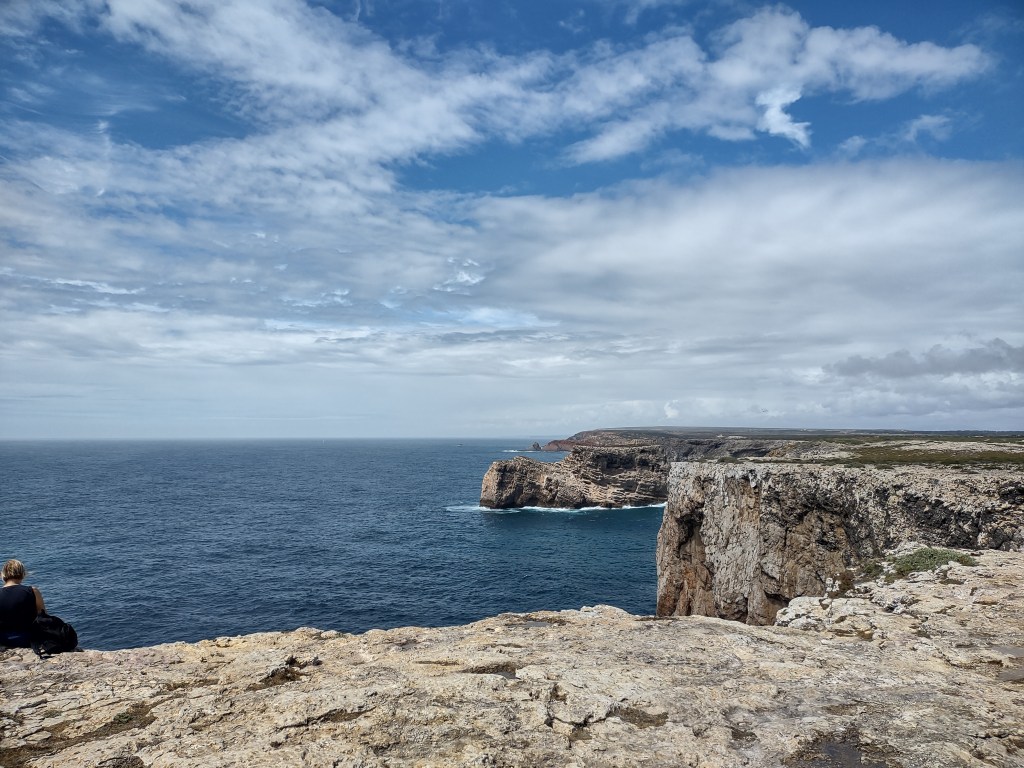
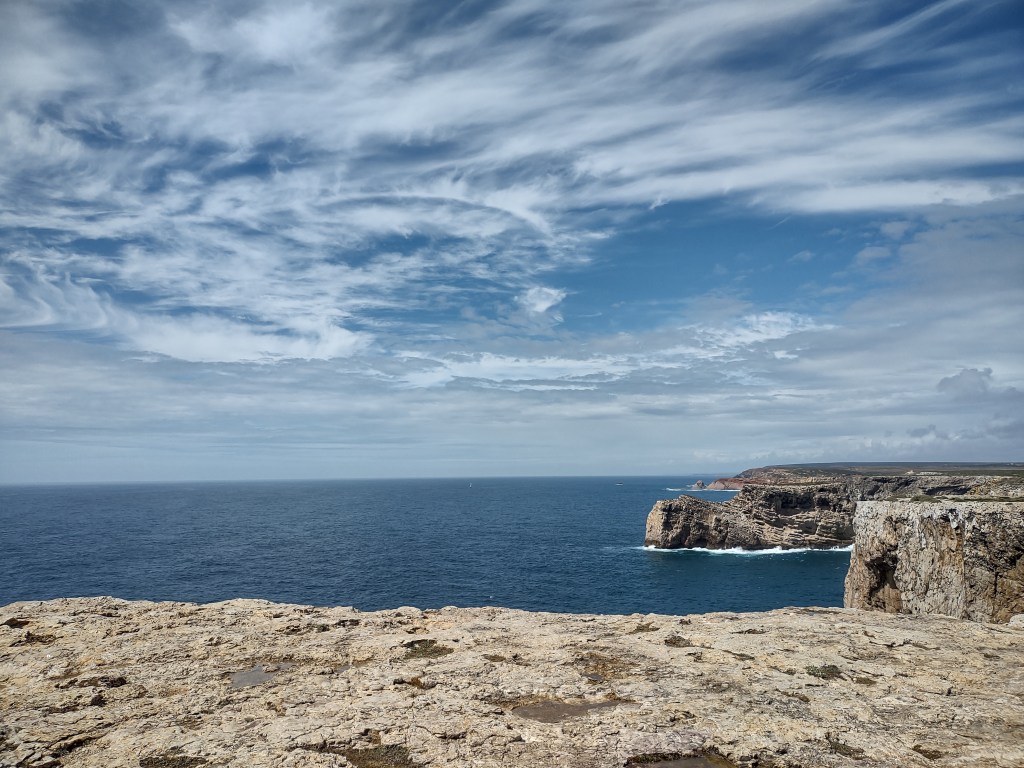
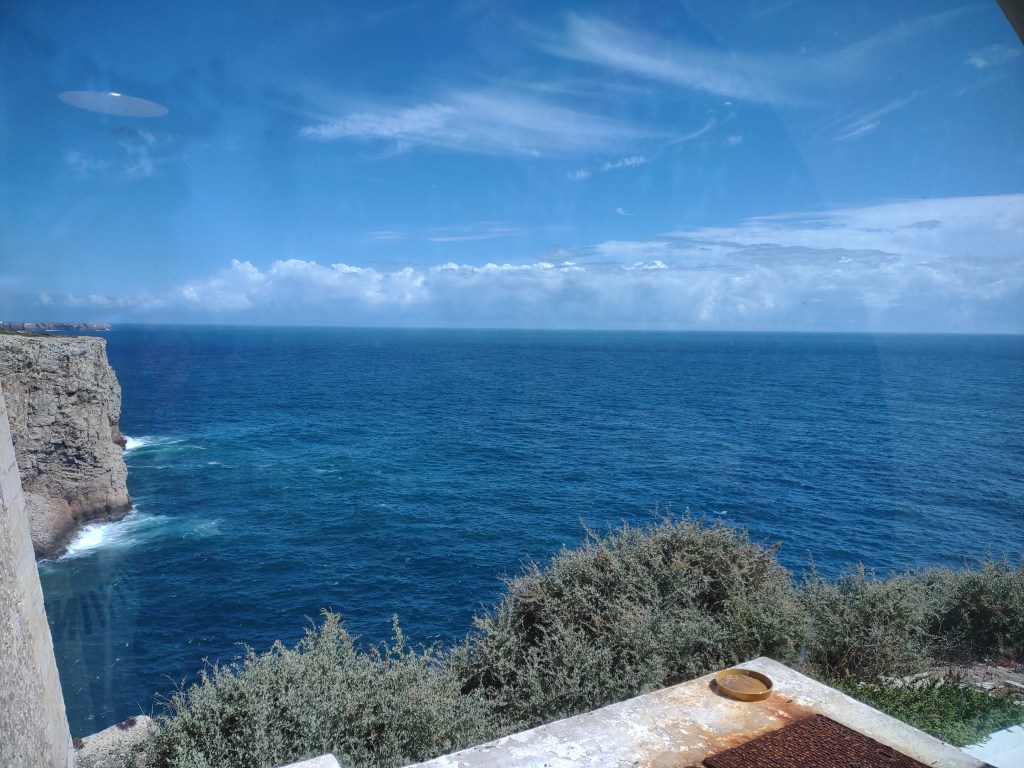
…it was time to head out to the south-west, and I mean the south-west. Cape St Vincent is the south-westerly point of the whole of Continental Europe.
The western shore, looking towards America. (Good luck with that.)
An important spiritual center since prehistoric times, there is a legend that after the Muslim takeover, the Moors brought the relics of St Vincent here so that the Christians wouldn’t know where to go to venerate him. Fortunately, the saint’s raven friends were on hand to protect his body (as they had done after his martyrdom) and so around 1187 the reconquesting Christians knew where to find him. To quote from the Ludex Pontifexus Dominus of Pope Alexander III – let me just translate from the original Latin…
“Your Holiness, Vicar of Christ – listen, the raven is trying to tell us something! [Latin for “chirp, chirp”.] He’s buried where? ”
The relics went off to Lisbon Cathedral where they remain to this day. It’s not recorded whether they gave the raven some well-deserved worms. If they hadn’t, well that would be crazy, almost as crazy as the Moors trying to snuff out a religion by just burying its relics at an enormously resonant location, rather than just throwing them over the cliffs.
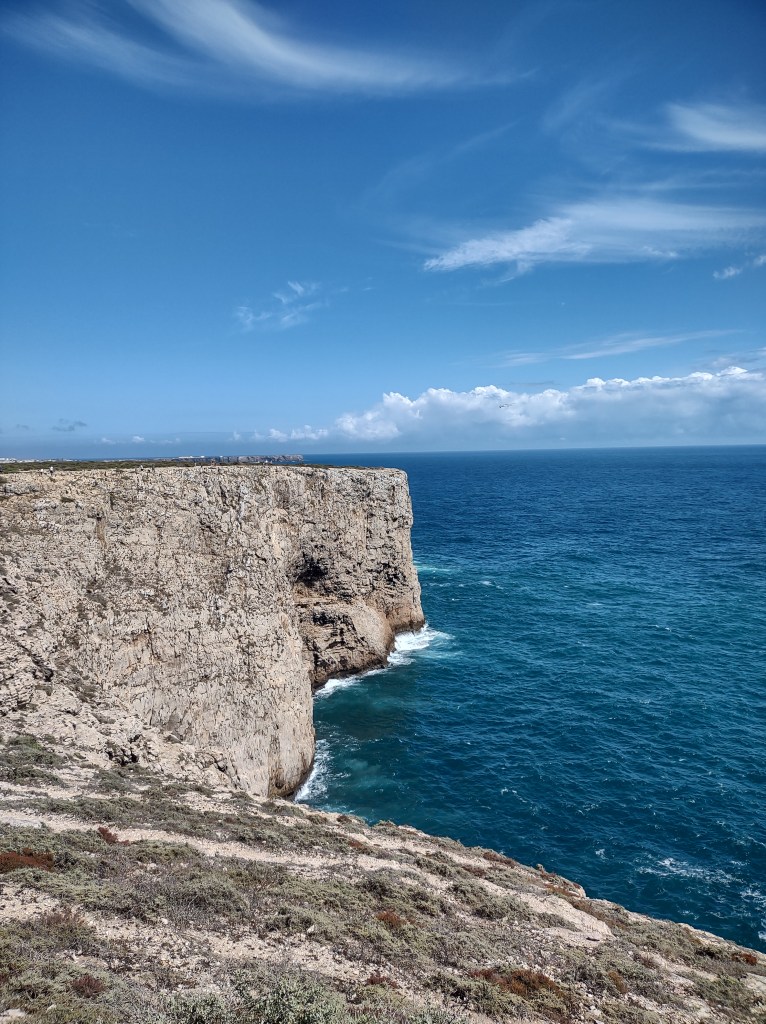
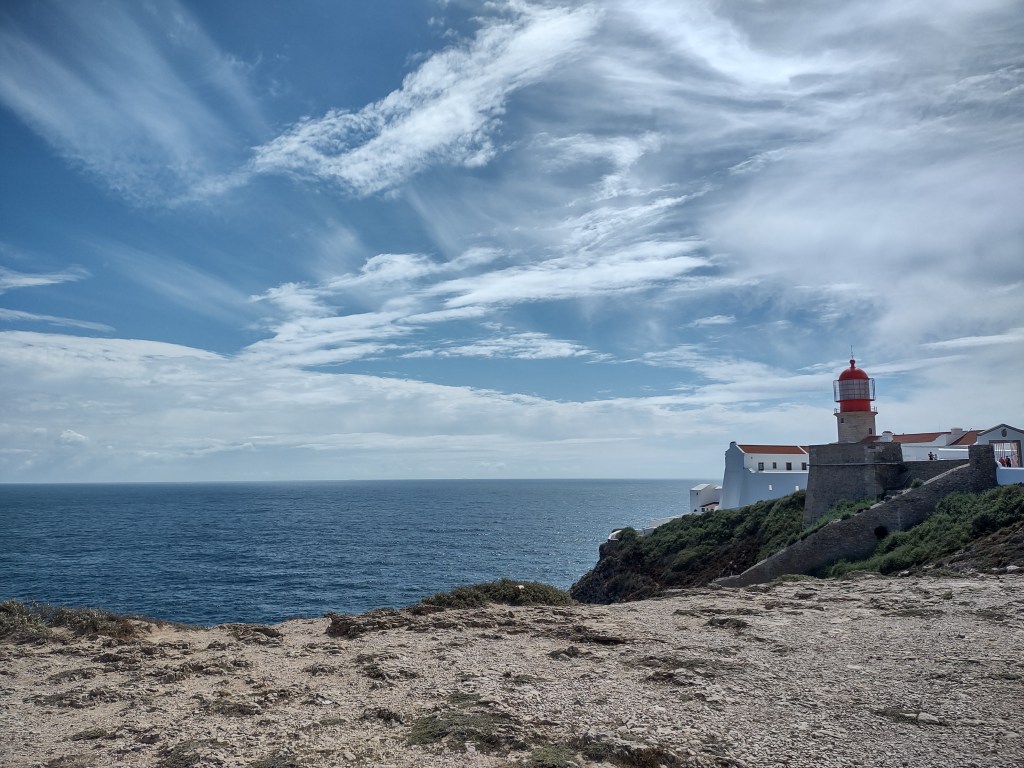
The southern aspect, looking towards Morocco. (Don’t bother with that one either)
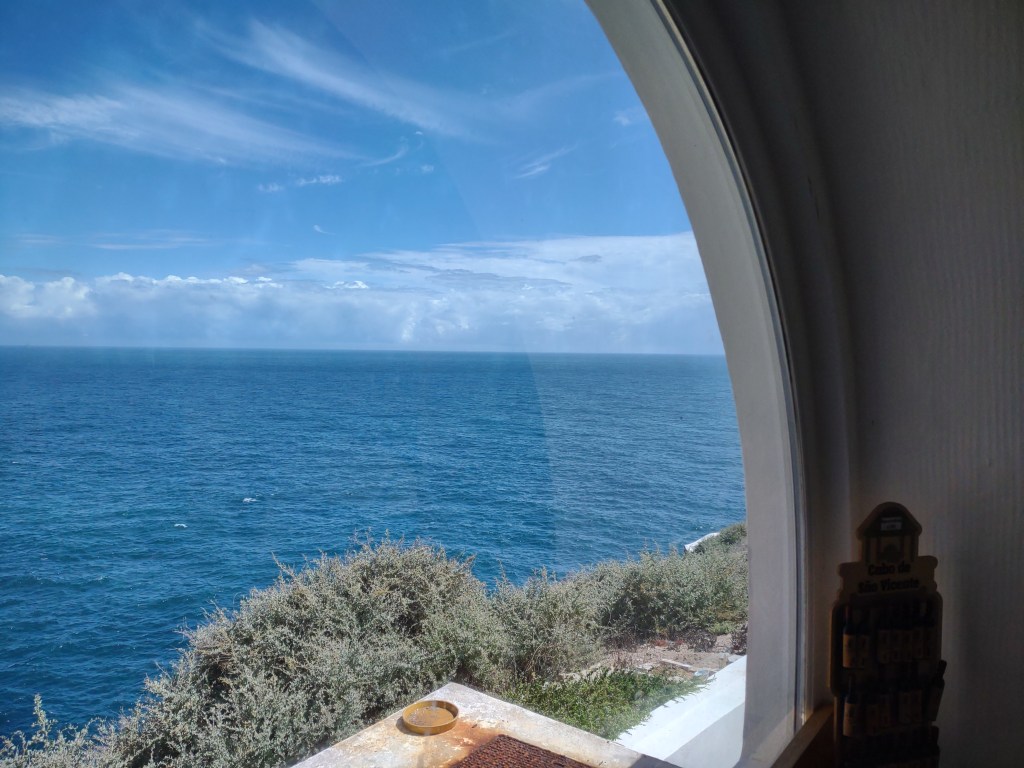
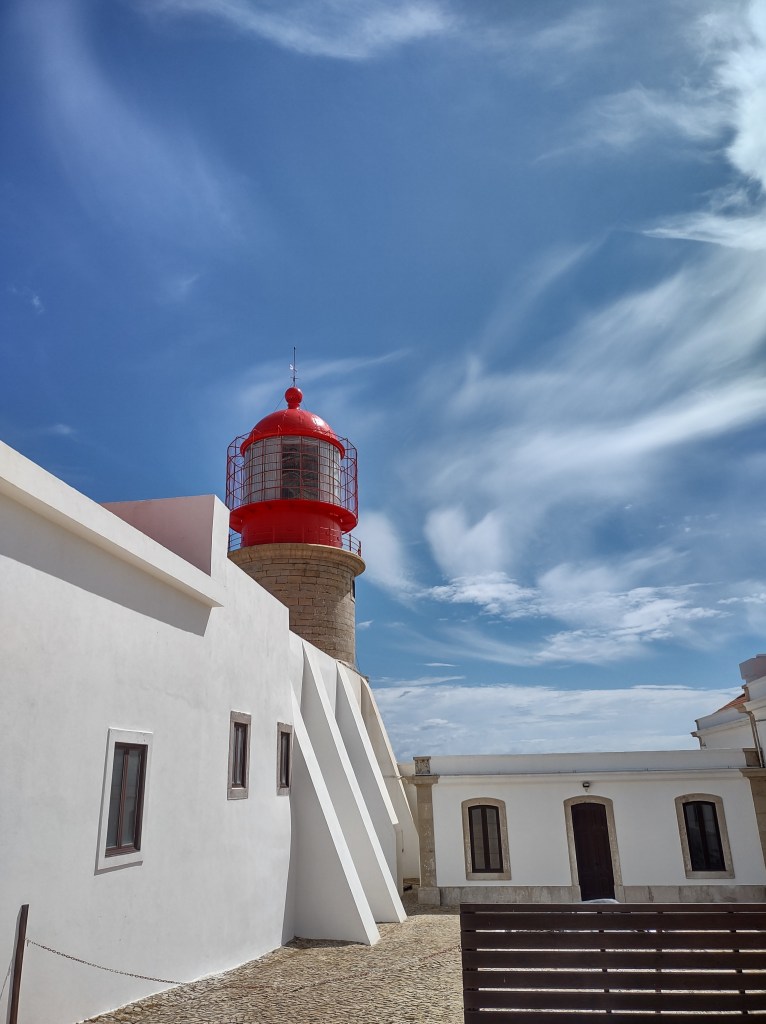
And a resonant spot Cape St Vincent is, even with the coachloads coming in to experience it. A lighthouse stands right on the edge of the main promentary, and unless you work there the closest you can get to the south-west point is via a window in the gift shop.
It’s somewhere to the right, behind the cashier and the postcards.
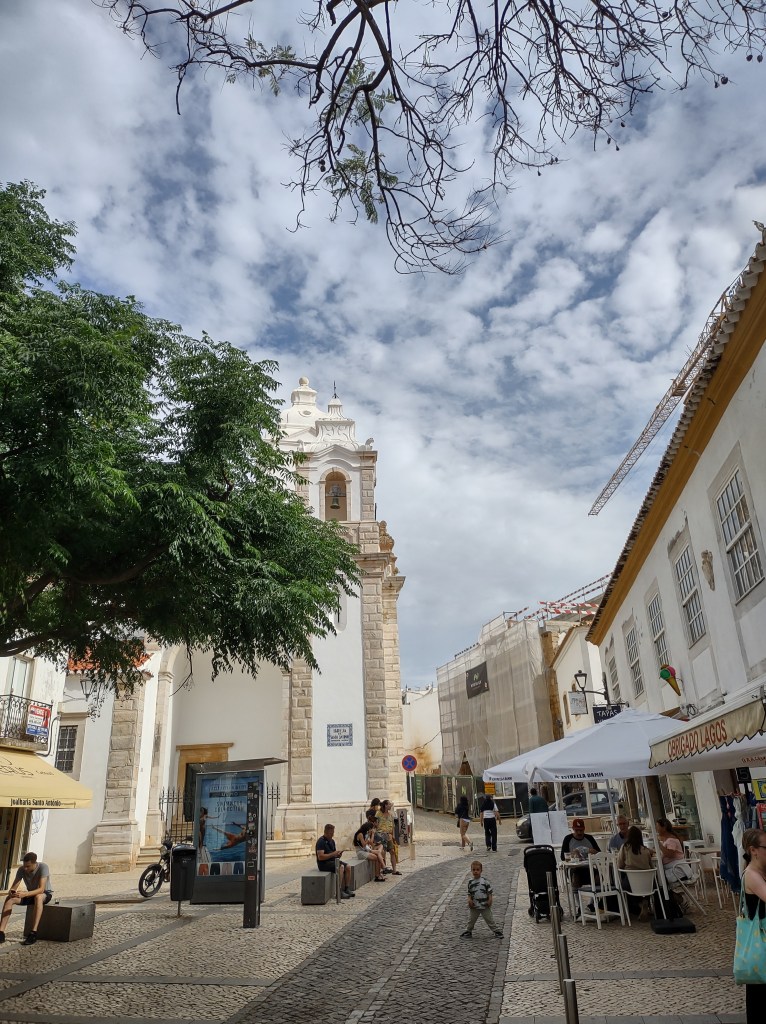
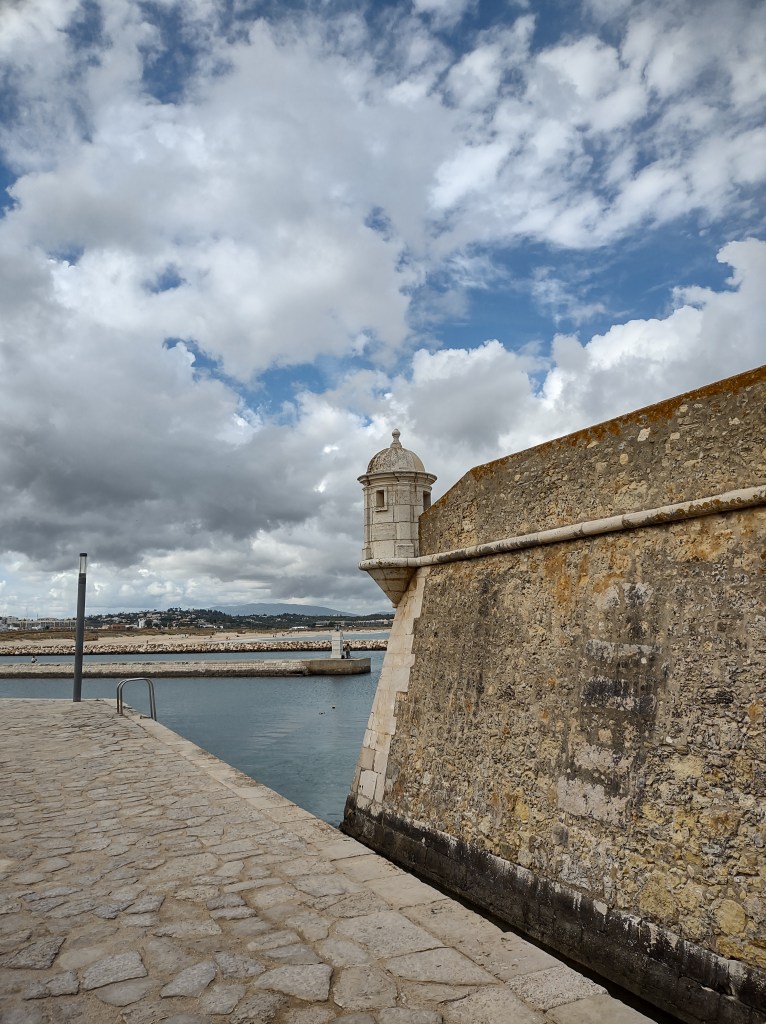
After the cape the tour headed back, making a final stop at the coastal town of Lagos (here pronounced, Portuguese-style, as La-gosh.)
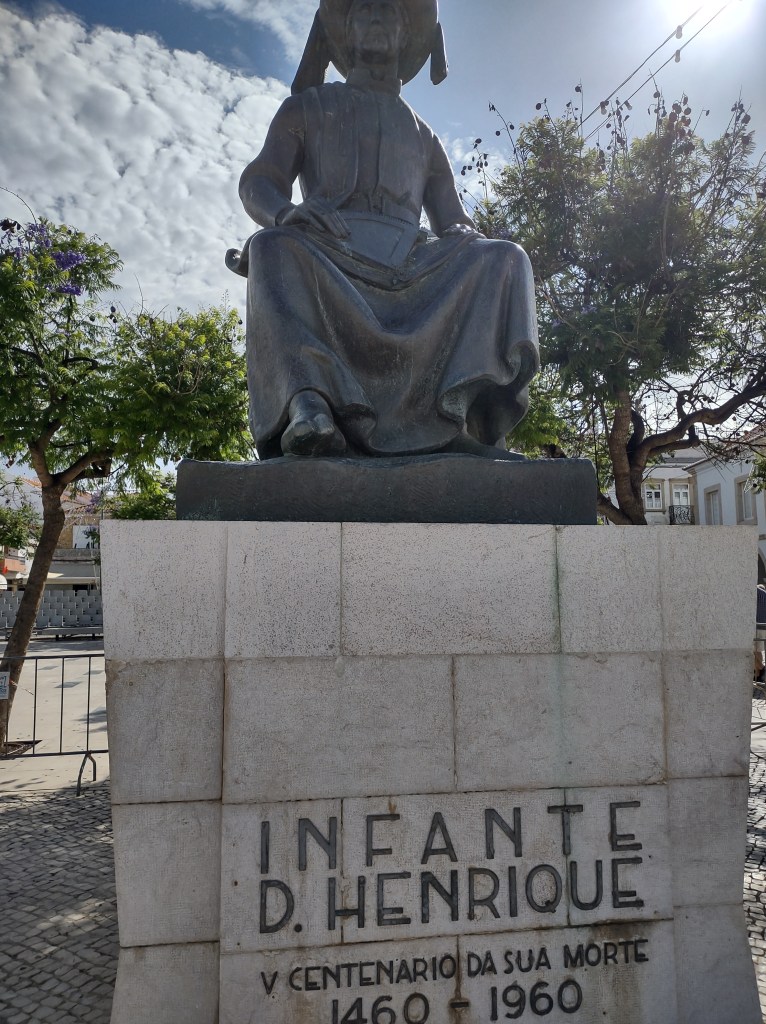
Here’s Henry the Navigator, the prince who set about making Portugal a great seafaring nation, creating a school of navigation down the road at Sagres. It was from Lagos that some of the earliest feats of Portuguese exploration slipped anchor. One of the most famous locals was a sailor called Gil Eames, who managed to get his ships around the West African coast.
A lovely little spot, Lagos, full of history, worth a longer stay.
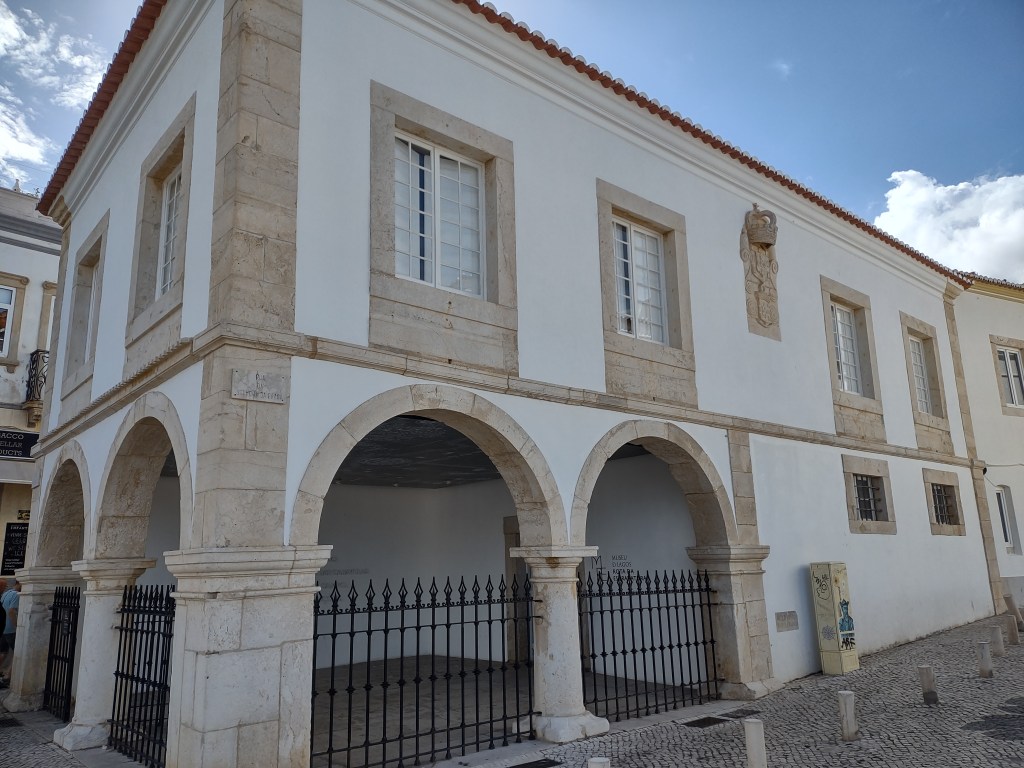
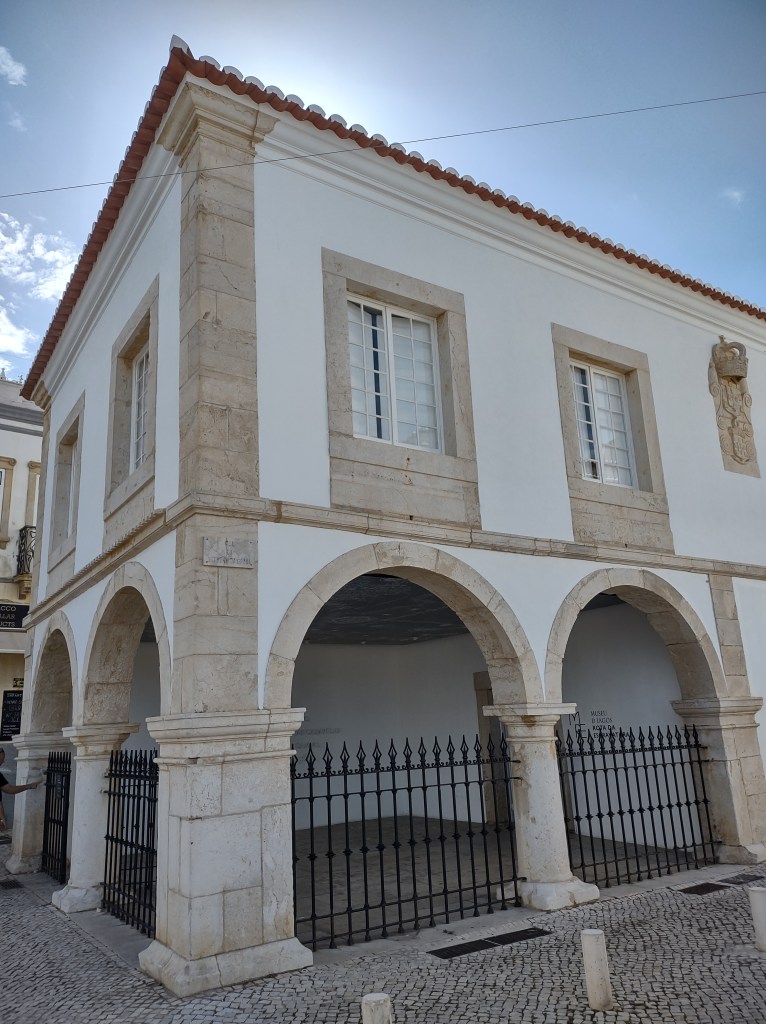
Ah, here’s a nice little collonaded spot. Charming.
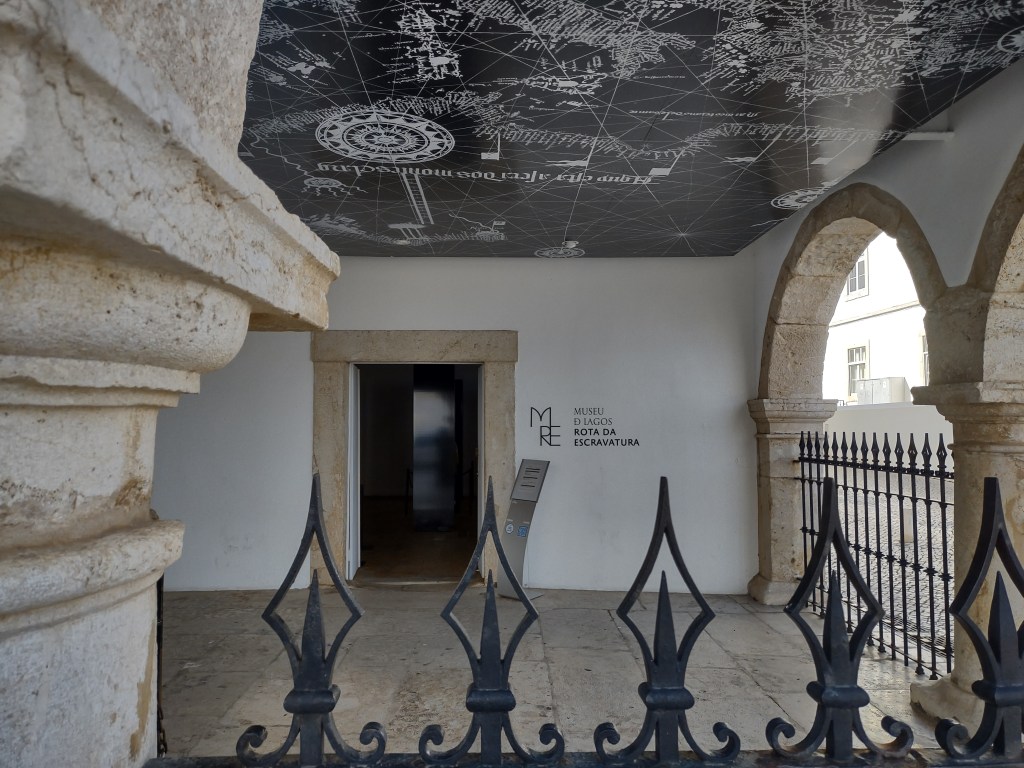
There’s a little museum inside, which I arrived too late to visit. Never mind, let’s check out the guidebook. Such a pleasant town this.
…riiight. It’s the oldest slave market in Europe.
Let me translate from the original chronicles – sorry everyone, no jokes this time.
A sobering and appropriate point on which to end this quick tour of a fascinating region with a rich, diverse, complex heritage that continues to influence – and haunt – the world of today.
They say that Lisbon is built on seven hills, like Rome. I’m sure I climbed dozens more during my short stay, and my legs and back muscles are claiming they bagged hundreds. But the cliche does hide a truth; it’s a hilly city. To really get the most out of it (I’m not sure I did this time) you have to face up to the climbs. There are ways of mitigating the challenge, which we’ll come on to (and which you probably know about already).
I spent four days there. As I write it all up in my new – and very different – location, I checked and found that I didn’t take as many photos as I thought I had. So this will by definition be a whistle-stop tour of what I saw and what it meant. And it’s a city I will need to return to someday to fill in the gaps, so what follows is not exhaustive.
Lisbon is a large harbour city, but for the purposes of the exercise just concentrate on the northern bank where the heart of the city lies. I’ll simplify it further; there’s a hilly western bit, the flat bit in the middle, and a hilly bit to the east. Which is the bit we’ll look at first. The Alfama.
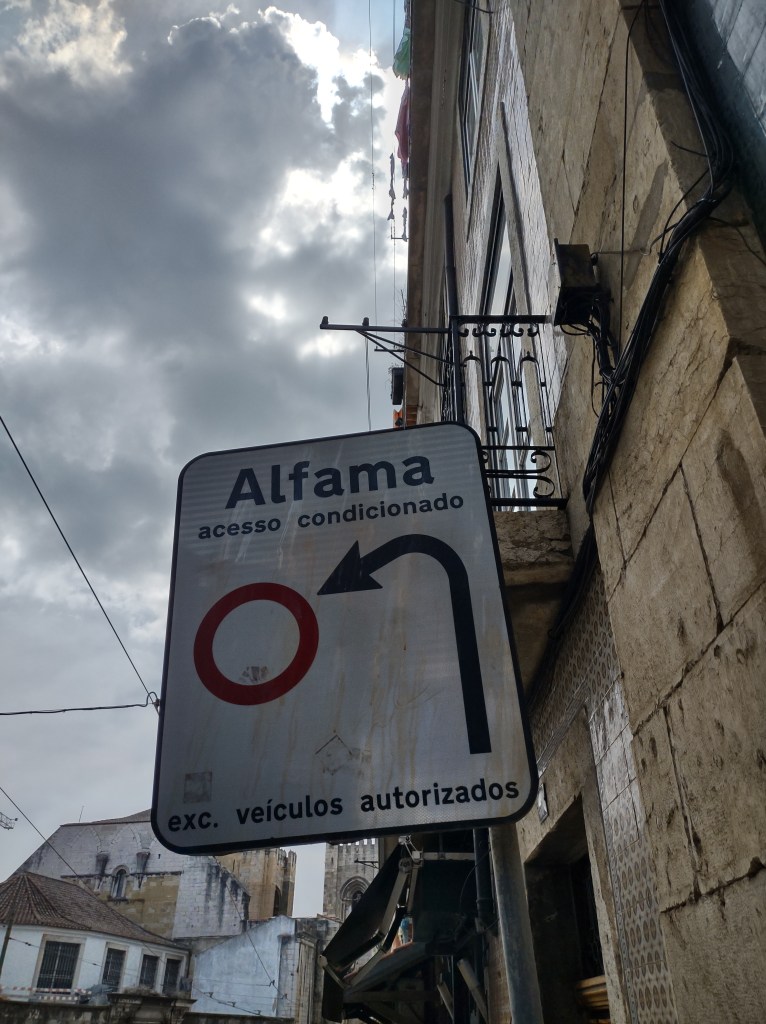
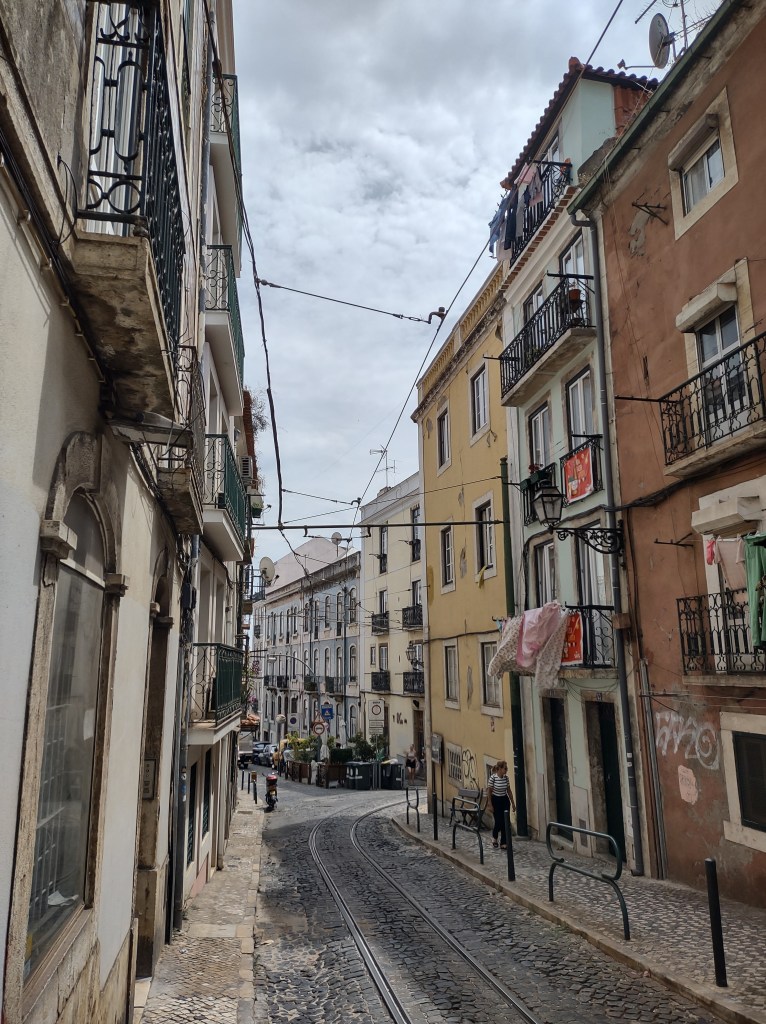
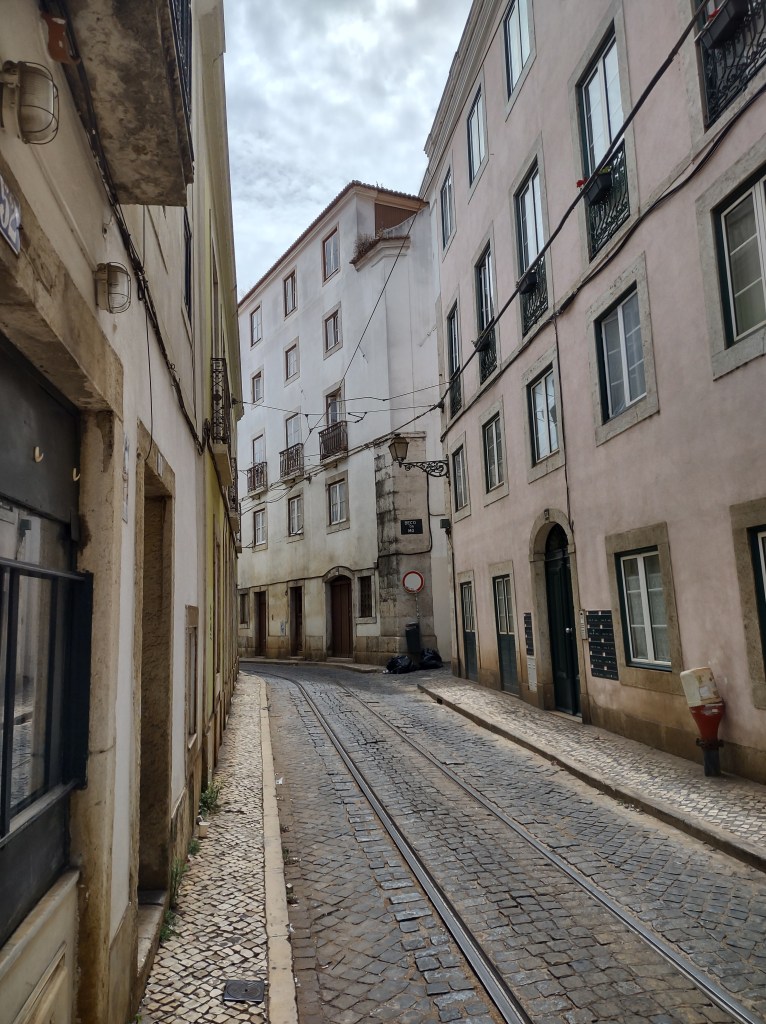
Moorish Arabs ruled southern Portugal from the 8th to the 12th century, and wherever Moorish Arabs went, they left a medina. The oldest part of the city, the Alfama has the incredibly narrow streets you’d expect, it’s just that they are perched up on steep slopes and if you were living here you don’t want to traipse up all the way from the centre of town only to discover you’d forgotten the milk. It’s no surprise then that the Alfama is also the most intimate and villagey of all the central districts, and if you come up here you’d find it hard to believe you’re in the middle of one of Europe’s great capitals.
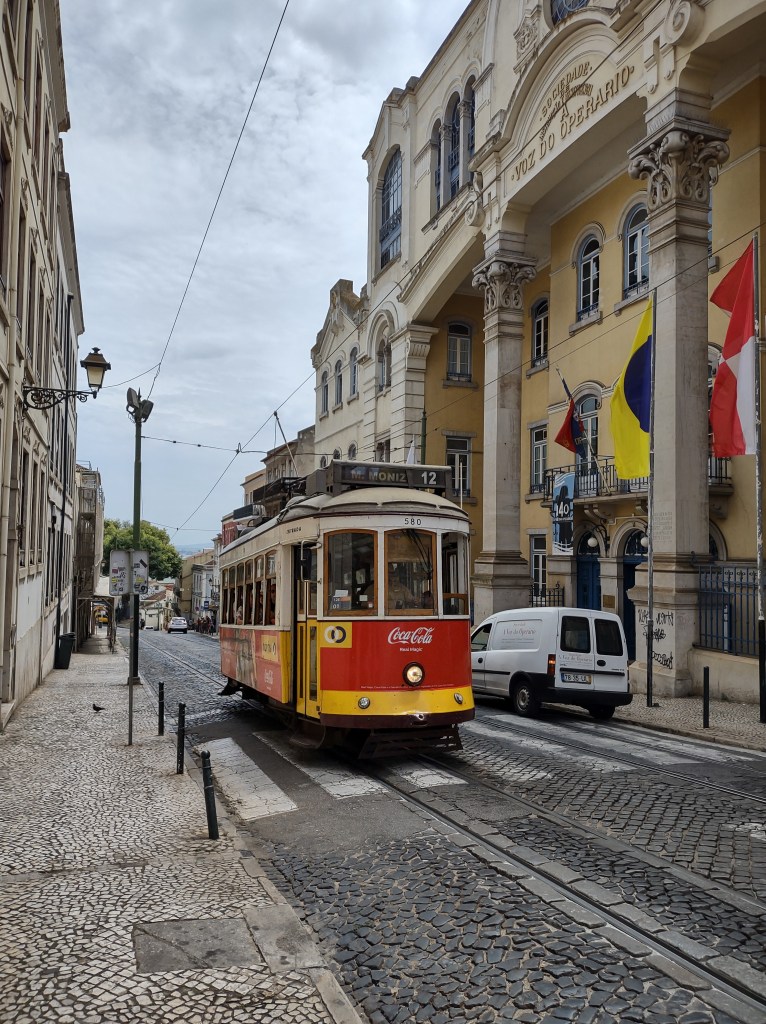
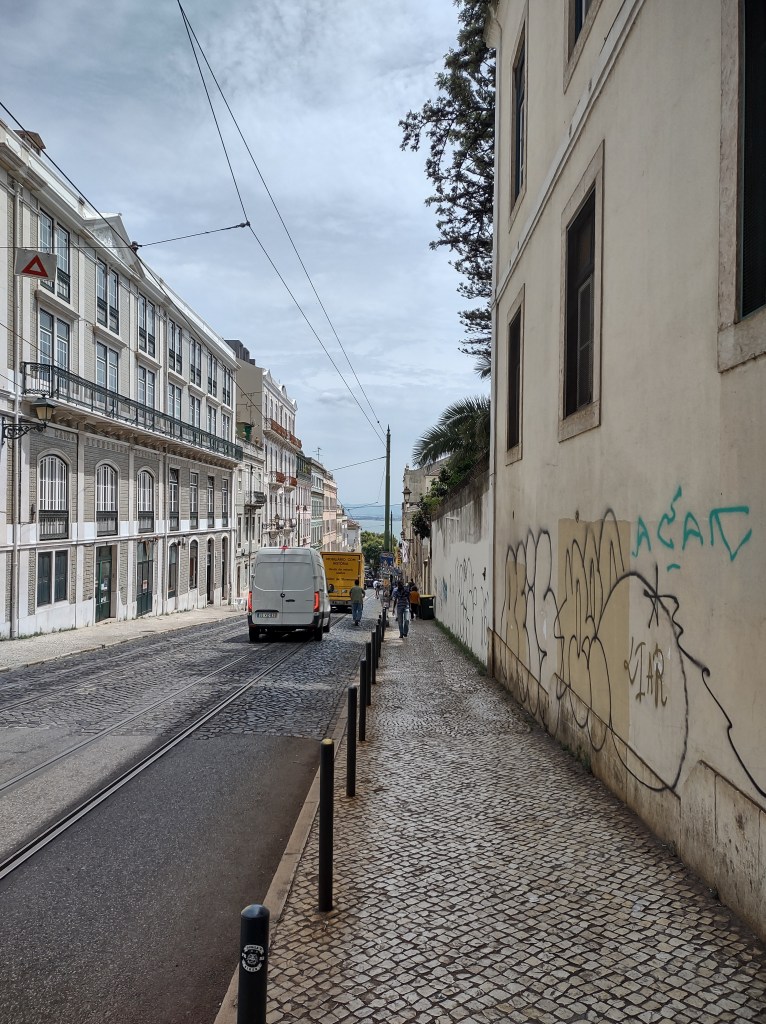
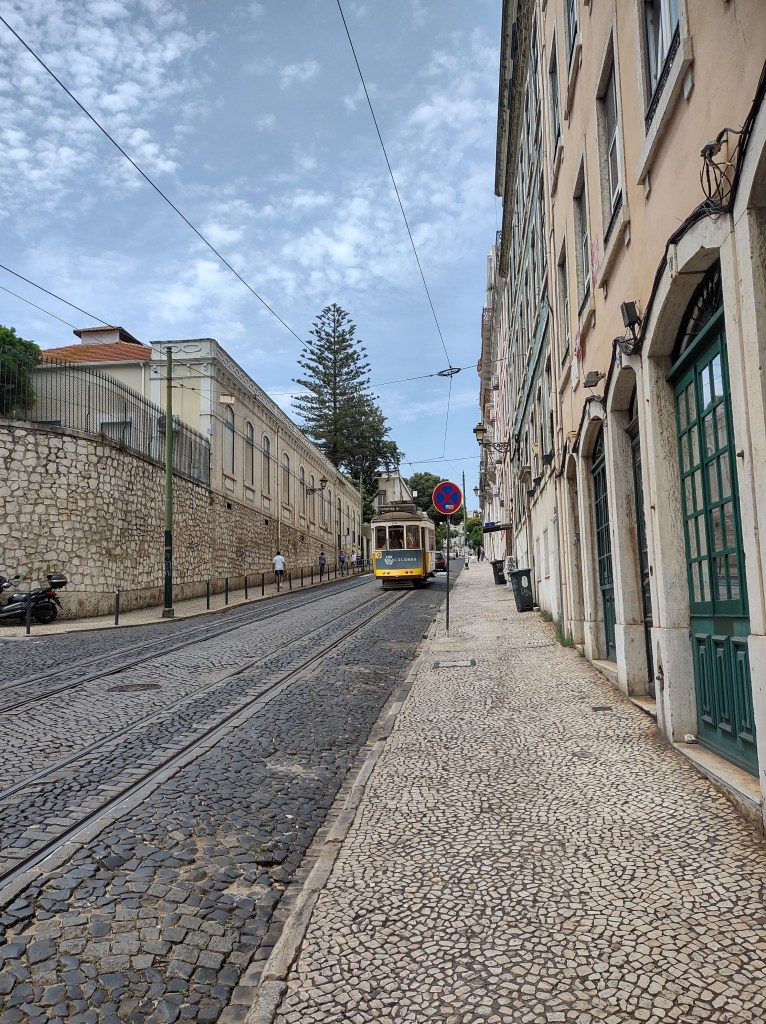
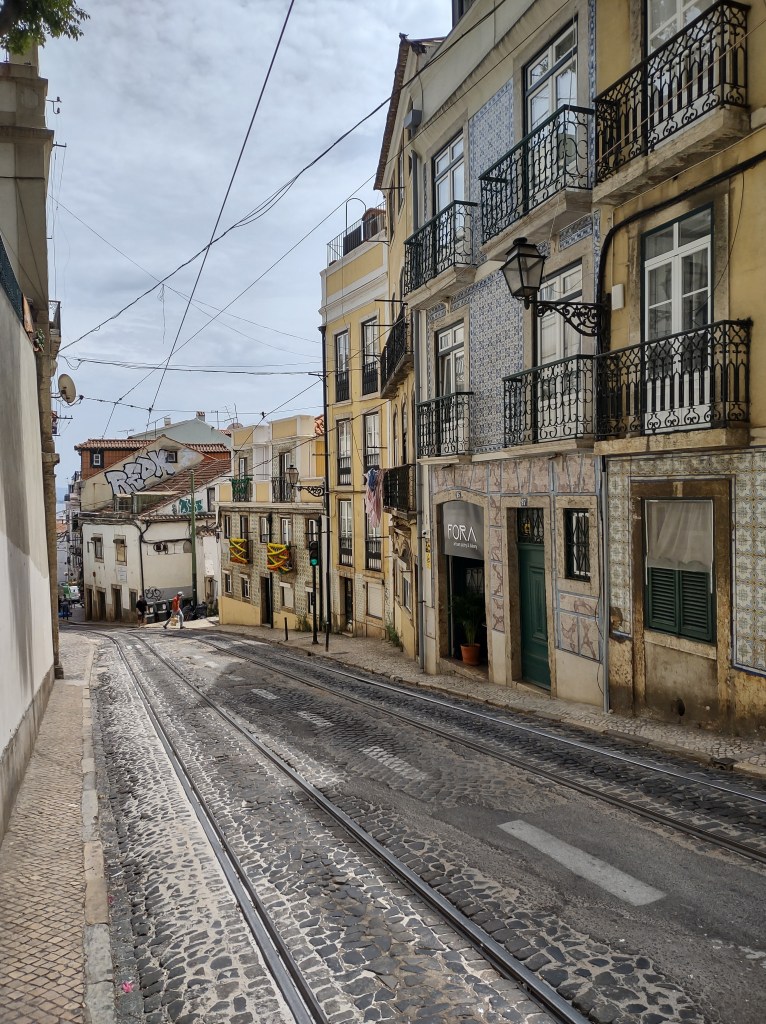
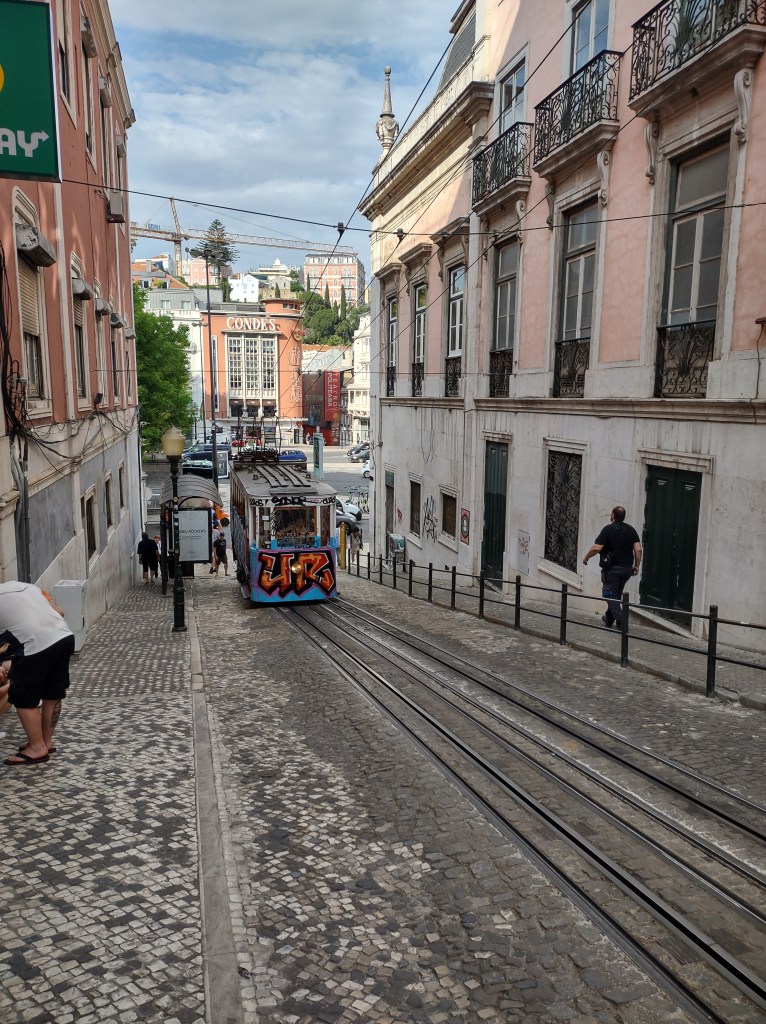
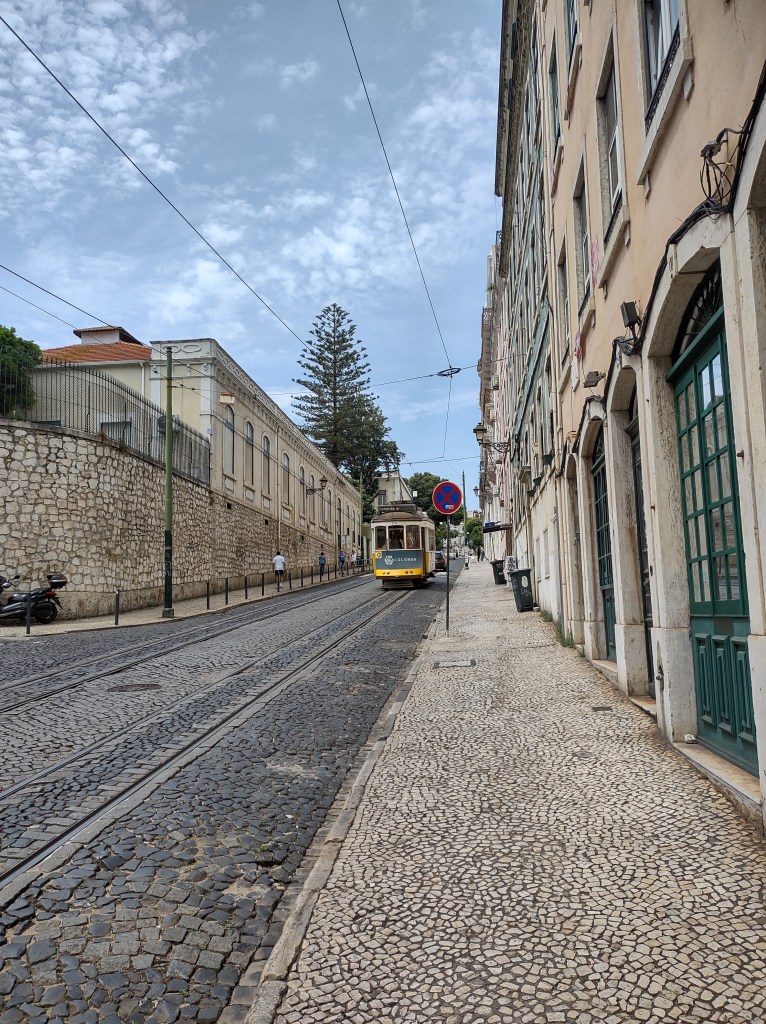
Lovely place, and it would be lovelier if you could get around it. The western hilly bit is also steep in places, and so in the late-19th century the city worthies installed a horse-drawn tram system. The old electric teams still run the routes, and they have become as symbolic of Lisbon as the red double-decker has of London.
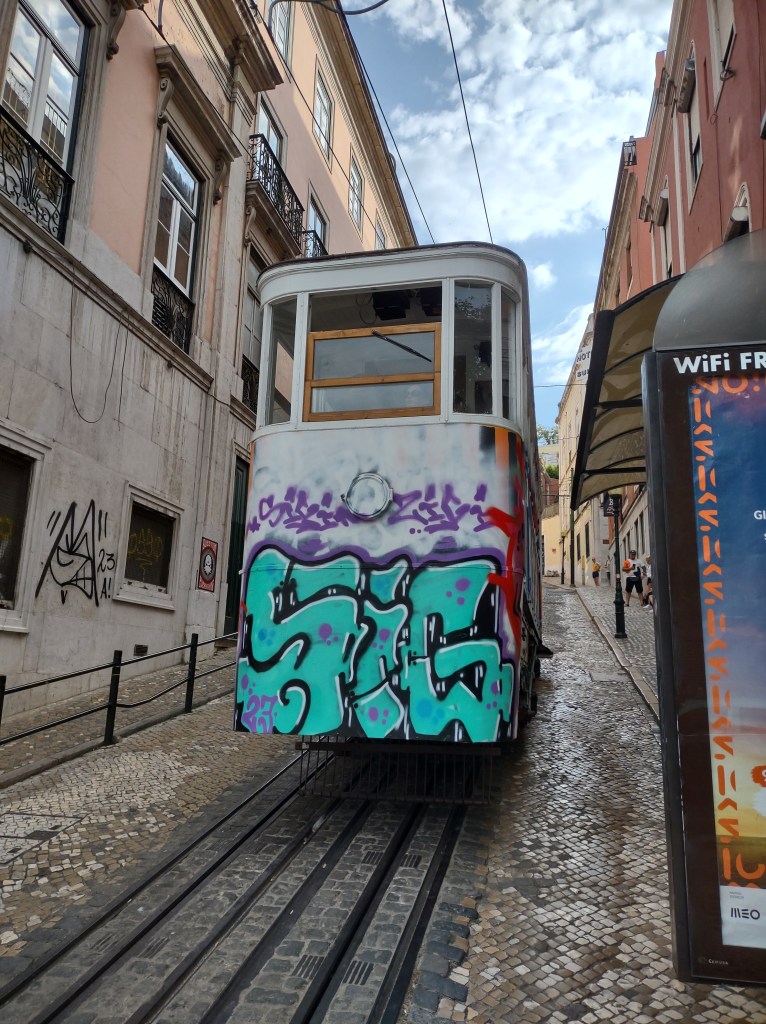
Though maybe in London our buses don’t get quite as graffitied as the Lisbon funiculars. Especially if there’s no garage.
The most famous of the Lisbon trams is no. 28, running past the biggest sites in the west, the middle bit (the Baixa) and the Alfama.
But add “most famous” to “small tram” with a touch of “heavily-touristed”, and you end up with long queues to get on. Unless you know where to get on. Instead, I decided just to walk the route down through the Alfama and take some photos. Have a look at them, but to get the full Lisbon experience you need to imagine you can only glimpse a tiny bit of each one while being thrown around hanging onto a strap and getting up close and personal with some American guy’s sweaty armpit.
We finally make our way down into the central strip, the Baixa.
There’s also one great plaza, we’ll come onto it later. The Baixa dates back to the 19th century, completely replacing the old Alfama- and Manueline-style buildings that were here before.
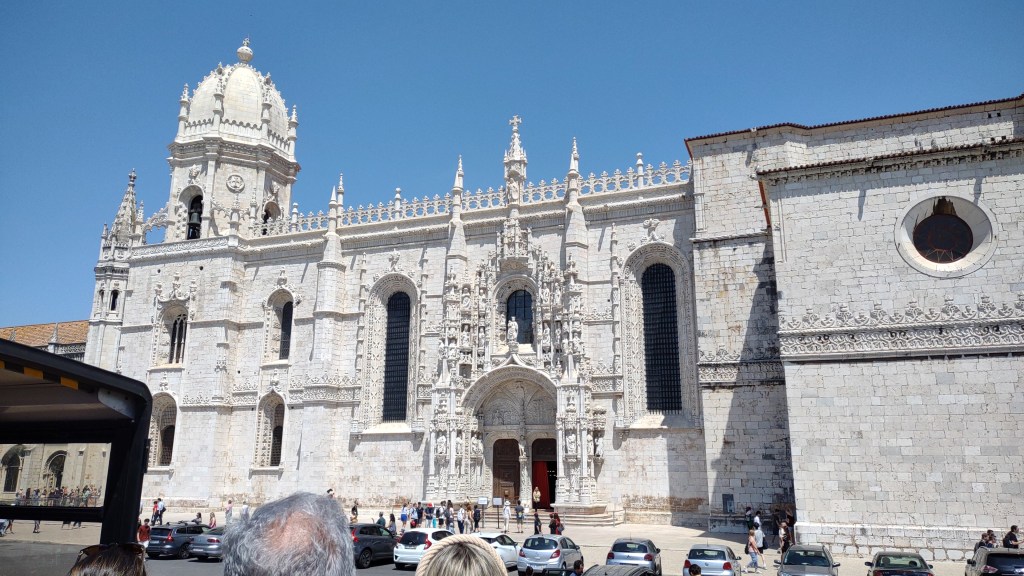
I’ve not spoken about the Discovery Age buildings of the Manueline, though you have seen the Belem Tower. Here’s the nearby Belem Palace.
Rather stunning, you’d agree. And you’d agree that the Alfama was pretty cool. But hardly any of it survives in the Baixa. Why would they want to get rid of so many fine buildings?
Well they may have wanted to modernise anyway, but the truth is their hand was forced. To understand more, up we go into the western districts of Barrio Alto and Chiado.
It is the 14th of August 1385, and Nuno Álvares Pereira is a worried man. He is a soldier in the Portuguese army, and here in central Portugal, near the town of Aljubarrota, the home team are facing a vast Castilian Spanish force. Lose, and they can say goodbye to Portuguese independence.
No pressure then, thinks Nuno through gritted teeth. It’s bad enough being a common footsoldier. Imagine having to lead this outnumbered army into a battle against such overwhelming opposition, when the stakes are so high.
Unfortunately for Nuno Álvares Pereira, the man in charge of the Portuguese is Nuno Álvares Pereira.
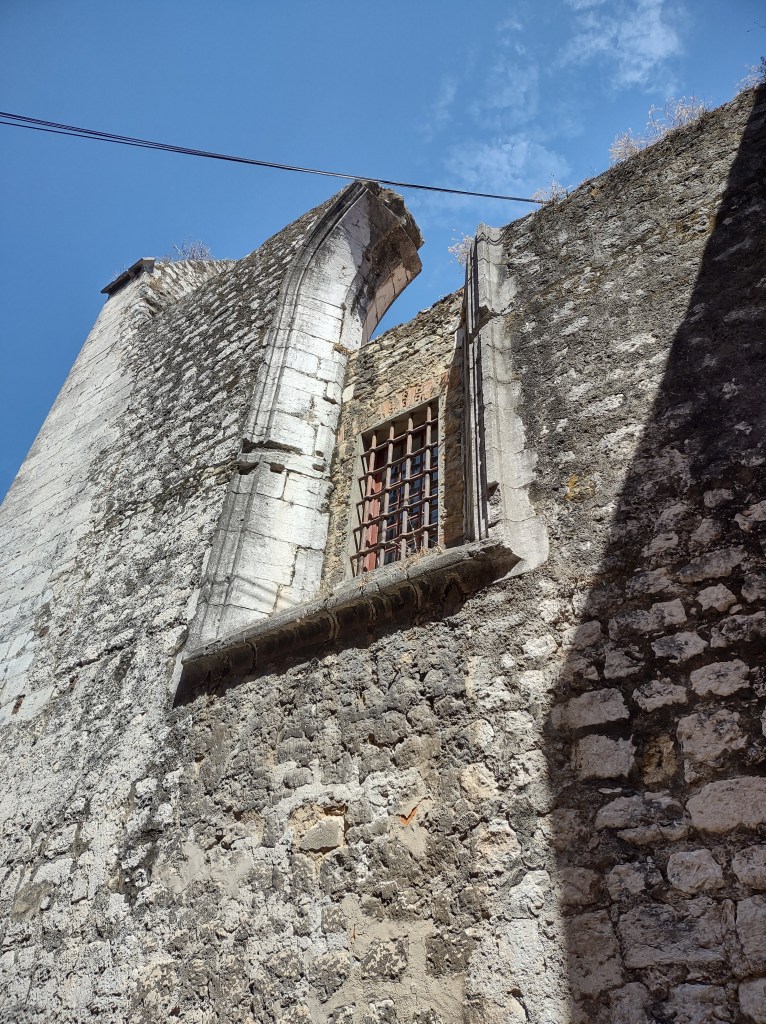
With all hope apparently lost, Nuno makes a bargain with the great Military Strategist in the heavens. If we win, I promise to build churches across Portugal, in particular the Carmelite convent in Lisbon, and dedicate them to you, Holy Mary mother of grace. Yes, holy mother of Jesus, it’s the one without a roof near the top of the most rubbish tourist trap in Lisbon, the Santa Justa lift. Except that the alfresco bit will come later. As will the lift. Anyway, Holy Mary, I pray to you, help us!
And – by the grace of God – the battle of Aljubarrota was a shock home win! Up went the churches, and up rose the convent. And so Lisbon survived and flourished under the blessed protection of heaven, discovered an empire, enjoyed riches beyond compare.
There were of course the odd hiccups – the odd conflict with Spain, competition with the Dutch and the British empires, even – God forbid – an earthquake every now and again. But Lisbon thrived, and no doubt the good people of the city had much to thank the Lord for as they congregated in the city’s many fine churches.
And such a day of congregation was All Saint’s Day, 1755. Once again the churches were packed with the devout citizenry, and maybe some within the convent walls thought of Nuno’s promise and gave thanks to the Virgin Mary for her continuing benevolence to city and nation.
Which was a mistake. If the Virgin had blessed Lisbon, she’d inserted some very small print. And as the walls shook and tumbled upon the congregations across the city that November 1st, the warranty ran out.
The earthquake rumbled on for an unprecedented ten minutes or so, virtually destroying the whole city and leaving the convent roofless. Those who clamboured out of the ruins thought themselves lucky, maybe blessed. A faith strengthened by a new miracle that now made manifest. Thousands of survivors headed down towards the Tagus river, which – blessed be God – had astonishingly started to recede!
During the Age of Discoveries, the Portuguese had been the first Europeans to establish contact with Japan, but had obviously not listened enough to what the Japanese had told them about earthquakes and what happens afterwards. For it wasn’t another blessing from God. Not only had the warranty expired on blessings. He was now sending in the bailiffs…
Whatever survived the main earthquake was finished off by the massive tsunami wave that now thundered in. It’s estimated that 30-40,000 people, maybe twice as many, lost their lives in the catastrophe, Europe’s worst natural disaster for which we have record. Earthquake and tsunami were followed by fire, started by looters as they ransacked anything they could.
Meanwhile the tsunami barrelled its way through Europe, this time as a psychological and political storm surge through the academies and the world of letters. If there was a rational God, as Enlightenment thinkers believed, how could he let something like this happen when people were in church? Voltaire, for one, lost his belief in Optimism after the earthquake, mercilessly skewering the very idea in Candide. And so out from the rubble of Lisbon would emerge a more radical Enlightenment that would eventually lead to the French Revolution.
Also arising from the rubble of Lisbon would be…a new Lisbon. With virtually everything gone except the Alfama, city planners now had the opportunity they’d been waiting for, to create the 18th-century city of their dreams – Neoclassical, wide avenues, even earthquake-proof. The king having essentially given up the tiresome business of doing anything, the job fell to his PM, the Marquis of Pombal, a great social reformer as well as town planner. He is still revered in Lisbon, and his orders after the earthquake still reverberate down the centuries – “bury the dead and then heal the living”.
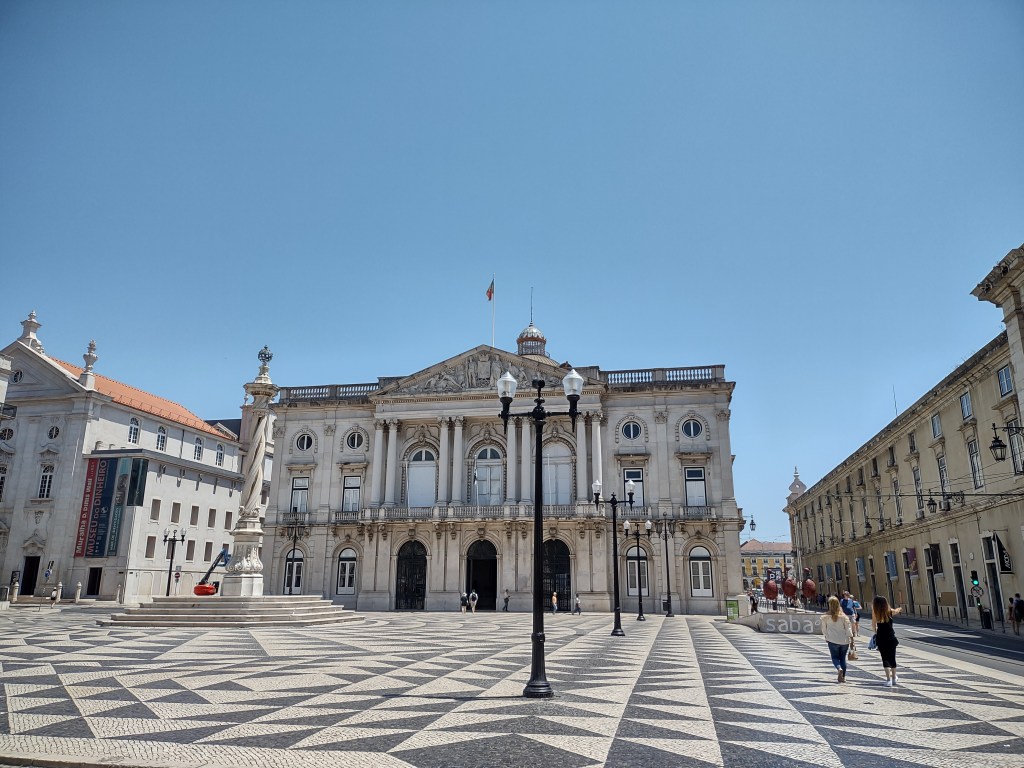
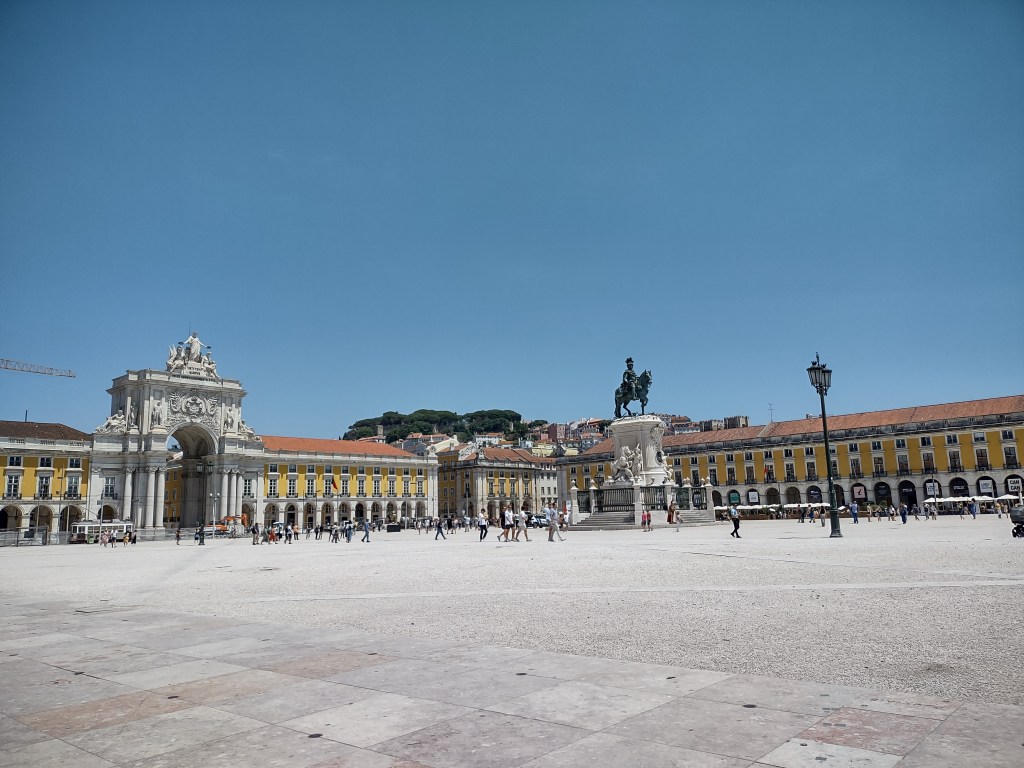
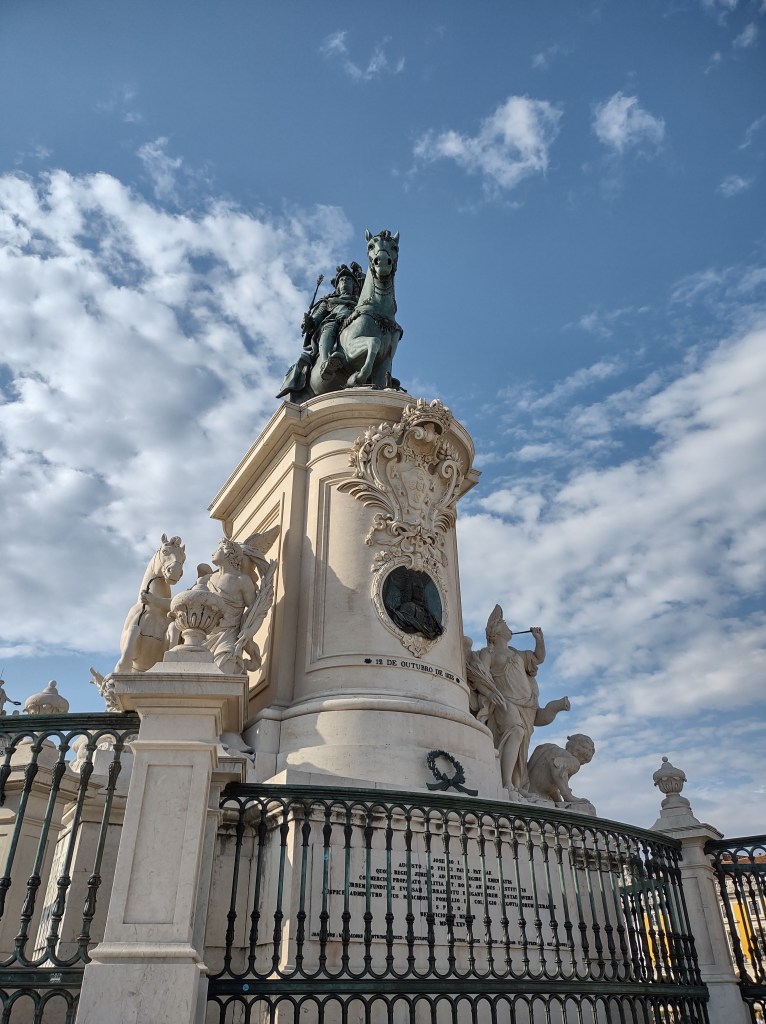
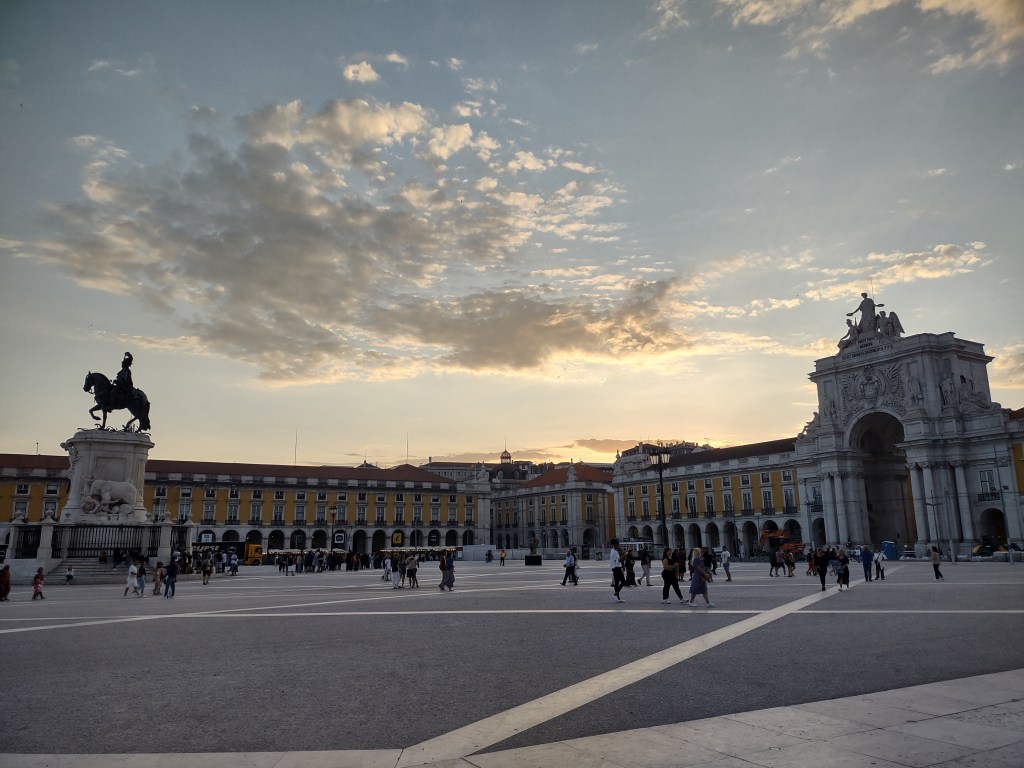
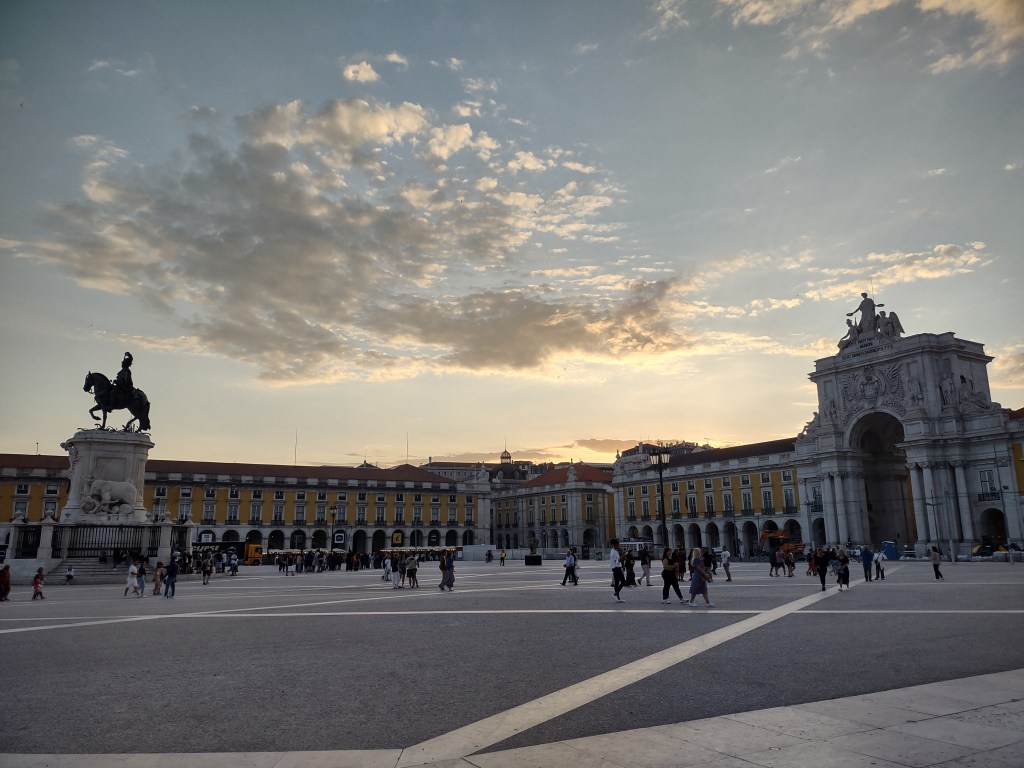
So we have the newish central strip of the city, and it runs down to the Tagus harbour at Terreiro do Paço. This is probably Pombal’s masterpiece, the great gateway to Lisbon that represents the rebirth of the city, through which countless VIPs have entered the city over time, and on which so many celebrations and festivals, commemorations and demonstrations, have been held. The true heart of the city.
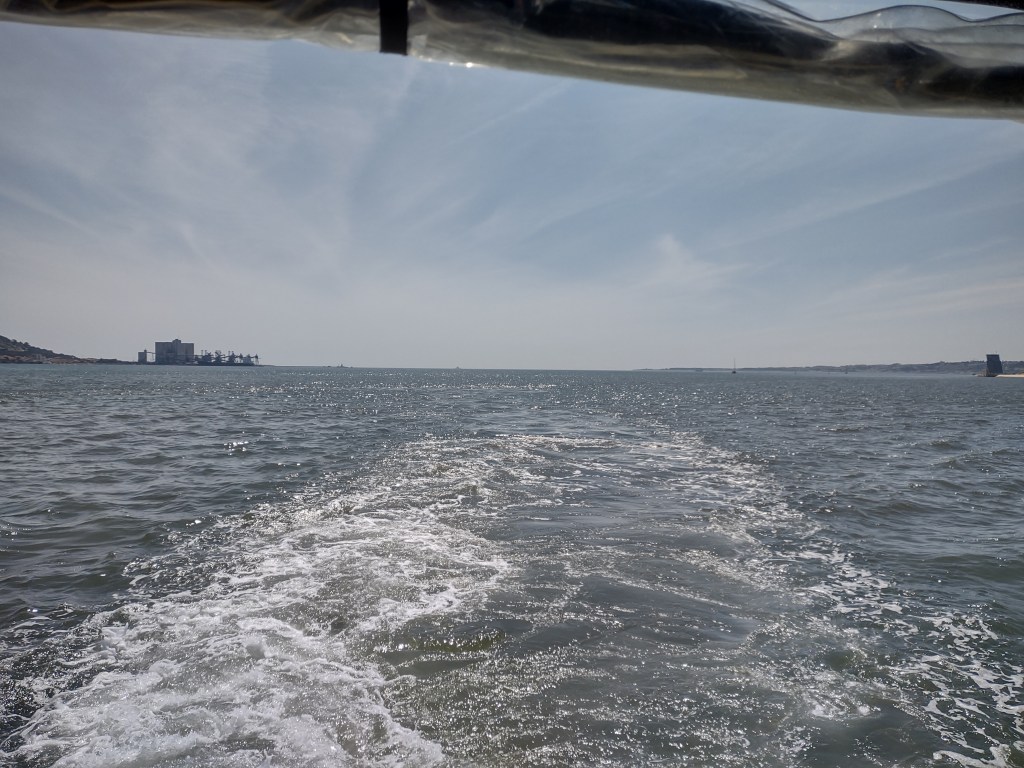
And so the mighty Tagus river, the greatest in Iberia, slips slowly out of the great lagoons of Lisbon, and out through the breakwater and into the wide Atlantic itself.
Take a look at that horizon, that gap between shore and shore, mysterious and alluring, the unknown open sea. Not completely unknown to Phonecian, Roman, Moor; the growth of Lisbon had always been rooted in its superb harbour and seaborne trade. But in the 15th century Portuguese sailors took it upon themselves to truly extend the margins of this unknowable sea, to go in new directions, to follow old directions further than those who had gone before.
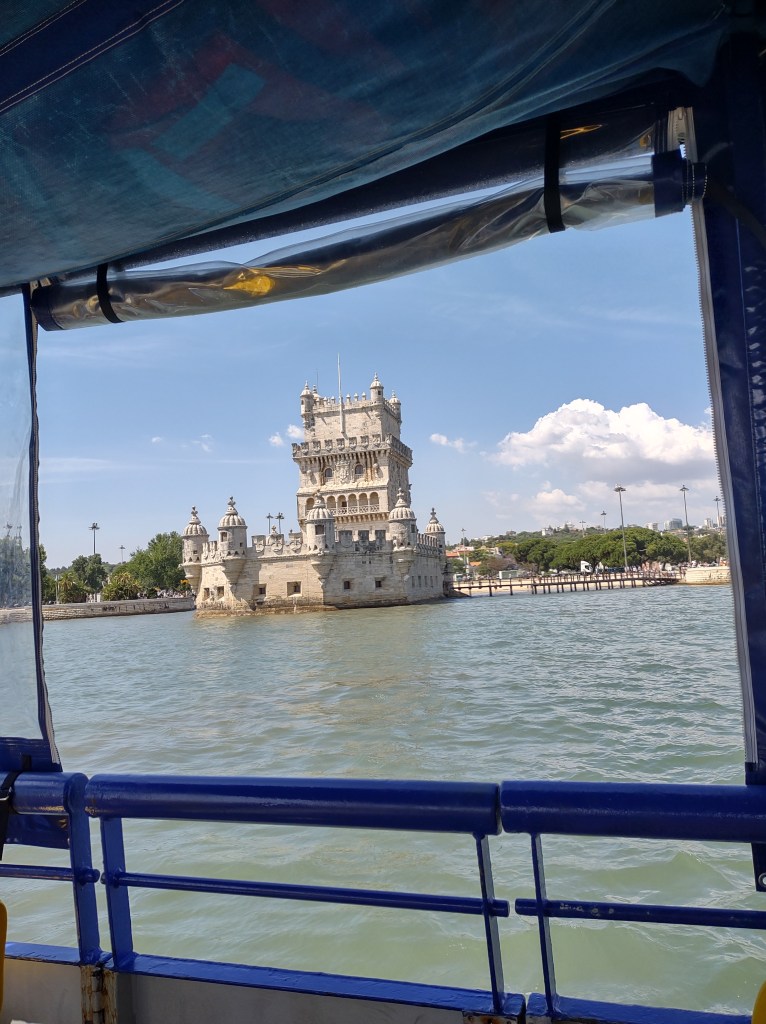
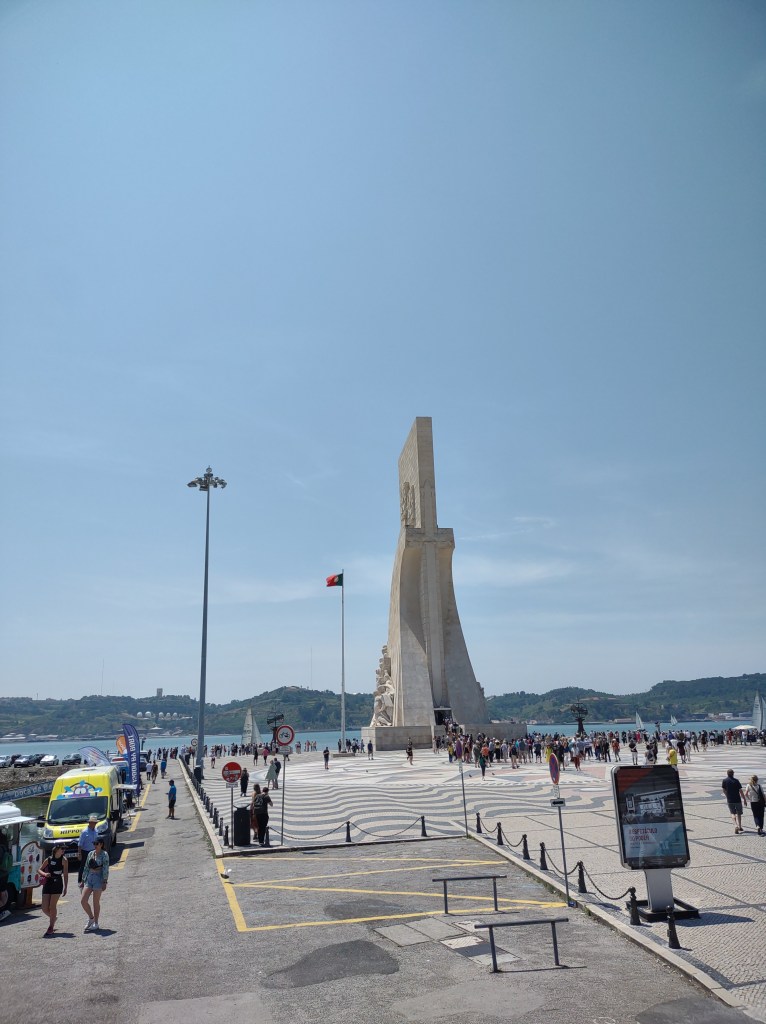
Lisbon and Portugal continues to celebrate this Age of Discoveries, when Portuguese adventurers like Vasco de Gama discovered the sea route to India, and others sailed west and ran into what we now know as Brazil. And so Portugal grew a great maritime empire, stretching from South America to the coasts of Africa and across the Indian Ocean.
The Belem TowerThe Discoveries Monument
So come with me to the bustling streets and jetties of Lisbon in this Golden Age as the great ships sail out and the gold and spices roll in. Smell the exotic scents, marvel at the spectacular Manueline architecture as a new city emerges, rub shoulder-to-shoulder with people from across this new world, marvel again at the strange animals that have been brought across to the amazement of the locals. Look over there! some elephants, from India, or Africa, who knows, but they look quite the sight…ah, good, the handler has seen us and he’s leading one of them over to us.
It’s the Elephant in the Room.
What Portugal calls the Age of Discoveries was not so golden for the “discovered” of course. The mere fact that you were considered “discovered” suggests you had no independent existence in the first place, leaving you ready for dispossession, enslavement and colonisation. That’s if you were lucky. Vasco de Gama was no innocent tourist; his ship was armed and for example he used them on unarmed Arab boats on the East African leg of his trip. (He eventually stopped off at Malindi in Kenya to ask the locals how to get across to India.)
You don’t see much about the other side of the ledger in the tourist stuff here. Undoubtedly Portugal is one of a number of European countries struggling to deal with its colonial past, but I was surprised by how unapologetic it was until I was reminded of something else.
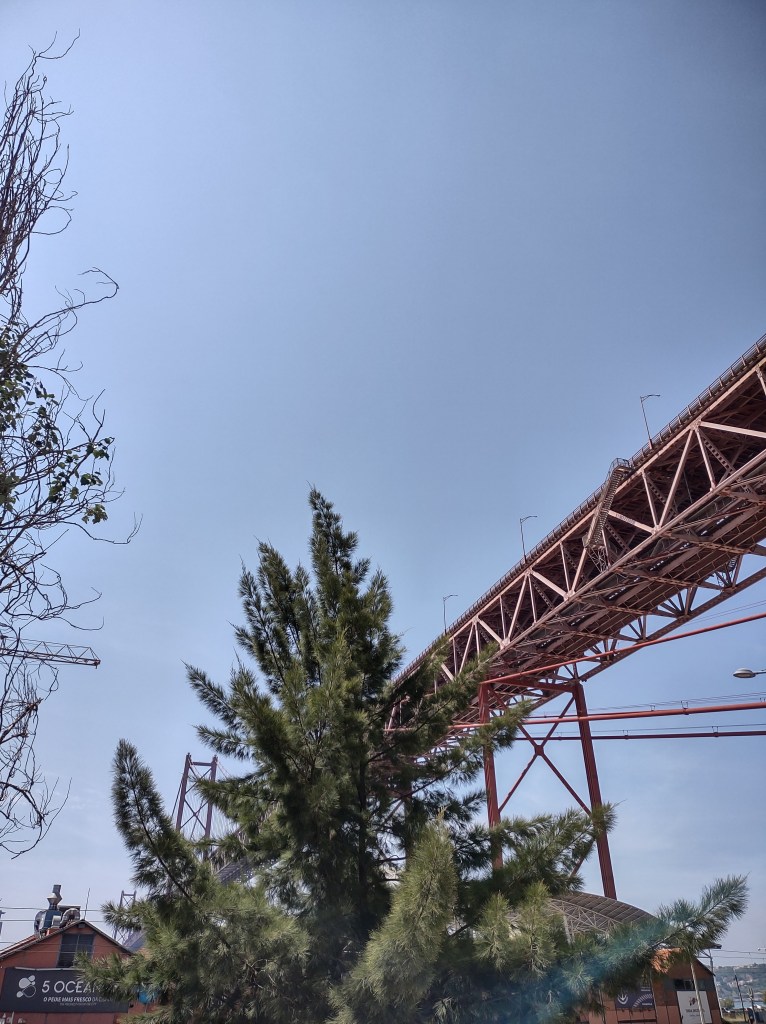
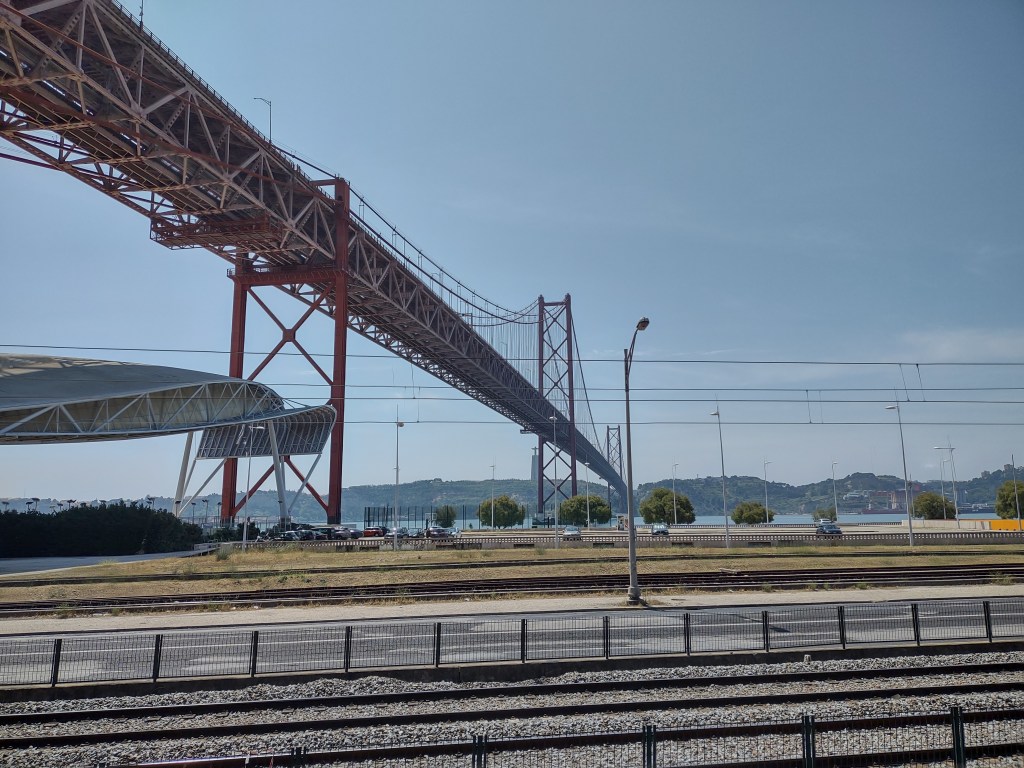
The graceful span of the Antonio Salazar suspension bridge across the Tagus, a few minutes from the Belem Tower and all that discovery glory.
Well that was what it was called up to 1974, named after the de facto dictator who ruled Portugal from 1933 to 1968. In 1974 it was renamed the 25th of April Bridge. Why? Because that was the day the army rose up against the hard-right regime, after years of young men being forced to fight in anti-independence wars, years of people risking everything in their fight for democracy.
It was a unique revolution. Triggered by the radio playing Portugal’s Eurovision Song Contest entry, and then a more militant song, the troops left their barracks and took all the usual strategic points in Lisbon including the one where the then dictator was held up. Meanwhile, a local shop owner was getting ready to celebrate the anniversary of her store by decorating it with red carnations. But when she saw the squaddies out on the streets, she handed the flowers out to them instead. Some of them stuck them in their gun barrels – which were never fired in anger.
Back to my theory. It’s only 50 years since the Carnation Revolution. Portugal’s democracy is still young. And the habits that come with being an open society – including a self-critical approach to your own history – are still developing. How Portugal develops during this new Age of Self-Discovery is up to the Portuguese. But as a small country in a wider world that is breaking free of the social and psychological chains of the colonial past, the routes it charts this time will not always be the ones it chooses.
Enough history for now. I’ve come to Lisbon on the recommendation of a number of people, and it was time to put aside my fears about the place being over-touristed (there are lots of tourists and the pavements are narrow) and just see for myself, to establish, to paraphrase Portugal’s most notorious son, whether or not it is a special one.
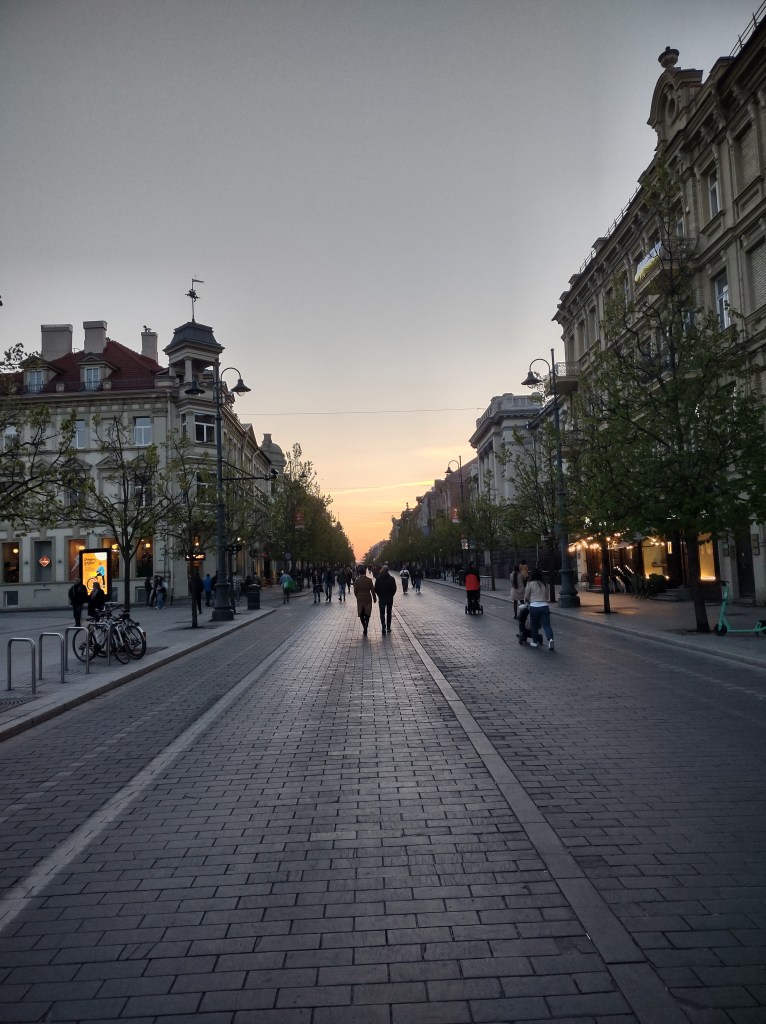
Although the most well-known part of Vilnius is its atmospheric and charming Old Town, as a visitor your chief reference point will probably be Gediminas Avenue, the broad 19th-century thoroughfare that runs through the heart of the town. Lined with banks, ministry buildings, shops and food outlets, sooner or later you’ll find yourself on or nearby Gediminas Avenue.
Or should that be (St) George Avenue? (Tsarist Russian Empire)? Maybe Adam Mickiewicz Avenue (Polish occupation, post-1918)? How about Stalin Avenue (early Soviet Union) or even Adolf Hitler Strasse (Nazi occupation). Too much? Perhaps good old Lenin Avenue fits the bill (pre-independence).
As you can tell, the old joke about the Eastern European man who spent the 20th century living in seven different countries, without ever leaving his house, has some truth in this part of the world. Lithuania has had, and continues to have, a complex relationship with its neighbours, and sometimes it surprises. For example at one time most inhabitants of Vilnius were Polish (only 6% Lithuanian) and today over 50% are ethnic Lithuanians and 40% Poles. And that’s even before we get to the 4% ethnic Russians and the tensions there.
It’s a very deep story to develop satisfactorily in a little blog like this, and I’m heading home today, my short stay over. So the best I can do is give you a necessarily superficial view of some of the sites, the feel, the quirkiness of the place.
We start with a wander down Gediminas Avenue
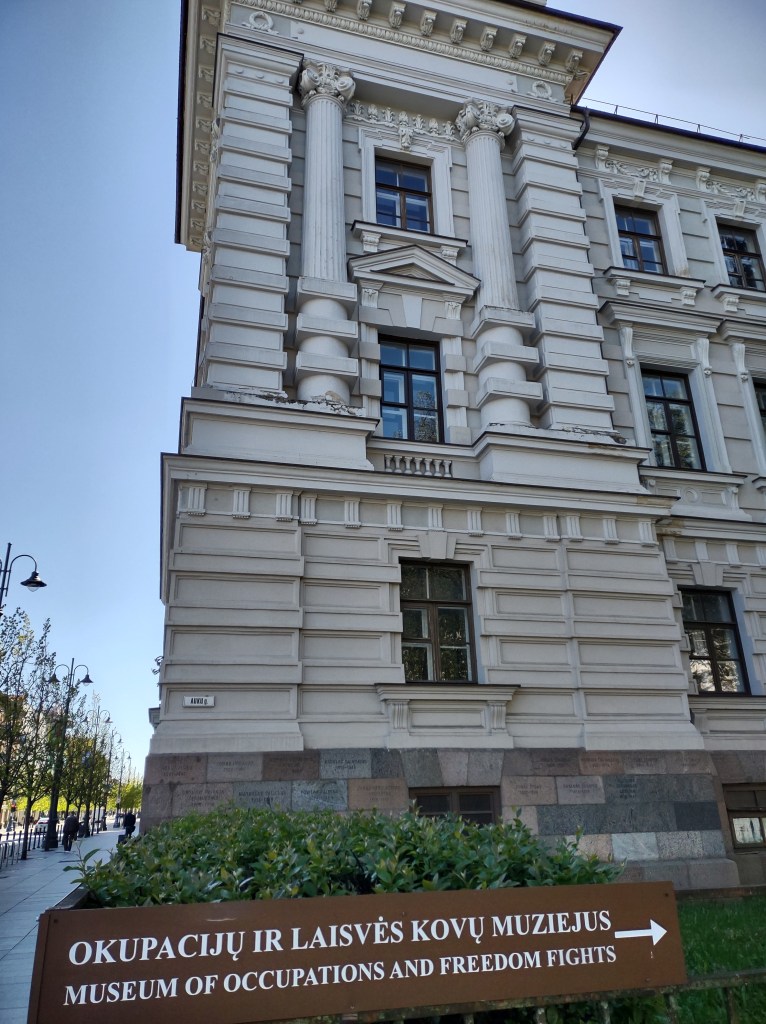
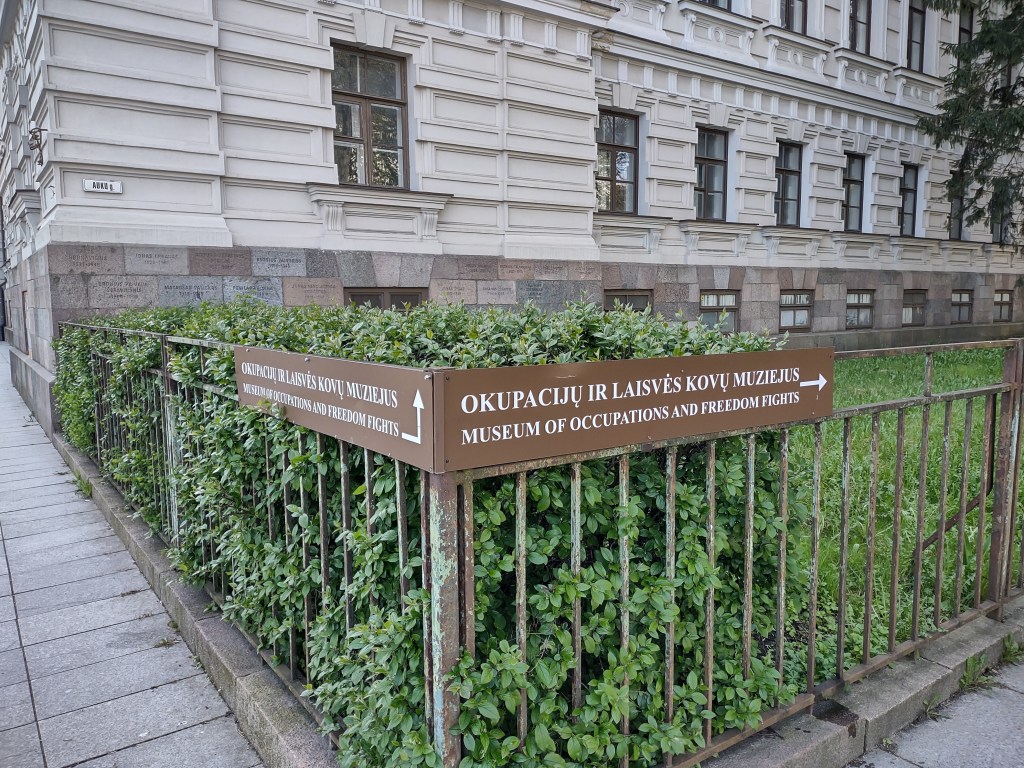
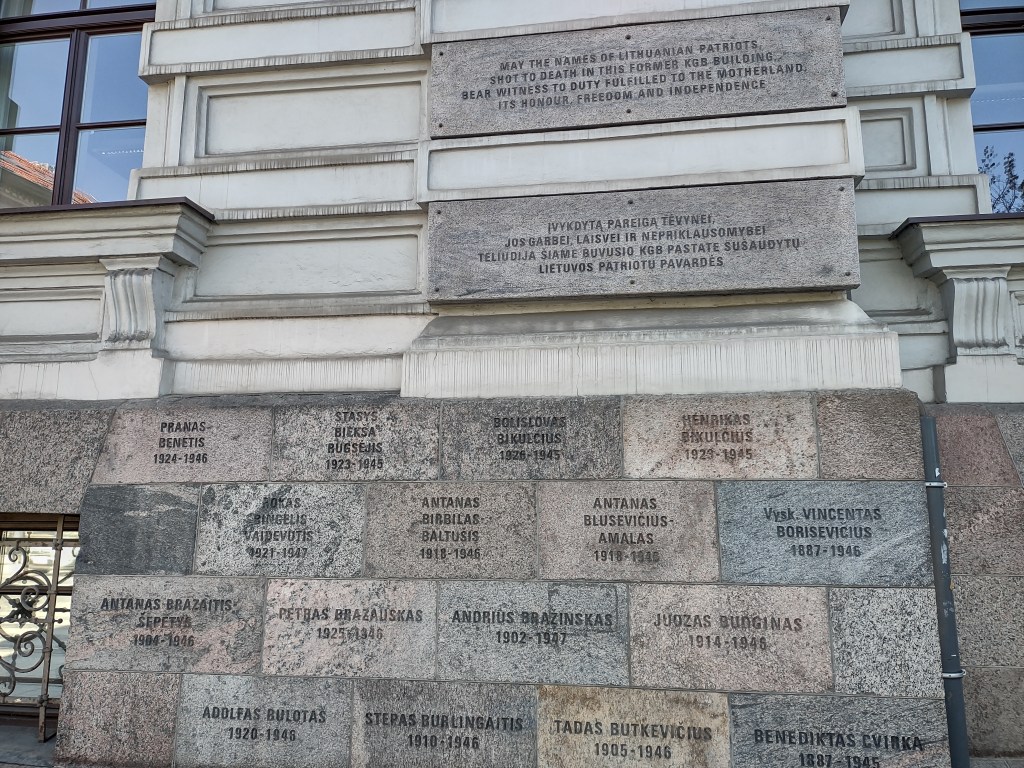
This innocent-looking building was indeed an innocent office block until Stalin took over and it became the local headquarters of the KGB. When the Germans arrived in 1941 they appreciated its heritage of torture and brutality and the Gestapo set up shop. The Soviets liberated the town in 1945 and down in the basement proceeded to “liberate” numerous local partisans from their lives. Their names are carved into the walls of the building, which is now a museum to its grim history.
I didn’t go in. Ironically, the museum dedicated to Soviet Communist oppression was closed for the May Day holiday.
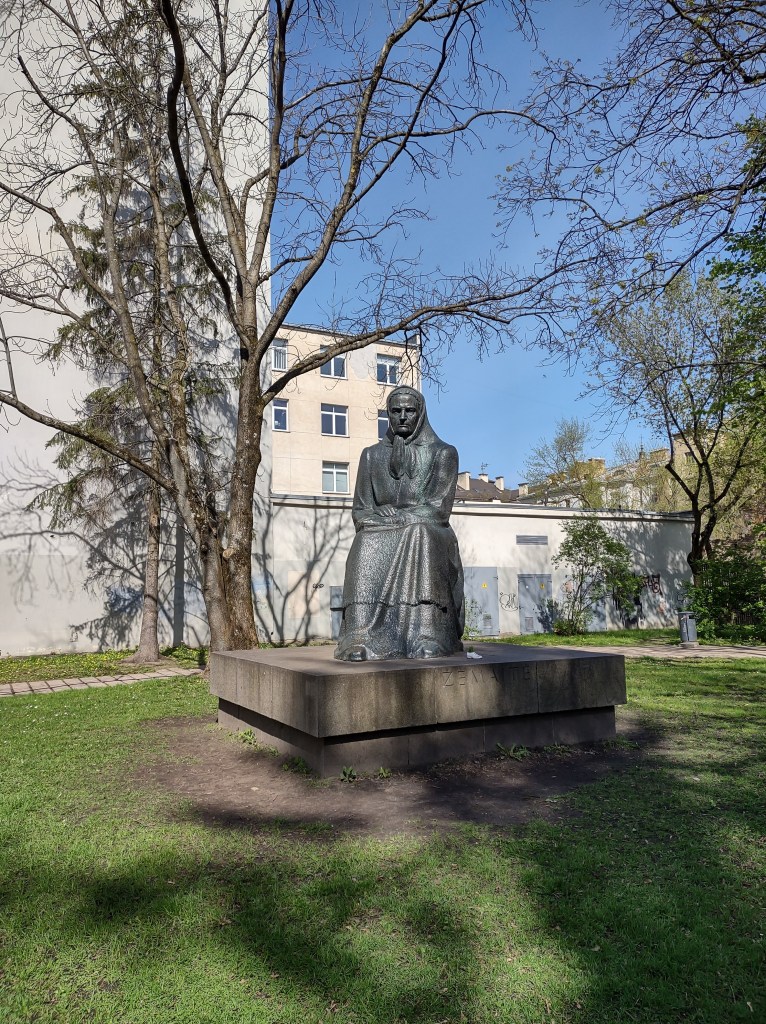
On we go, down the street, past the odd statue…
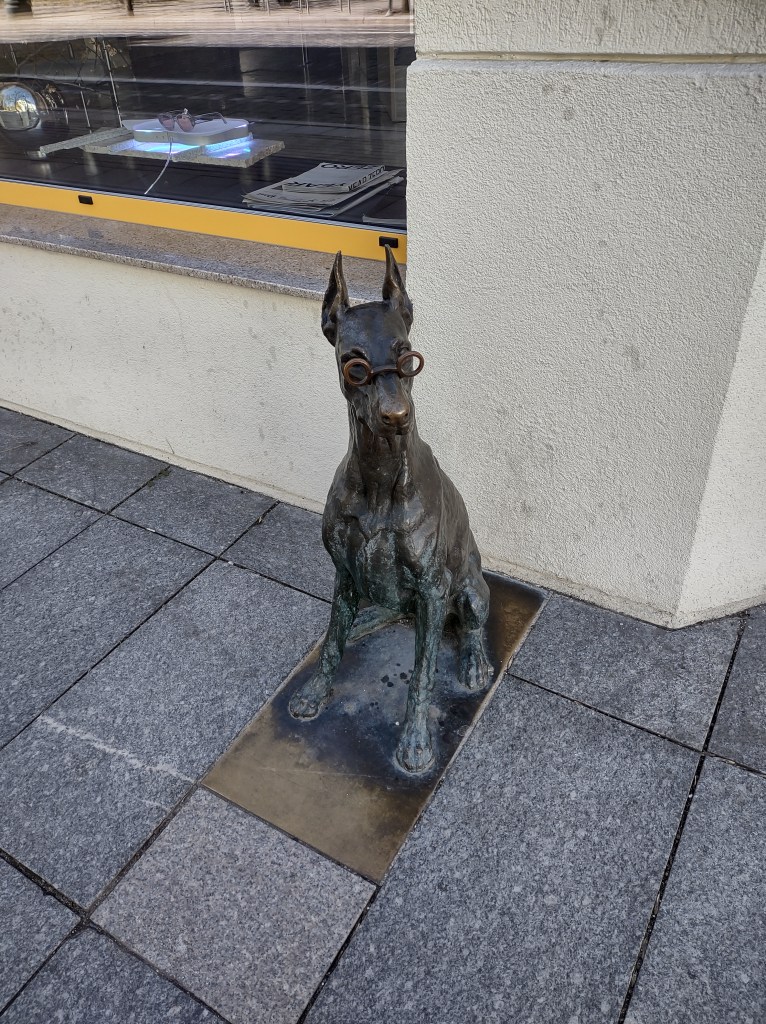
…opposite the odd opticians…
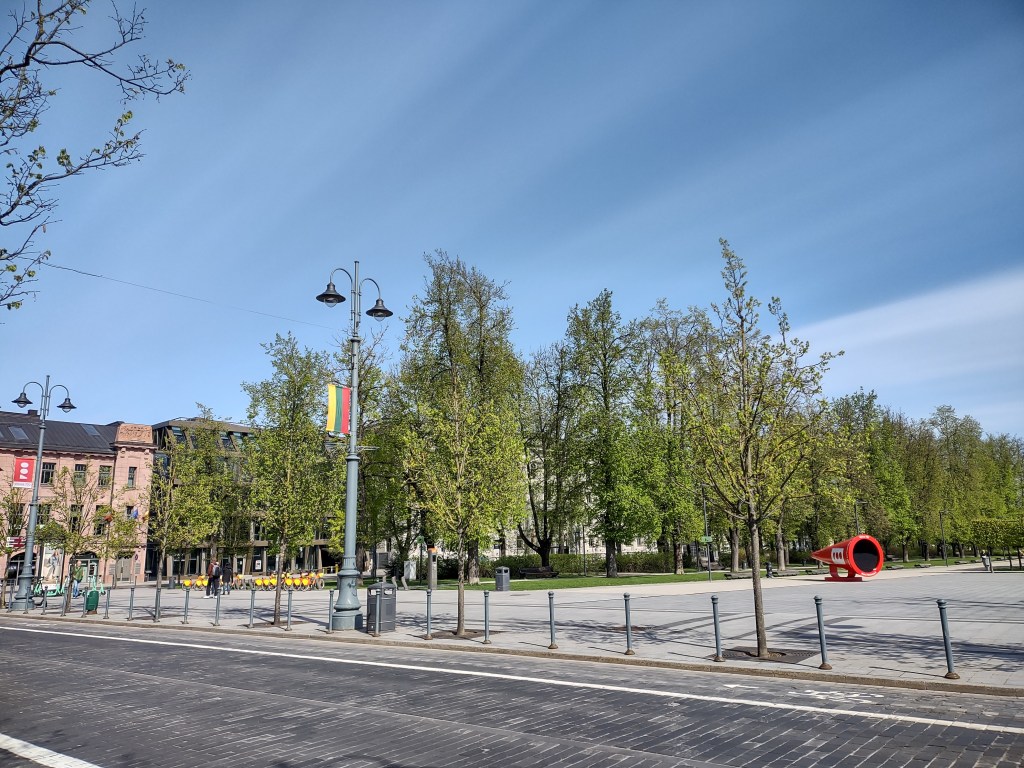
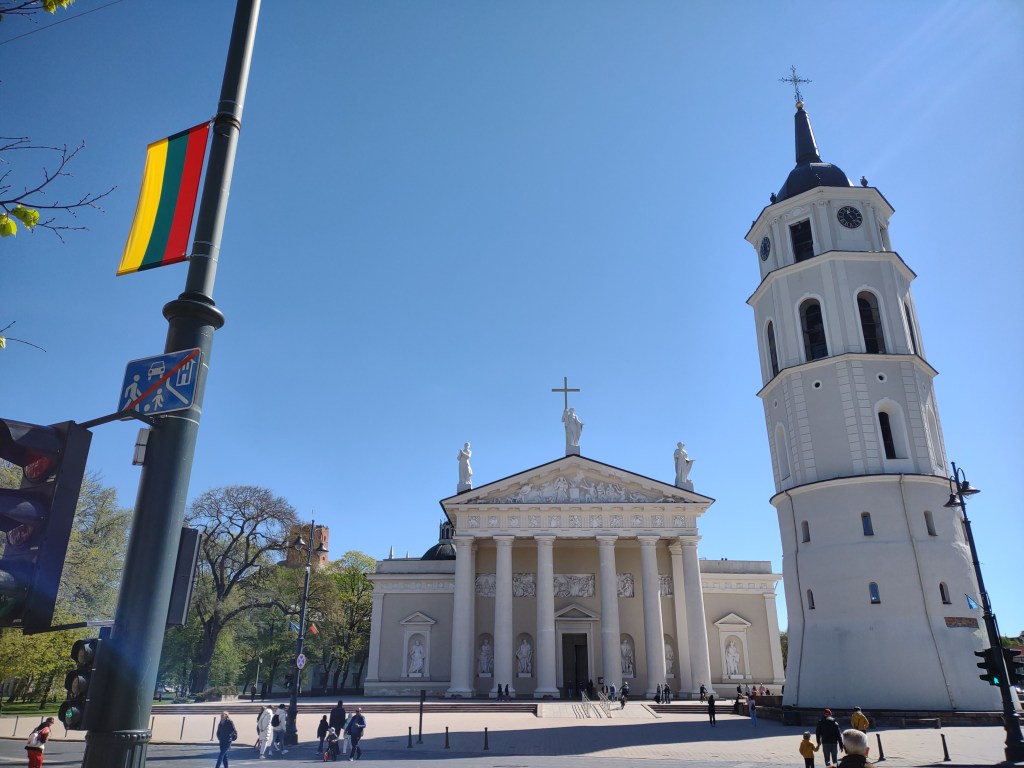
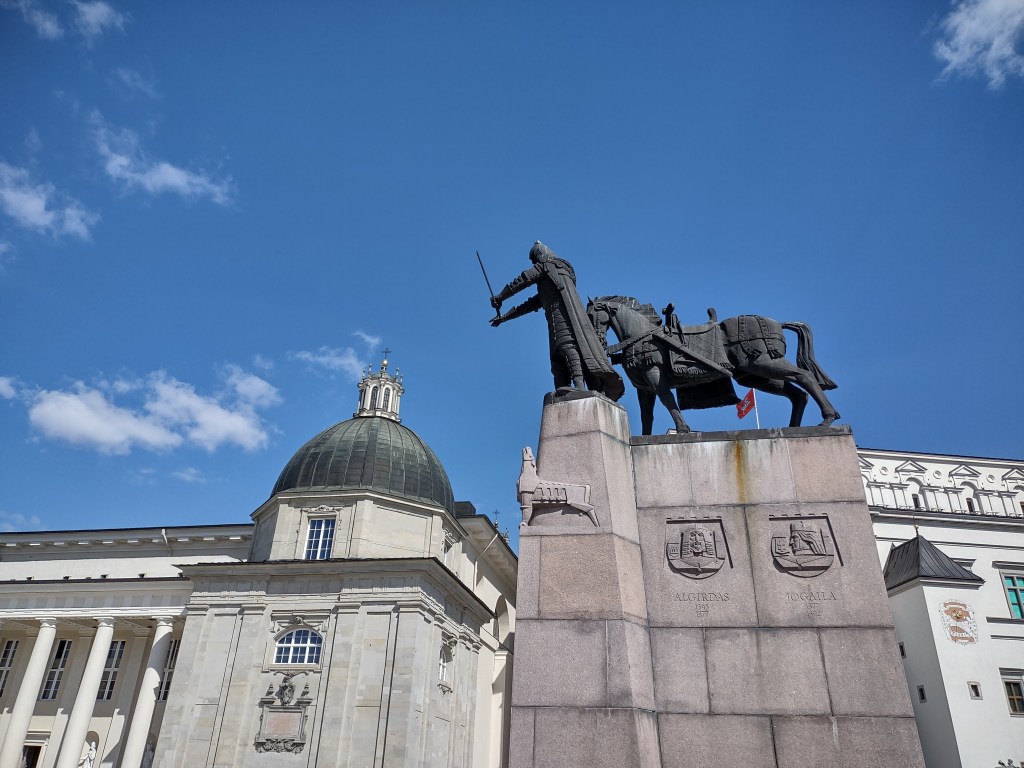
..until eventually the Avenue gives out onto the great plaza that marks the centre of town, and probably the whole of Lithuania itself. Cathedral Square.
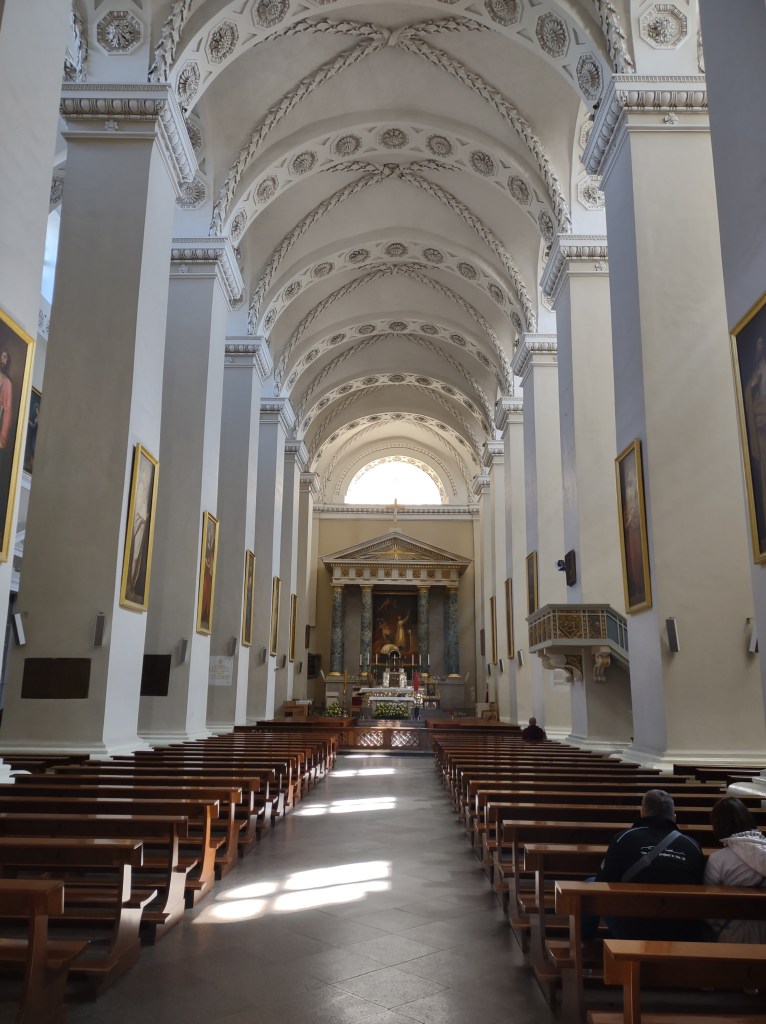
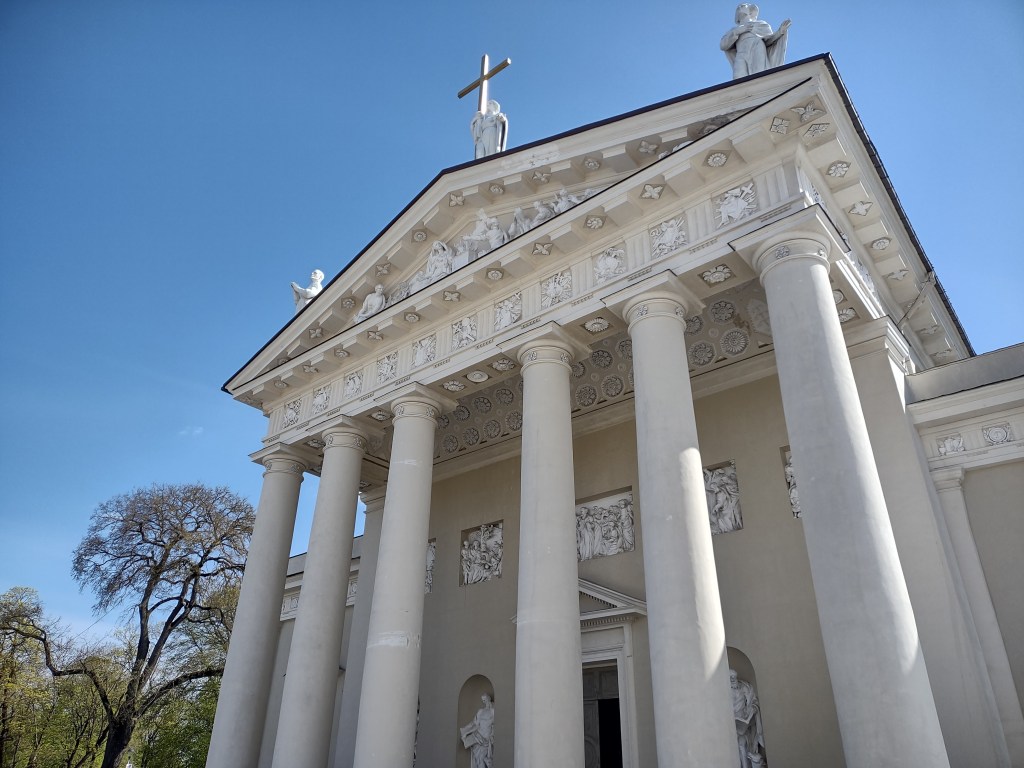
Vilnius is considered the most Baroque city north of the Alps, but the monumental Cathedral is a masterpiece of Neoclassisism. It’s been the spiritual heart of Lithuanian Catholicism since it was completed in 1783 – except for that period when the Soviets turned it into a warehouse.
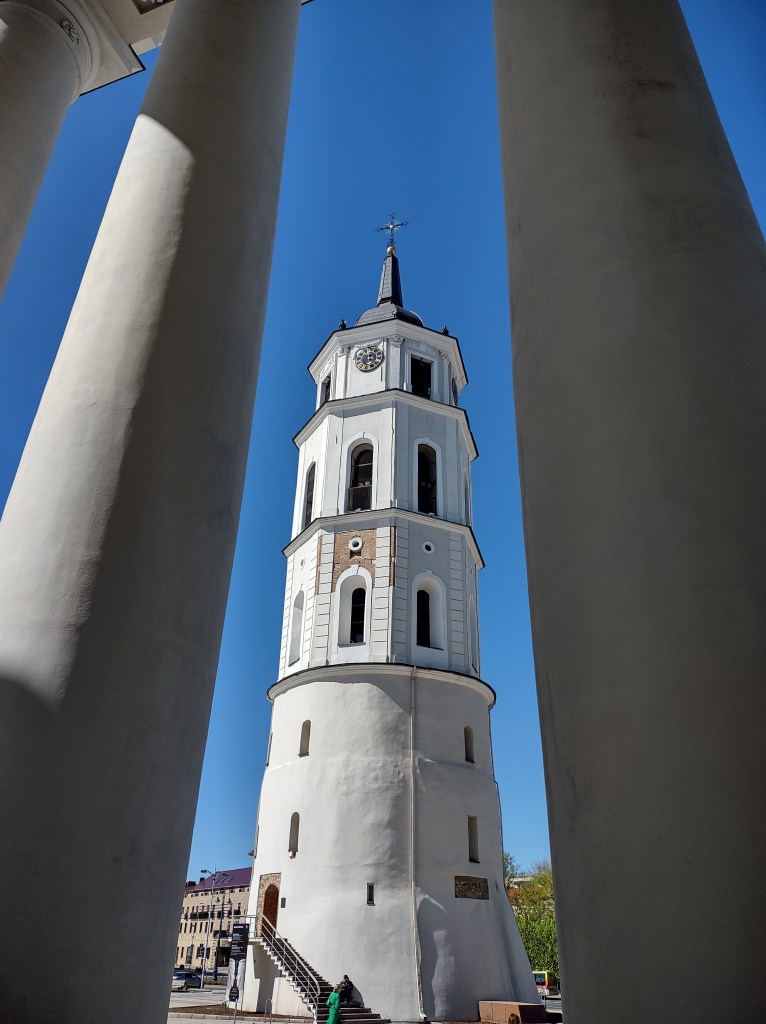
The free-standing Bell Tower is all that remains of the old 14th-century castle walls that ran through what is now a square. The walls were torn down and the old battlement tower was turned into the cathedral’s campanile.
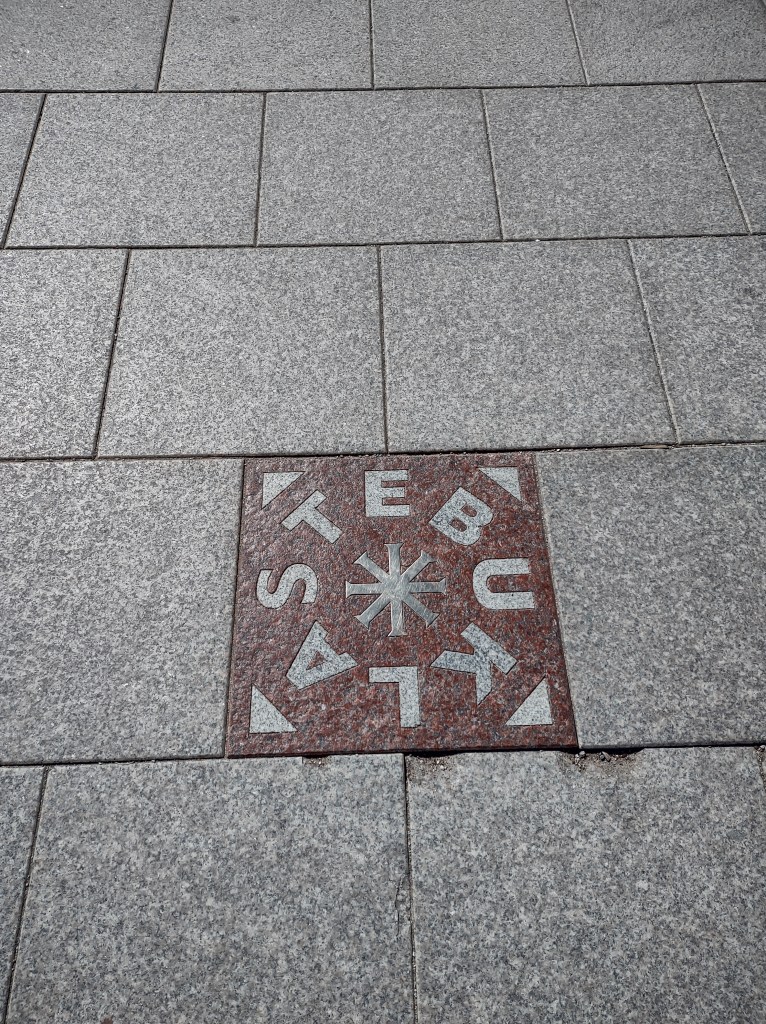
If you find this spot between the cathedral and the tower, your luck might be in. Legend has it that if you stand on it, turn around three times, and make a wish, that wish will come true. Stebukla means “miracle”. And the locals believe a great miracle did happen around here.
I am here to tell you I am old enough to remember the miracle. And if you are as old as me, you saw it too.
I’ll tell you later.
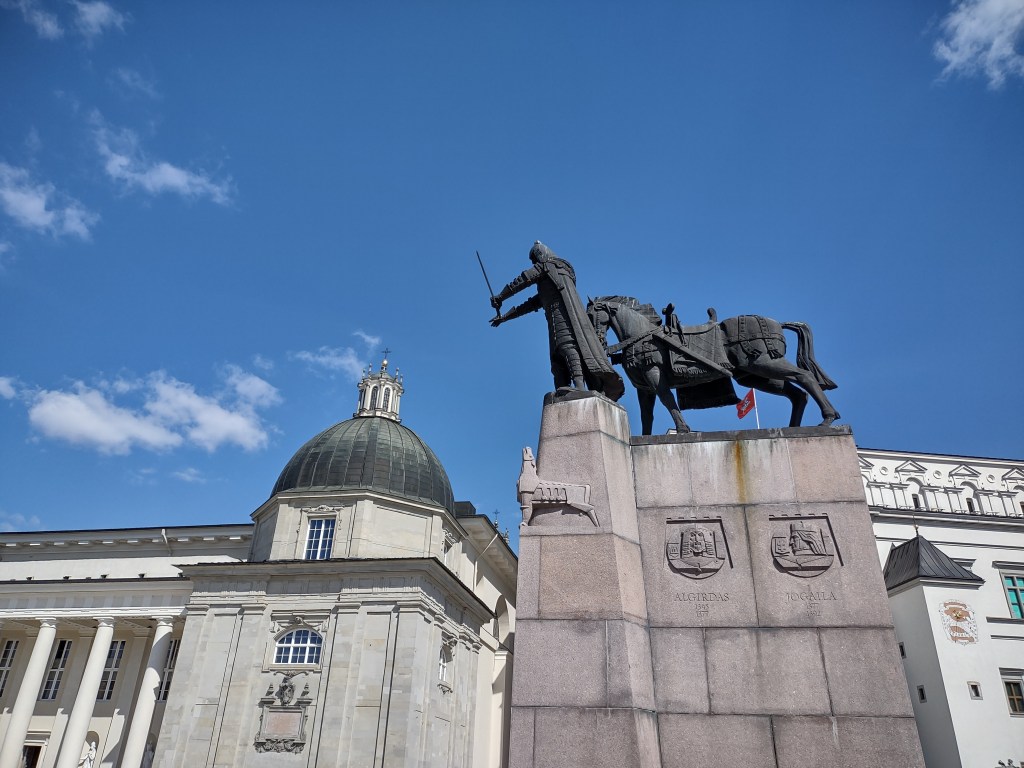
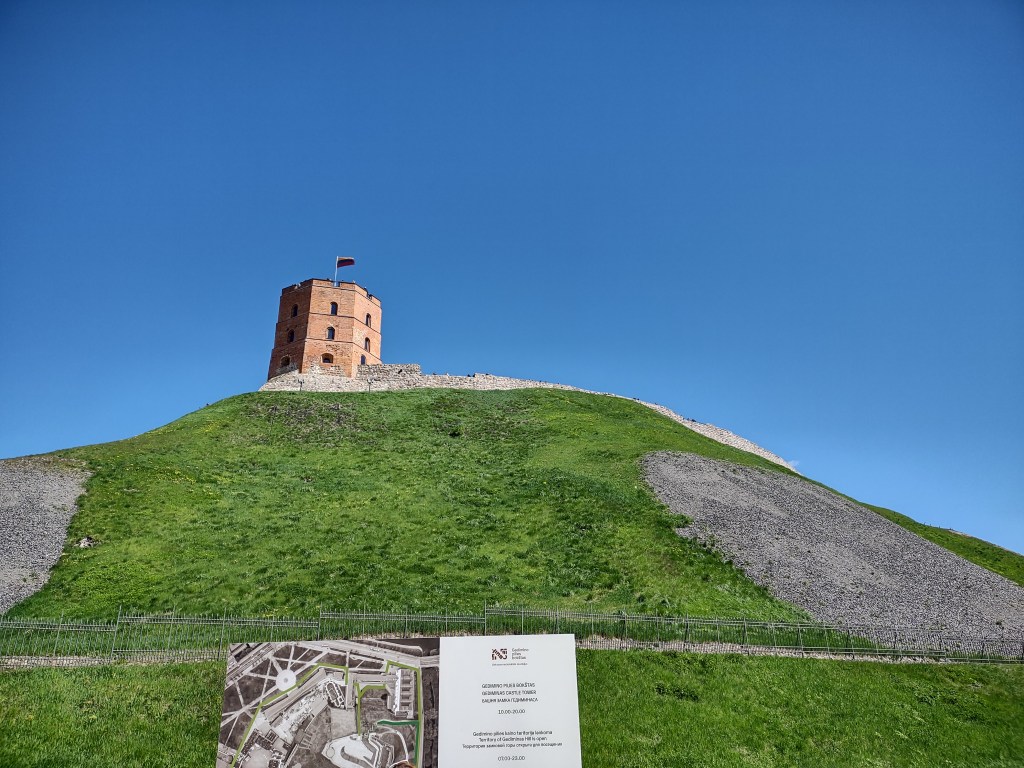
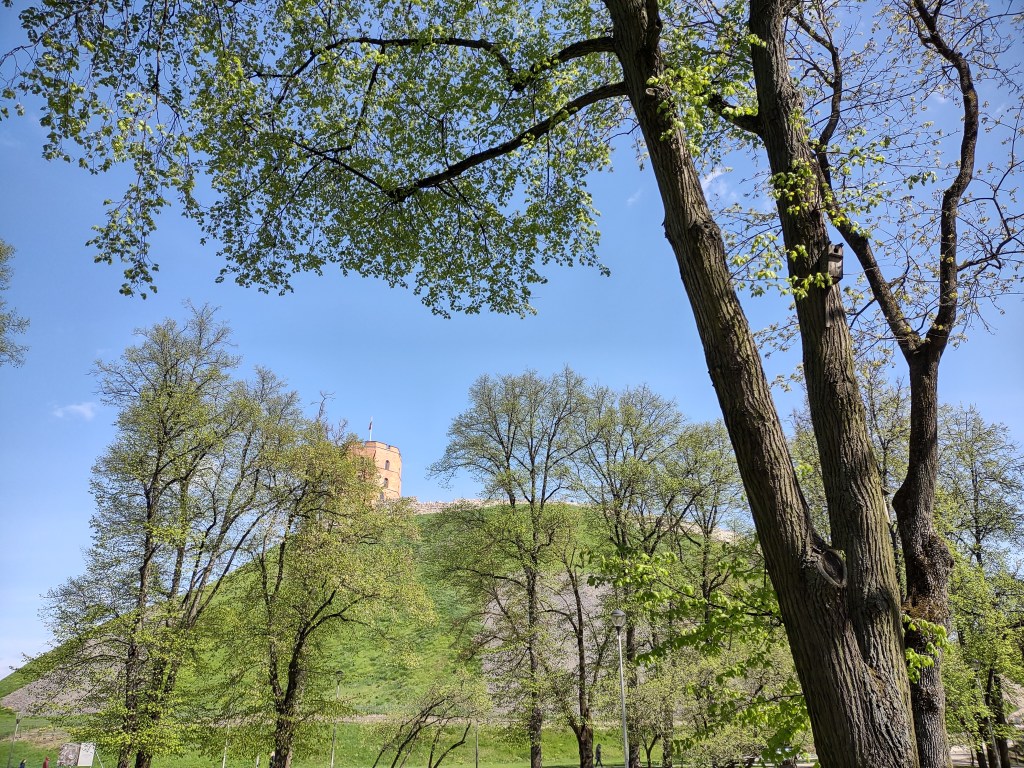
You’ve seen this one before. Cathedral to the left, to the right the rebuilt Palace of the Grand Dukes of Lithuania, and in front there’s good old Gediminas, and you can also make out that wolf. Behind and to the right there’s the park that leads onto Gediminas Hill with the ruins of the old castle. Let’s take a quick look.
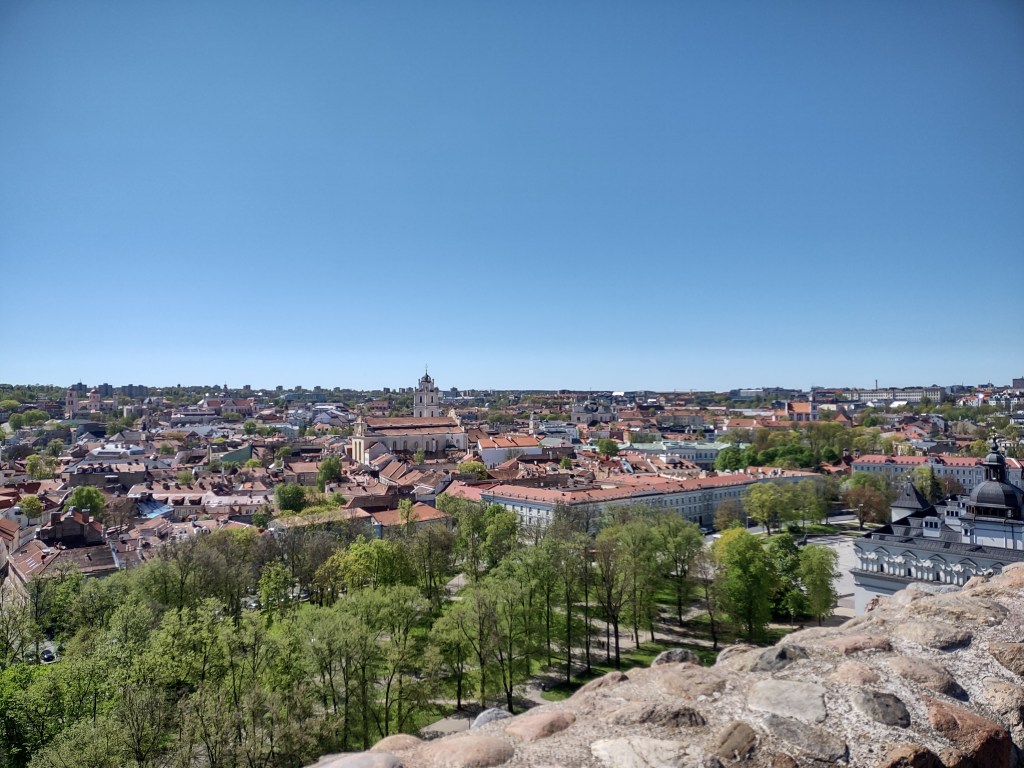
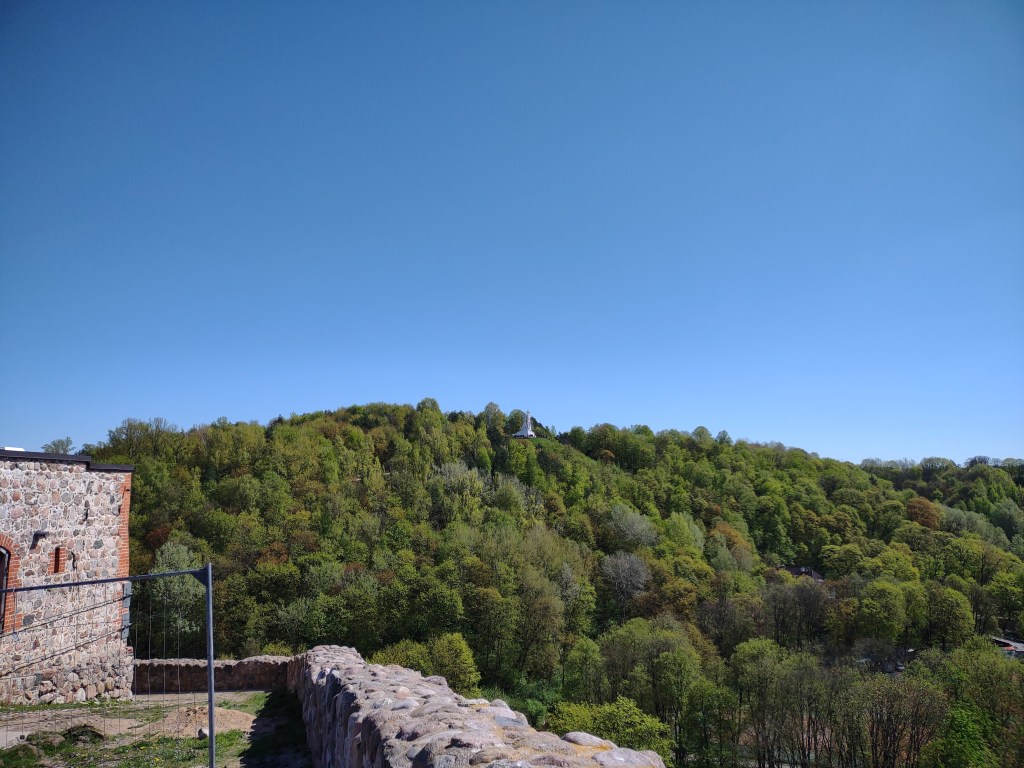
Nice view of the Old Town…
…and over to the Hill of Crosses, marking the martyrdom of a number of Christian priests in the time when Lithuania was pagan.
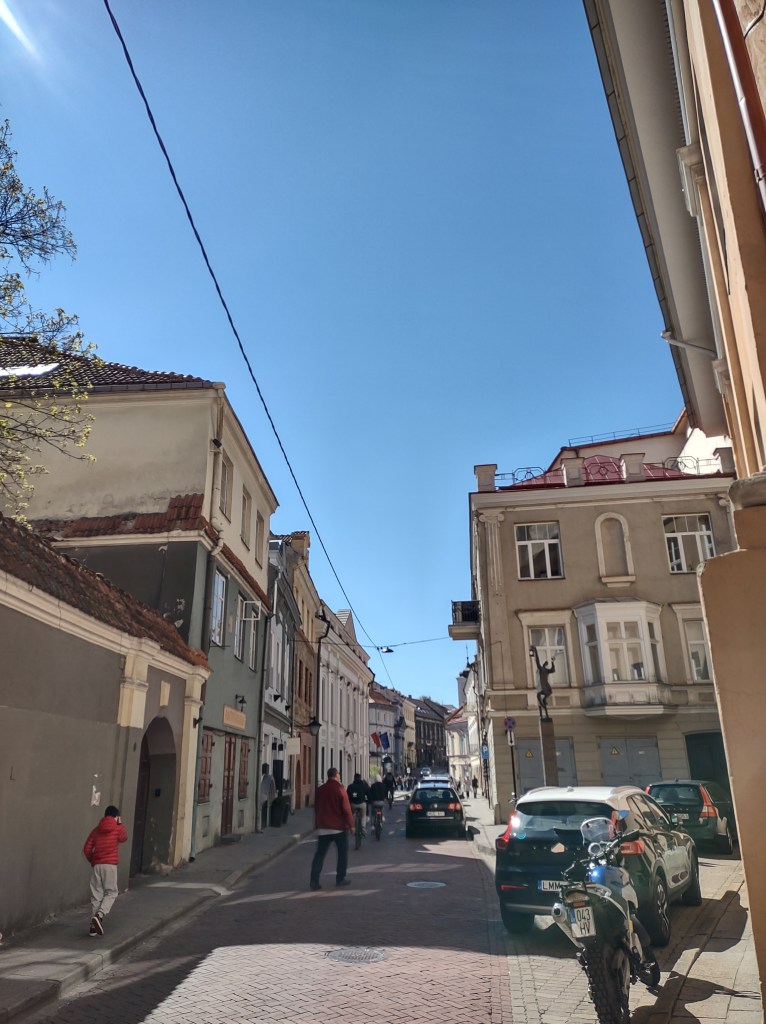
Heading down, let’s explore the Old Town a bit.
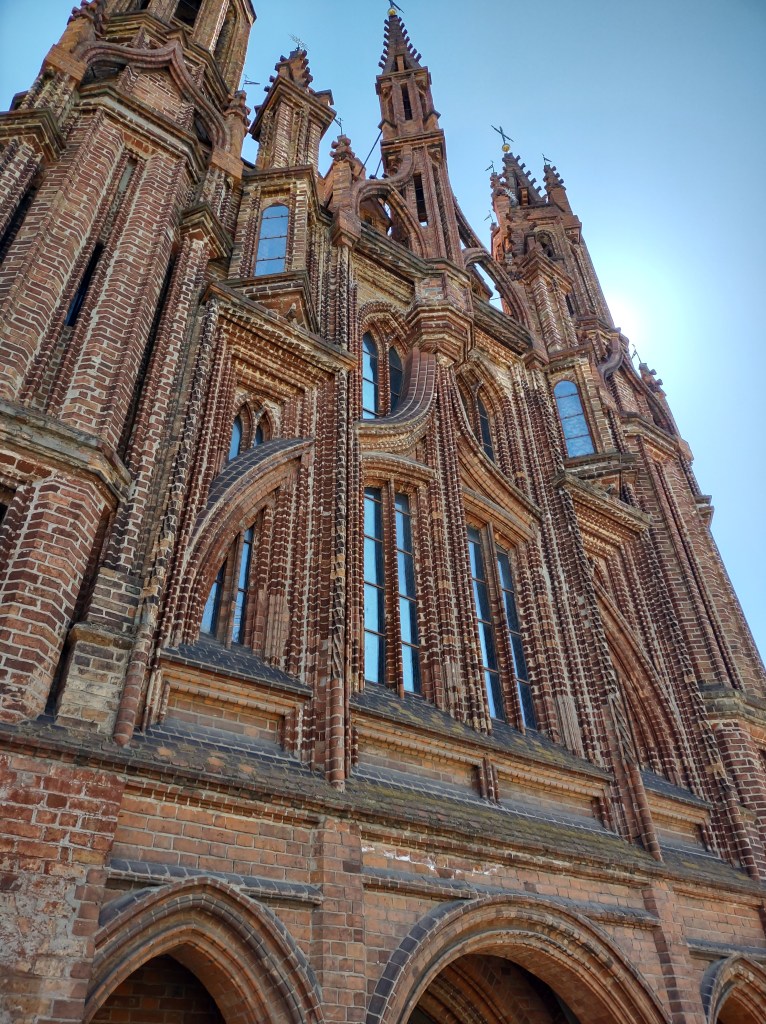
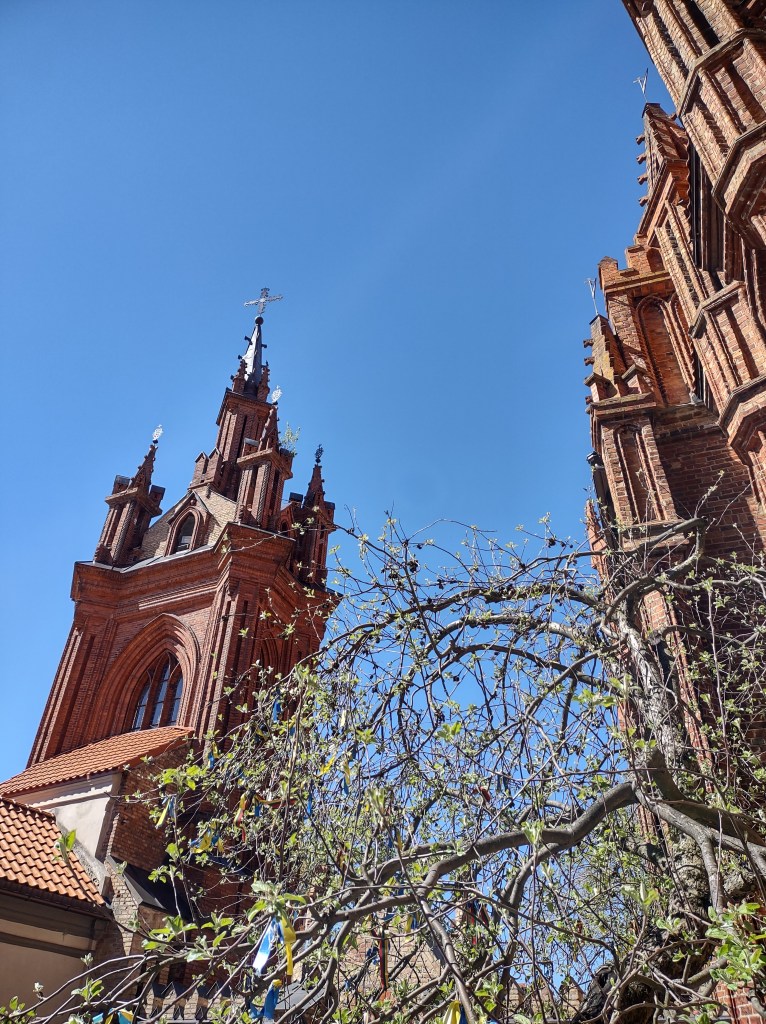
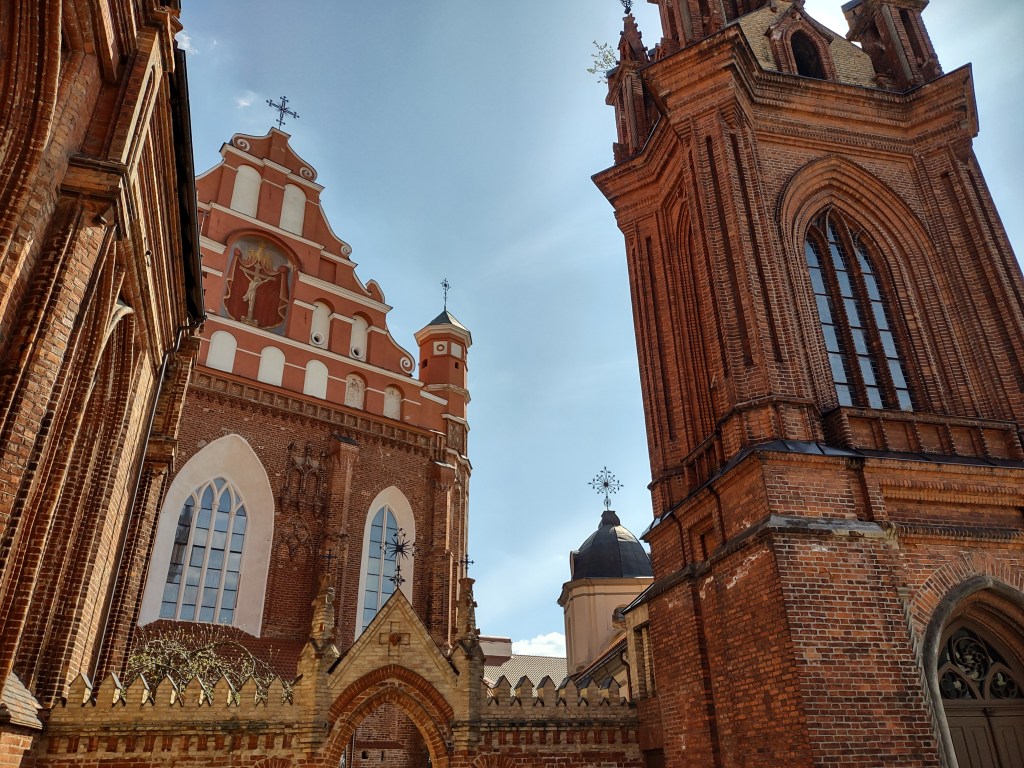
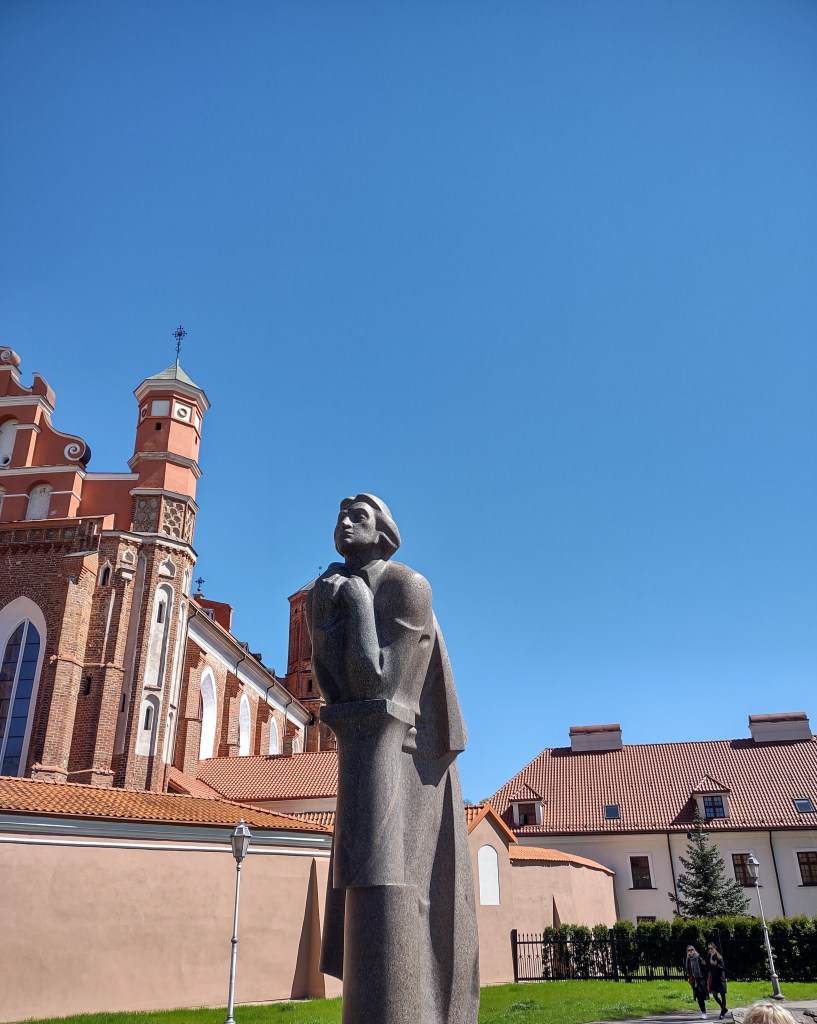
Napoleon thought it was so lovely he wanted it brought back to Paris with him. Constructed at the end of the 15th Century, St Anne’s Church is a fine example of Flamboyant Gothic. Right behind it is the less-flamboyant Bernadine church.
The French were less keen on this one, so much so they used it as a battlement. Obviously Napoleon wasn’t a true sightseer, or if he was this was a short layover for him and his friends as they headed to their final destination in Moscow. The return journey wasn’t so comfortable though; there were no catering facilities on board and they couldn’t switch off the blasted aircon.
Nearby stands this statue of the great Polish romantic poet, Adam Mickiewicz. We mentioned him before, the big avenue was renamed after him during the brief Polish occupation after World War One. Even so it turns out that Lithuanians have a lot of respect for him and his encapsulation of the desire for national awakening amongst subject peoples. In 1987, at the fag end of Soviet rule, the monument witnessed the first meeting of a Lithuanian patriotic movement aiming to break free from the USSR.
The growing anti-Soviet momentum across Eastern Europe in 1989 only accelerated the protests, and in August of that year activists across all three Baltic states organised a massive human chain. 600 miles long, it stretched down from Tallinn (capital of Estonia) through Riga (capital of Latvia) down to Vilnius. And it ended right in front of the cathedral – in fact, at a spot between the cathedral and the tower…
A new freely-elected Lithuanian parliament declared independence the next year. Nice cuddly Mr Gorbachev wasn’t so happy and eventually sent in troops, but the die was cast and by the end of 1991 the Soviet Union had collapsed.
Now that sounds like a miracle. A social and political miracle. The Lithuanian for “miracle” is Stebukla.
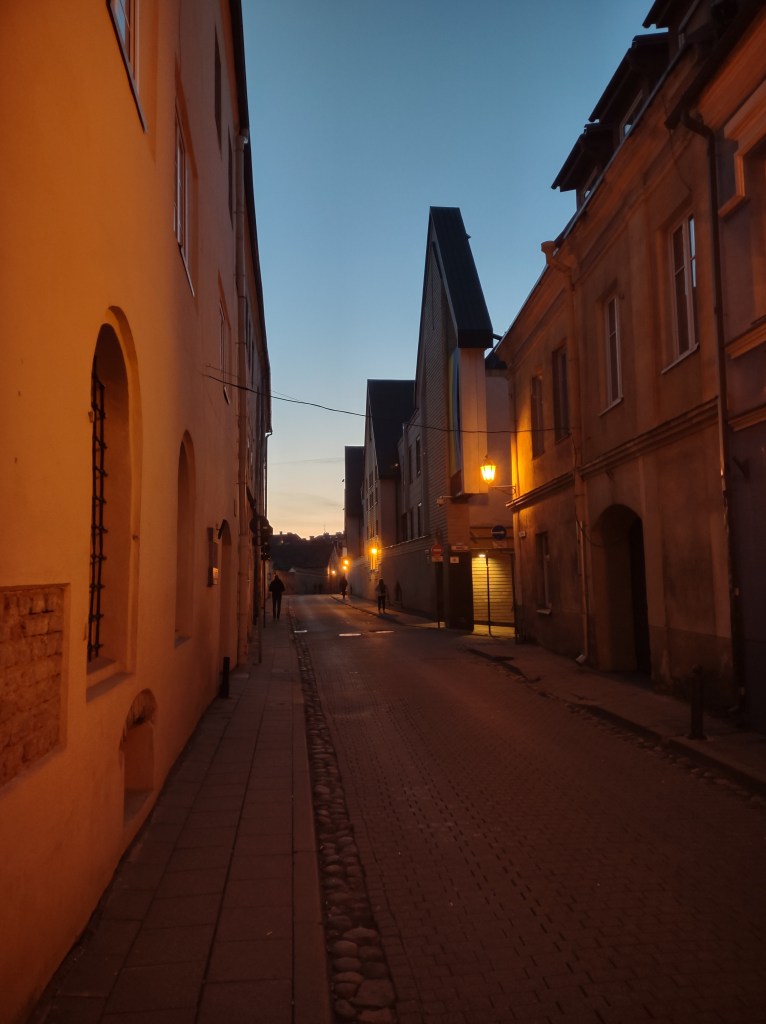
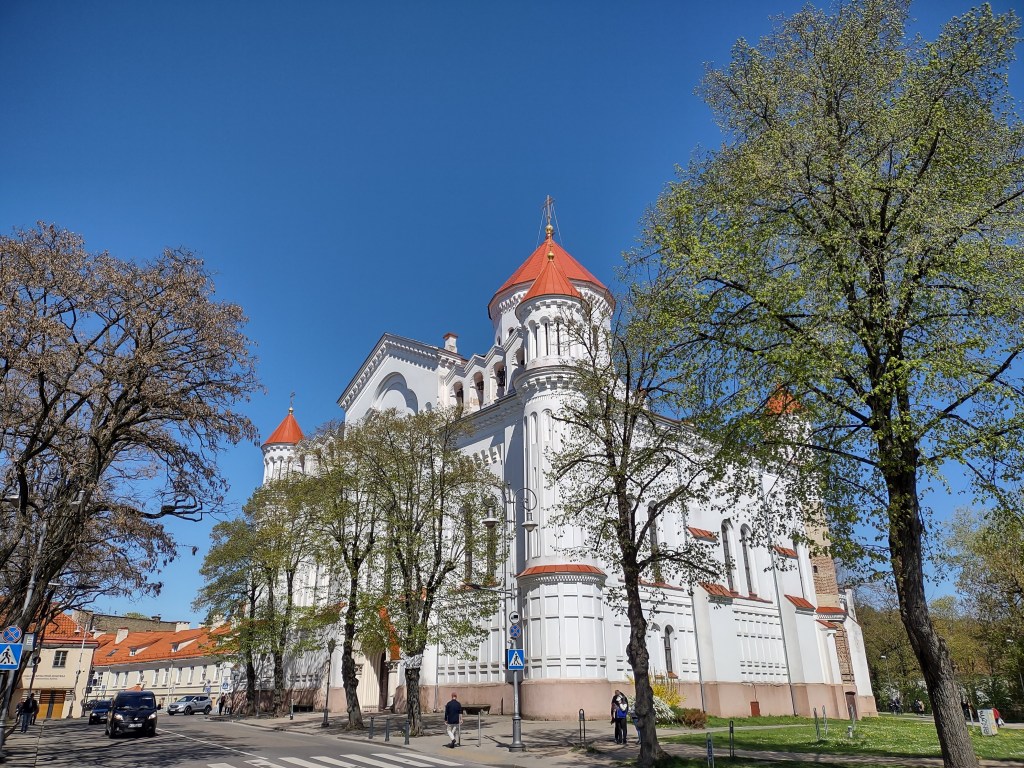
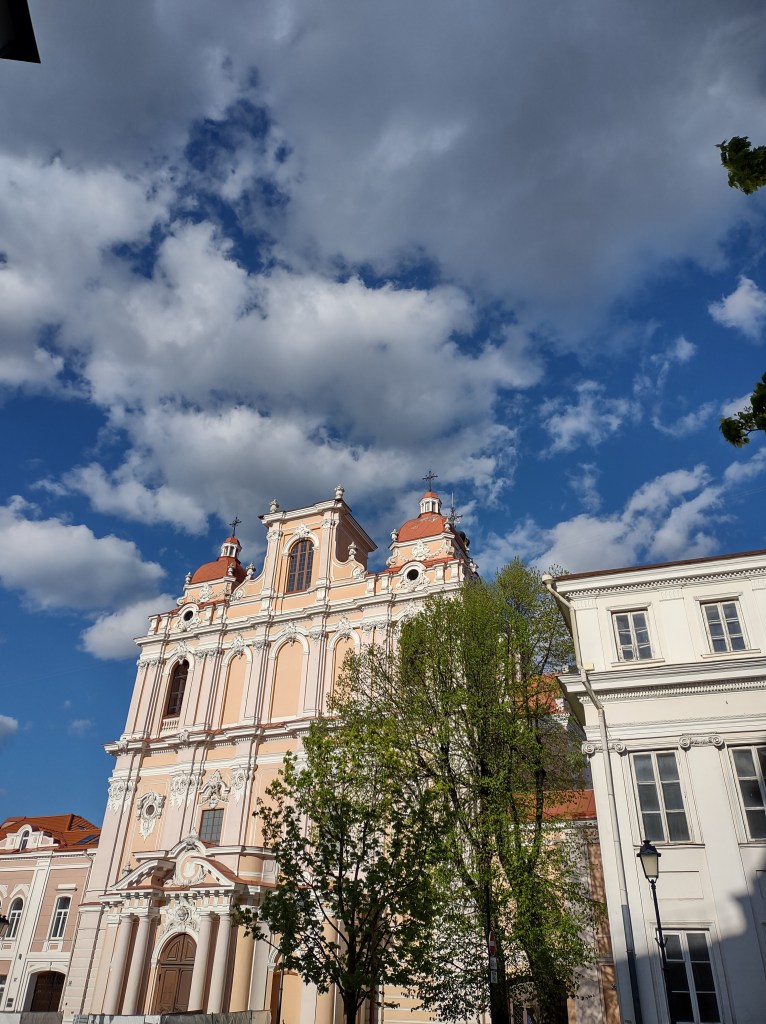
I’m going to end this travelogue by crossing another international frontier. In the meantime, here are some more pictures of the Old Town…
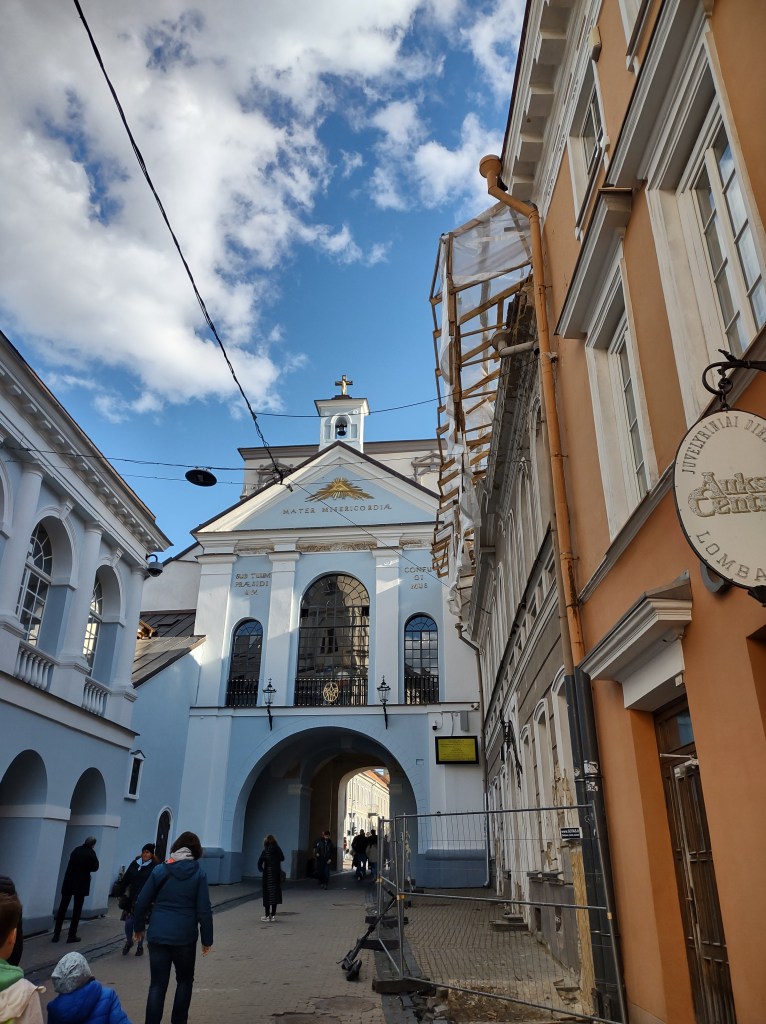
…ending with the renowned but deeply-underwhelming Gate of Dawn, a remnant from the old city walls.
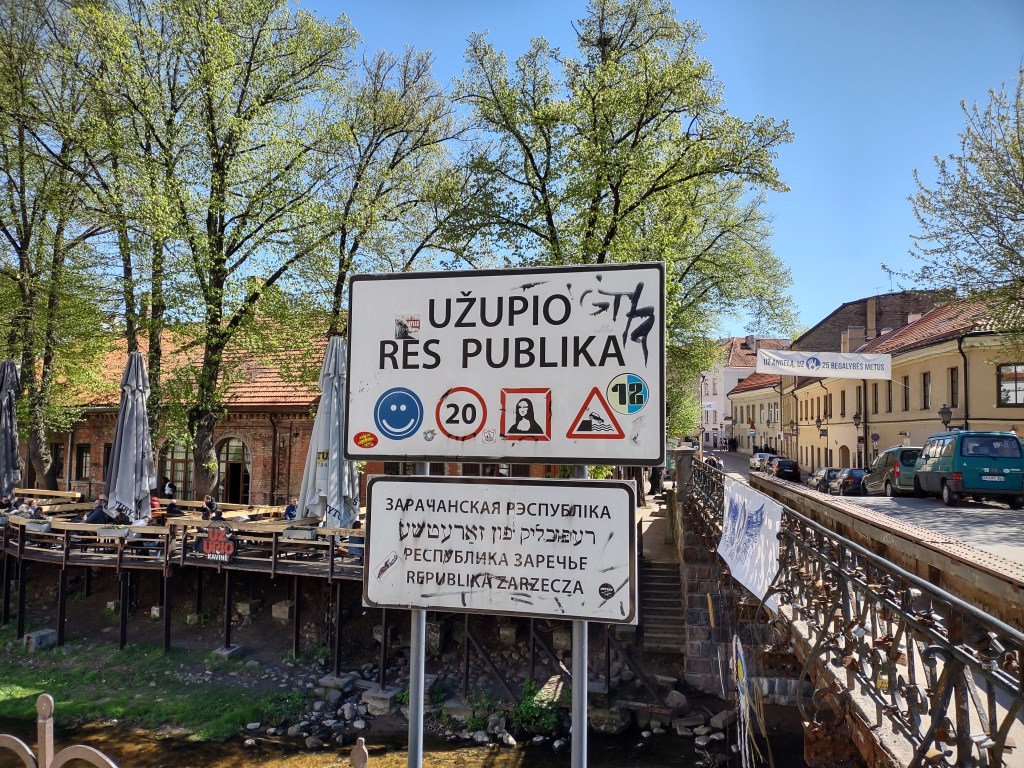
We’ve reached the border. Belarus is a few miles down the road, but don’t worry, this frontier just took me a couple of minutes to reach.
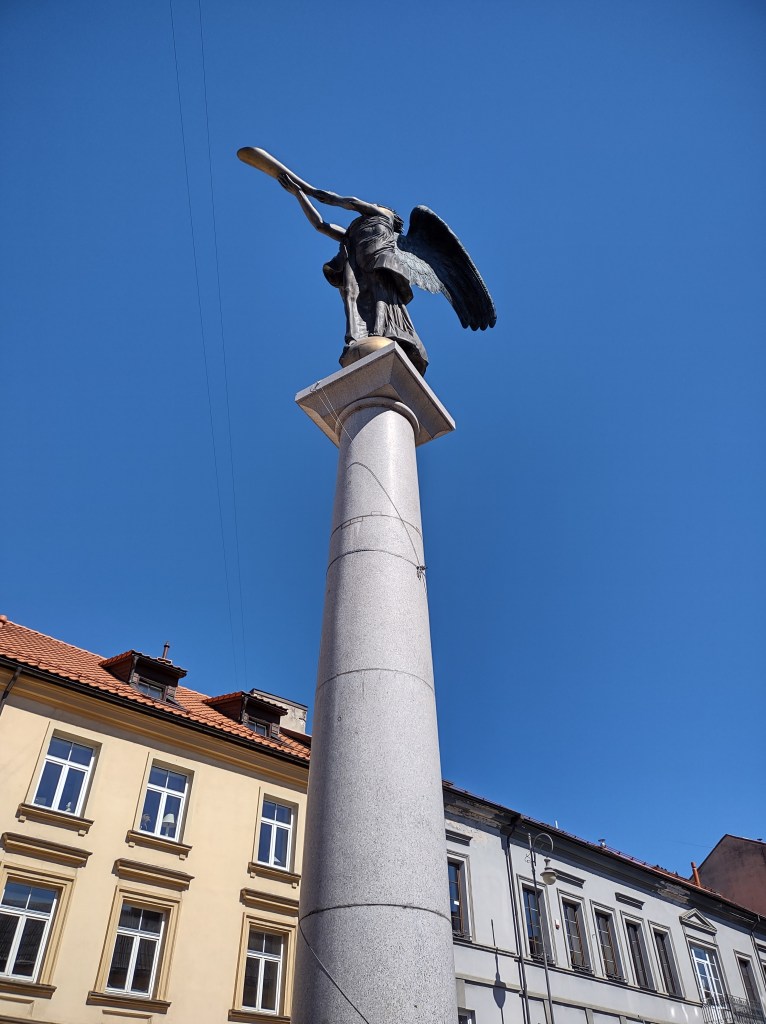
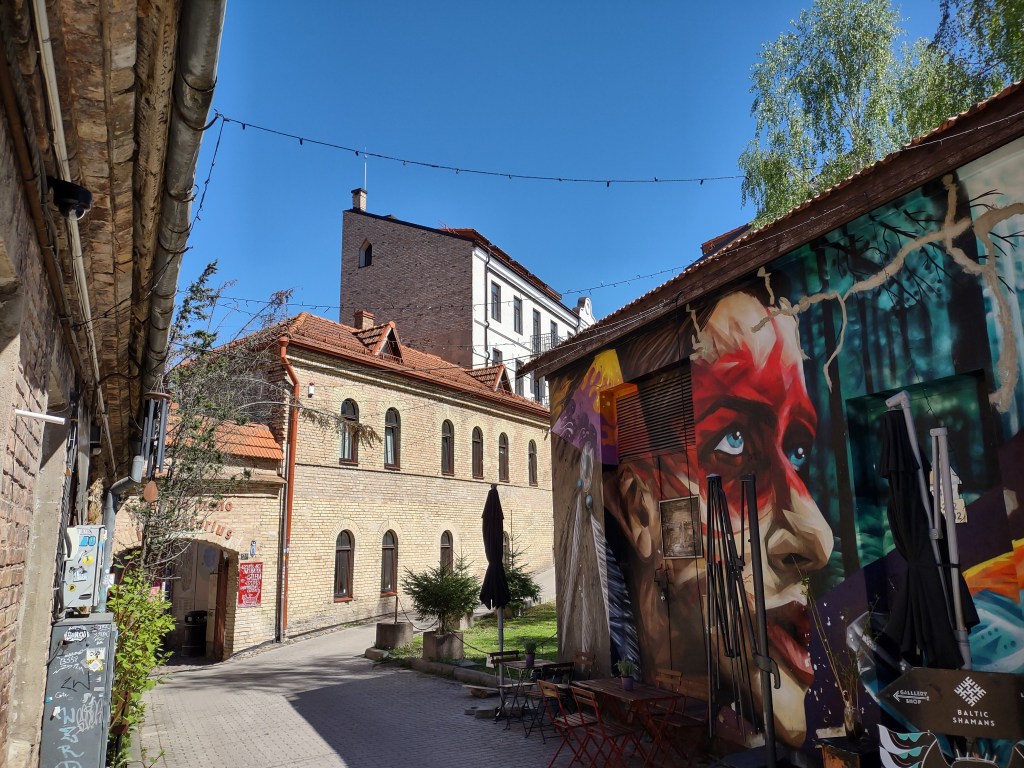
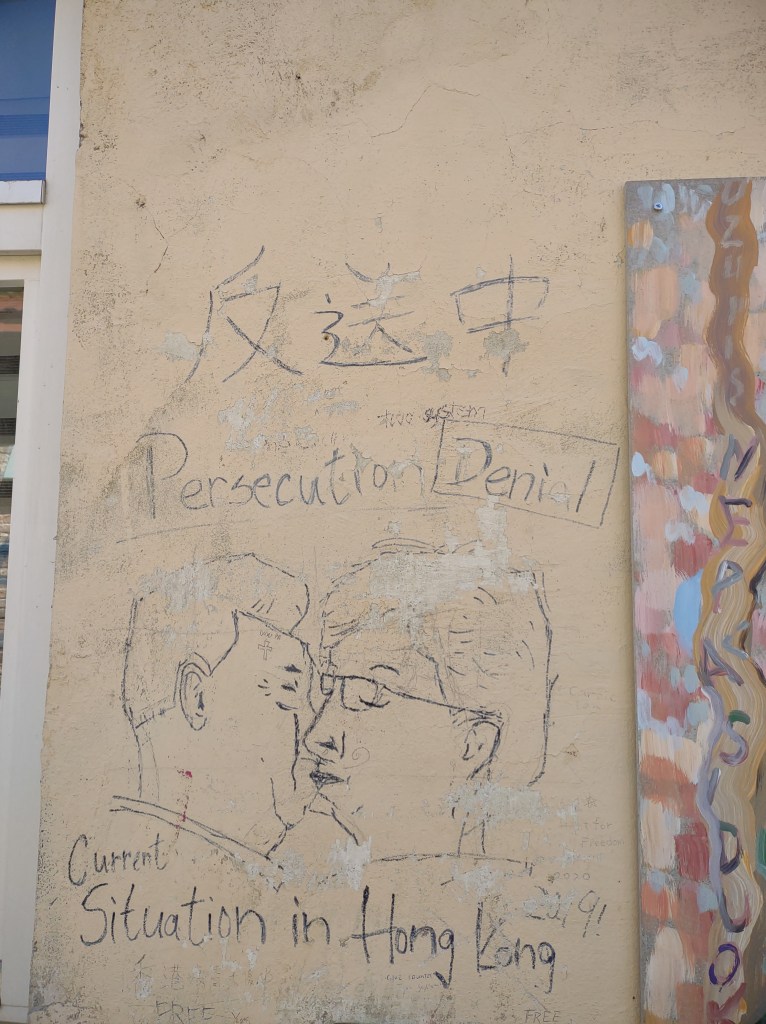
Welcome to the Republic of Uzupis, a district across the river Vilna from the Old Town that declared independence in 1997. It has a flag, president, cabinet, army (since stood down) and anthem, and celebrates its independence day on April Fools Day. Its most famous monument is the Angel of Uzupis.
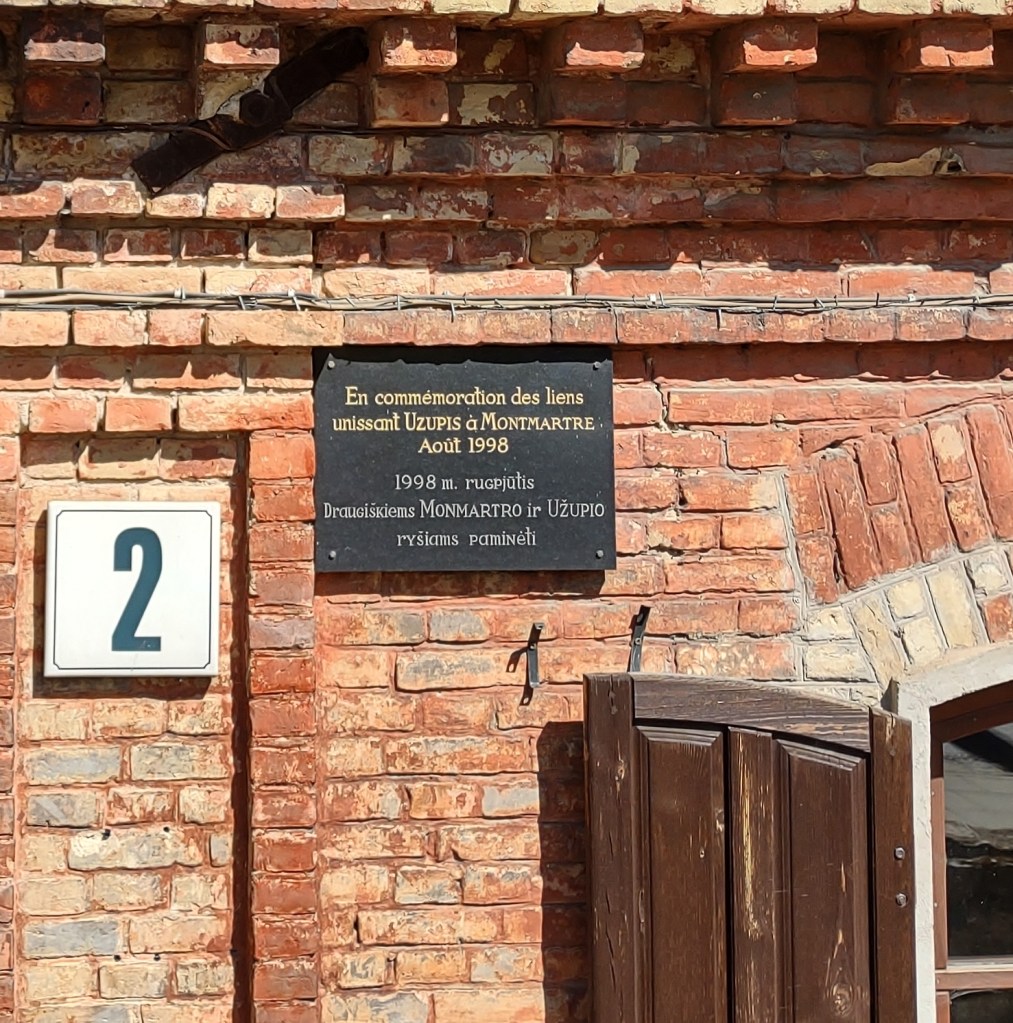
Uzupis was a mainly Jewish area until the Nazis arrived, and it spent the rest of the Soviet era falling into destitution and decline. Artists and arty-types started moving in and…well you can guess the rest. It’s really just a genial and creative bohemian colony bearing comparison to its friends in Montmartre and Christiania in Denmark
Montmartre. There you go.
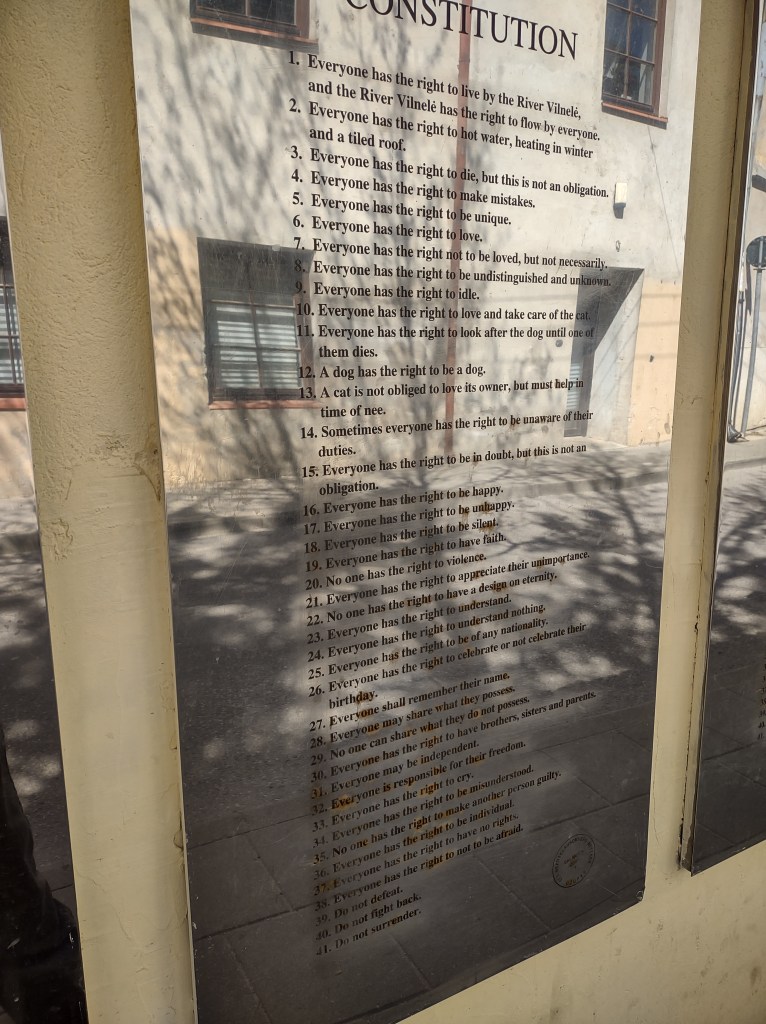
A bit of arty humour, all of this? Well, maybe. There is, however, a constitution. Engraved in forty languages and displayed on metal plates on a street wall, it’s probably Uzupis’s – maybe Vilnius’s – most interesting attraction. And it’s a great way to end our tour.
Some of the rulers in the countries around here, historical and current, would have done well to follow these rules.
You may have noticed that the menu is broken. It’s a continual problem I have with the settings on this site, in fact I’d thought I’d fixed it but looks like it only made things worse.
I’m going to see what I can do about it, but in the meantime if you want to check out the posts from my earlier trips then scroll to the bottom of the page, pick a link you fancy, and repeat!
Amidst the ghostly swamps and forests of the north-eastern corners of Europe, as the night sweeps in across the wetlands, the princely knight grows tired from the day’s hunting and looks for somewhere to lay his head. It has been a worthwhile excursion from his ducal seat at Trakai, and out here by the banks of the lazy Vilna river he and his party have managed to bag a wolf. But it’s time for rest.
And sleep brings dreams, dreams to the brow of peasant and princely knight alike. And not even a Grand Duke of Lithuania can control what the night will show him in his slumber. As Gediminas sleeps, suddenly the wolf appears atop a great hill by the river. And apparently made of iron. And inside the iron wolf appear a hundred more, all howling, and such a howling had never been heard since the pagan gods had created the great pagan world…
What could it mean! In the morning Gediminas wisely consults with his krivis, his pagan priest. The priest replies; the iron wolf represents the castle you will build on this hill, and the great city that will grow around it. And the howling? That’s the sound of the city’s deeds and accomplishments bellowing across the world, echoing across history. That and “thanks for sticking that arrow up my how’s-yer-father, you’re a charmer aren’t you?”
I made that last bit up. And so Gediminas built the city of his dream, the city named after the river, the city that we know of as Vilnius in English. It was then opened up to German immigrants, religion not a problem, and over the centuries Vilnius developed a reputation as a multicultural centre of trade and learning, a place where one of the most significant Jewish communities in Europe sat alongside Muslim Tartars, Eastern Orthodox and Polish Catholics. Gediminas remains a hero here, though clearly they’re willing to forgive his rather indelicate funeral arrangements – as his body was cremated, they didn’t invite his best friend and some of his slaves to the wake. They were invited onto the funeral pyre instead.
To this day Vilnius’ symbol is the iron wolf, and over the last four or five hundred years or so the inhabitants must have felt like they were too being slowly barbecued over a roasted spit. Incorporated into the Russian Empire in the 1700s, breaking free in 1918 only to have to fight off the Poles, ending up with Stalin and the Soviet Union, despite a brief period of Nazi, er, freedom (a good number of Lithuanians willingly joined in with the Holocaust). Today Lithuania has been independent for just over 30 years, but as I write this in 2023 old ghosts are arising, ghosts of invasion and war, arising again over the eastern borders, echoing through the troubled sleep of today’s Vilnius…
By the way, it’s a lovely city. Fancy a look? See you soon.
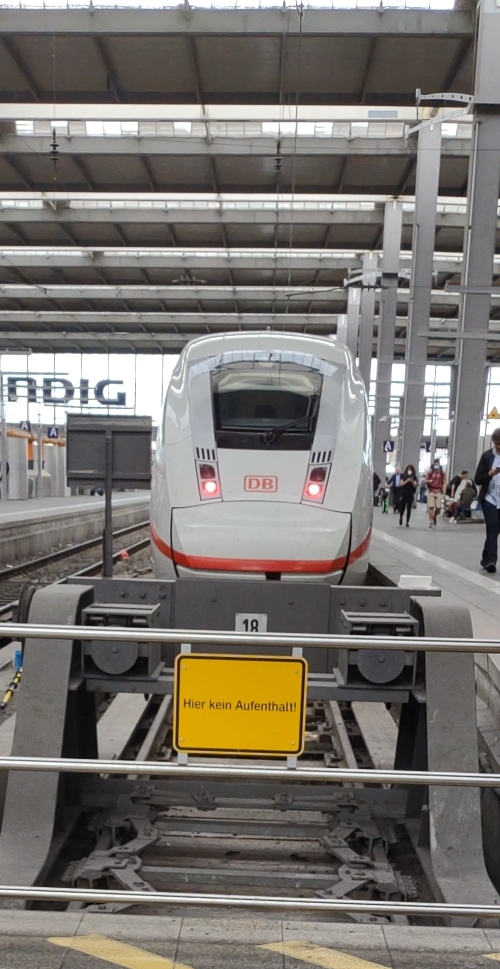
The final stop on my train trip is Munich. Busy, business-like, full of office workers rushing past, tourist crowds wandering along the streets and through the cavernous station subways. Distinctive Munich, capital of a Bavarian duchy that became a kingdom under Napoleon and stayed that way until 1918. Even within the modern Federal Republic, Bavaria stands apart, linguistically and culturally closer to Austria than to the rest of Germany. Munich, the place where the chic shops start selling Lederhosen and Dirndl for Oktoberfest. Where the blue-and-white colours of Bavaria are everywhere, including the logo of the local carmaker Bayerisches Motor Werke. (Or BMW for short.)
Like most great European cities Munich has its share of lovely churches and monumental avenues, but much of the built environment has had an eventful recent past. Indirectly, this was because Munich was also the birthplace of Adolf Hitler’s Nazi movement. The famous bierkellers were a good place for meetings in the formative days, and in 1923 it was here that he launched his Beer Hall Putsch. His grab for power failed and he ended up in jail, but he was handed easy time and soon he was back on the scene, leading to a war that caused the destruction of 45% of Munich’s buildings.
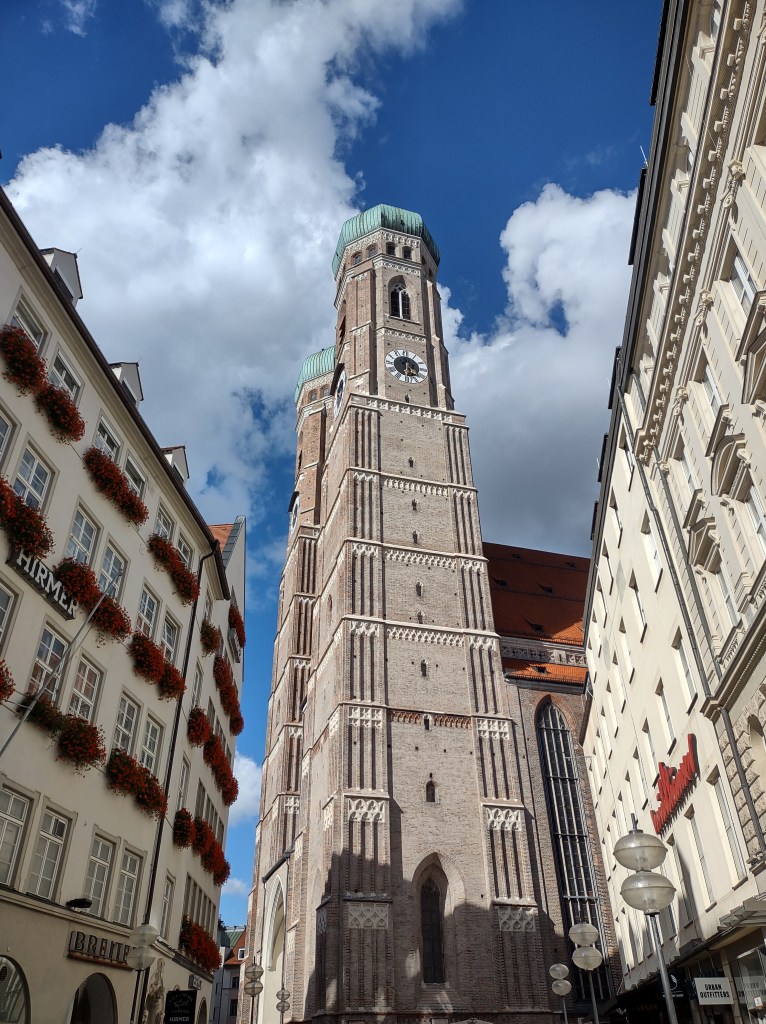
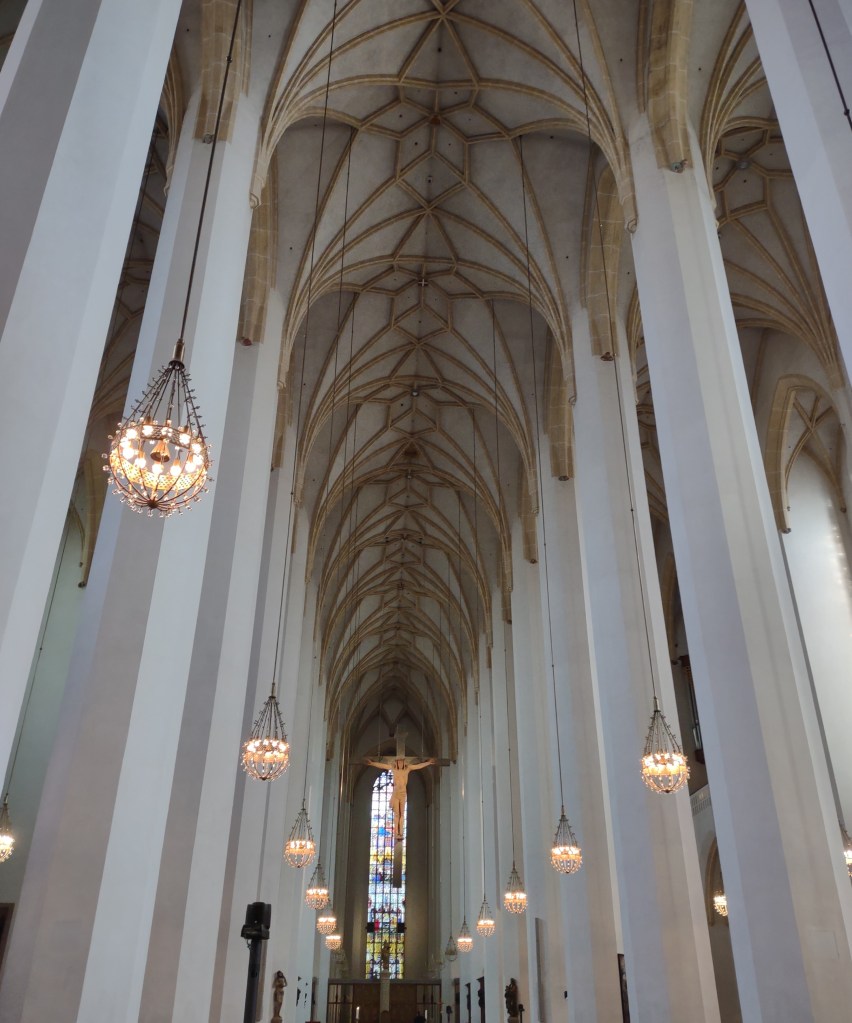
As in Cologne, Munich’s great icon is its cathedral, the Frauenkirche. And once again those two great towers were great navigational aids for Allied bombers. So they both escaped the serious damage the rest of the church suffered. Personally I prefer the flamboyant Gothic stylings of Cologne’s Dom to the more austere redbrick on show here, although there’s something deeply moving and restrained about those two towers, as though they’re monuments to events that must not be forgotten.
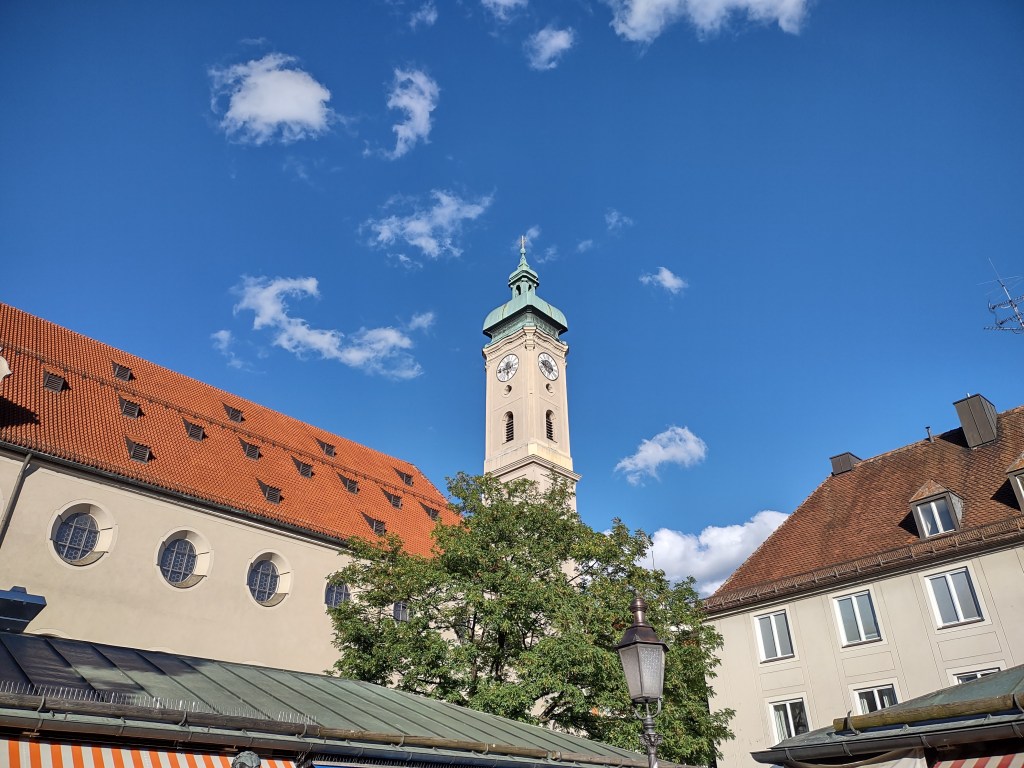
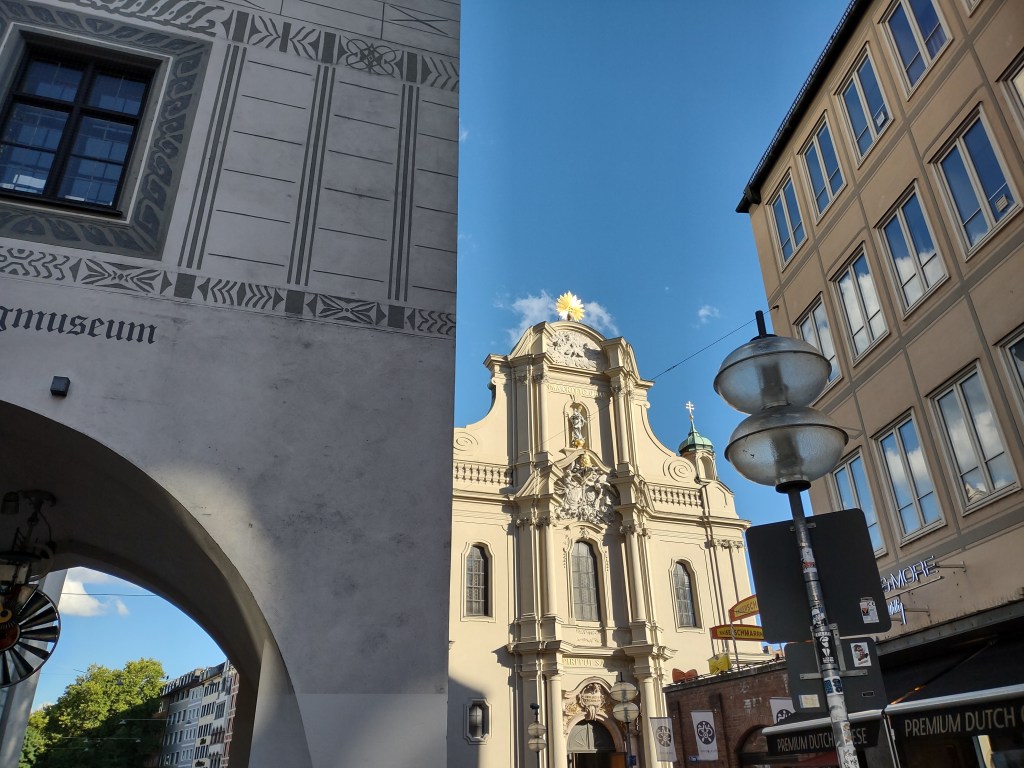
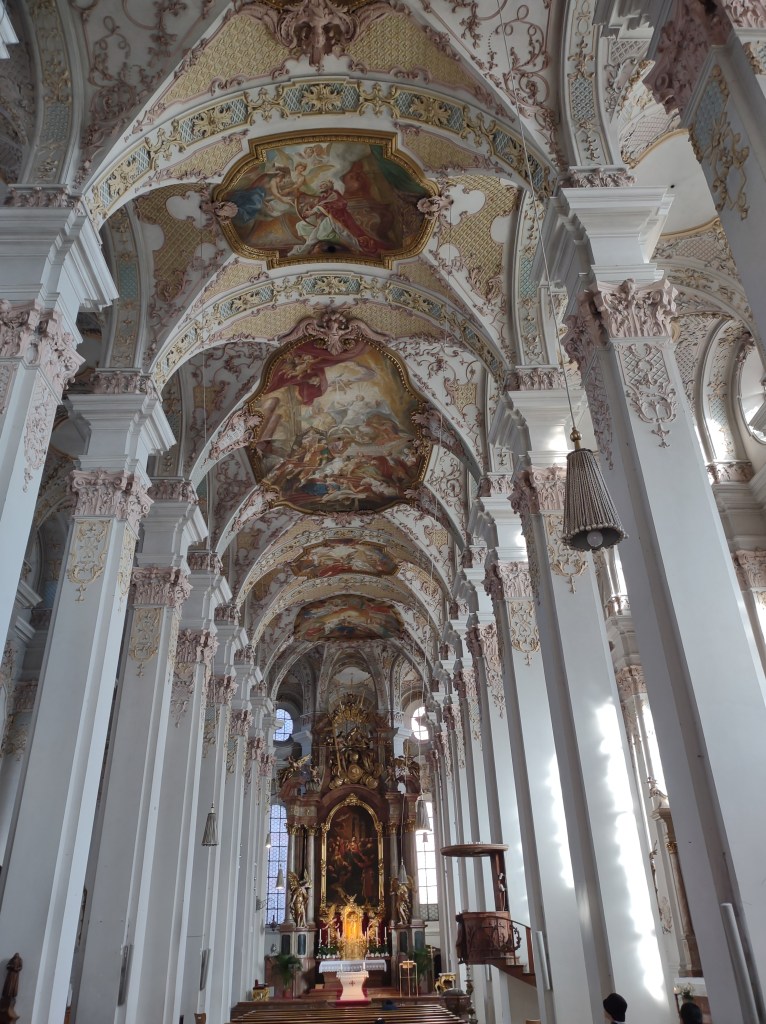
This jolly ceiling belongs to the Holy Ghost church and it’s quite the riot of guilded rococo stylings and grand Biblical narrative. A stunning revelation when you step in from the busy Mariaplatz area – and nearly all of it a post-war reconstruction.
Soon it was time to indulge in that other Munich, beery Munich, bierkellers and steins, oompah bands, lederhosen-heavy fun. I was a month early for the city’s most famous festival, but it’s always Oktoberfest in the kellers, and the most famous is the Hofbräuhaus.
Starting out as the state brewery in the 16th century, it was remodelled exclusively as a tavern at the end of the 19th when the brewing moved to the suburbs. Much of the building was destroyed in the war but that’s of little concern when visitors come to get destroyed every night. I made my way in, looked for a spare space on one of the trestle tables, ordered a beer and got stuck in.
Bierkellers are a great way to talk to strangers because the tables are long enough for different groups to sit alongside each other in an extremely convivial setting. So I got chatting to an American couple, sometimes mentioning the rather worrying news story I was following on my phone, but otherwise the fun continued, the in-house oompah band struck up again, and I settled down to my Hofbrau beer. A quick look at that news feed.
…and the Queen was dead.
I can still recall the seat, the wooden panel opposite, at a stretch my subconscious might even recall every graffito scratched into the table by the generations of visitors to the Hofbräuhaus. The oompah band played on, but it’s a blur. I passed on the news, the nice Americans passed their condolences. Soon I left, not knowing what you should do when your monarch dies (like most Britons under 75). And I’m not even a royalist.
I headed out into the Munich night, my head spinning, a central and unifying backdrop to all our lives having been ripped down, wondering what this meant for my homeland when terrible crises were already heading our way this autumn. Meanwhile back home, the well-practiced Operation London Bridge swung into action, old public figures got new titles, and I would spend much of the following day watching it unfold on TV.
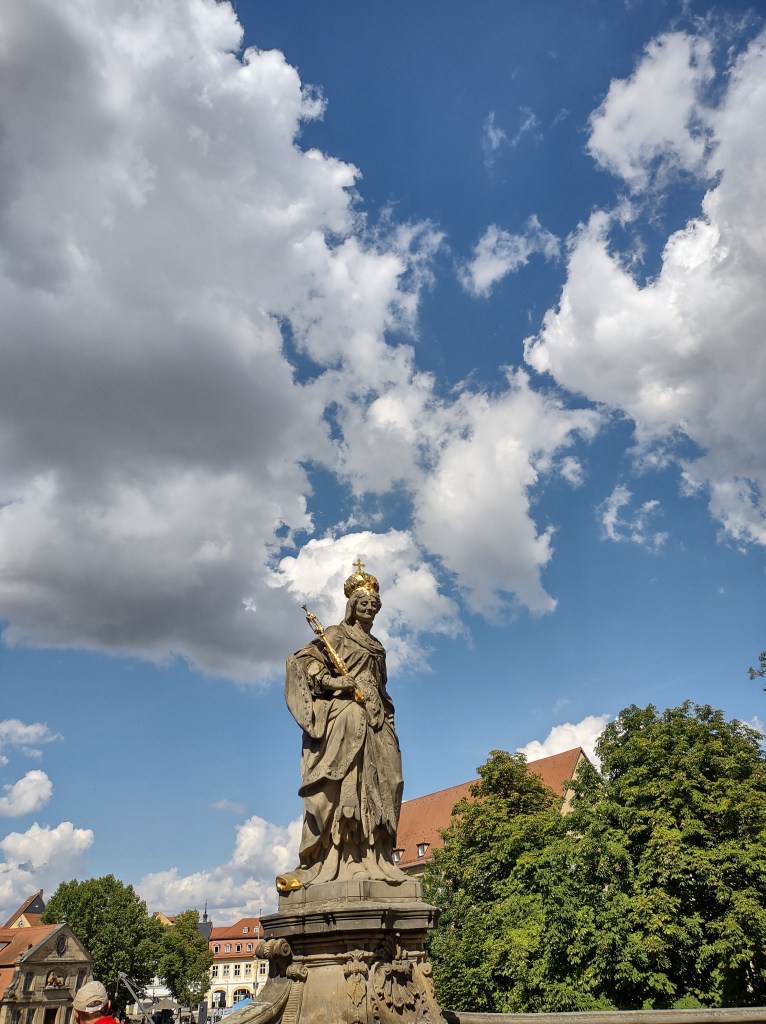
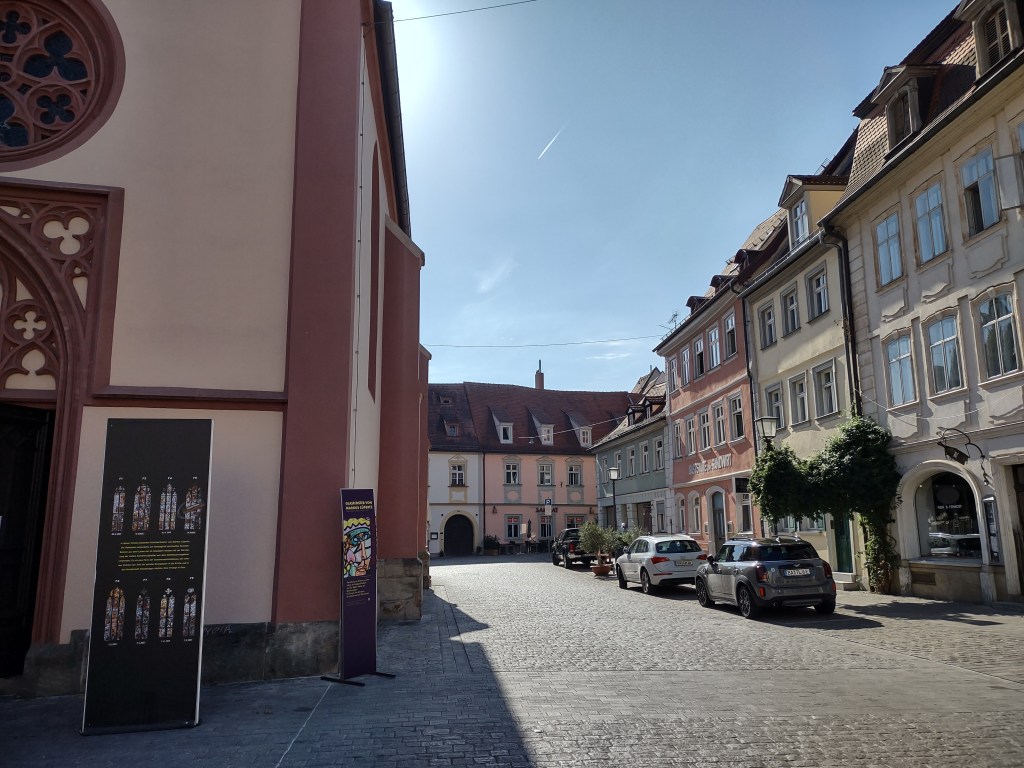
Say hello to Kunigunde, everyone. (Kunigunde says Hi.) There she is, right in front of us, on her favourite spot on the old bridge right in the heart of beautiful old Bamberg.
And that’s not the only reason why she’s smiling. Her husband Heinrich, son of a Bavarian duke no less, has given her a most romantic “morning gift”. Now what could it be? The finest jewels, the most elegant dresses?
A booking for two at one of Bamberg’s picturesque restaurants? No. Fish from Bamberg:s own “Little Venice”? Nein. A lifetime consignment of smoked beer from one of Bamberg’s sixty-five old breweries? Nope.
No, hubby isn’t interested in any of the wonderful things the good people of Bamberg can come up with. Oh no.
She’s getting the whole of Bamberg itself. Now, look at that smile again. Smug, isn’t it?
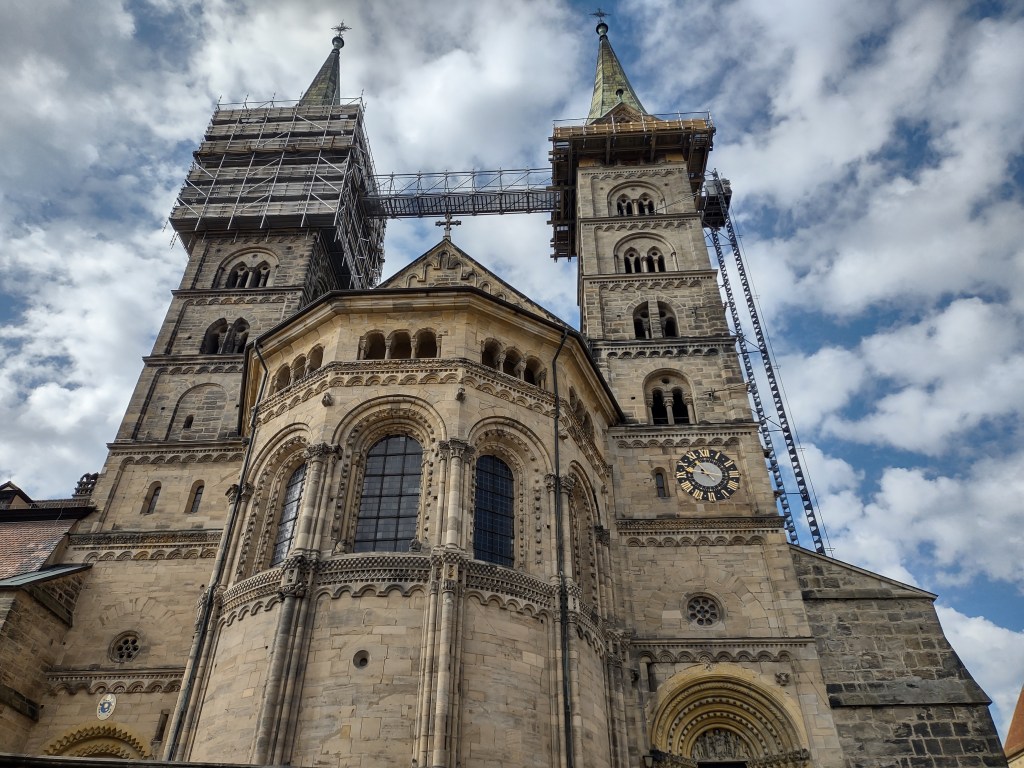
Still, the locals wouldn’t begrudge them anything, since Heinrich (who became Holy Roman Emperor) and Kunigunde were heavily responsible for Bamberg’s development having founded a bishopric here in 1007. In fact Kunigunde, a key political advisor to her husband, was loved so much they made her a saint. The power couple even had a cathedral built in 1002. After a few fires we’re left with a reconstruction that dates back to the early 13th century.
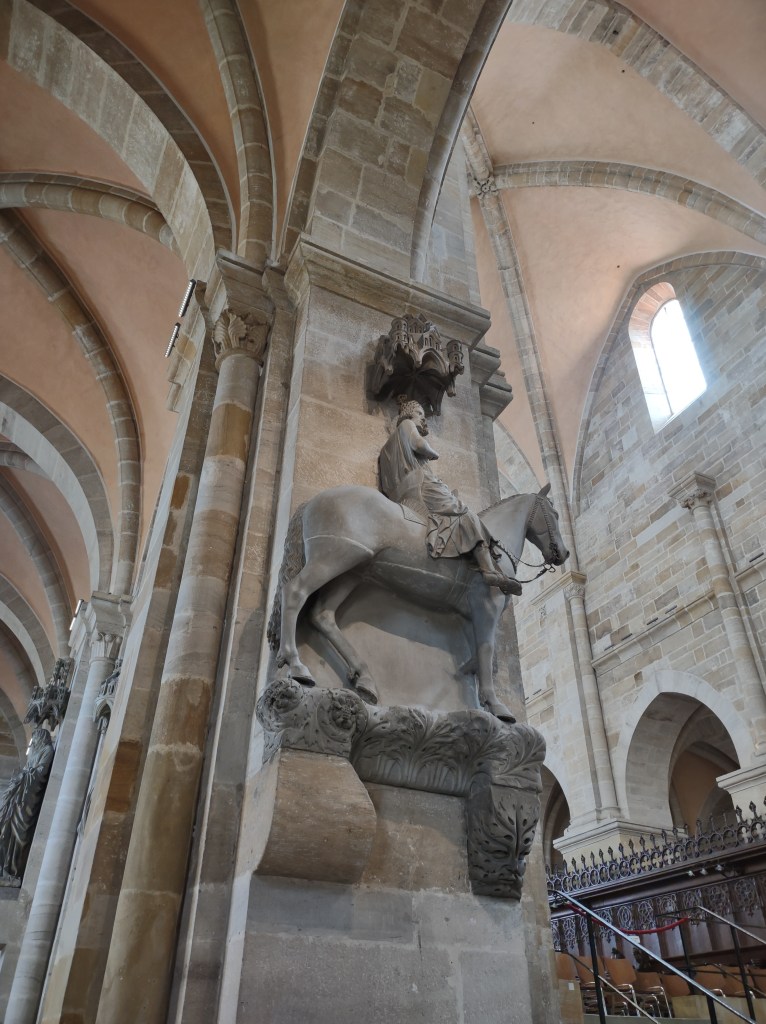
Ah, you’ve found him, the enigmatic Rider. Rather distractedly, as if he’s thinking about checking his phone for texts, he’s looking towards the tomb of Heinrich and Kunigunde. A pilgrim? King Stephen of Hungary? No-one knows, although scholarship is tending to the latter. What we do know is that he was originally painted and with dark hair. And what you probably already guessed was that Hitler and the Nazis tried to pretend the Rider had been painted with blond hair and blue eyes. But that was eighty years ago. Such a good thing that things have moved on and we no longer have to deal with the lies and misinformation of the far-right.
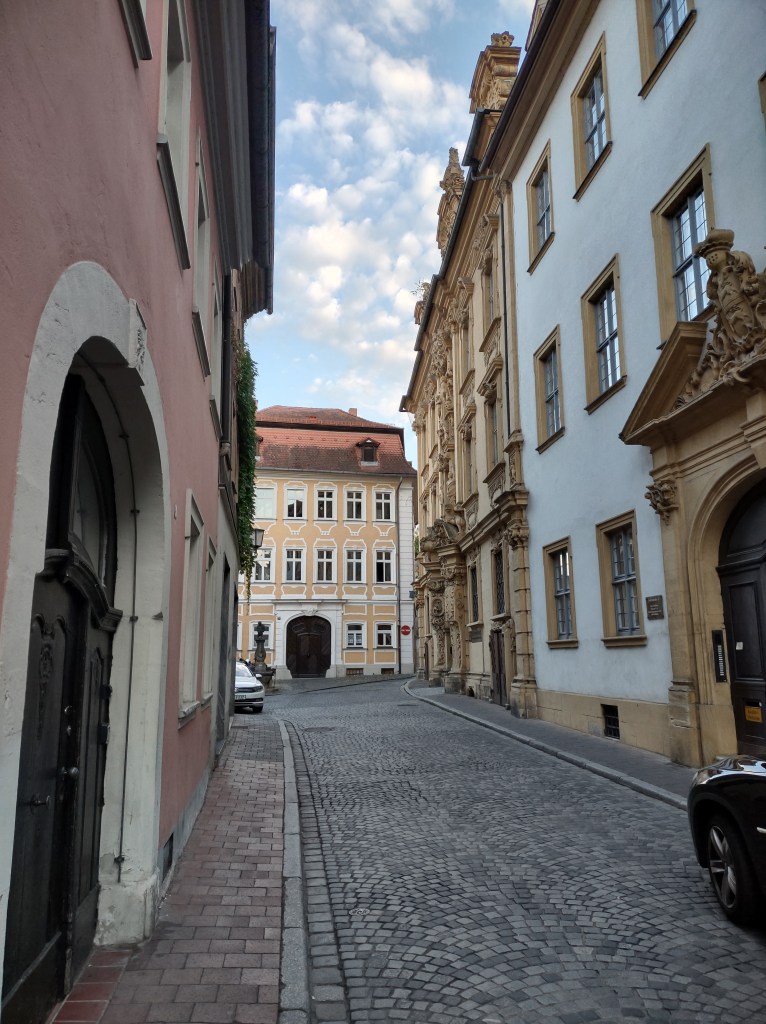
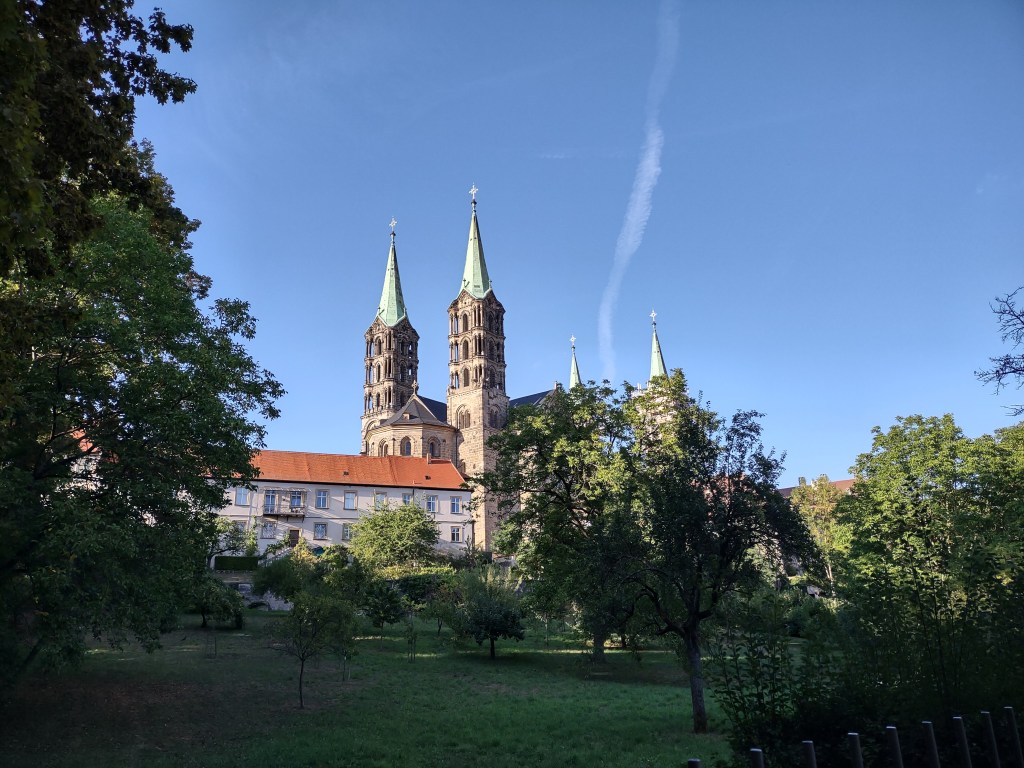
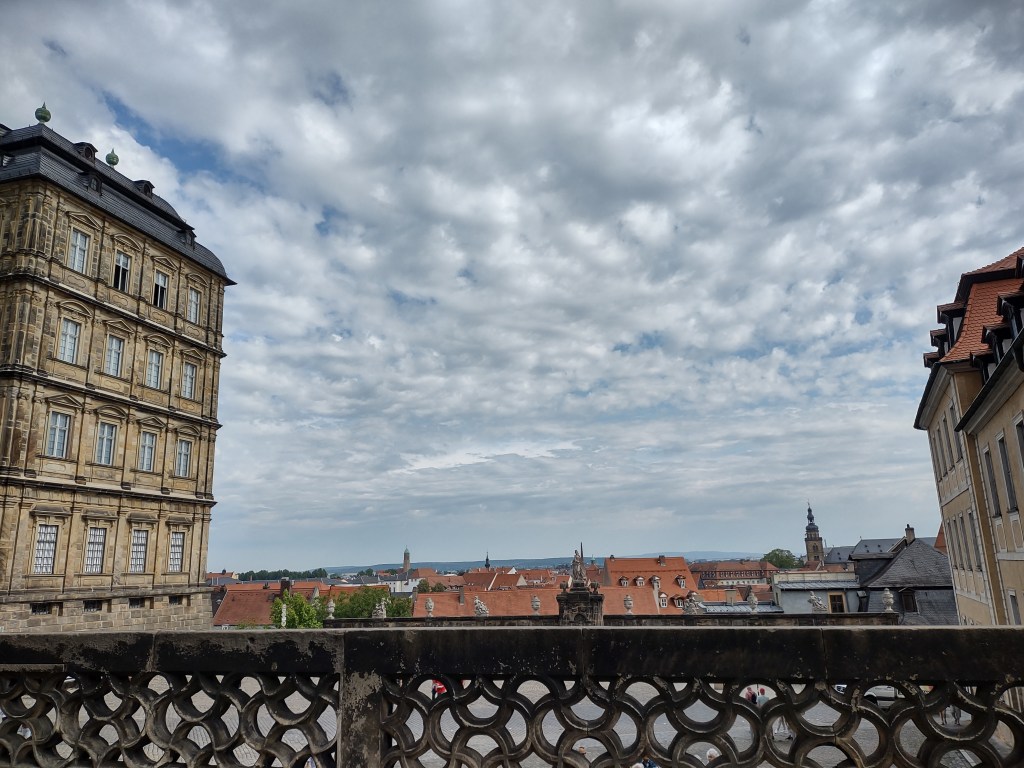
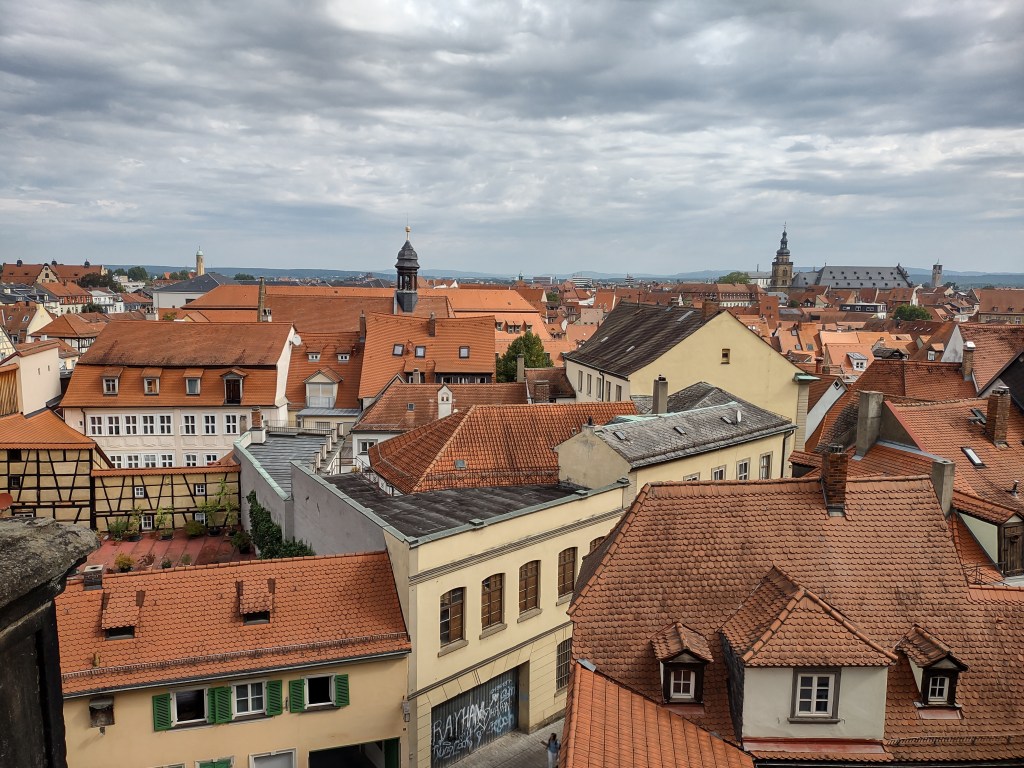
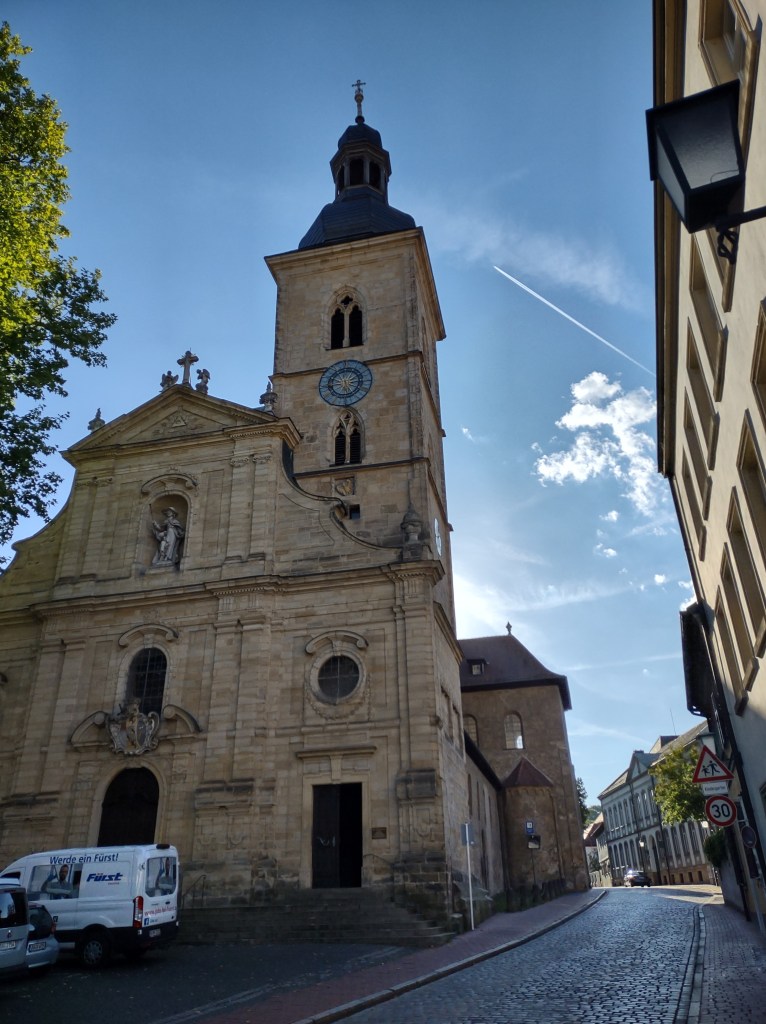
The cathedral lies on one of the supposed seven hills of Bamberg, on the town’s south west corner. Here the prince-bishops had their very-splendid residences and Bamberg continued being lovely as it developed from the medieval through the Counter-Reformation and onto the Baroque. It wasn’t all wonderful though. There were wars now and again, but the worst came with the witch-burning mania of the early 17th century. It’s estimated that around 800 people, mostly women, were murdered until the Swedes occupied the place during the Thirty Years War and the madness came to an end.
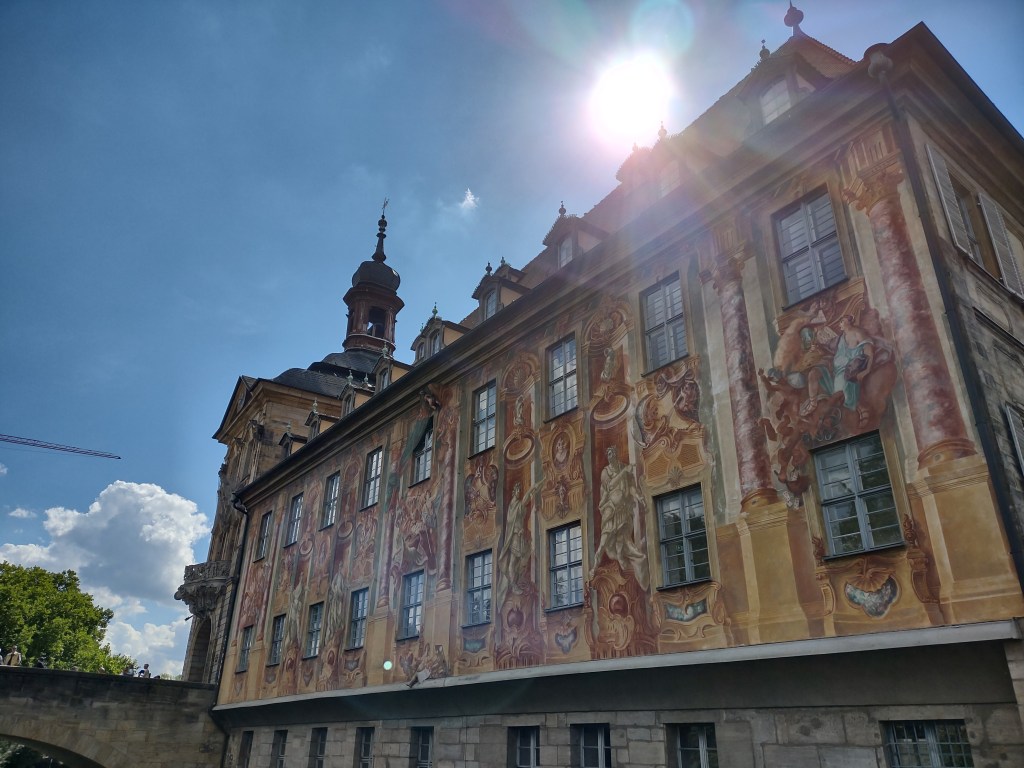
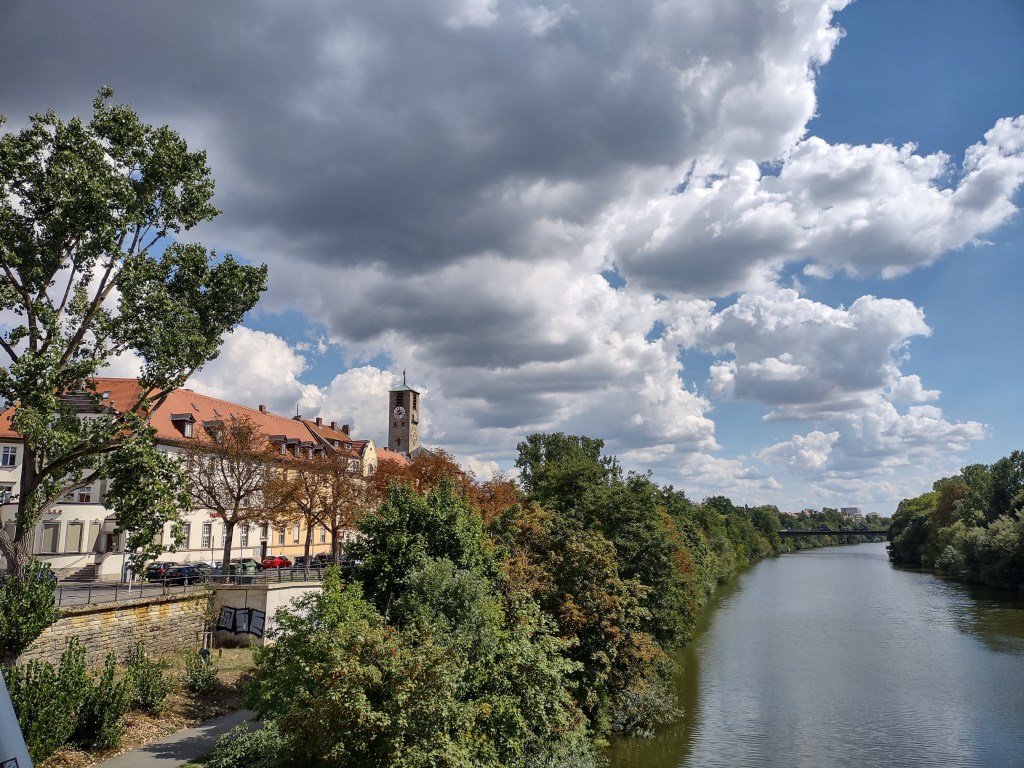
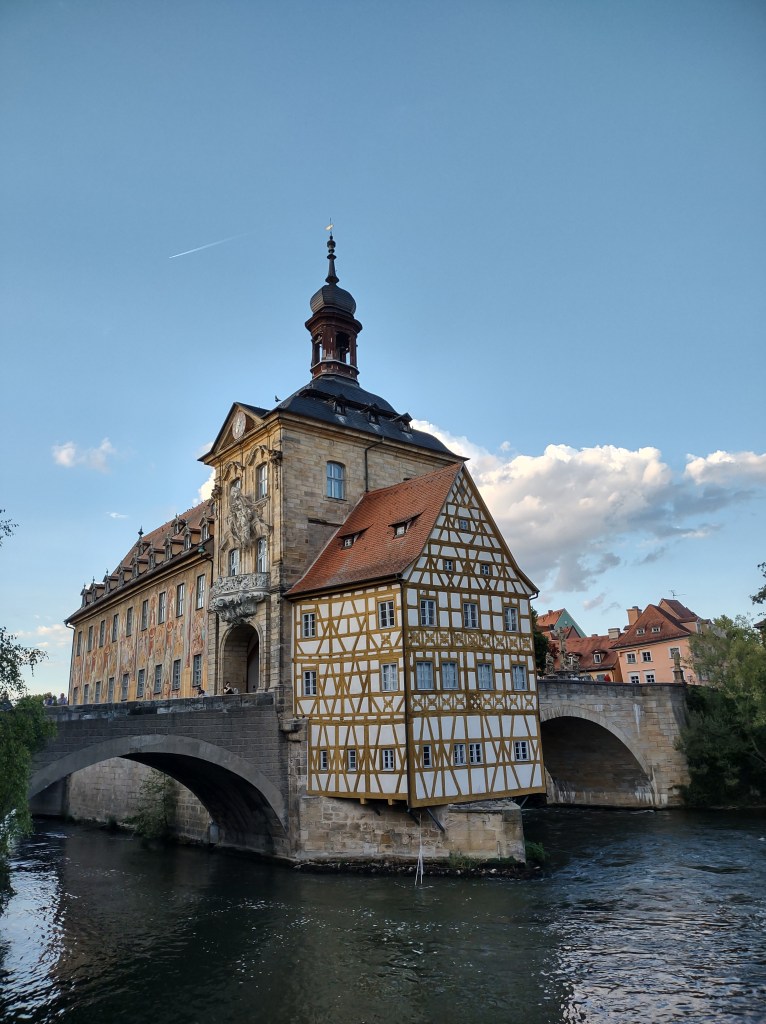
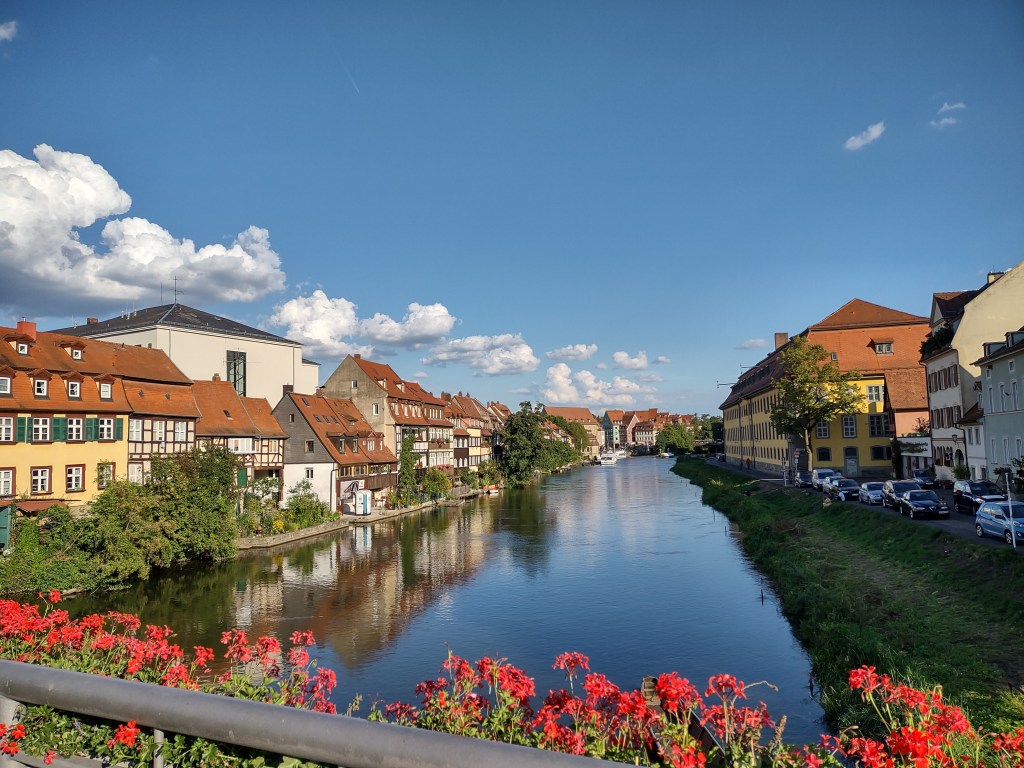
So there’s two spires of the Cathedral to the left, a monastery on the hill to the right, and you can also see the river Regnitz. Note the buildings on the riverside, a very narrow stretch of land called the Strand. The hills belonged to power – the church, the Franconian nobility, the prince-bishops – and the local people had to find somewhere else if they were going to have a decent-sized town hall. It’s not clear to me why they didn’t just plonk it on the bank from where we observe the scene, maybe it belonged to someone else. So the story goes that the frustrated burghers just dug some stakes in the middle of the Regnitz, created an artificial island, and went on to build one of Germany’s most famous sights, the Altes Rathaus.
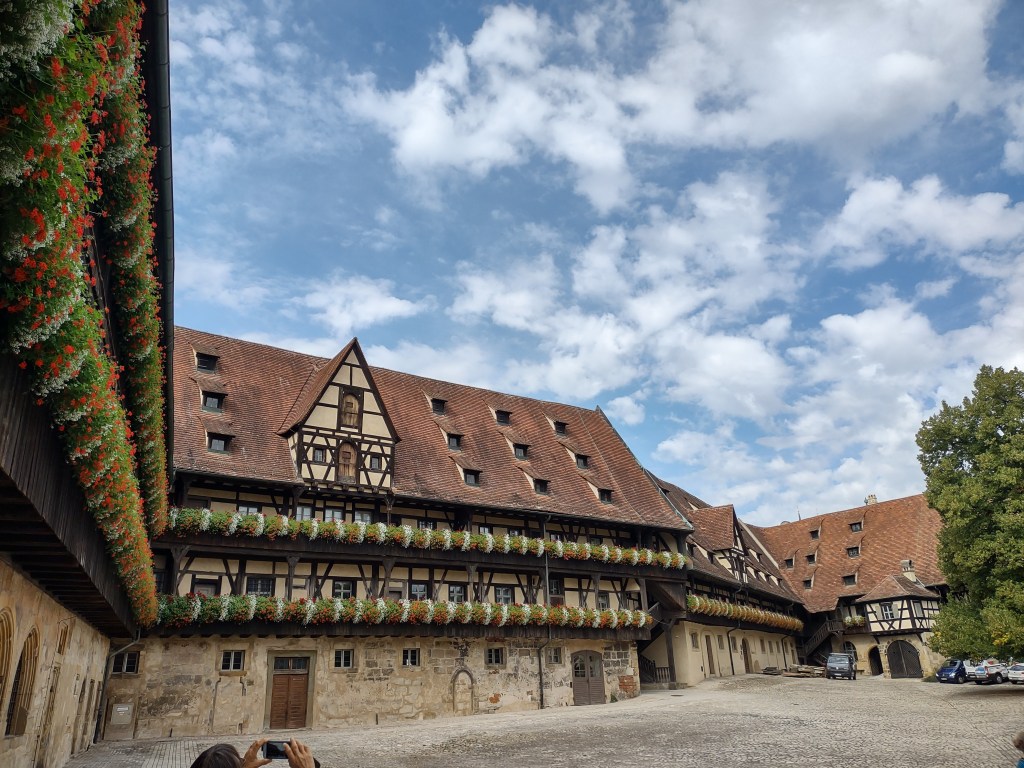
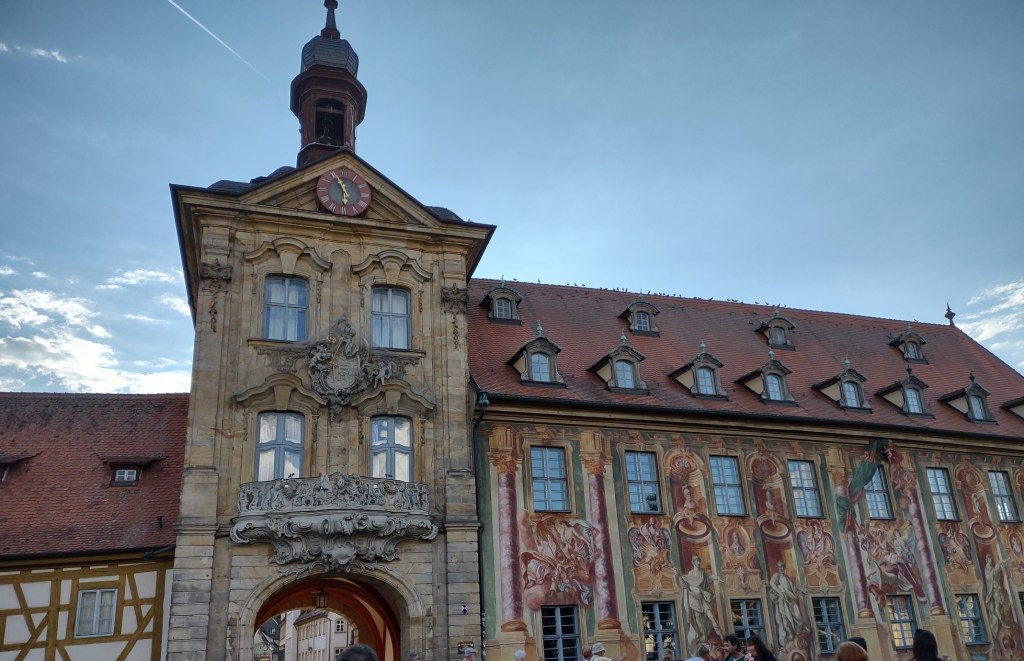
With the fine Baroque additions, the gatehouse, the frescoes, it’s quite a thing to see from any angle. There’s another bridge through the other wing by the way, and that’s where you’ll find smiling Kunigunde.
Now you’re probably asking yourself something. Given what we said about Cologne, is what we’re seeing here original, or a post-war reconstruction? (The answer to your other question is easy. Rat is German for “council”. I don’t know where the pest controllers work).
It turns out Bamberg was cleverer. The city prospered through the Middle Ages and onwards to the 18th century, but it started to slide in influence and in 1802 it was ceded to Bavaria from Franconia. So they’d managed to jettison their economic and strategic importance well before the Second World War! In the end only about 4 percent of the town was destroyed and everything I’m showing you is original. Happy days. (Unless you were in the 4%…)
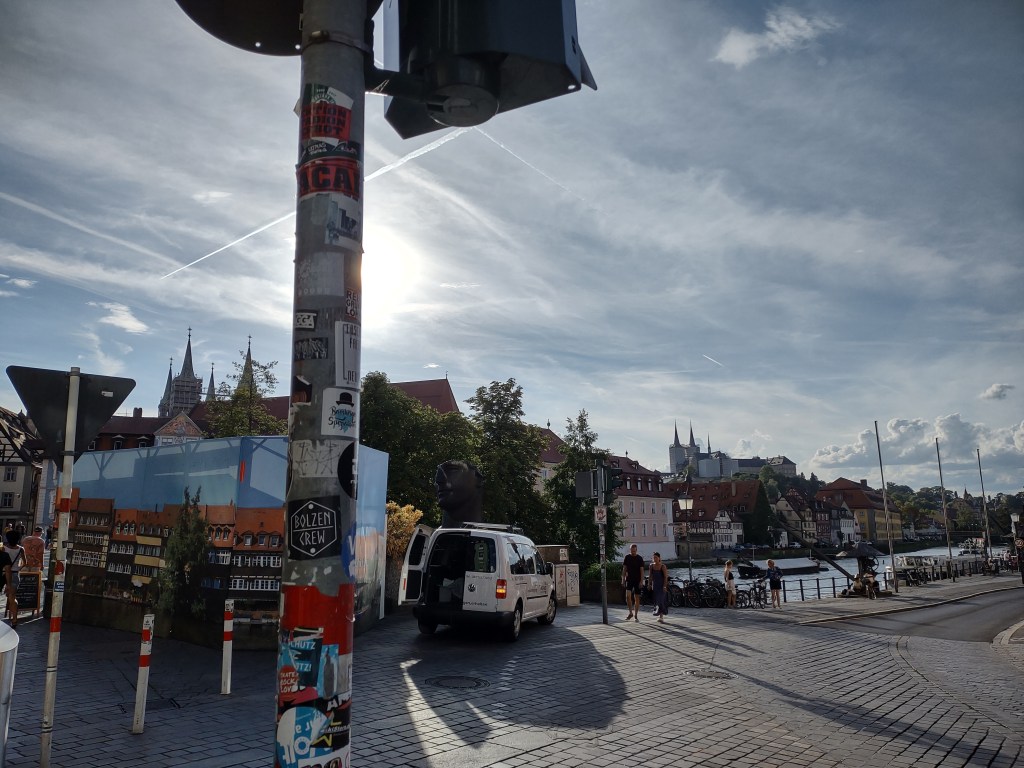
The old fisherman’s cottages along the Regnitz, at “Little Venice”
Bamberg then. A special jewel in the heart of old Franconia-sorry-Bavaria. I’ve been lucky with the weather while I’ve been here, and I hope it holds as I push on further on into Bavaria tomorrow. So much more I could have said, so much more I could have shown you, but I hope this is enough for you to feast upon, maybe encourage you to come out sometime to have a look for yourself. (If you do, I suggest you crack open your Duolingo and brush up your German; unless the inland cruise ships are in town it’s very much set up for domestic tourism).
One more tidbit to leave you with. I implied that Bamberg wasn’t bombed because the Allies saw no reason to concentrate on it. Apparently some of the locals have another explanation. The RAF and the Americans did give it a go but they came up against a impregnable defensive shield which no munition could get through.
The name of the person responsible for this defence system is probably still top secret, but I’ll give you a hint. She’s got a lovely smile…
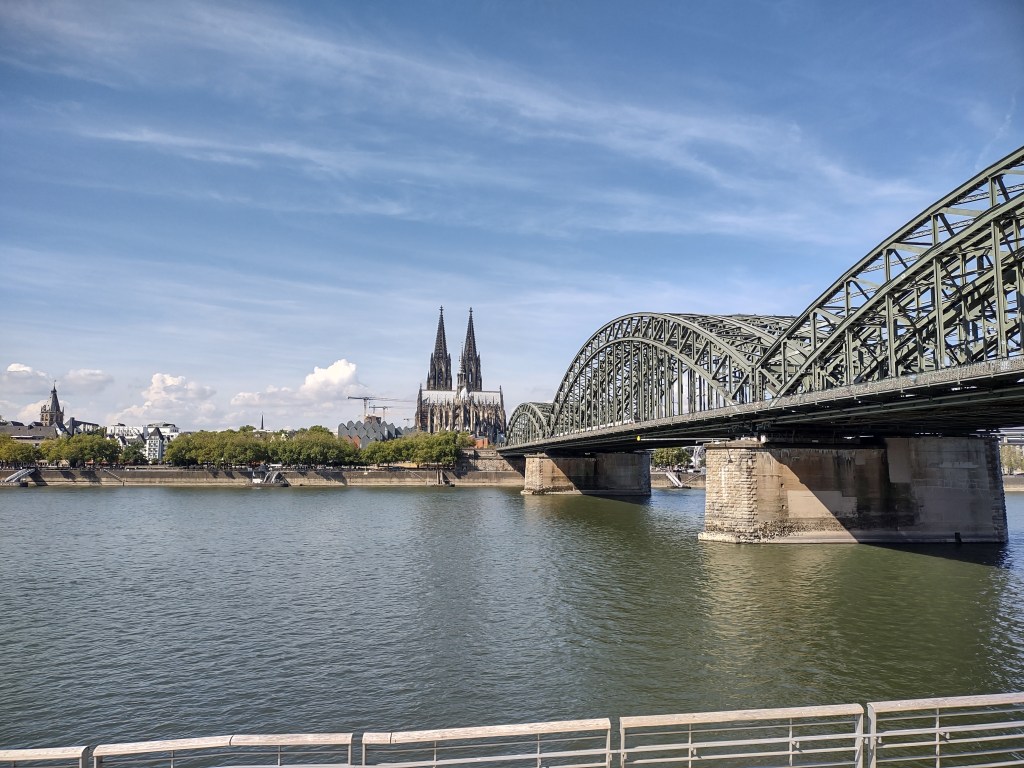
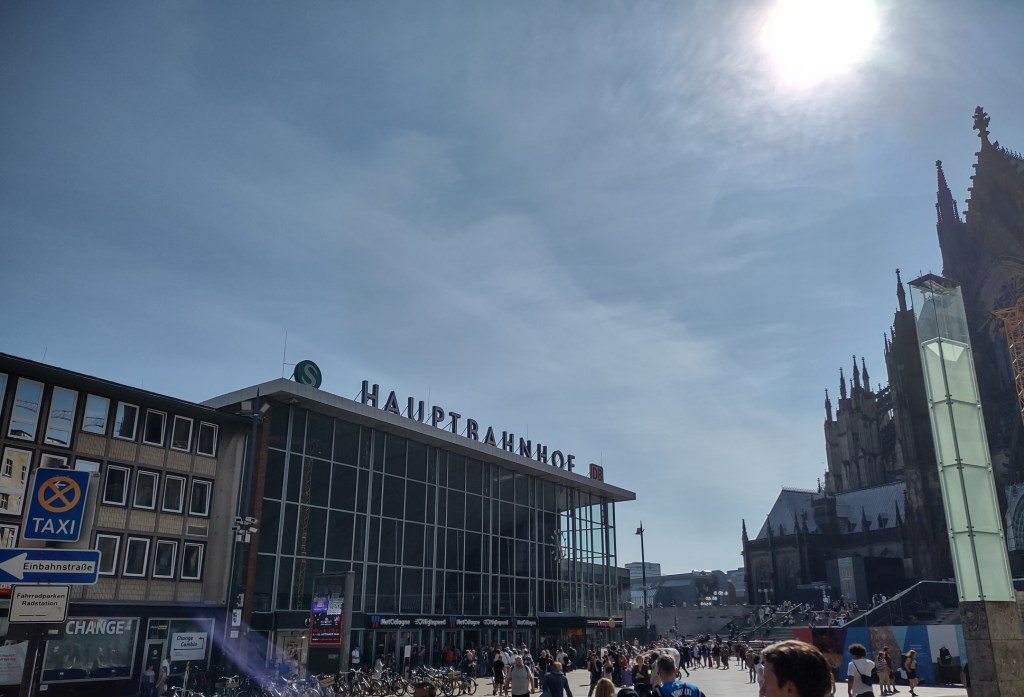
It might have been because of the sunny weather (better than forecast) but Cologne really appealed to me. Set by the gracefully flowing Rhine, Cologne has two thousand years of history going for it, back from when the Romans established their Colonia Claudia Ara Agrippenensium here on the banks of the mighty river.
The city thrived during the Middle Ages and became renowned for its twelve Romanesque churches, as well as a few markets in the bustling old town. The churches and the markets are still there, but the bustling nowadays bustles between modern buildings. Cologne was one of the most bombed cities anywhere during the Second World War, and the city was completely destroyed. They chose not to restore the market places or the old town, just the churches.
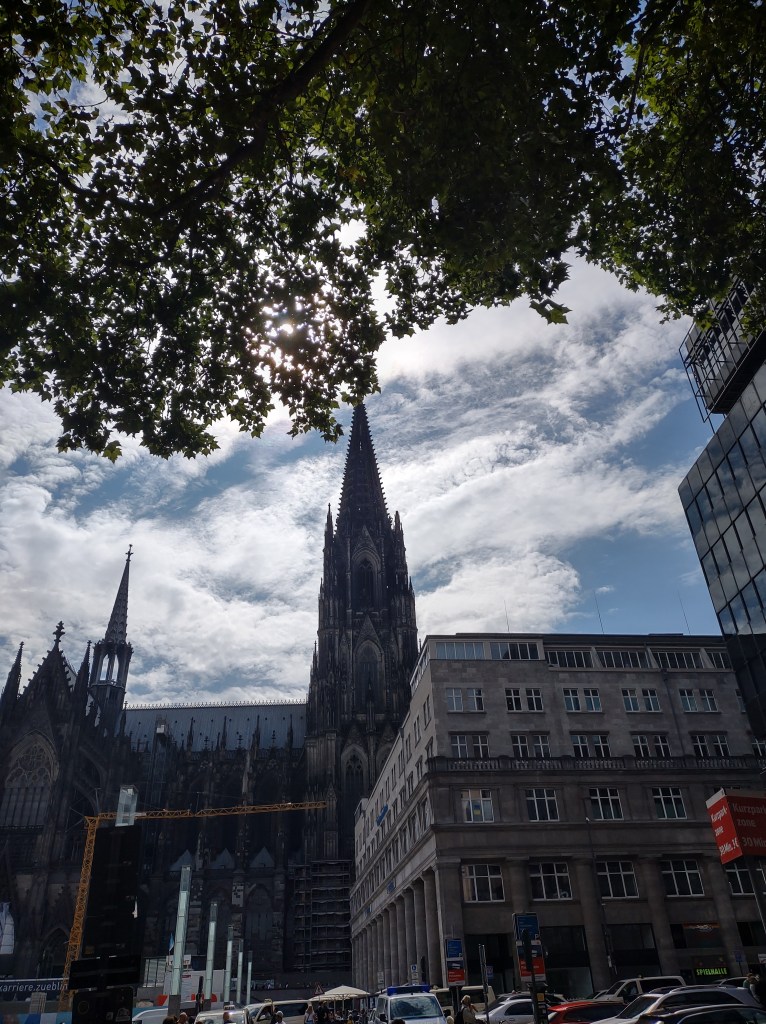
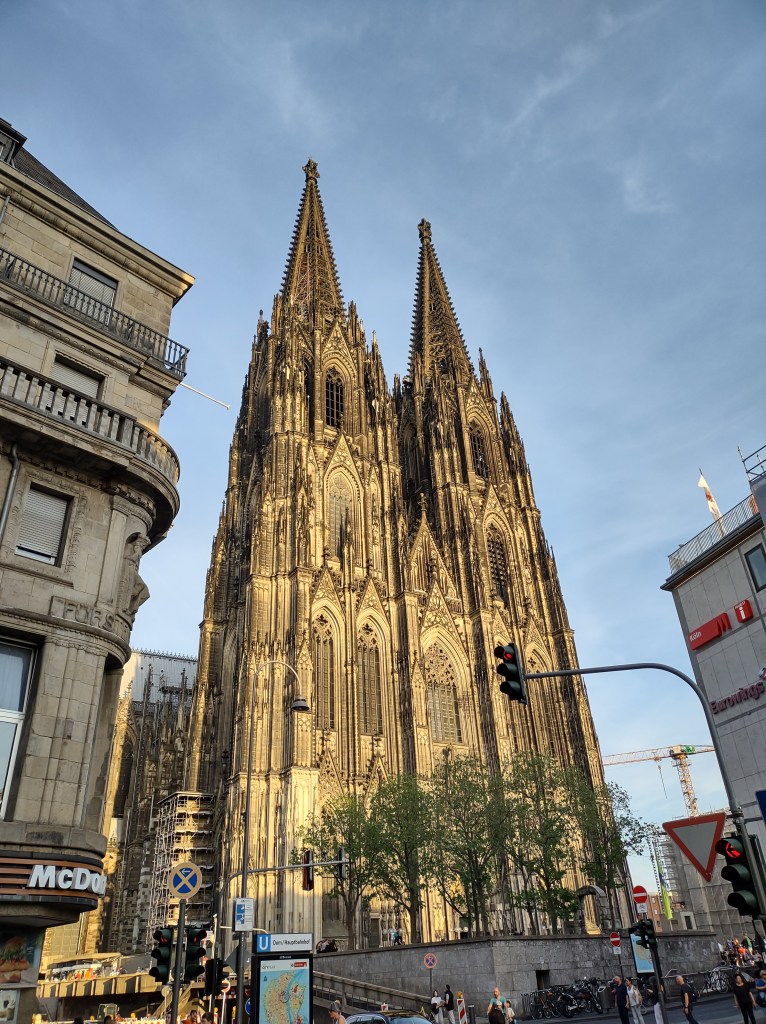
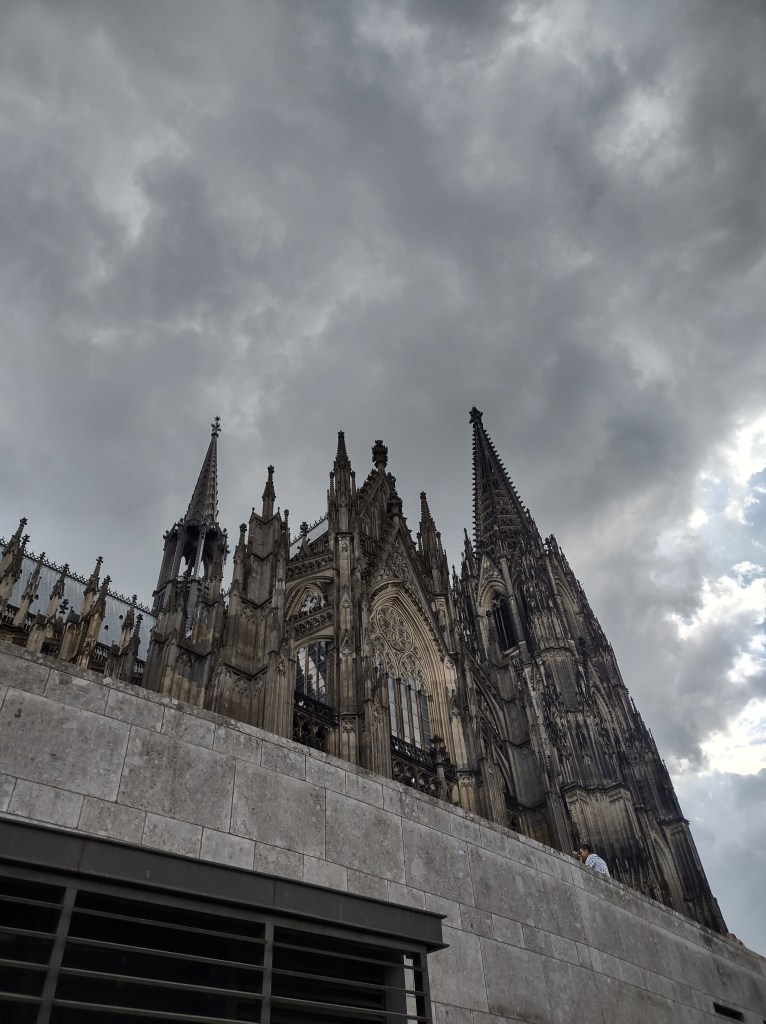
One place that just about survived was the city’s symbol, the Dom.
Cologne Cathedral.
In 1248 they wanted somewhere to store a reliquary of the Three Kings. And in those days, for that sort of thing you tended to go large. That way the Amazon delivery people would know where to leave it.
They went so large that the money ran out in 1560. In 1814 they found something behind an equally big sofa and started up again. By 1880 they’d finally finished. The towers are 157 metres high, making it the third tallest church in the world. Truly impressive, visible for miles around, and built to the original plan.
Unfortunately, members of the Allied air forces in the 1940s had strong views about the German ecclesiastical architectural ascetic. In general, towers were good for navigation purposes, but the rest really had to go. So the Dom was bombed fourteen times, but repaired over subsequent decades. And of course Air Vice-Marshalls Erosion and Pollution are still scrambling their forces, and the work goes on.
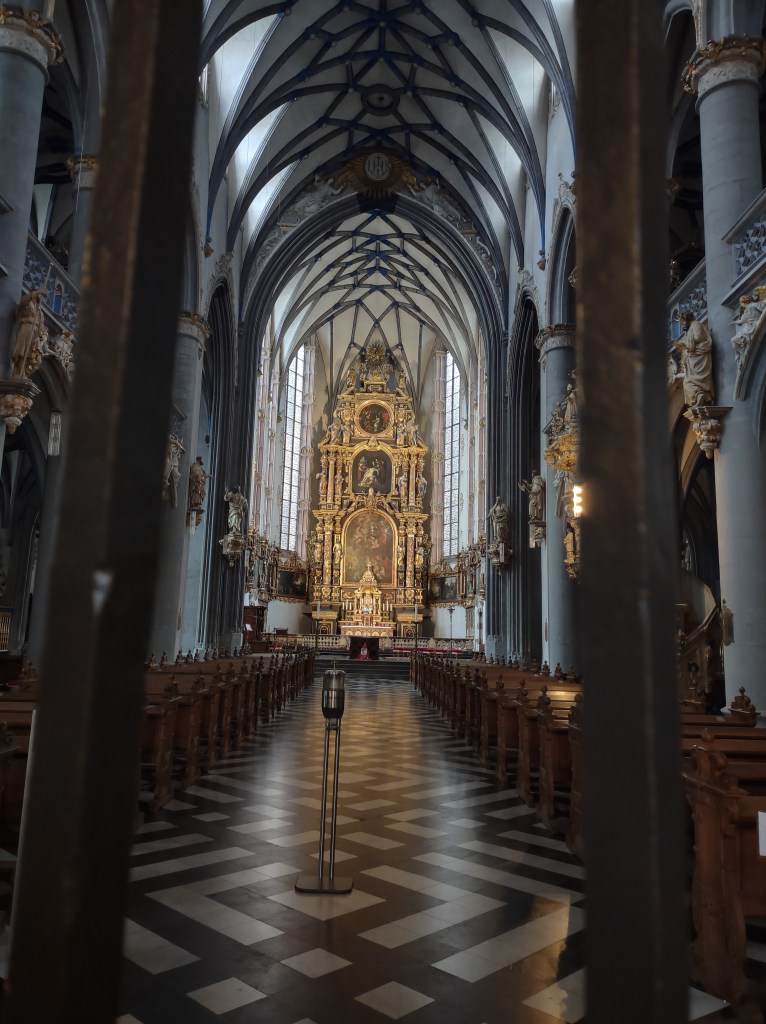
As you see, I took lots of photos but stayed outside so as to avoid the queues and enjoy the city a little more. I did get inside the porch of the Church of the Assumption nearby…
…but the gate to the nave was locked. A pity because the church houses some works by one of Rembrandt’s pupils…
…Bernhard Fuckeradt.
And after that, it was time for even more of the local Kölsch beer, before packing my stuff, catching the train and heading to Bavaria.
You will have noticed from my posts that I’d done a bit of travelling since COVID travel restrictions had begun to roll back in 2021. And it’s something I love and I hope I’ll always be grateful for having the opportunity to go off and enjoy these adventures.
As 2022 rolled into view I hoped that some decent degree of normality would have returned by summertime and there were a stack of places I wanted to see. But normality wasn’t quite, well, normal. It wasn’t just the insanity in Ukraine and the consequent hike in fuel prices, although they didn’t help. As demand picked up again, the airline industry had real problems getting in the staff they needed. Some airports cut their slots and airlines cancelled whole tranches of summer flights. And for those passengers who managed to get a flight, the staff shortages meant their problems were only beginning.
In the distant past, in other words three years ago, it was simple. You’d look for somewhere to go, you booked a trip at a reasonable price, and then you’d sit back and look forward to the whole magical sequence of arriving at your swanky departure terminal, ready to be whisked through check-in and security and through to your gate, giddy with anticipation. Now, after finding one of the few flights available and paying the extra cost, you sit back and wait for the worrying email from the airline recommending that you better check your wheelie bag in. Once the morning arrives, your excitement on discovering that your flight hasn’t been cancelled is tempered when you remember that email. Why would they want to put more pressure on the understaffed baggage handling? Could it be … good God! … and then you remember those social media photos of humongous security queues stretching back out of the terminal all the way back to the gates of Hell itself.
So you resolve to take the advice you never had to take seriously before, and get to the airport three hours before your flight. Shaken with stress you survive security and eventually you get to the gate, and they are indeed carrying out a purge of the wheelie bags. Fortunately your seat is not affected and you, lucky traveller, are granted the humbling privilege of being allowed to take your cabin luggage into the cabin. But unfortunately the flight is late. After all that, you eventually limp down the jetty and make it to your seat, time to relax at last, sit back, and smile, as the plane pushes back, roars down the runway…and helps destroy the planet with its carbon emissions.
Some of these things had happened to me this year and I got to the point of not wanting to see the inside of an airport terminal for a long, long time. I’d had enough.
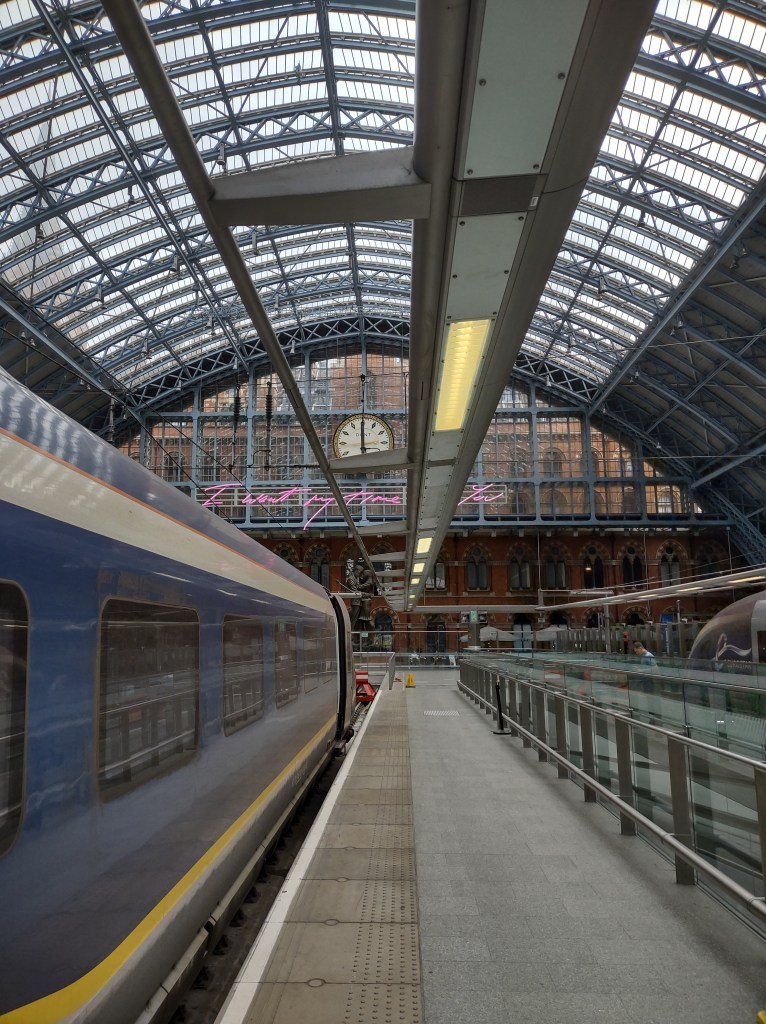
But I still wanted to do one more foreign trip this year, and it was going to have to involve the Eurostar from London St Pancras. And yes, it did mean my options were limited to northwestern Europe (even if I was going to compromise by flying back home from my final stop). But travelling by train offers many benefits of flying, if you’re happy with the extra travel time. It’s more relaxed, more flexible, and you feel more connected to the environment you’re travelling across when you travel through a place instead of over it – the changing landscape as Europe develops before you, the great towns, the pretty villages, the countryside, farms and forests, hills rising above and around you. It’s easier to believe your destination has grown around you organically while you’ve been travelling, rather than something you’ve been plonked into from a great height.
So it was with some excitement that I reached St Pancras and then left the dingy, overcrowded departure hall for the gleaming Eurostar to Brussels, underneath the still glorious station canopy.. A couple of hours later I was skipping off the train and heading for my hotel in the equally dingy Belgian capital for my one-night stay.
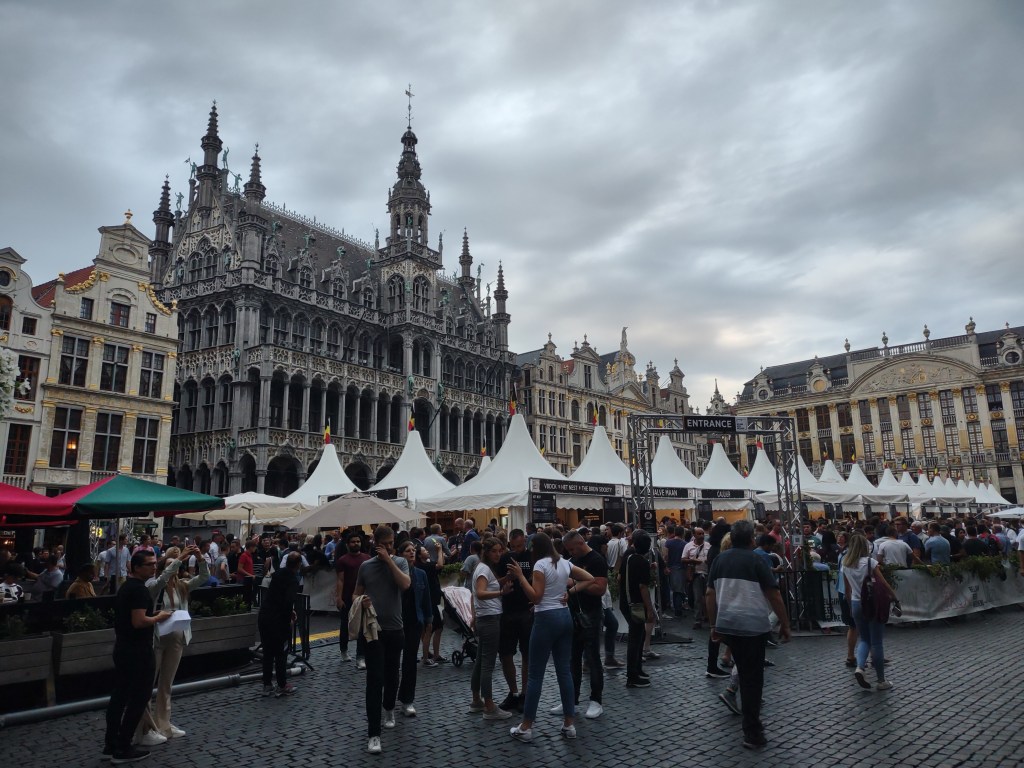
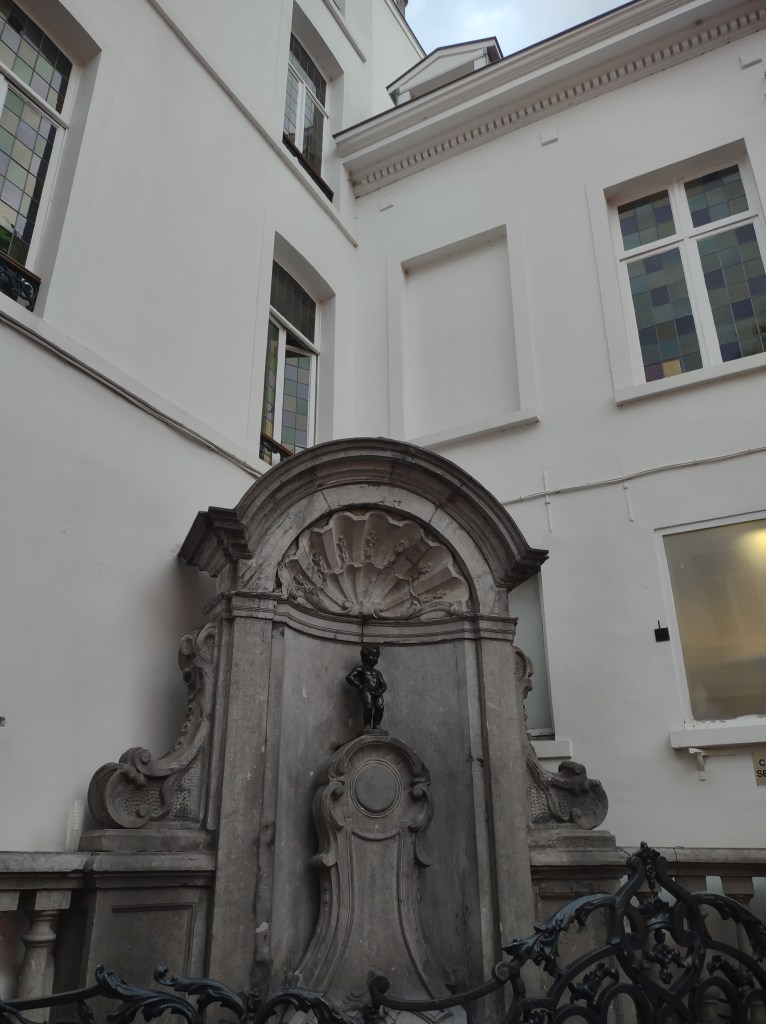
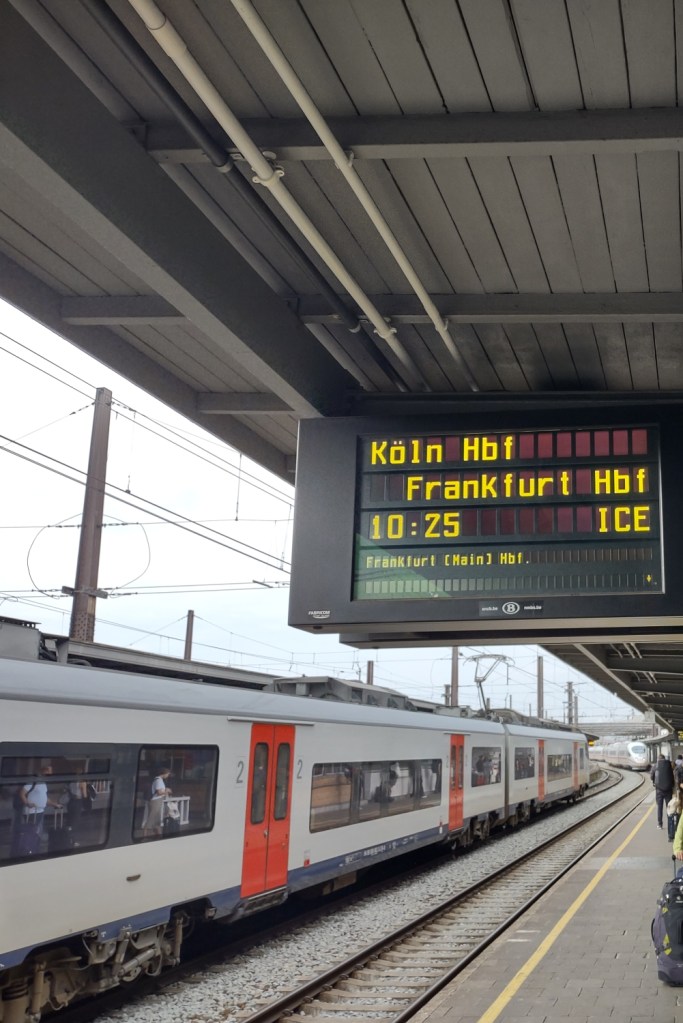
A quick peek at the Grand Place, and then around the corner to the most overrated tourist attraction in all Europe, and back to the hotel. The following morning, I was on my way to Cologne for the first of two nights there before heading off into deepest Germany.